National Championships

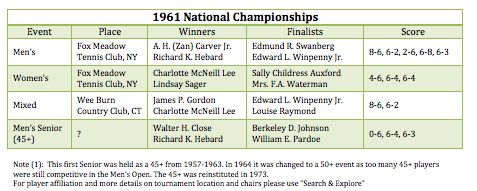
1961

Future multiple champion and Hall of Famer Charlotte Lee emerged on the paddle scene as a winner in the Mixed with James Gordon, and in the Women’s with Lindsay Sager.

Hebard partnered with Zan Carver to win the Men’s, and with Walter Close to win the 45+.

Source: Oliver H. Durrell, The Official Guide to Platform Tennis, 1967

John P. Ware (1921-1999)

John P. Ware elected APTA President (1961-1963)

Ware, Blanchard’s son-in-law, spent roughly 40 years of his adult life nurturing and promoting the game of platform tennis. He served as Secretary of the APTA from 1959 to 1961, during which time he did extensive research on format, size, and timing of tournaments and the composition of paddles.

Ware was instrumental in bringing young people into the game when he inaugurated the first APTA Junior Boys National Championships in 1963 and was the driving force behind changing the ball color from white to orange and persuading manufacturers to adopt the new color.

He designed the crossed paddles and ball insignia for the Association. The logo was modernized in the late 1970’s, but Ware’s original design remains on the crests presented to Hall of Fame recipients and past Presidents.

Ware was inducted into the Hall of Fame in 1995

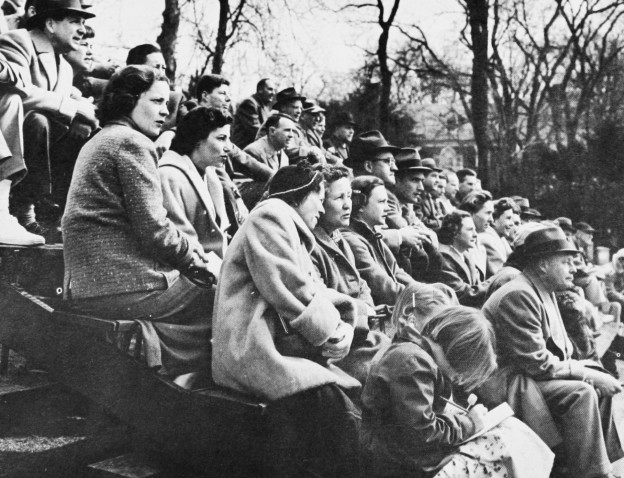
A typical gallery at Fox Meadow during this time. Photograph is from 1959.

National Championships – Portion of Men’s Filmed by Telesports

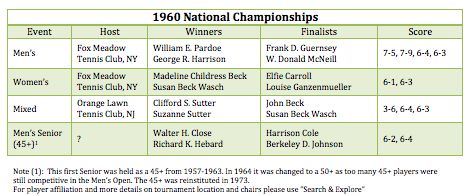
1960

Telesports made a 16mm sound film of about 5 minutes showing part of the 1960 National Men’s Doubles Finals. The APTA 1963 Annual Meeting Minutes indicated that the film was the property of the APTA and was available to any member club at no cost by contacting the Secretary-Treasurer.

Harrison and Pardoe win their second title in a tough match against the 1953 & 1954 champions and tennis stars Guernsey and McNeill.

Madge Beck and daughter Susan Beck Wasch win their second title in a row.

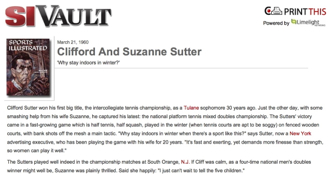
Cliff and Suzanne Sutter captured the Mixed over FMTC’s Susan Beck Wasch and her brother John Beck, earning them a mention in the March 21st edition of Sports Illustrated.

Blanchard called Cliff Sutter, “a canny player if ever there was one and few can compare with him in the way he varies his game and keeps opponents guessing.” Sutter had won the intercollegiate tennis championship as a Tulane sophomore and won his first Mixed title in 1941.

Source: Oliver H. Durrell The Official Guide to Platform Tennis, 1967

Clifford and Suzanne Sutter - Sports Illustrated, March 21, 1960
Clifford and Suzanne Sutter – Sports Illustrated, March 21, 1960

James K. Cogswell Jr. (1893-1959)

Death of James K. Cogswell, Jr. (1893 – 1959)

Jimmy Cogswell was a co-founder of the game and served as President of FMTC in 1939. He was among the first group of individuals inducted into the Platform Tennis Hall of Fame in 1965.

Upon retirement, Jimmy moved back to his boyhood roots in Maine and settled in Kittery, where he proceeded to build a retirement home and accompanying barn. He used the latter to pursue his hobbies that had expanded to include building a dinghy.

He acquired a classic Down East open lobster boat and embarked on a retirement career as an avid amateur lobster fisherman.

He died suddenly one morning in 1959 while attending to his lobster pots and was buried at the First Congregational Church in Kittery Point, ME.

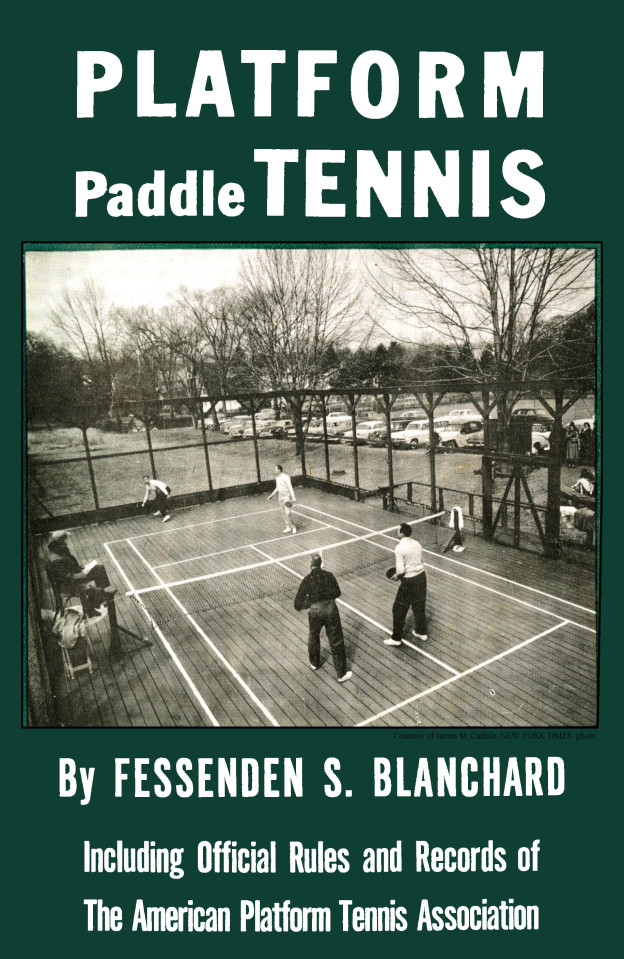
Blanchard’s second book on the game, Platform Paddle Tennis, which was published that year, was dedicated to his memory.

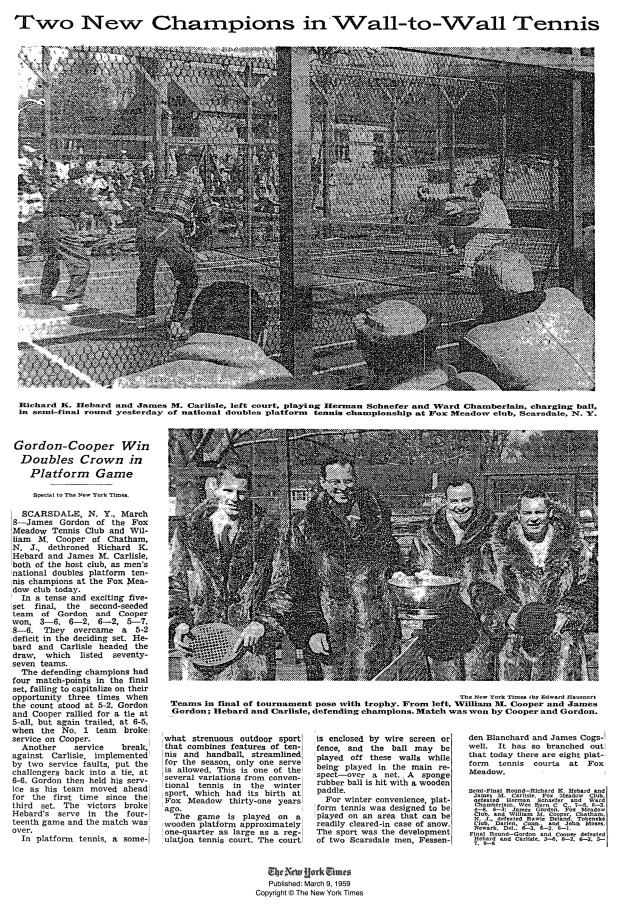
Two New Champions in Wall-to Wall Tennis

The New York Times and Reporter Dispatch cover Nationals

The Reporter-Dispatch of White Plains, New York, was one of the leaders among the local Scarsdale papers in giving interesting, illustrated accounts of platform tennis. The March 9th edition of “One of Saturday’s features,” speaking of the Men’s Nationals , commented on the play of Earle Gatchell of Fox Meadow and Ken Ward of Manursing Island Club, who admitted to a combined age of 128 years.

“They beat two younger men from Massachusetts in the first round in straight sets before bowing out. Gatchell helped construct the world’s first platform tennis court three decades ago. I might add that the older team taught the youngsters something about the strategy and tactics of the game. When Earle came to report the results, he said, ‘There has been a dreadful mistake. I know it wasn’t supposed to happen, but we won.’ Platform tennis covers a wide span of years.”

Source: Adapted from Fessenden S. Blanchard, Platform Paddle Tennis, 1959

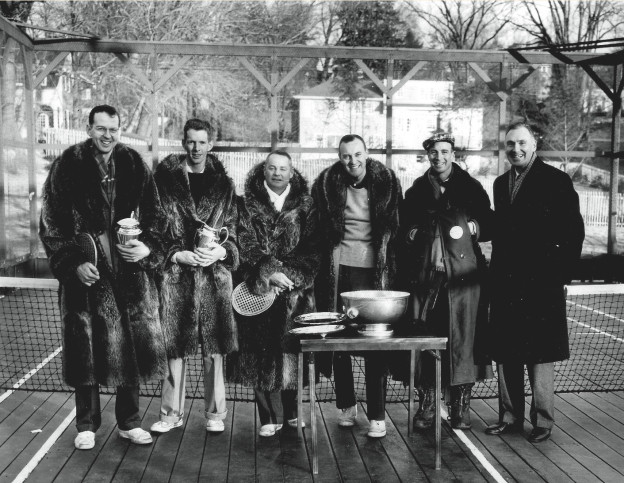
1959 Men’s Nationals: Jim Gordon and Bill Cooper (champions) with Jim Carlisle and Dick Hebard (1959 finalists, but champions in 1955 and 1958). Also pictured are Walter Close, tournament chair from Fox Meadow Tennis Club, and umpire Jack Whitbeck

National Championships

1959 Rev1

This was the largest Nationals since its inception. Fifty-one teams played in the mixed doubles at the Wee Burn Club in Darien, Connecticut. Thirty-one teams fought it out in the national senior men’s doubles, and there were 43 teams in the women’s doubles, both held at the Fox Meadow Tennis Club of Scarsdale, New York. The men’s doubles draw, also at Fox Meadow, was the highlight, with 77 teams from 35 clubs from Massachusetts to Virginia entered. It was run by a committee under the able chairmanship of Walter H. Close, the APTA President. With the aid of four Manursing Island courts, 154 players were taken care of in two days. The Women’s event was won by the mother-daughter team of Madeline Beck and Susan Beck Wasch.

Source: Adapted from Fessenden S. Blanchard, Platform Paddle Tennis, 1959

“In 1959, also, was played one of the best matches of men’s doubles ever seen in the finals of the national championships. William M. Cooper and James P. Gordon won from James M. Carlisle and Richard K. Hebard 3-6, 6-2, 6-2, 5-7, 8-6, after being down 2-5 in the final set and having 4 match points against them. The last two sets, particularly, produced some of the most brilliant play on both sides that the game has ever seen. Hard hitting and changes of speed in the return of service, particularly by Jim Gordon, combined with good lobbing, were features of the match. I was sorry to see so many opportunities for winning a point missed by a failure to use a drop or stop volley, but then that is a failure characteristic of many good players. I have often felt that if some players would study and practice the technique in that respect of Fred Walker, Helen Barnes or Susan Beck, they, as well as the game, would benefit by the experience. Despite this one lack, few of us have ever seen a match in which such excellent play predominated.

I understand that the combined age of the winners was 32 years less than those of the runners-up, yet the teams battled on practically even terms. This is good evidence that even championship platform tennis is a game for all ages.”

Source: Fessenden S. Blanchard, Platform Paddle Tennis, 1959
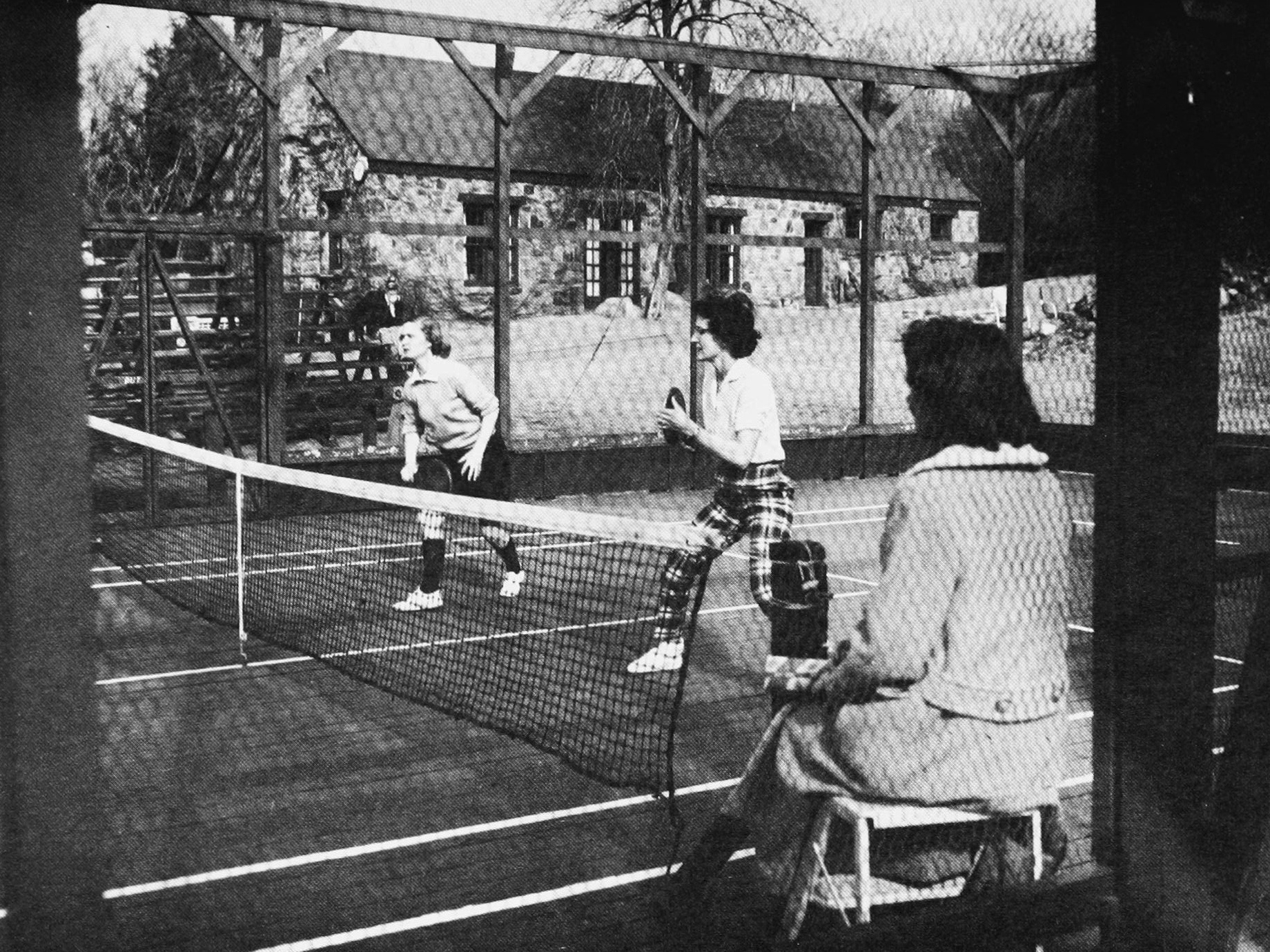
Women's Nationals 1959: Barbara Koegel and Ruth Walker, Finalists. Louise Raymond - umpire. FMTC clubhouse in background
Women’s Nationals 1959: Barbara Koegel and Ruth Walker, Finalists. Louise Raymond – umpire. FMTC clubhouse in background


Fox Meadow takes over Jambles

Blanchard considered the Scrambles event championed by Ken Ward to be “one of the greatest steps forward in the history of platform tennis.”

The Scrambles was a men’s event and was followed by Jamborees, a mixed event that Oz Moore was active in fathering.

In 1959, the APTA turned over all responsibility for the Jambles to Fox Meadow, where a Scrambles event had been run very successfully for a number of years. Fox Meadow also had enough courts to handle the number of teams signing up.