Platform Tennis News covered the charity tournament hosted by Fox Meadow that supports The Children’s Village in Dobbs Ferry, NY.

Paddle makes a difference in the real world

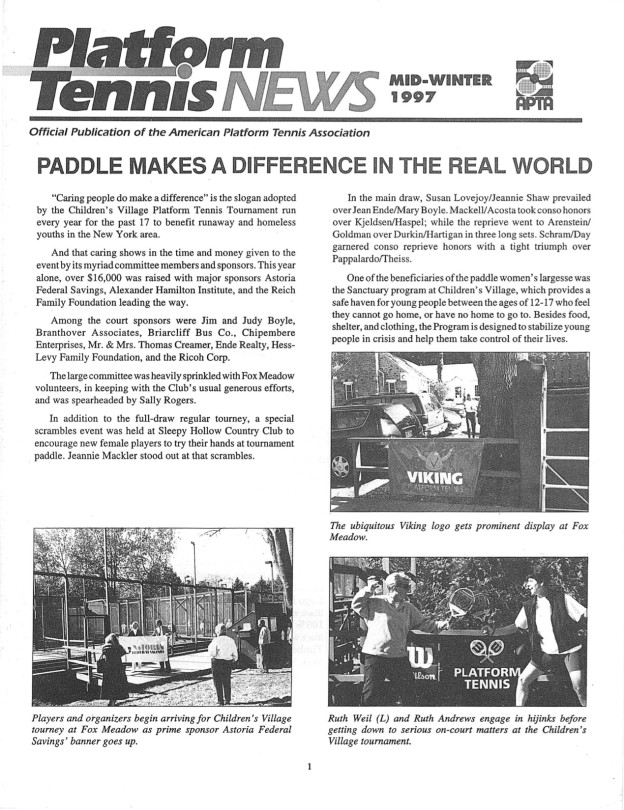
The Children’s Village Platform Tennis Tournament was co-founded by Fox Meadow Tennis Club member Sally D. Rogers, and had been run at Fox Meadow since the early 1980s.

The beneficiary was the Sanctuary program at Children’s Village, which provides a safe haven for young people between the ages of 12-17 who felt they could not go home, or had no home to go to.

Besides food, shelter, and clothing, the program was designed to stabilize young people in crisis and help them take control of their lives.

The tournament covered a significant part of the Sanctuary’s annual operating budget.

Balls used in National Championships – Viking, Wilson and Marox

For the first time in the history of the game, more than one brand of ball was approved for use in the different National Championships.

Three manufacturers were allocated a portion of the designation “Official APTA National Championship Ball” by a vote of the APTA Board.

The ball to be used in the Men’s and Women’s National Championships was awarded to Viking Athletics. The Senior Championship would be played with the ball made by Wilson Sporting Goods. The Mixed National and the Mixed Masters would use the Marox ball.

Source: Platform Tennis News, Winter 1997

Platform Tennis News welcomes Carolyn Tierney

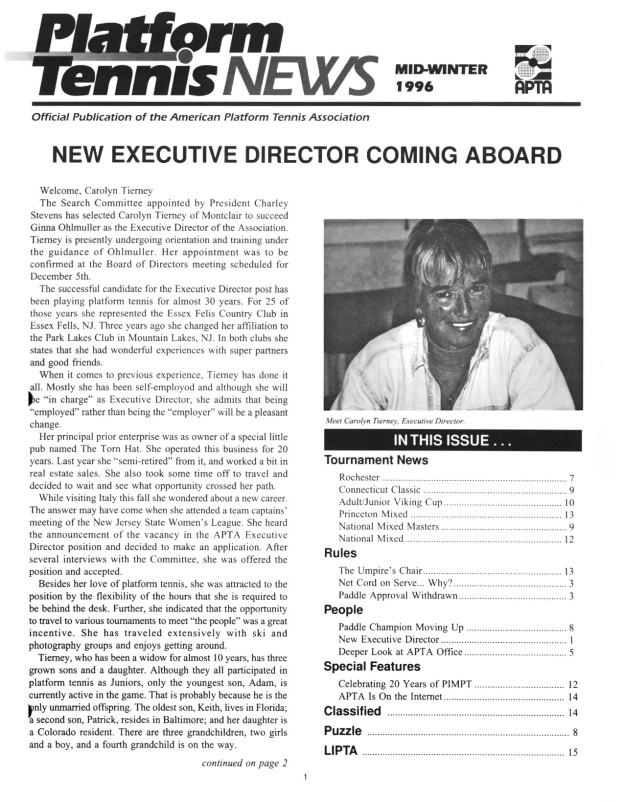
New Executive Director for APTA – Carolyn Tierney

The Search Committee, appointed by President Charley Stevens, selected Carolyn Tierney of Montclair to succeed Ginna Ohlmuller as the Executive Director of the Association.

At the time, Tierney had been playing platform tennis for almost 30 years. For 25 of those years, she represented the Essex Fells Country Club in Essex Fells, NJ. Three years prior, she changed her affiliation to the Park Lakes Club in Mountain Lakes, NJ. In both clubs she had wonderful experiences with super partners and good friends.

Source: Platform Tennis News, Mid-Winter 1996

A National Platform Tennis Center is proposed

Jack Randall, a long-time player, coach and supporter of the game had a dream: that a national platform tennis center could be developed.

His vision:

“I’m convinced people everywhere will love paddle once they have a chance to know what it is and have had a chance to play it. This cannot be done strictly through private clubs. The solution: A National Platform Tennis Center at a public facility is needed to accomplish this. A place important enough to the media to give it some exposure – especially on TV – along with an offer to come down to the center and try the game for free. We make it easy; newcomers try it ‘indoors’ and comfortably. Once they like it, they move with their friends outdoors. It seems natural to locate such a center in the heart of the area where the sport originated … a place with a large population, in a major media market and in an active area of play .. a place where players will talk about the center, tell others, and will come visit, assuring the center’s success and adding incentive to the media to cover this new sport phenomenon.”

Source: Platform Tennis News, Fall 1996 and APTA BOD May 1994 Meeting Minutes

A serious accident to her son required Ginna to resign after nine successful years as Executive Director

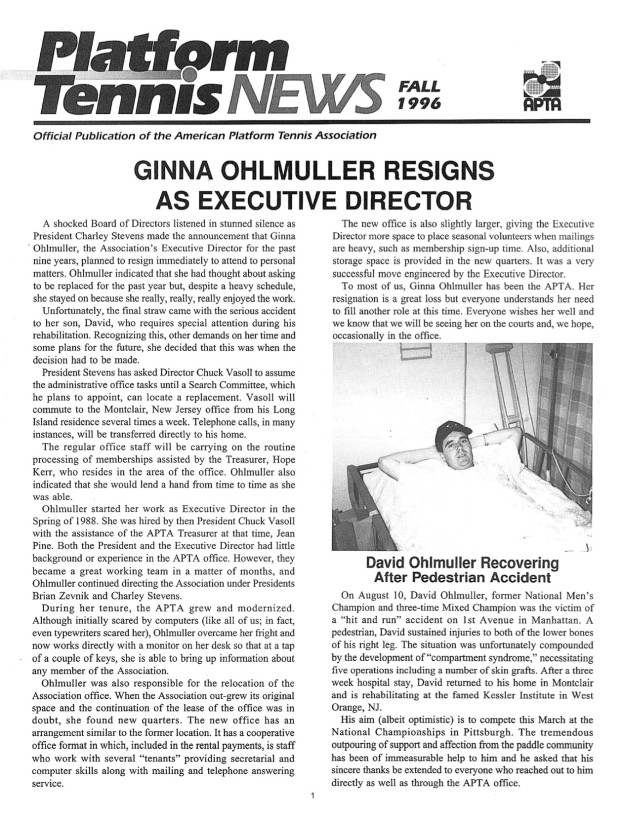
Ginna Ohlmuller resigns as Executive Director

A shocked Board of Directors listened in stunned silence as President Charley Stevens made the announcement that, after nine successful years, a serious accident involving her son David had precipitated Ohlmuller’s decision to resign. David, a National Men’s Champion and a three-time Mixed Champion, had been the victim of a “hit and run accident” on First Avenue in Manhattan, NYC.

Ohlmuller started as Executive Director in the spring of 1988. She was hired by then President Chuck Vasoll with the assistance of Jean Pine, the APTA Treasurer at that time. Both the President and the Executive Director had little background or experience in the APTA office. However, they became a great working team in a matter of months, and Ohlmuller continued directing the Association under Presidents Brian Zevnik and Charley Stevens.

During her tenure the APTA entered the electronic age despite the fact that even typewriters scared her and she was responsible for modernizing many procedures. She was spearheaded the relocation of the Association office.

Source: Platform Tennis News, Fall 1996

Eleventh edition of the Official Rules issued

All the talk as the paddle season opened was about the change in the Official Rules under which play would continue on a net cord service.

Some changes in wording were necessary to emphasize that, although many paddle tennis rules were derived from tennis, there were situations where they were different in certain respects.However, there were a few substantive changes in the Eleventh Edition of the Official Rules.

The Rules Committee, under direction from the Board of Directors, had been asked to make the calling of lines by players in an un-officiated match, less “hard and fast” and more “forgiving.” This was accomplished by expanding the comment following Rule 10 by incorporating most of the wording from the “The Etiquette of Platform Tennis.”

The “Continuous Play” regulation found in Rule 24 had a new paragraph (c) inserted which read: “During a service game, the server is permitted a maximum of 20 seconds between the finish of play on a point and the delivery of the next service.” While rarely an issue, it was determined that, on some occasions, players may be exceedingly deliberate or talkative between points, to the extent that play was slowed and the delay was sometimes used as a tactic to upset opponents.

Finally, in Appendix B, a new diagram was added to illustrate the new standards for racquets with wrap-around rims. This enabled new manufacturing techniques to be used in the production of (possibly better) paddles for the game.

Source: Platform Tennis News, Fall 1996

Region V’s Jack Hogan

During his tenure as president of Region V, Hogan was a mover and shaker in growing participation in his home city of Indianapolis and throughout the Region. He saw his role as being “to develop a stronger and wider membership base and provide services to all players, at every level of the game.”

Hogan instituted creative tactics to grow the sport locally. Upon noticing that many area players were not APTA members, he incorporated APTA membership into the Indianapolis chapter membership program. The league he started in 1989 with 32 players had grown to more than 200 APTA/IPTA members by 1996. The building of several new courts at the Indianapolis Racquet Club had helped the boom in play.

Hogan noted, “Not only do we need to expose more people to the game, at the same time we must provide facilities on which they can play. All those players (especially young people) who can’t afford or decide not to join a private club need access to facilities. Inaccessibility and cost may be reasons we are losing members in the East. My goal is to make more courts available to the general public.”

Source: Platform Tennis News, Summer 1996

Midwest paddle booms

Although the sport was born and bred in the Northeast, fifty years later the rebirth of paddle was taking place in America’s heartland. The Midwest had witnessed a surge in paddle over the past five years, signaling good news for the health and well- being of the sport.

Growth in the region’s paddle community was evidenced by strength of play and players. As opposed to years past, many of the top-ranking competitors were from points west (Mansager and Goodspeed, men’s double champs from Michigan and ranking contender Bill Fiedler from Chicago, to name a few).

Tournament participation was up, as well as the number of mid-west-based facilities. The APTA now had five board members from mid-western states. Most telling was the fact that APTA membership in the Midwest had outpaced that in the East.

Yet, while the numbers proved a point, they did not tell the whole story. Growth came through the hard work and dedication of leaders in the Mid-west paddle community.

APTA Executive Director Ginna Ohlmuller explained, “This is not a sport that easily runs itself. To flourish, paddle needs strong organization and a catalyst.”

Source: Platform Tennis News, Summer 1996

Viking Cup Adult/Junior Tournament

An Adult/Junior platform tennis tournament was conceived by Robin Rich Fulton following her experience running the National Junior Championships the previous season at the Wee Burn Country Club in Darien, Connecticut. She enlisted the assistance of Bob Callaway in the venture, and had the support of David Kjeldsen of Viking Athletics as the title sponsor.

The goal of the tournament was to promote the game among the younger set by giving them an opportunity to play with adult partners; learn from them; enjoy the camaraderie and ambiance of a tournament; and inspire juniors to continue to practice and play. The National Junior Championship would follow the event on the APTA schedule. The concept was to have regional play in as many locations as interest could be generated. Four sites had already signed up and winning teams from these locations would be invited to a central location play-off for the Viking Cup.

Each team would be composed of one junior (male or female) under 18 years of age and an adult, also male or female, but the combined ages of the team had to be a minimum of 43 years. Viking Athletics would donate a permanent “Cup” plus appropriate prizes.

Source: Platform Tennis News, Summer 1996

Foot-Fault awareness

Foot-fault 1996

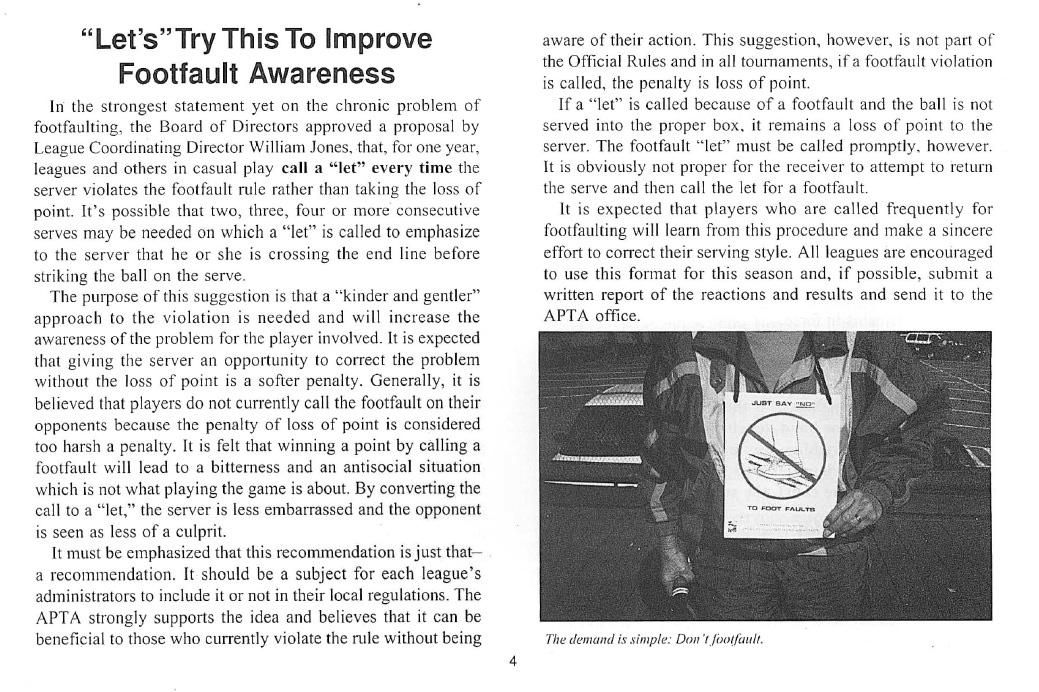
In the strongest statement yet on the chronic problem of foot-faulting, the Board of Directors approved a proposal by League Coordinating Director William Jones, that, for one year, leagues and others in casual play may call a “let” every time the server violated the foot-fault rule rather than taking the loss of point.

The purpose of the suggestion was that a “kinder and gentler” approach to the violation was needed and would increase the awareness of the problem for the player involved.

Source: Platform Tennis News, Summer 1996