Jim Reilly recounted the trials and tribulations of building a court at the American Embassy in Sofia, Bulgaria.
Apparently a diplomat league was in the making





Jim Reilly recounted the trials and tribulations of building a court at the American Embassy in Sofia, Bulgaria.
Apparently a diplomat league was in the making
The Board approved a proposal to loan “seed money” of up to a maximum of $5,000.00 to a National Championships Committee for expenses prior to the receipt of entry fees and sponsorship funds.
It was anticipated that the funds would be used for the purchase of products for fundraising activities and other deposits needed to secure facilities for the event.
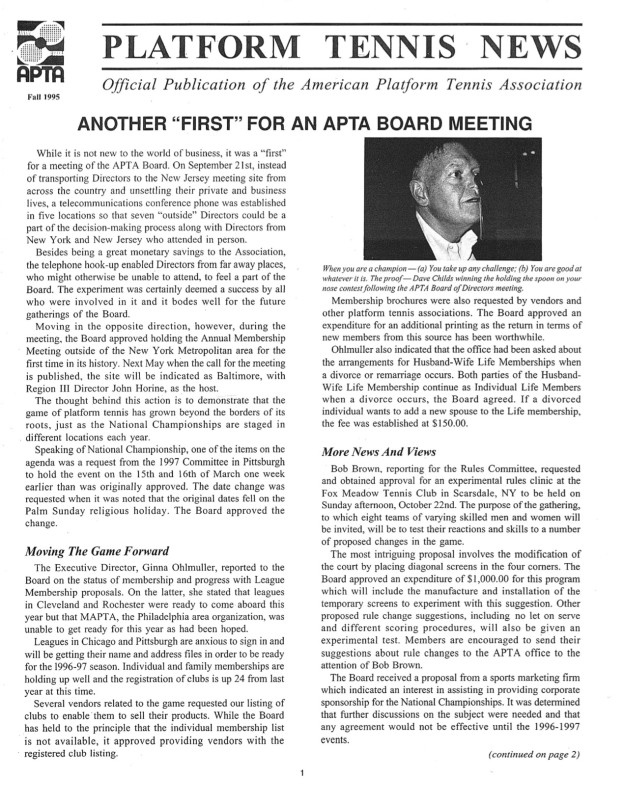
The first step was implementing teleconferencing for Board meetings to make it easier for seven Directors outside of the New York Metropolitan area, historically the usual location of the meetings, to participate.
The second step was Board approval of holding the Annual Membership Meeting outside of the New York Metropolitan area for the first time in its history. The next meeting, in May 1996, would be in Baltimore, with Region III Director John Horine, as the host.
The thought behind this action was to demonstrate that the game of platform tennis has grown beyond the borders of its roots, similar to the way the National Championships were now staged in different locations each year.
Source: Platform Tennis News, Fall 1995
In 1995, the APTA Board of Directors embarked on the most aggressive and comprehensive marketing program in its history.
The Board had started preliminary discussions with RHB Ventures to assist the APTA in the growth of the game throughout the country. RHB Ventures, a sports marketing firm based in Philadelphia and Washington D.C., had secured corporate sponsors for sports such as tennis, golf, cycling, sailing, basketball and football, and owned and managed The Champions Tour, the 35-and-over professional tennis tour featuring Jimmy Connors, John McEnroe, Bjorn Borg, and others.
Tapping the extensive marketing expertise of RHB Ventures, the APTA hoped to implement a multifaceted marketing program.
Among the major points of this program were:
a) sell corporate sponsorships on behalf of the APTA
b) complete a comprehensive demographic study of the current membership
c) attain a greater membership base from among the estimated 400,000 paddle players from around the United States
d) produce promotional materials to help “grow the game”
e) develop membership opportunities for non-tournament level players
f) create new events and stimulate interest among the “B” and “C” level players and juniors
g) provide greater benefits – via new corporate sponsorships – for new and existing members of the APTA.
Source: Platform Tennis News, Fall 1995
The announcement by Wilson Sporting Goods Company that it was entering the platform tennis market with a line of paddles and paddle accessories was made at a press conference at the U.S. Open tennis tournament.
In a separate news release, it was indicated that development of the new platform tennis paddles stemmed from the technology used in Wilson’s tennis racquets. All four paddles would be constructed of molded graphite. The new models were designated Hammer 9, Hammer 8, Pro Staff 6, and Pro Staff 5. The numbers assigned to each paddle corresponded to a specific “Power Series” rating that fit a certain style of play.
Source: Platform Tennis News, Summer & Fall 1995
Separately, Wilson had acquired the Vittert V30 ball business from Hedstrom so they now could supply both balls and paddles. This development became an issue for A2Z/Viking Athletics as Wilson no longer would supply them with balls as they were a competitor in the paddle business. This forced Viking to enter the ball manufacturing business – see also A2Z Acquires Marcraft’s Platform Tennis Business
After three years of supporting the game of platform tennis, including the commitment of tens of thousands of dollars in tournament prize money and raffle drawings, the Lineal Group announced that it would no longer be able to sponsor the Lineal Group Grand Prix Series. Several executive, as well as business, changes had occurred at the company and thus it became necessary to end its successful relationship with competitive paddle tennis.
Ginna Ohlmuller, Executive Director of the APTA, commented on the development: “The Lineal Group provided a real boost to the game of paddle tennis over the last three years and they were a pleasure to work with.”
Ohlmuller made special mention of Arnie Ditri1, head of Ditri Associates, and John Balch, Lineal’s senior marketing manager. “Mr. Ditri had a genuine interest in the game of paddle and committed substantial time and effort to help the game graduate to the next level and John gave up numerous weekends over years to attend the tournaments, as well as spending innumerable hours in the office organizing the financial details, in order to make the relationship a first class one.”
Balch made the following statement:
“The Lineal Group is grateful for the opportunity we have had to sponsor our ‘Grand Prix’ tournament series. For three seasons, these events have been a good means of increasing awareness of our furniture brands and, quite frankly, we had a lot of fun in that endeavor.”
Diane Tucker, who along with Robin Fulton, finished the 1994-1995 season at the top of the Lineal Group Championship Series, provided a view from the women’s tour:
“The Lineal Group brought the men’s and women’s games together, and I got to know a lot more players because of their sponsorship. There was an added level of excitement when there was money on the line. The players felt a little more pressure and had something a little higher to aim for.”
Source: Platform Tennis News, Fall 1995
Note 1: Arnold E Ditri was President and Chief Executive Officer of Hedstrom Corporation, a manufacturer and marketer of children’s leisure and activity products, from March 1993 to December 2000. He was non-executive Chairman of Hedstrom from January 2001 to July 2001. Mr. Ditri served as President of Ditri Associates, Inc. from 1981 until 1994, which company, with a number of financial partners, specialized in acquiring and building under-achieving companies with Mr. Ditri serving as Chief Executive Officer of the acquired companies.
Responding to the occasional “bad apple in the bushel,” the APTA released a statement that describes the expected conduct of competitors in its tournaments and the penalties that may be enforced against violators.
The “Code of Conduct for Platform Tennis Players” below appeared in the Tournament Schedule as “a constant reminder to participants of what is expected of them when they enter sanctioned events.”
Players shall not engage in unsportsmanlike conduct. At no time, but especially during the course of a match, shall a player engage in:
a) verbal or physical abuse of any persons connected with the game or spectators;
b) use of visible or audible profanity;
c) mistreatment of the equipment, the court or its fixtures;
d) behavior that reflects a failure to accept the decisions of officials and/or disregard for the rules and spirit of the game.
Any official or player may report conduct considered improper on the part of a player to the Tournament Director and/or the office of the American Platform Tennis Association for investigation by its Conduct Review Committee. The Committee shall report its findings to the Board of Directors of the Association, which will assess penalties as it deems appropriate.
The penalties may range from refusal to accept an individual’s or team entry in a future tournament at the same venue, to suspension from sanctioned tournaments for 12 months.
Source: Platform Tennis News, Summer 1995

As the result of new manufacturing techniques, the Equipment Committee, headed by former APTA President Robert A. Brown, was asked to review the APTA paddle specifications.
The Board approved a recommended change to make the total maximum length of the paddle 18″, and eliminate the separate handle/play length designation.
It also approved a change in the edge (or rim) that will allow a 1/8″ height wraparound of a maximum 1/2″, in addition to the flush-with-face surface that was previously the only one allowed.
Source: Platform Tennis News, Summer 1995
Treasurer Hope Kerr reported at the Board’s May meeting that the revenues of the Association for the 1994/95 fiscal year exceeded expenses by $14,815.81.
This was the best year for the Association in some time, and reflected a good increase in membership as the result of the joining en masse of several leagues.
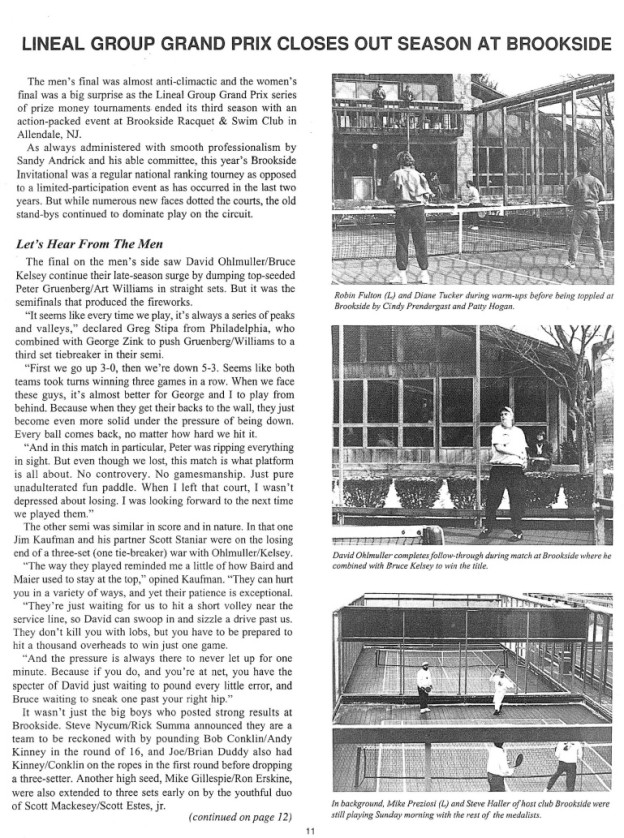
The men’s final was almost anti-climactic and the women’s final was a big surprise as the Lineal Group Grand Prix series of prize money tournaments ended its third season with an action-packed event at Brookside Racquet & Swim Club in Allendale, NJ.
The final on the men’s side saw David Ohlmuller/Bruce Kelsey continue their late-season surge by dumping top-seeded Peter Gruenberg/Art Williams in straight sets. But it was the semi-finals that produced the fireworks with Greg Stipa and George Zink pushing Gruenberg and Williams to a third set tiebreaker, and Jim Kaufman and Scott Staniar to three sets against Ohlmuller and Kelsey.
Some people were starting to complain that women’s tournaments had become too predictable, with the same teams dominating from start to finish. Jersey’s Patti Hogan and Delaware’s Cindy Prendergast helped squelch that attitude at Brookside by knocking off heavy favorites Diane Tucker/Robin Fulton in fairly routine fashion.
Source: Platform Tennis News, Spring 1995
 © 2026 Platform Tennis Museum and Hall of Fame Foundation, All Rights Reserved.