Dave Kjeldsen, founder of A2Z (later renamed Viking Athletics), with his familiar horned hat and cigar

A2Z acquires the assets of Marcraft Recreation Corporation

There was a new/old “player” in the manufacturing ranks of the platform world. A2Z, headed by President David Kjeldsen, had transformed itself from Marcraft ‘s largest retail distributor into a manufacturer/wholesaler of platform equipment, by purchasing the assets of Marcraft Recreation Corporation’s domestic platform tennis division in April 1995.

At the time Marcraft was just a paddle manufacturer. They had been a ball manufacturer for a while in the 1970s (Big M yellow and red balls) but had stopped production and had become a reseller of the game’s dominant ball, Hedstom’s Vittert V30.

When Hedstrom sold their ball manufacturing business to Wilson – see Wilson Acquires Hedstrom Ball Business – this created an issue for A2Z (renamed Viking Athletics in 1996) as Wilson refused to allow them to continue selling the V30 ball as they were now a competitor in the paddle market. This forced A2Z to develop their own ball

Platform Tennis News covered the induction ceremony (summer 1995 issue)

APTA Honor Awards: Drowne, Irvine and Ware

Bradley Drowne: Bradley Drowne served as the National Tournament director for the APTA for many years and pioneered the rankings system employed today. He was “Mr. Steady” as a player and won the National Men’s in 1968, the Mixed in 1969 and 1974, and his first Men’s 45+ in 1973 over Baird and Lankenau.

Hank Irvine: Hank Irvine was a player who changed the game and was always exciting to watch. His shot-making and control of the ball set new standards, and he had great hands and ease of stroke, coupled with economy of body movement and consistency. He started playing and teaching the game in 1973, when he became head pro at the Short Hills Club after immigrating from Rhodesia (now Zimbabwe). By 1997, he had won his first National Men’s with Herb Fitz Gibbon; they repeated the following year. Six years later, he again won back-to-back Men’s nationals in 1986 and 1987. In the senior events he won the 50+ once, the 55+ four times, the 60+ three times and the 65+ once. Hank was a wonderful ambassador for the sport as a teacher and devoted much time to the development of juniors. (Short Hills Club).

John Ware: John P. Ware’s first achievement was changing the color of the original white ball, which was hard to see, into an orange one with the use of spray paint. Eventually,he got the ball to be manufactured that way, until the change to yellow took place. He served as Secretary of the APTA from 1959 to 1961, and as President from 1961 to 1963. He inaugurated the first APTA Junior Boys National Championships in 1963, and designed the crossed paddles and ball that was used on stationery, trophies, ties, scarves, and everything that represented the APTA for years. As Blanchard’s son-in-law, Ware became the game’s historian, writing numerous articles on the game and helping to publish books. With his wife, Molly Blanchard Ware, he put together the first and only – and truly magnificent – slide show presentation on the history of platform tennis. It was shown first at the Princeton Club in October 1976.

Garden State Nationals, March 23 - 26, 1995

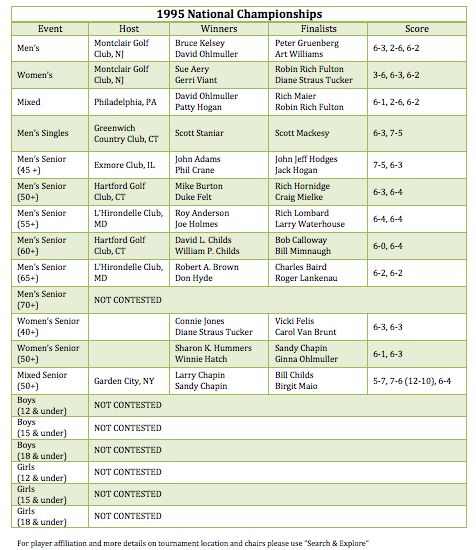
National Championships and coverage of the Men’s and Women’s Nationals

1995

PTN Spring 1995 covered the Men’s and Women’s Nationals:

For one 96-hour period, all platform tennis roads led to New Jersey, as the Garden State Nationals and concurrent President’s Cup events were hosted to perfection by Montclair Golf Club and Short Hills Club.

Players and spectators came from every point of the compass, and play reached its usual outstanding levels. But there were differences this year. For one, the Children’s Specialized Hospital of Mountaindale (NJ) was the recipient of the generosity of the sponsors and advertisers who supported this year’s Nationals, and received in excess of $10,000.

Another new wrinkle at this year’s event was the presence of the omnipresent eye – television. Spearheaded by sports editor Paul Spychala, Suburban Cablevision taped both the men’s and women’s finals for showing to some 2.5 million subscribers on its system. The tapes were also made available to outlets in several other regions, including Philadelphia and Boston.

On the court, there were upsets galore, top teams rose to the top, and three-set matches and tight finishes were commonplace. David Ohlmuller and Bruce Kelsey continued their late season surge and staked their claim to the title of “platform’s best” by dumping defending champions Peter Gruenberg and Art Williams in a match that had a little bit of everything.

For the second year in a row, Nyack’s (NY) Gerri Viant and Plainfield’s (NJ) Sue Aery confounded the status quo and knocked off the top-seeded duo of Robin Fulton and Diane Tucker. All season long it seemed like those two teams were at loggerheads when push came to shove in the finals of various events.

Source: Platform Tennis News, Spring & Summer 1995

Nationals draw now overseen by APTA office

1995 marked the first year that the draw was prepared by the APTA office, rather than by the National Championship Committee at the host site.

Local input on the ability of unknown teams was still sought by the draw committee, but otherwise the selections were to be made in strict conformance to the guidelines published by the APTA.

Charity dinners are out; Paddle tournaments are in

Instead of gala balls and celebrity-studded formals, charities around the country are finding that platform tennis can be an important vehicle for both raising funds and enhancing their visibility and image.

Paul Delaney, who played out of Bronxville, arranged a mixed tournament to support the Visiting Nurses Services of Westchester and received lots of positive reaction because of the good cause and the popularity of mixed events in Westchester. He hoped to make this an annual event, and it still is.

Source: Platform Tennis News, Winter 1995

Platform Tennis News, Winter 1995

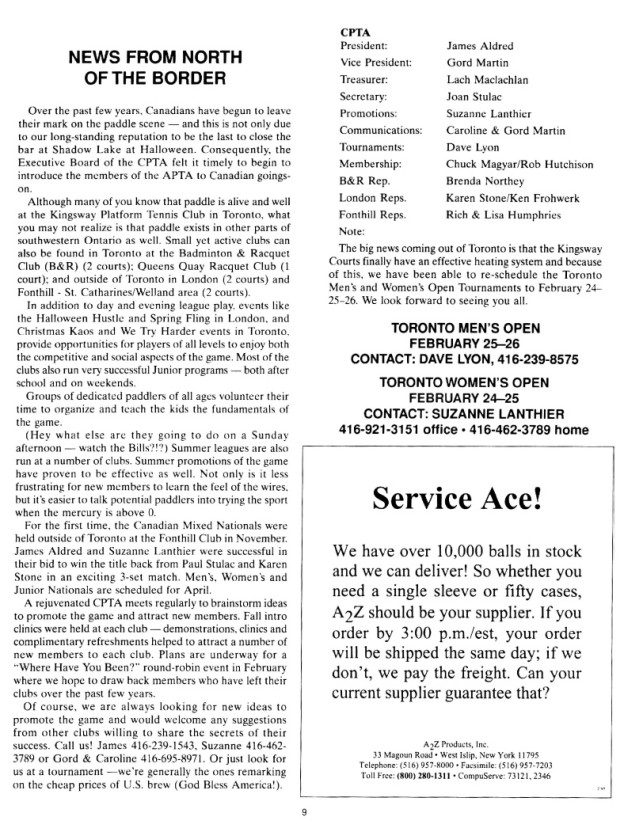
News from north of the border

Over the past few years, Canadians had begun to leave their mark on the paddle scene, and not just due to their long-standing reputation to be the last to close the bar at Shadow Lake (Penfield, NY, near Rochester) at Halloween.

Consequently, the Executive Board of the Canadian Platform Tennis Association (CPTA) felt it timely to begin to introduce the members of the APTA to Canadian goings-on.

[Note: Hall of Fame inductee Chuck Baird had spent some years in Toronto when he was with International Nickel Company of Canada (INCO) in the 1970s and had served on the Canadian Platform Tennis Association and was instrumental in getting them to join the APTA]

The Winter edition of Platform Tennis News ran the report from the CPTA.

Source: Platform Tennis News, Winter 1995

APTA Board again struggles to address foot-faults

In the continuing struggle to contend with the foot-fault violation, and possibly clarify the foot-fault rule, the APTA Board again considered the matter.

The discussion focused on two questions: (1) What could be done to control/reduce the incidence of foot-faulting among players? and (2) Should there be any change or changes in the foot-fault rules?

It was decided that, starting with the 1995 season, all National Championships should have a foot-fault judge in all matches from the quarterfinals on, unless there was a chair umpire. While it was recognized by the APTA that this would be a difficult chore for both the committee and the appointee, it was felt that it can and should be done in order to further curb the incidence of foot-faulting.

With regard to the second question, the discussion focused on the current wording of the foot-fault rule (Rule II) in the Rules Book. The rule states that the server, throughout the delivery of the service. may not “change position by walking or running,” but the rule goes on to state that the server is not deemed to be walking or running as a result of “slight movements of the feet which do not materially affect the location originally taken by the server.” In focusing on what is a “slight movement,” the Board considered changing the rule to be more specific, but decided to defer this decision and think further about it during the season.

The APTA had also received suggestions that the rule specify that the forward foot must maintain its original position, thus disallowing any movement, although “pivoting” of the forward foot would be allowed. It was deemed that such a regulation would be even more difficult to enforce than the current violation of simply stepping on the line, so the Board also deferred consideration of this suggestion.

Source: Platform Tennis News, Winter 1995

Experimental clinic report recommends “no-let” be implemented

The committee (Robert A. Brown, Walter Peckinpaugh, Charles J. Stevens and Charles E. Vasoll) recommended that the APTA Board consider implementing the “no-let” rule in the 1996-1997 season; that the diagonal corner screens were not a practical innovation the Board should consider further; and, that the no-ad rule, which had been favorably received, should be given further consideration.

A full report on the experimental clinic was included in the Mid-Winter edition of Platform Tennis News.

Source: Platform Tennis News, Mid-Winter 1995

APTA Board approves experimental clinic to explore changes to the game

Bob Brown, reporting for the Rules Committee, requested and obtained approval for an experimental rules clinic at the Fox Meadow Tennis Club in Scarsdale, NY.

The most intriguing proposal involved the modification of the court by placing diagonal screens in the four corners. The Board approved an expenditure of $1,000.00 for this program, which included the manufacture and installation of the temporary screens to experiment with this suggestion.

Other proposed rule change suggestions, including no-let on serve, and different scoring procedures, were also to be given an experimental test.

Source: Platform Tennis News, Mid-Winter 1995

Philip Jay O’Meilia (1927- )

Philip Jay O´Meilia was born in 1927 in Tulsa, Oklahoma, where he still resides today. Between military stints in WWII and Korea,serving as a Navy artist, he attended the Art Students League in New York (1945-46, 1947-49) and the Chicago Academy of Fine Art (1946-47). He also attended the Cape School of Art in Provincetown, MA, George Washington University in Washington, DC, and the University of Tulsa. O´Meilia also received special instruction from Eliot O´Hara and Frederic Taubes.

O´Meilia’s work has been displayed in galleries and museums across America, including the Smithsonian Institution, the National Academy of Design in New York, and the National Cowboy Hall of Fame in Oklahoma City. His sculptures, paintings, serigraphs, and prints are in the permanent collections of more than 500 private and corporate organizations worldwide.

A lifelong sports enthusiast, O´Meilia is highly regarded for his artistic depiction of professional and collegiate football, particularly at the University of Oklahoma, professional tennis, golf, and other sports. Among other highlights of his career, he was commissioned by the PGA to create the official painting for the 2001 U.S. Open Tournament at Southern Hills Country Club in Tulsa.