



Traditional equipment manufacturers, like Marcraft, Marox, and Vittert,struggled in the early 1990s and started to leave the game.
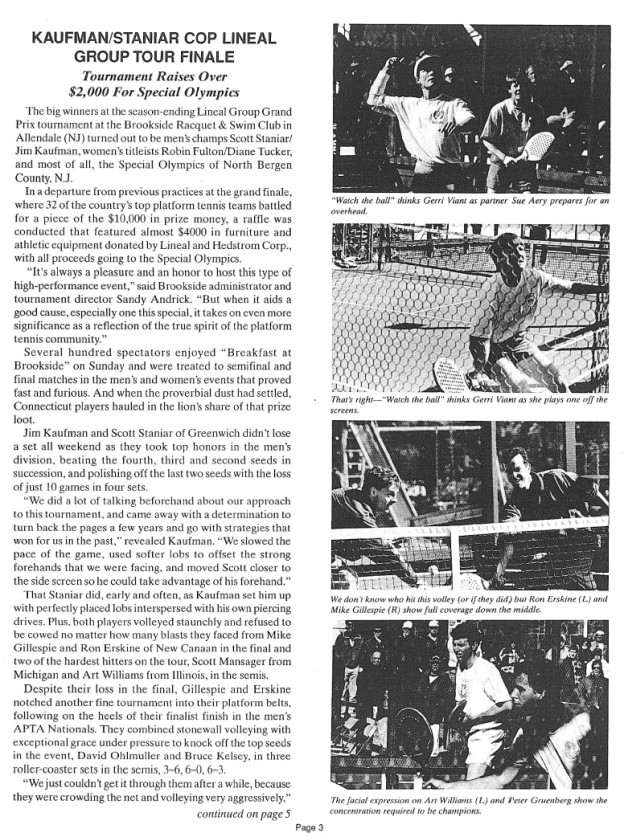
Kaufman and Staniar cop Lineal Group Tour finale
The big winners at the season-ending Lineal Group Grand Prix tournament at the Brookside Racquet & Swim Club in Allendale, NJ, turned out to be men’s champs Scott Staniar and Jim Kaufman, women’s titleists Robin Fulton and Diane Tucker, and most of all, the Special Olympics of North Bergen County, NJ.
In a departure from previous practices at the grand finale, where 32 of the country’s top platform tennis teams battled for a piece of the $10,000 in prize money, a raffle was conducted that featured almost $4,000 in furniture and athletic equipment donated by Lineal and Hedstrom Corp. All proceeds went to the Special Olympics.
Source: Platform Tennis News, Spring 1994
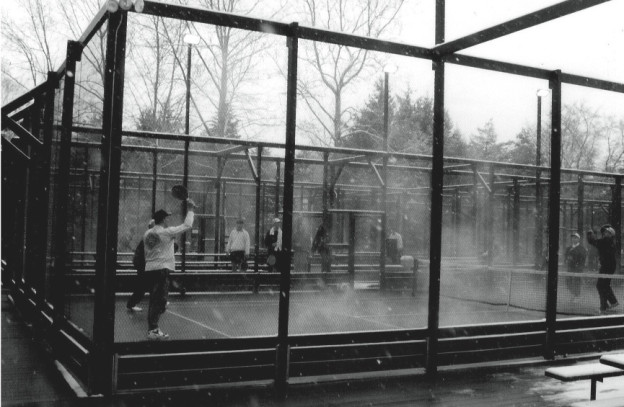
Fox Meadow Hosts Men’s and Women’s Nationals, and President’s Cup
This was the last Men’s and Women’s Nationals hosted by the club. The Men’s was chaired by Jo Rogers and the Women’s by Roger Lankenau. The game had grown and now hosting the Nationals required access to facilities beyond the club’s capabilities.
Source: Platform Tennis News, Winter 1994, and Nationals Program
Besides the cheering for the participants, plaudits were heaped on those individuals who never took a paddle in hand all weekend, but without whom there would have been no tournament. Jo and Sally Rogers, in particular, were stalwarts in bringing off the event, ably assisted by a topnotch committee that included Bob and Ann Brown, Roger and Marilyn Lankenau, Jim and Brenda Borho, Joan Marie O’Connor, and literally dozens of other high-effort contributors. From the ladies who so graciously served up the food and spirits, to people like Brook Kindred who could be observed slicing turkey one minute and umpiring a semi-finals the next, to individuals like Fox Meadow president John Miller, who wielded a mean broom in sweeping the courts of water and snow so play could go on. It’s a true measure of the game of platform and the APTA National Championships that so many individuals contributed so much volunteer effort to make sure it was an exceptional and memorable experience for everyone
Source: Platform Tennis News, Spring 2004
Letter from Dick, Jim,and Kathy Reilly to FMTC Board
The Board of Directors
Fox Meadow Tennis Club
P.O. Box 219
Scarsdale, NY 10583
To all the wonderful people at Fox Meadow:
After basking in Sunday’s beautiful sun, Jim, Kathy and I would like to extend our warm, sunburned, and most happy feelings of gratitude to you for doing such a wonderful job of hosting this year’s Nationals.
Many of you contributed much talent and effort in preparing the food, the draw, housing, court usage, awards, and on and on. A few most unselfish individuals contributed a huge amount of time to make this such a successful and desirable major event.
It was encouraging to see such a relatively large and especially enthusiastic crowd. The play was outstanding. And the women had the biggest crowd ever for an excellent match. Even the rounds of 32, 16 and quarters on Saturday were well attended, as they much deserved to be.
You performed many firsts which is so healthy and appropriate for Fox Meadow, the “grand-daddy” of platform tennis.
Thanks so much.
Dick, Jim, and Kathy Reilly
Brewster, New York
Source: Platform Tennis News, Spring 1994
Tenth year of competition for Manhold Cup held In Chicago
The Exmoor Country Club on the North Shore of Chicago was the site of the tenth renewal of the battle for the Manhold Cup, representing supremacy among the six APTA regions in Senior platform tennis.
Region V was the winner, with each member receiving a trophy.
Jerry Manhold, “The Legend,” was also presented with an award in appreciation of his efforts for Senior platform tennis.
This special event is played as a prelude to the 50+ and 60+ National Championships. Each region sends a team of ten players: four representing the 50+ group, and another representing the 55+ category, with the other two in the 60+ category.
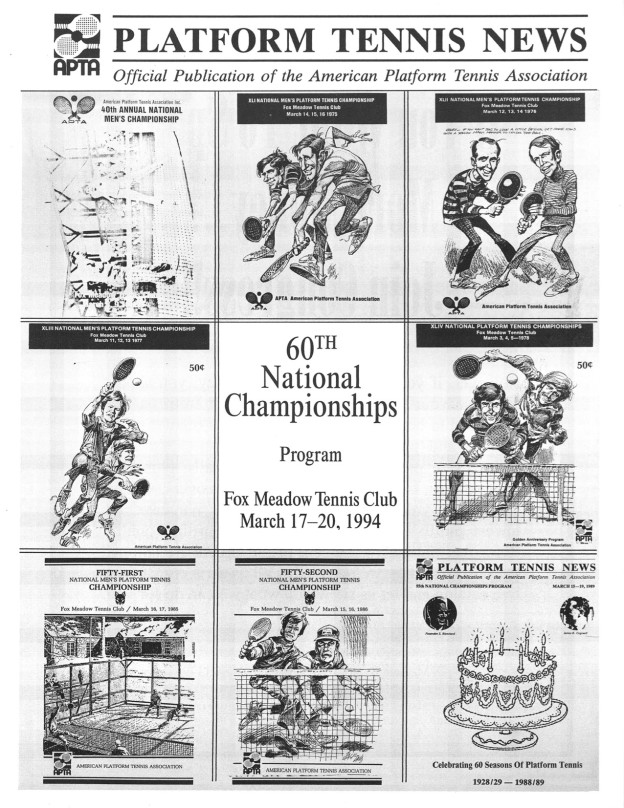
National Championships – The Men’s return “home”
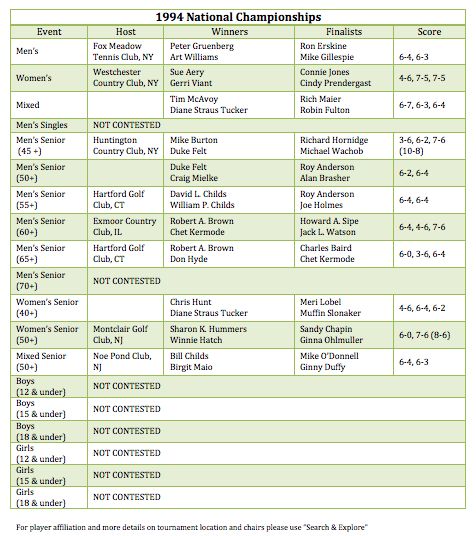
Reflecting the nature of the game of platform itself, the 1994 National Championships were a study in contrasts, a series of highs and lows that left everyone with vivid memories of on- and off-court occurrences. While all the champions deservedly celebrated their winning efforts, a shadow was cast over the entire event by the untimely death, during the warm-up for the first round match, of one of the Men’s participants, longtime paddle player and former National Champion Mike Wachob.
In a reversal of fortunes, last year’s men’s finalists, Peter Gruenberg and Art Williams, shook off the memories of their three-set defeat in Cleveland to knock off Ron Erskine and Mike Gillespie in the finals. On the other hand, the dominant women’s team and defending champions, Robin Fulton and Diane Tucker, stumbled in the semis and opened the door for new champions Sue Aery and Gerri Viant to display their formidable wares and run the table for the championship in a tight three-setter with Cindy Prendergast and Connie Jones.
Source: Platform Tennis News, Winter & Spring 1994, PTN Nationals Program
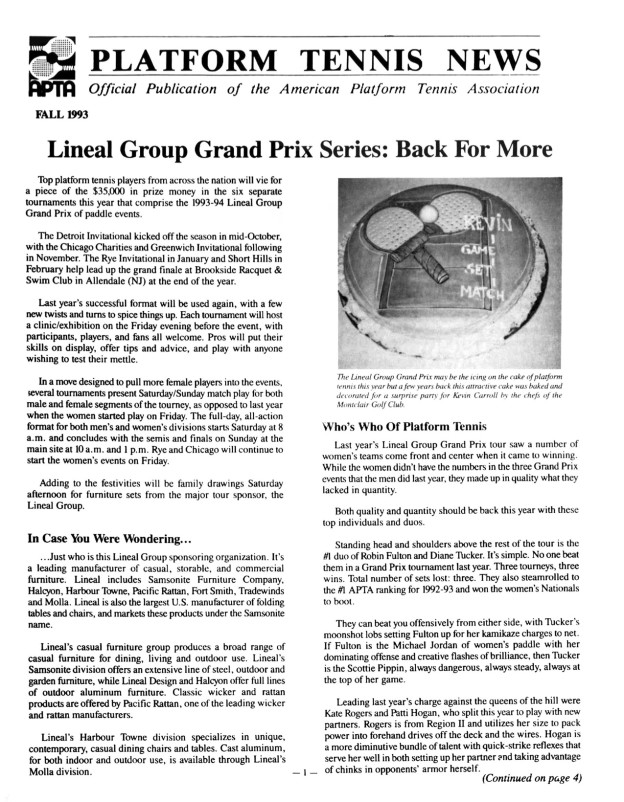
Lineal Group re-ups for 1993-1994 season
Top platform tennis players from across the nation vied for a piece of the $35,000 in prize money at stake in the six separate tournaments that comprised the 1993-94 Lineal Group Grand Prix of paddle events.
The Detroit Invitational kicked off the season in mid-October, with the Chicago Charities and Greenwich Invitational following in November. The Rye Invitational scheduled in January and Short Hills in February help lead up to the grand finale at Brookside Racquet & Swim Club in Allendale, NJ, at the end of the season.
The previous year’s successful format was used again, with a few new twists and turns to spice things up. Each tournament hosted a clinic/exhibition on the Friday evening before the event, with participants, players, and fans all welcome. Pros put their skills on display, offered tips and advice, and played with anyone wishing to test their mettle. In a move designed to pull more female players into the events, several tournaments had Saturday/Sunday match play for both male and female segments of the tourney, as opposed to when the women started play on Friday.
Source: Platform Tennis News, Fall 1993

Back to the basics for President’s Cup
Over the years, the President’s Cup event had developed from the proverbial backyard barbecue into an all-out regional holy war.
Participants had come from some of the strongest teams in each Region, as opposed to the more “club-oriented” atmosphere that once existed.
Each year as well, the APTA discussed how to steer the PC more firmly down its original path, which is explained in the accompanying material from an article written in 1978.
To that end, the new restrictions included the members of the top eight ranked women’s teams from 1992-93, and the members of the top 16 ranked men’s teams. These teams were now ineligible for President’s Cup consideration.
Also, any player who had reached the quarterfinals of either of the two previous APTA National Championships (Long Island or Cleveland) was ineligible.
In order to earn PC points for a region, a player must be a member of the APTA before he or she played in a PC qualifying event. No member, no points.
The aim was to encourage more mid-level and club paddlers to play their way onto a regional team and enjoy the competition and team spirit that accompanied such an achievement.
Source: Platform Tennis News, Summer 1993
LETS Committee files a report
Despite a century-long period during which the inconsistent rules pertaining to let cord situations (serve or during play of point) had been perpetuated, the recently formed committee came out strongly in favor of consistent treatment – i.e., play should be continuous on all let cords which, after striking the net, land fairly in the opponent’s court, whether it be on service or during play after the service.
The committee’s rationale for this recommendation were:
1. The rules with regard to the play of all lets should be consistent.
2. The recommended change would speed up the game.
3. There would be no further disputes over whether a let on service was indeed a let (heard by one, but not by others).
4. One less official (the let cord judge) would be required in matches that are officiated.
5. Playing the let on service will add interest to the game.
6. Over the long run, points won or lost on lets on service will probably even out between server and receiver. The let service that just dribbles over the net into the receiver’s service court will usually be a winner for the server. On the other hand, the let cord service that pops up high and drops into the receiver’s service court will often result in an easy winning return for the receiver. The bulk of the let services that just graze the net cord will be routinely returned by the receiver.
The committee recommended a two-year trial period for the new rule, during which all matches had to be played using the new rule. This was a period long enough to permit players to adapt to, and become comfortable with the rule, thereby avoiding the natural human tendency to react negatively to change without giving it a try. This trial period recommendation was tabled by the APTA Board until 1996, when it was again considered and finally adopted. After the two-year trial period ended in 1998, the “no-let” rule was approved and became official in all play.
Source: Platform Tennis News, Summer & Fall 1993
New experiment: Local and APTA joint membership
In the latest attempt to encourage “average league players” to become APTA members, the Board of Directors approved an agreement with the Long Island Platform Tennis Association, as a one year experiment, to provide all of its members with full APTA membership at a reduced rate.
The experiment brought in 700 family members, and other areas expressed interest in the program.
Official Rules updated
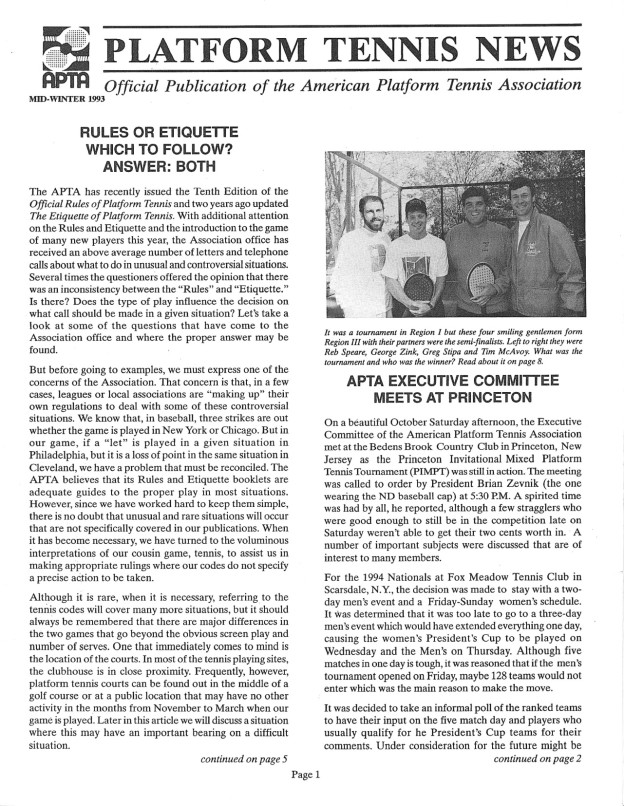
The new edition was more than a reprint of existing text. With input from all the directors of the Association, and suggestions from members, Rules Committee, Director Bob Brown did a major rewriting of the text.
One of the seemingly simple, but really arduous tasks was to remove all the male pronouns (he, his, him) from the rules, in line with current practice.
The second major effort was to clarify rules for certain play situations that were not specified, but were understood to be accepted practice in actual court action. For example, the circumstances surrounding the ball hitting a net post were defined much more clearly than in the prior edition of the Official Rules.
Source: Platform Tennis News, Summer 1993
 © 2026 Platform Tennis Museum and Hall of Fame Foundation, All Rights Reserved.