Madeline Childress “Madge” Beck ( -1991)

When Fox Meadow celebrated its hundredth anniversary in 1983, they almost ran out of numbers in recording Madeline “Madge” Beck’s accomplishments on a national ranking level. Madge Beck counted among her accolades the women’s singles crown in 1936, and the mixed doubles titles in 1939, 1953, 1954 and 1956.

But it was in Women’s doubles where she left her greatest legacy, winning the national championship for five consecutive years (1938-42), then again in 1949, then another streak of four (1951-1954), and again in 1959 and 1960.

Fox Meadow also cheered its famous women’s player with a quiz question:

What individual went the greatest span of years between winning National Championship honors?

Madge Beck holds that honor with a 22-year span between her first and last women’s doubles titles.

Source: Platform Tennis News, Mid-Winter 1991

Albany Added to Region II

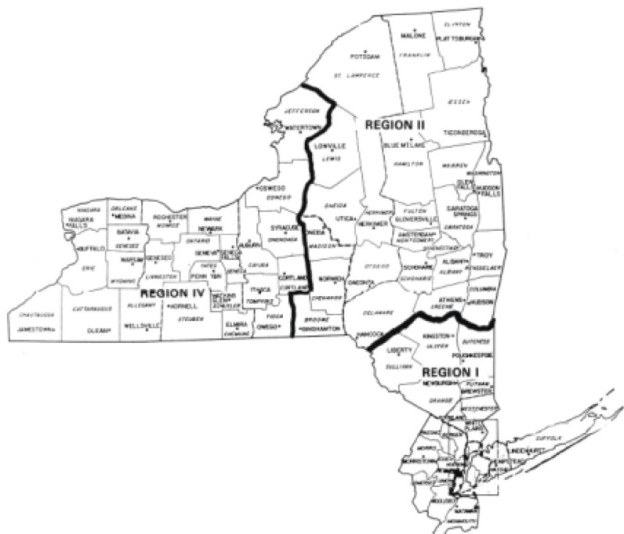
It had been unclear for several years where the lines were drawn in upstate New York between the current Region IV that encompassed the Rochester area, and Region I, which appeared to end someplace north of New York City.

At it’s May 17th meeting, the Board of Directors resolved the problem by deeding the unknown area to Region II. From testimony presented by Region II president Dan McCormick, it was determined that players in this area, particularly those in and about Albany (NY), were more comfortable traveling east to Vermont and Massachusetts for tournaments than coming downstate or heading west. Thus, a line was drawn north of Dutchess, Ulster and Sullivan counties and east of Jefferson, Lewis, Oneida, Chenango and Broome counties to define the southern and western boundaries of Region II in New York State.

This left areas such as Syracuse in Region IV, but placed Utica and Binghamton, as well as Albany, in Region II.

Source: Platform Tennis News, Fall 1991

Foot-Fault alert

Why doesn’t the APTA do something about “foot-faulting?”

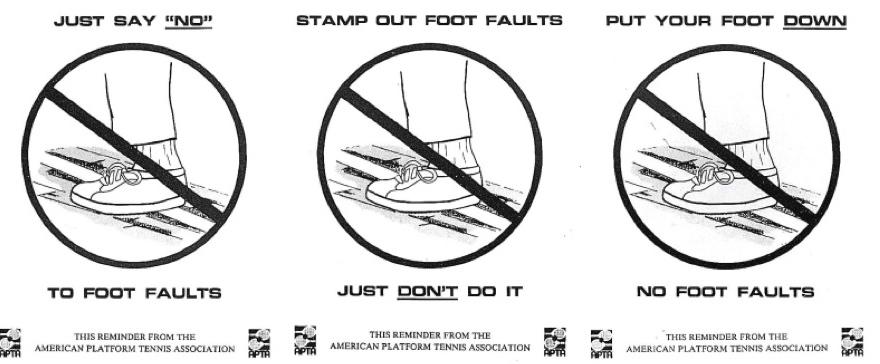
The APTA had heard it expressed verbally and in writing many, many, many times. Some complaints were quite loud, and some were very strong. They responded to this criticism in two ways. First, by taking up a suggestion that came from Mike Dougherty of Garden City, Long Island (NY), they attacked the problem from a light side. A series of three posters, illustrated below, had been sent to every member Club to display in their warm-up huts, bulletin boards, or locker rooms, to remind players of this violation of the rules.

Foot-faults

The second step was a directive given to the APTA Rules Committee, led by former President Bob Brown, to look into the problem and make some recommendations.

Source: Platform Tennis News, Fall 1991

Platform Tennis News covered the innovations

Innovations suggested for President’s Cup

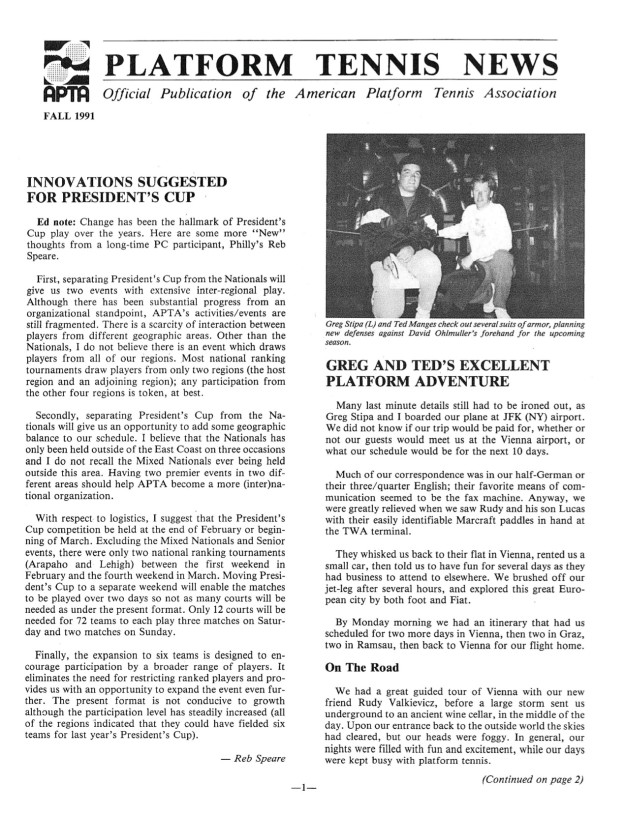
Change had been the hallmark of President’s Cup play over the years and Reb Speare provided some more. In PTN’s Fall 1991 issue, he announced the oranization’s decision to separate the President’s Cup from the Nationals, and offered the following reasons:

“First, separating President’s Cup from the Nationals will give us two events with extensive inter-regional play. Although there has been substantial progress from an organizational standpoint, APTA’s activities/ events are still fragmented. There is a scarcity of interaction between players from different geographic areas. Other than the Nationals, I do not believe there is an event that draws players from all of our regions. Most national ranking tournaments draw players from only two regions (the host region and an adjoining region); any participation from the other four regions is token, at best.

Secondly, separating President’s Cup from the Nationals will give us an opportunity to add some geographic balance to our schedule. I believe that the Nationals has only been held outside of the East Coast on three occasions and I do not recall the Mixed Nationals ever being held outside this area. Having two premier events in two different areas should help APTA become a more (inter) national organization. With respect to logistics, I suggest that the President’s Cup competition be held at the end of February or beginning of March. Excluding the Mixed Nationals and Senior events, there were only two national ranking tournaments (Arapaho and· Lehigh) between the first weekend in February and the fourth weekend in March. Moving President’s Cup to a separate weekend will enable the matches to be played over two days so not as many courts will be needed as under the present format. Only 12 courts will be needed for 72 teams to each play three matches on Saturday and two matches on Sunday.

Finally, the expansion to six teams is designed to encourage participation by a broader range of players. It eliminates the need for restricting ranked players and provides us with an opportunity to expand the event even further. The present format is not conducive to growth although the participation level has steadily increased (all of the regions indicated that they could have fielded six teams for last year’s President’s Cup).”

Source: Platform Tennis News, Fall 1991

Vittert works to improve their ball

G.A.I. Partners had acquired Hedstrom, the manufacturer of the Vittert ball, and the new corporate leader was a platform tennis enthusiast. The new owners had given Hedstrom the funds to provide the innovative leadership the game has requested to enhance ball performance. They hired new technical talent, implemented new manufacturing methods, and started a statistical process control and continuous improvement program. The main thrust of Vittert’s efforts was on improving the physical aspects, as the balls had been lopsided, were losing their flocking, and worst of all, wearing out very quickly.

Besides the composition of the ball itself, there were other contributing factors. Court surfaces had become more “severe,” as new methods were introduced to keep them rough. Screens, especially the newer and tighter ones, took a toll. Plus players were learning to use more “English” on balls to create a competitive edge. But ball durability was still, plain and simple, a problem. So Vittert was seeking solutions.

Vittert tested over a dozen new formulations, and sought insights from players on all those variations. As the new balls were put into play, the company solicited feedback, from both tournament players and the average Joe and Jane, who were the real backbones of the ball-buying market. One surprise in this research involved the bounce of balls, as one segment of the market leaned toward lower bouncing balls while another wanted higher bouncers. Vittert was making both, and considered adding a third type to round out its coverage of all the market niches.

Source: Platform Tennis News, Summer & Fall 1991

New ball by ARD approved by APTA

Advanced Recreation Design (ARD) introduced a new platform tennis ball to the sport during the 1991-1992 season, after a significant amount of research and development. Carly Swain explained the journey:

“One of the main points concerns the APTA specifications for approved baIls. Those specs include such factors as weight, diameter and rebound or bounce, with acceptable tolerances dictated for each measure. But the specifications do not take into account other factors, such as durability, playability, and color retention. Nor do they address the question of quality control in terms of how many balls are tested to meet the specifications.

(Note: The APTA’s rules and equipment committee had struggled with the tactical aspects of inspecting balls for some time. There were questions about how many balls to test, how to acquire the balls and where they come from, and who paid for the testing. None had simple answers.)

ARD has spent the last three years researching the creation of a strong ball. Over that time, we have expended a great deal of time, energy and money in studying different types of rubber, glue and flocking. We’ve also developed a number of sample balls during this research period, some of which would certainly have met the basic APTA standards for approval. But we held back, mainly on the recommendation of nine-time national men’s champion Rich Maier, who is ARD’s primary player/tester. His standard for the balls’ playability has been very demanding. Rich did not think it was fair or feasible to market to players a ball that he wouldn’t be comfortable playing with himself. He pushed for a ball that wasn’t too soft or too hard, and which consistently bounced true, with no wobble or wiggle when hit.

We think we’ve successfully fulfilled all his demands. The final product, the new ARD ball, is currently for sale throughout the U.S. and Canada. It is APTA approved for play in sanctioned and ranking events. ARD is confident the effort put into the ball’s development has created a ball that will please platform players with its quality and consistency.”

Source: Platform Tennis News, Winter 1992 and APTA May 1990 BOD Meeting Minutes

Has global warming changed the game, or is it the ball?

Pete Mathews posed the global warming question based on his observations over time, and questioned ball specifications His comments appeared in the Spring 1991 edition of Platform Tennis News.

“Has ‘Global Warming’ really begun to affect the climate? I’m no expert, but I’ve noticed one thing for sure. Paddle seems to be played under much warmer conditions than I seem to remember in years past. How many photographs in PTN do you see where the pictured players are in either shorts or short sleeves? Furthermore, with the Nationals played later and later in March, the likelihood for warm conditions is greatly heightened for what is the culmination of our season and the supreme test of the game as played today.

Well here’s the real issue for discussion. The current V-30 ball produced by Vittert (and the only ball sanctioned for tournament play) has evolved a good bit over the past 10 years. It is less dense than the ball that I remember learning to play with and has, from my perspective, changed the nature of the game.

I’m not sure what brought about the change. I would appreciate any insight from an informed source. Both our racquet and court technology have improved. The oversized racquet provides a larger sweet spot and lighter weight, while aluminum decks and superstructure provide more consistently true playoff the deck and tighter screens. The ball, however, has in my opinion fallen back. To start with the ball becomes unplayable in about one-half the time that it used to. In addition, I do not remember a problem with lopsided balls when they were made of a denser foam. Secondly, but more importantly, the ball is too lively for play in conditions above 32 degrees. My version of the ideal game is played with tight and true screens and a firm ball which accelerates off the paddle when a drive is struck and hits hard on the paddle of an opposing player who is not back up to net and must attempt a volley from the knees or below. The “old ball” had these characteristics and yet still came off the screen appropriately if driven through the net players to provide opportunity for recovery.

I’ll make an analogy that may or may not be appropriate. Playing with the current ball is like playing racquetball instead of squash. The ball stays in play for much longer. It is tougher to put away either with a drive through the net players or with a delicately placed overhead off a short lob. The good lob is also not as rewarded because the player fielding the deep lob does not need to return as close to net since he/ she can make a volley easily enough from well off the net. Finally, the drop shot, one of the few true put-away shots, is largely negated as a weapon when the ball is as lively as it is now. I guess I do remember when the discussion centered around the appropriateness of the ‘high-bounce’ ball for tournament play in extremely cold weather, but gee I’d love to have to think about that issue again.

Do they still make the ‘high bounce?’ From my perspective, the current ball almost qualifies as one. The benefits of the current ball however are not lost on me. Platform tennis elbow is, I suspect, less prevalent given the reduced shock effect of this ball and the ability to play with lighter racquets. In addition, it is easier for novices to learn and enjoy the screen-play aspects of the game. Now I may be a lonely dissenter on the issue of the ball, and maybe we will return to a period where I’m complaining more about the cold instead of the warm. As a Mid Atlantic player I’m sure I am prejudiced by my geographic location. So here’s one vote for the return of a ball which was: a) firmer, b) rounder, c) held up better, d) died on the racquet if fielded off the shoe tops, e) died in the corner when delicately placed with an overhead, and f) died behind the net when dropped from on top of it. Extended rallies are still an important part of the game, but let’s reward the really good shots and impose a little more of a penalty for poor ones. The old ball accomplished that.”

Source: Platform Tennis News, Spring 1991

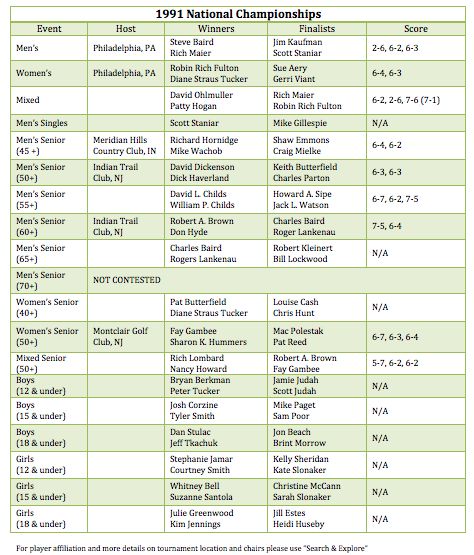
1991 National Platform Tennis Championships, Philadelphia, March 21-24, 1991

National Championships

1991

The Men’s and Women’s Nationals were covered in PTN Spring 1991:

The National Championship field included 96 men’s and 64 women’s teams, showcasing the top-ranked professional and amateur players from the U.S. and Canada.

Due to the size of the field, the matches were played at several different sites. Aronimink Golf Club and Waynesborough Country Club hosted the National Championships. Overbrook Golf Club and Whitford Country Club hosted the Women’s and Men’s President’s Cup play.

In the women’s event, defending champions Gerri Viant/Sue Aery just couldn’t match the firepower of Connecticut’s Robin Fulton/Diane Tucker, and succumbed in a tightly-contested straight-set final (6-4, 6-3). The men’s event featured an upset-in-the-making for one set, before eight-time Nationals men’s champions Rich Maier and Steve Baird turned on the afterburners to overcome a 6-2 first-set loss to barely beat back the challenge of Jim Kaufman and Scott Staniar, 2-6, 6-4, 6-3.

Source: Platform Tennis News, Winter, Spring & Summer 1991

President’s Cup – Region I Women and Region III Men (fifth straight in a squeaker!)

The 1991 Women’s President’s Cup was taken by Region I by a landslide. They received the coveted trophy in dinner ceremonies at the Merion Cricket Club.

On the men’s side, the local Region’s team was going for its fifth straight men’s President’s Cup win on its home courts in Philadelphia. They prevailed with 57 points. Region V came in a close second with 54 points, followed by Region I with 52.

The competition was very close. Region III had to take six tie-breakers in the last three matches against Region I foes in order to clinch the victory. And they did.

Source Platform Tennis News, Spring 1991