APTA National Championship Medals

The Board of Directors of the APTA voted to initiate a program that would recognize the winners and finalists in all championship tournaments with the presentation of APTA Championship medals. The first presentations were made to the 1991 winners. The medals were designed with the assistance of the prestigious firm of Josten’s Inc., the supplier of many kinds of recognition jewelry, including the Super Bowl rings for the National Football League.

Champions would be presented with gold medals with green and gold ribbon, while the finalists would take home a silver medal with green and white ribbon. The presentations were to take place at all 17 doubles competitions, including the three ages of Juniors and the Singles event.

Source: Platform Tennis News, Winter 1991

APTA tackles complaints about balls

The following lament had been heard all too often, this time emanating from Weezie Lambert in Princeton:

“The ‘official’ ball is a round puff which self destructs after one set or less, growing shaggy and virtually falling apart. Who has a new variation? Where is the competition? Everyone in league play is fed up with spending more per ball, knowing it may be lopsided to start. Wish I had a solution. Does someone out there?”

Both manufacturers and the APTA had been working on the problem. The association had contracted with the United States Testing Company to assess a sample of balls from three different manufactures to see if they met the specifications published in Appendix A of the Official Rules of Platform Tennis.

One of the three balls tested was the then approved Vittert V-30 ball, which was found to conform to the APTA standards and tolerances. The other two balls, both new entries that were submitted for APTA approval, were found, on average, to fall outside the ranges on rebound and/or weight. The actual test results, with comments, had been provided to the manufacturers with the expectation that adjustments could be made to bring these balls within the acceptable tolerances before APTA approval could be granted.

Source: Platform Tennis News, Winter 1991

APTA Honor Award

APTA Honor Award reinstated

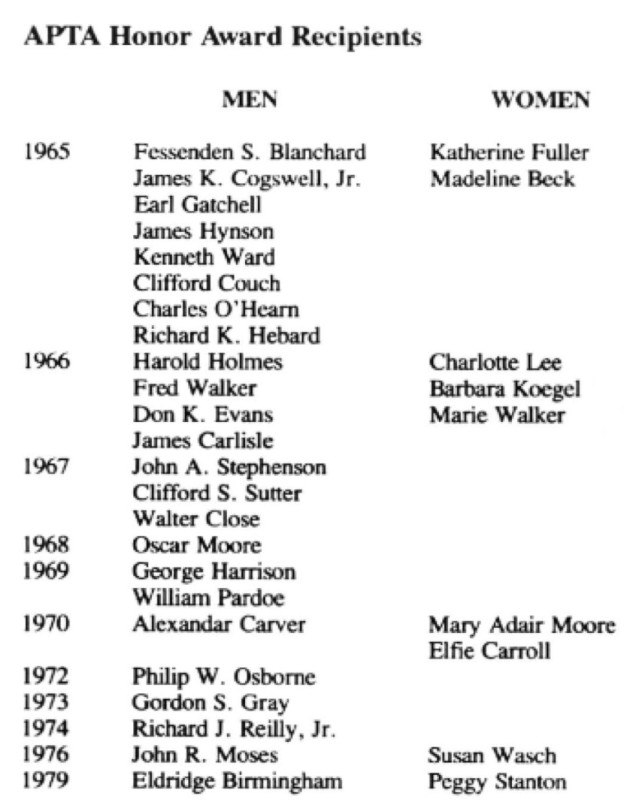
After an absence of 12 years, the Honor Awards program of the APTA was brought back at the urging of APTA President Chuck Vasoll.

The award provided recognition to those men and women who had contributed in an exemplary manner to the game of platform tennis. The last awards had been presented, in 1979, to Peggy Stanton and Eldridge Birmingham. Since the inception of the award in 1965, 24 men and 9 women had been honored.

Robert Brown accepted the appointment by APTA President Charles Vasoll to be Chairman of the Honor Awards Committee.

Source: Platform Tennis News, Winter 1991

Charlotte Lee (1914-1990), an outstanding champion despite only starting to play the game in her early forties.

Charlotte Lee (1914 -1991)

Kathy Reilly in the R. J. Reilly, Ic. publication Behind the Screens, as quoted in PTN, Winter 1991 said:

“If paddle had a Hall of Fame, Charlotte Lee would be a charter member. Charlotte Lee first picked up a paddle at age 42 in 1957, and since then has won sixteen National titles, been a runner up seven times, and has won an almost uncountable number of club and state championships in both mixed and women’s play.”

The winter edition of PTN carried the full tribute by Kathy Reilly, as well as a number of other remembrances, among which was one from Richard J. Reilly, Jr.:

“If ever there has been an angel to guide and inspire a sports following morally, physically, and spiritually, it has to be Charlotte Lee.”

Charlotte Lee was the recipient of the APTA Honor Award in 1966.

Source: Platform Tennis News, Winter 1991

Platform Tennis News, Mid Winter 1990, p 13

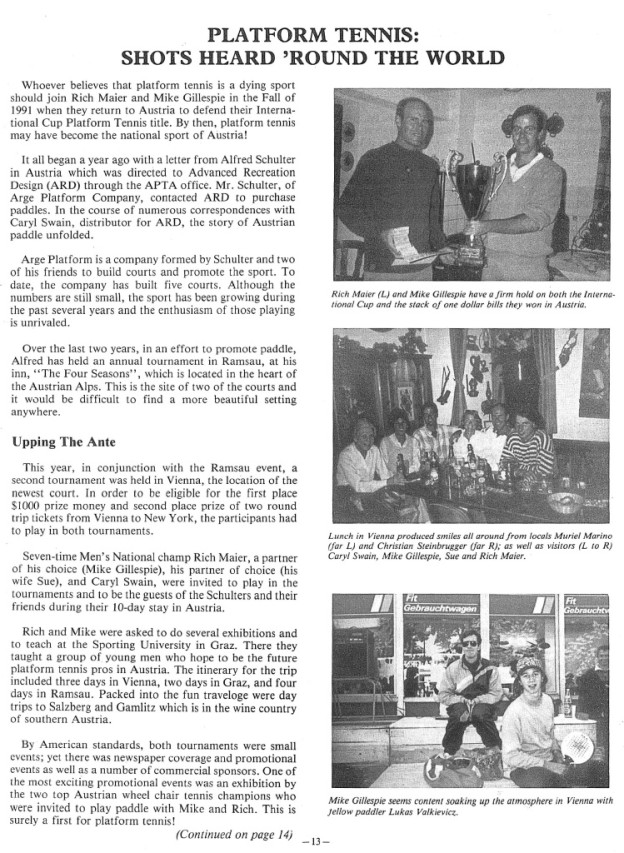
Rich Maier and Mike Gillespie capture International Cup Platform Tennis title

Arge Platform was formed by Alfred Schuter and two of his friends to build courts and promote the game in Austria. They also ran tournaments at Ramsau in the Austrian Alps.

In 1990, Rich Maier and Mike Gillespie were invited to play in a Ramsau event and a second tournament in Vienna, where a new court had been built. Rich and Mike were asked to do several exhibitions, and to teach at the Sporting University in Graz. There they taught a group of young men who hope to be the future platform tennis pros in Austria. One of the most exciting promotional events was an exhibition by the two top Austrian wheelchair tennis champions who were invited to play paddle with Mike and Rich. This was surely a first for platform tennis!

During the final awards ceremony, the International Cup was presented to Mike and Rich, along with their prize money, in hefty stacks of single U.S. dollar bills. Everyone toasted the new “mit den Weltmeistern” (world champions) with numerous shots of Schnapps. The top Austrian team would use its prize – plane tickets – to come to America in March 1991 to compete in the APTA Nationals in Philadelphia.

Source: Platform Tennis News, Mid Winter 1990, p 13

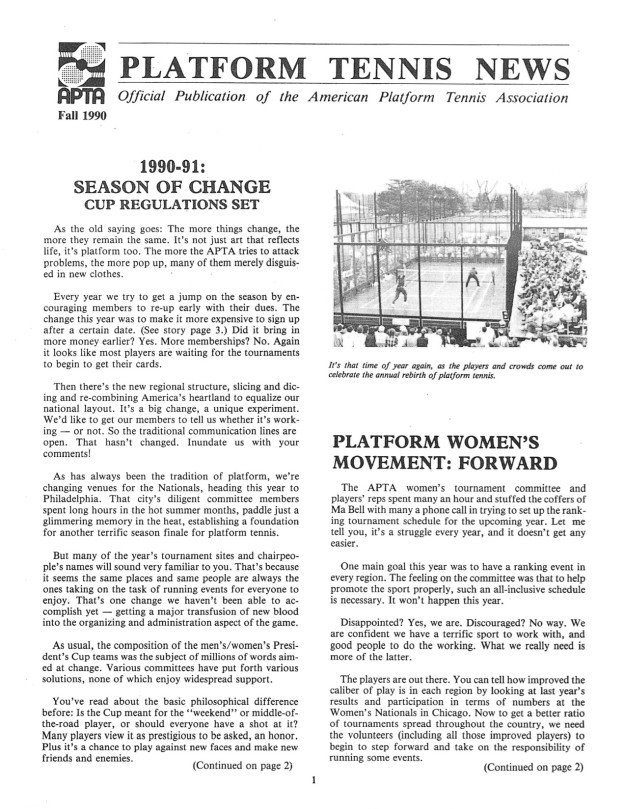
The 1990 Fall edition of Platform Tennis News covered the planned changes in the President’s Cup

Composition of President’s Cup teams – what a conundrum!

As usual, the composition of the men’s/women’s President’s Cup teams was the subject of millions of words aimed at change.

Various committees had put forth various solutions, none of which enjoyed widespread support. There were basic philosophical differences: Is the Cup meant for the “weekend” or middle-of-the- road player, or should everyone have a shot at it? Many players viewed it as prestigious and an honor to be asked.

The APTA Board went so far as to develop a ballot with a series of options. The majority of both the men and women agreed that no top eight teams from the 1989-90 season could represent their regions, whether as individuals or teams.

Source: Platform Tennis News, Fall 1990

Platform Tennis News draws imitation

The Orange Lawn Tennis Club published a mock version of Platform Tennis News and PTN’s editor Brian Zevnik made a case for covering the human-interest side of the game.

“They say imitation is the sincerest form of flattery. In this case, it’s not just flattering. It’s funny. The Orange Lawn Tennis Club produced a mock PTN last year and sent me a copy. I wish all of my PTN copy were as ingenious and humorous as theirs. Of course, they also had a fake lingerie ad, which would certainly spice up these pages. But alas and alack, this is a family publication!

Anyway, I’m reprinting their lead story below. It’s amusing, and I’m sure even funnier for the club members who know the ‘participants’ well. The point is, we can always use such literary help here at the APTA’s ‘real’ publication. That’s why I’m always drumming up business for us – writers, contributors, idea people, even complainers. I’ll reiterate once again. We want to cover the human-interest side of platform tennis, not just the numbers and scores. Anyone out there listening?”

Davis/Peck Break Two-Year Undefeated String

After an amazing two-year stint, Bern Davis/Richard Peck of Orange Lawn Tennis Club were finally defeated in a match that will go down in the APTA history books. The combination of Davis’ big spin serves and Peck’s exceptional corner play almost prevailed, over the steady play of Jack/Bob Kleinert of Indian Trail Club. It was in the second set that Davis/Peck appeared to just pull away by taking a commanding 5-2 lead, after winning the first set 6-1. However, at the change of ends, something unforeseen happened. Davis noticed a string hanging from the back of Peck’s impeccably tailored sports outfit, whereupon he reached over to rid Peck of the unsightly thread and pulled at the bottom of Peck’s jacket. Ten minutes later, when Davis was still pulling at what appeared to be an endless thread, Kleinert/Kleinert opted to invoke the “Delay of Game” rule and called the match. Later, after Davis/Peck recovered from their defeat and had an opportunity to recapture the events of the match, they discovered that the unsightly thread was not a thread at all, but a 500 yard container of Richard Peck’s newest sample of Moo Shu Dental Floss. Needless to say, this agonizing defeat left Davis/Peck hungry for more action in the upcoming 1990 season. Peck has promised to leave his floss at home.

Source: Platform Tennis News, Fall 1990

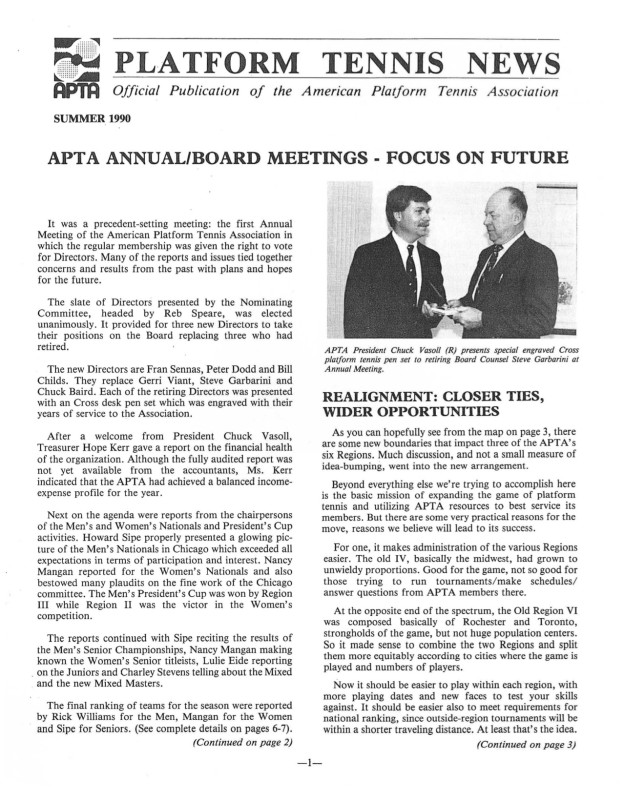
Platform Tennis News, Summer 1990. First annual APTA meeting at which members could vote for Directors.

Membership votes for first time on APTA Board slate

New bylaws gave voting rights to all members. Previously, only Life Members and representatives of clubs and other court owners were able to cast ballots for APTA leadership.

The Spring edition of Platform Tennis News covered the change:

“Enfranchisement may be sweeping over Eastern Europe these days, but it’s a year behind the ‘one-person, one vote’ move by the American Platform Tennis Association. At its annual meeting last May, the APTA Board of Directors approved a new set of by-laws for the organization that, for the first time gave voting rights to all members. Previously, only Life Members and representatives of clubs and other court owners were able to cast ballots for the organization’s leadership. Now it’s time to exercise your right. Your personal proxy ballot is enclosed in this issue of Platform Tennis News. Cast your vote for this year’s slate of nominees by mailing the proxy in. All members of the APTA are requested to mail in this proxy, even if you plan to attend our annual meeting.

This proxy also serves as official notice of that annual meeting of the APTA, which will be held on Friday, May 18 at 11:30 a.m. at the Montclair Golf Club on Prospect Avenue in West Orange, New Jersey.”

Source: Platform Tennis News, Spring 1990

Platform Tennis News reports on the Nationals

National Championships

1990-2

The Men’s and Women’s Nationals were covered in PTN Spring 1990:

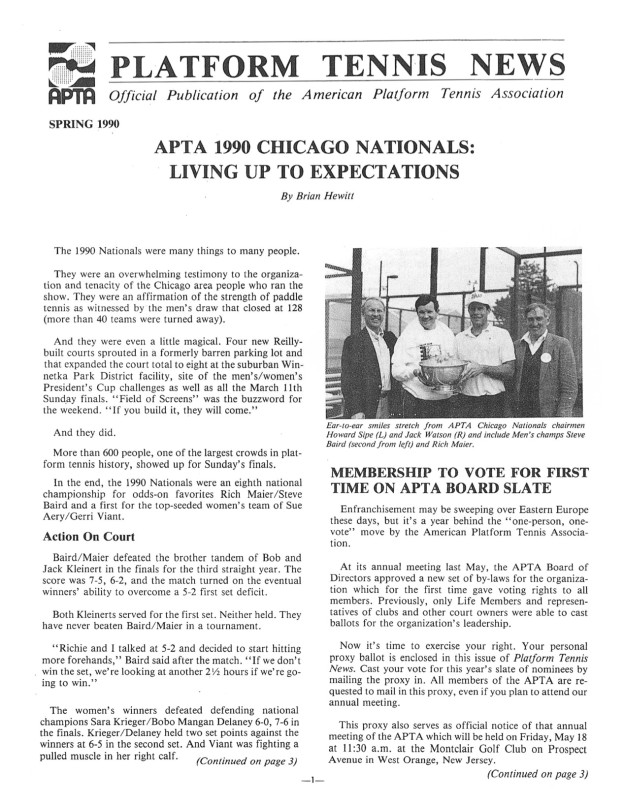
The 1990 Nationals were an overwhelming testament to the organization and tenacity of the Chicago-area people who ran the show. The strength of paddle tennis was evident by the Men’s draw that closed at 128 (more than 40 teams were turned away).

Four new Reilly courts were built in a formerly barren parking lot, expanding the court total to eight at the suburban Winnetka Park District facility.

The site hosted the men’s and women’s President’s Cup challenges, as well as all the March 11th Sunday finals. “Field of Screens” was the buzzword for the weekend: “If you build it, they will come…” and, they did. More than 600 people, one of the largest crowds in platform tennis history, showed up for Sunday’s finals.

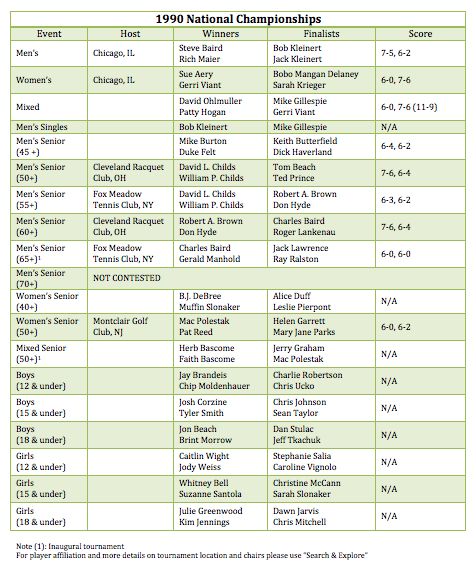
In the end, odds-on favorites Rich Maier and Steve Baird took their eighth national championship. Baird/ Maier defeated the brother tandem of Bob and Jack Kleinert in the finals for the third straight year. The score was 7-5, 6-2, and the match turned on the eventual winners’ ability to overcome a 5-2 first set deficit.

Both Kleinerts served for the first set but neither could hold. “Richie and I talked at 5-2 and decided to start hitting more forehands,” Baird said after the match. “If we don’t win the set, we’re looking at another 2+ hours if we’re going to win.”

On the women’s side, the top-seeded women’s team of Sue Aery and Gerri Viant grabbed their first national championship when they defeated defending national champions Sara Krieger and Bobo Mangan Delaney 6-0, 7-6 in the finals.

Krieger/Delaney held two set points against the winners at 6-5 in the second set. And, Viant was fighting a pulled muscle in her right calf. But the winners drew even at 6-6 and won the tiebreaker 7-5. “We did not want it to go three sets,” the injured Viant said afterward. “So we just gutsed it out.”

Source: Platform Tennis News, Spring 1990