


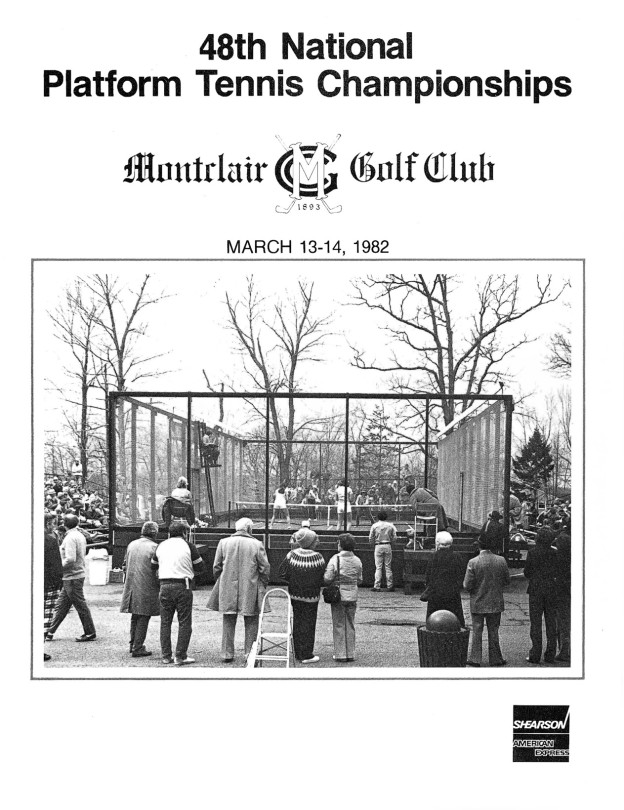
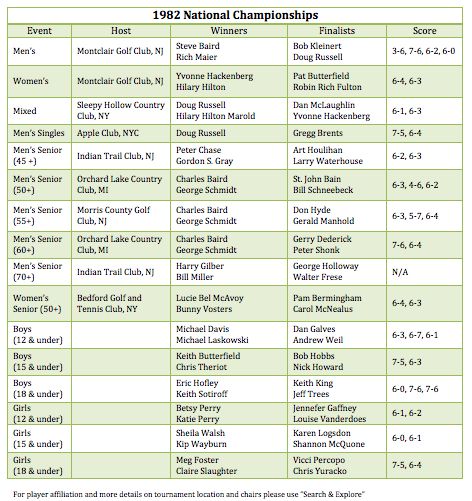
1982 Nationals brochure

National Championships

1982-2

The reigning men’s and women’s champions not only retained their National Championship titles, but did it for the third successive time. A total of 101 teams competed in the two open events that were centered, for the third year, at the Montclair Golf Club, West Orange, New Jersey. Shearson/American Express sponsored the March 13 and 14 event as well as the President’s Cup Competition.

In a notable achievement, Chuck Baird and George Schmid won three Senior events, the 50+, 55+, and 60+ Championships, the only time this has been done.

Platform Tennis News April 1982 – PTN carried the stories behind the results.

Source: Platform Tennis News, April 1982

Vittert donated balls, paddles and carry-all bags for the Juniors and the event was considered a great success.

Source: March 25, 1982 letter from APTA Executive Secretary, Diane Rinaldi, to Georgann Galik, Assistant Sales Manager, Vittert Sports

Note 1: There is some controversy as to how many National Women’s Singles were played after the APTA had sanctioned a Men’s event beginning in 1980. Women were participating in men’s singles events because they had difficulty getting enough teams to play. Both Men’s and Women’s National Singles Championship had been played from 1935-1937 when both were discontinued. The APTA Tournament Schedules for 1980-1981 as well as 1981-1982 indicate that both Men’s and Women’s Singles were scheduled for New York City. The 1982-1983 Tournament Schedule also suggests that both events were to be held. After that only Men’s Singles were scheduled.

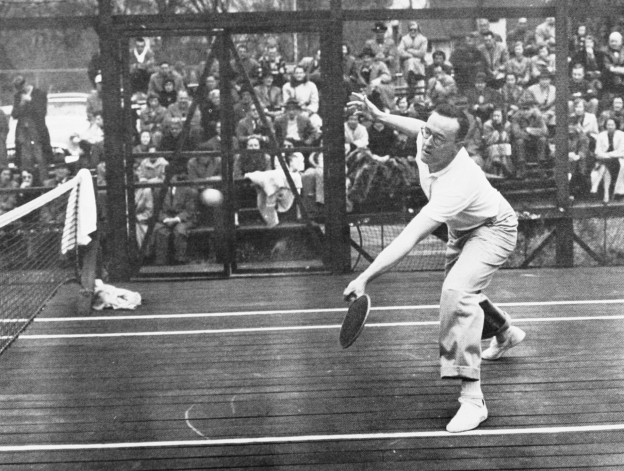
Fifth anniversary of the President’s Cup

The President’s Cup celebrated its birthday in New Jersey where this unique event was born five years earlier. A squad of big belters from Region I eventually took over the party and waltzed off with the trophy for the second year in a row. The annual inter-regional matchup was staged at the six-court layout of the Brookside Racquet and Swim Club in Allendale, NJ.

Shearson/American Express put up funds for both the Nationals and the President’s Cup. Part of the money was to cover travel expenses for the Allendale competitors.

As a further touch, just as an early spring sun banished the drizzle about 10 a.m., players blossomed forth wearing new, royal blue Shearson/American Express lined warm-up jackets.

Source:Platform Tennis News, April 1982

The game expands to Denver

In Denver, the “Mile High” city, platform tennis had found a new frontier and was slowly but steadily increasing in popularity. In addition to courts at two clubs and several private courts, more were being planned at a third. All of these facilities were within fifteen minutes of each other, making future tournaments more feasible. Sally Burbank of Englewood, Colorado, had given much of her time to teaching and promoting platform tennis, free of charge.

Source: Platform Tennis News, February 1982

The first annual Men's 70+ National Championship was played on March 28, 1982, in Franklin Lakes, New Jersey. Pictured (left to right) are the participants who came from Connecticut, Maryland, Ohio, Washington, D.C. and New York: runners-up George Holloway and Walter Frese, winners Harry Gilbert and Bill "Smoky" Miller, John Morse, Fred Lammis, Ed Fogel, Robert Thoman, Stuart Glover, and Larry Levy.

A National 70+ is proposed

The Men’s 60+ started in 1969, but, as these players grew older, their skills became less competitive against younger participants in this age group. However, these men still wanted to compete at a championship level and it was suggested that a National 70+ be held in conjunction with the New Jersey 55+ at the Indian Trail Club in Franklin Lakes. The event was contingent upon a draw of not fewer than eight teams.

The first event was held in 1982.

Source: Platform Tennis News, January 1982

John R. Moses playing at Fox Meadow Tennis Club

John R. Moses ( – 1981)

Moses was one of the earliest good “young” players of the game in the early 1940s and ‘50s.

He had been the #1 ranked junior tennis player in the nation and, at nineteen, he was the youngest person ever to be a finalist in the APTA National men’s doubles.

He won the APTA Men’s doubles title at the age of 23, again the youngest ever to attain that distinction. He was inducted into the Hall of Fame in 1976.

At the time of his death after a long illness, John had retired to East Boothbay, Maine, in the same area where his family had summered for several generations.

Source: Platform Tennis News, January 1982

Two serves or not two serves? That is the question

The APTA offered players an opportunity to use January and February as a 60-day trial period to test a two-serve option at different playing levels in various club events. Feedback via Platform Tennis News was requested.

The May-June issue of the magazine carried the results. There were 19 yes votes to change to two-serves, and 141 voting no, indicating strongly that the change was not favored.

Some of the reasons were:
…..it would ruin the game. We don’t want it like tennis

…..leave the game alone, it is an amateur’s game enjoyed as is

…..how about two returns?

Source: Platform Tennis News, November 1981 and May-June 1982

Emphasis starts to shifts to social roots of the game

In addition to APTA sanctioned events, local and regional tournaments, which often supported a charity, and social get-togethers at the clubs became increasingly popular.

Playing for recognition, rather than for money, was the order of the next dozen years until the Lineal Group stepped in briefly in the early 1990s to underwrite a series of events called the Lineal Group Grand Prix.

APTA increases amateur tournaments

During the 1980s and 1990s, the APTA sanctioned a record number of events each year around the country, including junior and senior age group tournaments.

Major events usually occurred over several days and often included an elegant cocktail party or dinner dance where the social component attracted more league players and filled up draws nationwide.

The pros and cons of aluminum decks

Although R.J. Reilly introduced the aluminum deck in the early 1970s, many of the courts built prior to the 1980s had wood decks. These decks were relatively inexpensive to install, yet became difficult to maintain as active play and the elements took their toll. Aluminum decking not only extended the life of a platform tennis court, but builders now had the ability to install heaters beneath the courts that would warm the decks and eliminate thin layers of snow or ice that would prohibit play.

Aluminum decking revolutionized the court-building industry, yet it had an unforeseen impact on the accessibility of courts outside the more privileged country club scene. Wooden courts around the country that had been decommissioned, particularly in communities, municipalities, and schools, were simply not replaced because, though aluminum courts are less expensive to maintain, they were much more expensive to install.

The boom in court building during the 1970s slowed considerably with the trend toward aluminum courts in the 1980s, and by the 1990s most activity was firmly back in the private club arena.