Gregg Brents, Men's Nationals finalist in 1981, with Greg Moore

National Championships

1981wWomen's Singles

In the Men’s, Steve Baird and Rich Maier won their second title (the third for Baird who had won in 1976 with his brother Chip).

Yvonne Hackenberg and Hilary Hilton won their second title (the fifth for Hilton and the third for Hackenberg).

Hilary Hilton and Doug Russell completed their hat-trick in the Mixed and their fourth overall.

Doug Russell captured his second straight Singles and the Boy’s 18 and under was won by the future 1994 National Champions Art Williams and Pete Gruenberg.

Robin Rich Fulton won the Women’s Singles1

Chuck Baird won his third straight Mens 55+ with his third different partner, Roger Lankenau.

Note 1: There is some controversy as to how many National Women’s Singles were played after the APTA had sanctioned a Men’s event beginning in 1980. Women were participating in men’s singles events because they had difficulty getting enough teams to play. Both Men’s and Women’s National Singles Championship had been played from 1935-1937 when both were discontinued. The APTA Tournament Schedules for 1980-1981 as well as 1981-1982 indicate that both Men’s and Women’s Singles were scheduled for New York City. The 1982-1983 Tournament Schedule also suggests that both events were to be held. After that only Men’s Singles were scheduled.
Age eligibility for tournaments

The APTA had been fielding many requests on age eligibility. A preliminary ruling of a cutoff date of May 1 was repealed in favor of leaving the established calendar year “as is” for the balance of the season.

For example, if one attained age 45 in a given calendar year, one was eligible to play in any 45 tournaments during that year.

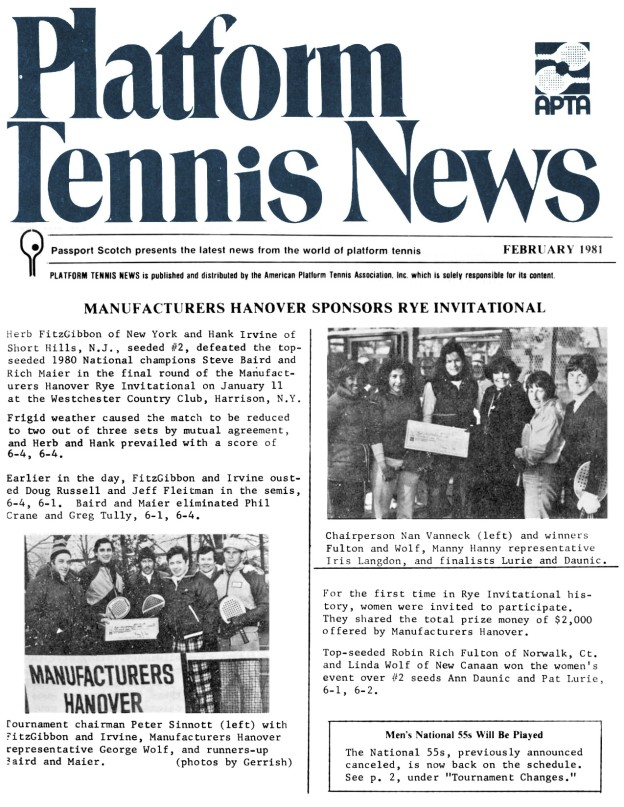
Platform Tennis News Feb 1981

Manufacturers Hanover Rye Invitational

Herb Fitz Gibbon and Hank Irvine, seeded #2, defeated the top-seeded, 1980 National champions, Steve Baird and Rich Maier, at the Westchester Country Club in Harrison, NY.

Frigid weather caused the match to be reduced to two out of three sets by mutual agreement, and Herb and Hank prevailed with a score of 6-4, 6-4.

Women participate in men’s singles

Very few women were entering singles tournaments. In order to encourage more to play Mark Bliss, a promoter of singles from the Apple Club in New York, suggested allowing women to participate in men’s tournaments.

Following this, Robin Rich Fulton and Linda Wolf played in a couple of the men’s warm-up tournaments before the National Singles championship.

Hi-bounce or Low-bounce ball?

Many players liked a more bouncy ball, especially when it became very cold. To accommodate them, Vittert made both a lo-bounce (V-30) and a hi-bounce ball. The APTA had approved the V-30 for all National ranking tournaments and the hi-bounce ball only for singles. The January edition of Platform Tennis explained the APTA position and provided guidance for using the V-30 ball in cold.

When it’s really cold, the standard V-30 needs a respectable warm-up, or it will just dribble when you expect a bounce. Nevertheless, cold is part of life on the platform. So, what do you do about ball selection? Well, the “book on bounces” says:

• For virtually all doubles tournaments or matches, use the standard, low-bouncing V-30.

• Always warm up with two balls. When you start to play, put the second ball in the warming hut, a warm car, a ball-warmer, or perhaps a down jacket — but never on the court.

• For the kind of tournament that sometimes coincides with a bitter cold spell (Chicago had one with wind chill of minus-22° and the players in ski masks or protective Vaseline), the National Tournament Committee may okay the use of Hi-Bounce. The local committee has to have this option
on its list of “things to do.” If the forecast reads “below-zero temperatures expected,” then someone will have to put in a fast order for the Hi-Bounce.

• In very cold conditions, for play among beginners, or at any social get together, or even in local tournaments (not on the APTA-sanctioned list), use the Hi-Bounce. Why not? It means longer rallies, a livelier ball, and more enjoyment all the way.

• For teaching in the winter, Hi-Bounce is recommended. It’s easier for the new player to reach. And he or she may not be able to keep a standard V-30 in play long enough to warm it up and thus make it more active.

Source: Platform Tennis, January 1981

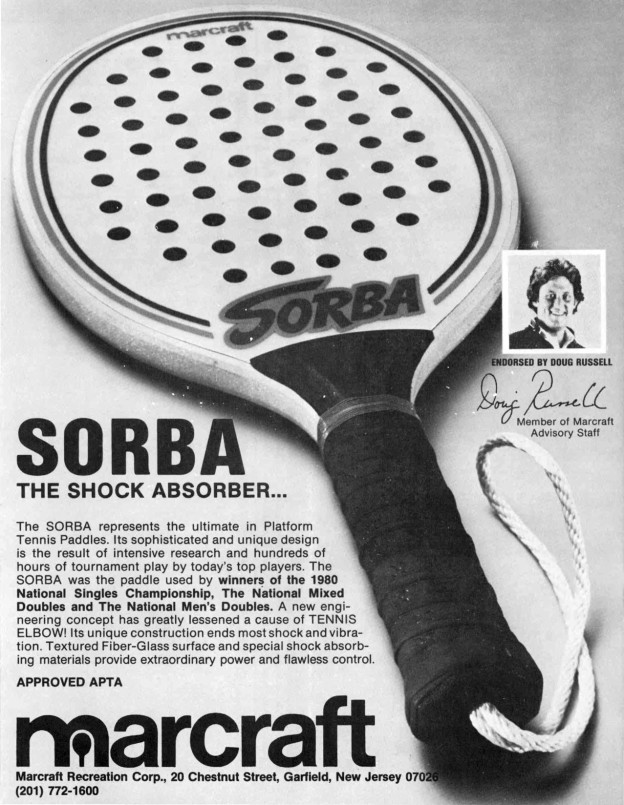
Advertisment for the Marcraft Sorba paddle

New sneaker endorsed by APTA

The APTA endorsed the Swift River “Reflex” court shoe following tests by a Board-appointed players committee.

The Swift River “Reflex” court shoe was made in New Hampshire.

The sneakers had bottoms made of a gum-colored compound of high-abrasion rubber to assure maximum mobility in any weather, as well as resistance to abrasion.

New Canaan Savings Bank sponsors women’s national ranking tournament

For the second year, the New Canaan Savings Bank was the sponsor of the women’s National-ranking New Canaan (CT) tournament on November 19-20. The event was played at the Country Club of New Canaan, New Canaan Field Club, and Waveny Park.

The top 10 winning teams divided the $2,000 in prize money.

After winning the Chicago Invitational on November 7-8, Yvonne Hackenberg and Hilary Hilton continued their unbeaten streak with a win against the unseeded pair of Meri Lobel and Allison McCance.

Source: Platform Tennis, January 1981

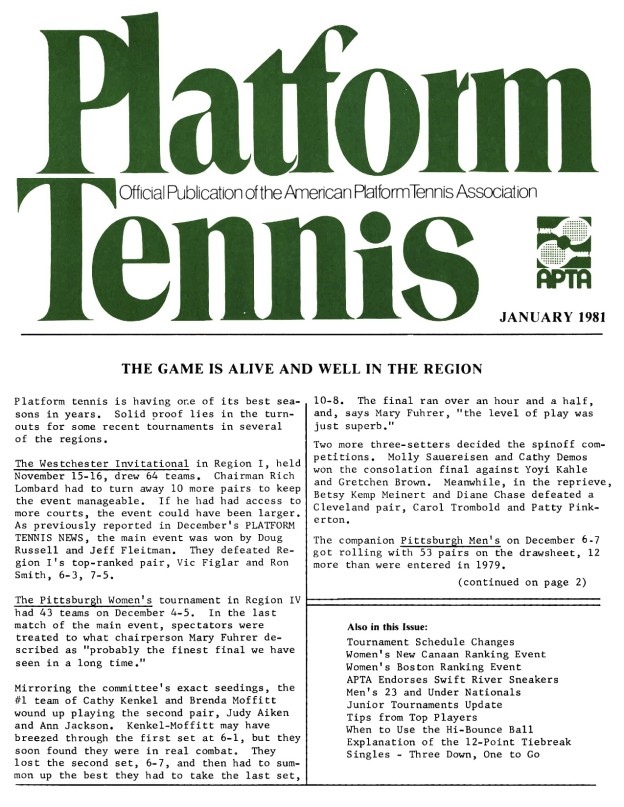
One of the best seasons in years, but APTA was facing financial difficulties as sponsorship declined

The lead article in the January edition of Platform Tennis was on the large turnouts for regional tournaments.

The Westchester (Rye) Invitational put a 64 team cap on the number of entries to keep it manageable.

Despite this the Minutes of the APTA Executive Committee of February 9, 1981 reflected the struggle the APTA was having with dwindling sponsorship and the crisis this was having on Tournament play and the APTA’s bottom line. The forecast for 1981 was for a $11,903 loss. [Also see APTA 1981 Annual Meeting Minutes>]

The European licensee for R.J. Reilly Company hosts a tour

To kick off the 1980-’81 season, 15 couples combined platform tennis with a sightseeing tour in Europe. Bellfires, the European licensee for R.J. Reilly Company, sponsored the October event.

The players were on the road for eleven days, wheeling around Europe on a luxury bus. Starting in Paris, the couples played platform tennis indoors and toured the sights. Then the bus took them to the Mediterranean coast, near Perpignan, where two courts had been built. Then, on to Switzerland to compete on the highest courts in Europe (with a little skiing on the side), and to visit Basel where there were courts in town.

Source: Platform Tennis News, April 1980

League play is vital to the game

The APTA worked hard to develop league play around the country. The November issue of Platform Tennis News carried an article on how to build a successful program.

“This fall, literally thousands of men and women are absorbed in what has to be the most vital part of paddle: league play. To get a league going, it takes three ingredients: commitment to the sport, organizational ability, and energy.”

The article went on to provide detailed advice for those building a league.

Source: Platform Tennis, November 1980