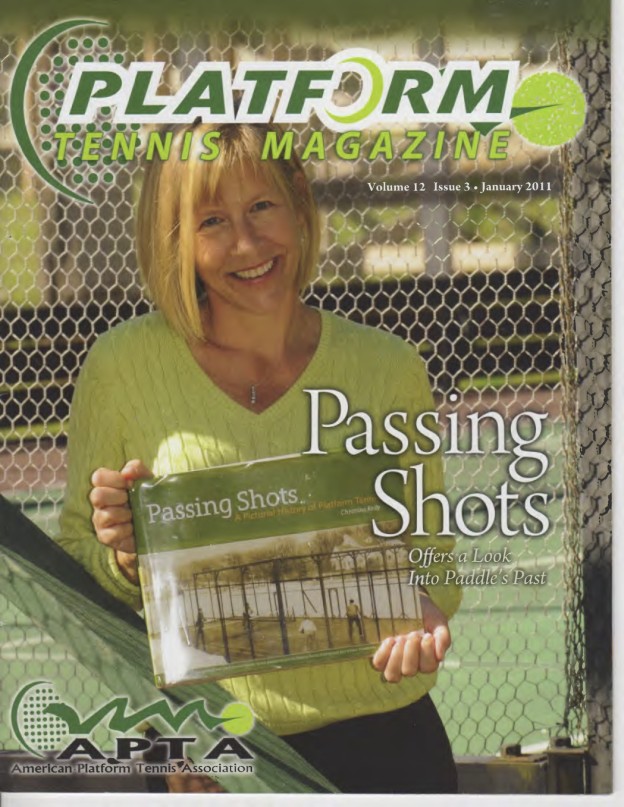
Passing Shots – A Pictorial History of Platform Tennis published

In the more than 80 years that our sport has been in existence, there have been rule manuals, magazines and instruction books, but not a comprehensive history detailing its evolution. Along similar lines, the Platform Tennis Hall of Fame Foundation has been a force for honoring the history of Platform Tennis without the benefit of having a building to call home.

That’s where Tina Kelly, APTA board member and author, came in with a project to serve both needs through one book — the creation of Passing Shots. This beautifully rendered coffee table book highlights platform tennis over the years. Proceeds from the sale of the book will go to the Platform Tennis Museum and Hall of Fame Foundation.

“The actual idea came from the Hall of Fame Foundation — Bob Brown, Rich Lombard, and their committee,” Kelly said. “Their concept was to do this book to raise money for the building effort and because they love and want to celebrate the sport.”

While Kelly has a magazine publishing background, has worked as an associate producer and writer for documentary films, holds a master’s degree in English from the Iowa Writers’ Workshop, and is a freelance crossword puzzle constructor (she’s had nine puzzles published in “The-New York Times”), Passing Shots is her first foray into book publishing.

“Although I coordinated, designed and wrote quite a bit of the book, it was definitely a collaborative effort. Many players and longtime supporters of the sport contributed. In fact, the book evolved into being a lot more text than we had planned originally, because there were so many wonderful stories that had to be told.”

When asked about her favorite part of the book, she found it difficult to pinpoint. “There were just so many fascinating mementos that we came across. From photos of rooftop courts in Tokyo and an Austrian exhibition of wheelchair paddle, to Radio City chorus girls being introduced to `paddle’, tennis in Atlantic City in 1937.”

Kelly said that while there were, literally, thousands of photos to sift through, each new cache presented its own unique challenges. “Frankly, a lot of the older photographs had water damage or were cracked or stained. And even if we did find an image we could use, it was quite a process to identify people, places and dates.

In many cases, the captions had completely faded. Thanks to hard detective work and the unflagging help of people like Jim McCready, curator of the Platform Tennis Museum and a platform tennis historian, we feel hopeful that we were successful in identifying and honoring so many of the pioneers of the sport.”

Out of about 180 photos in the book, more than 45 are from before 1960. And Kelly notes that some of the best old photos they found came from the personal files of Molly Ware and Do Deland, daughters of the inventors of the sport, Fessenden Blanchard and James Cogswell. “Of course Bob Considine generously contributed many terrific modern action photographs as well, which gives readers a sense of today’s fast-paced game.”

Other unique memorabilia in the book include old draw sheets, ticket stubs, and tournament brochures, as well as some vintage advertisements from the 1930s and a tournament invitation from December of 1938.

“I was astounded when sorting through the old material. In one box I came across the original 1936 Men’s Nationals draw and in another a shadowy photo of the Old Army Athletes, the original group of players who lived on or near Old Army Road in Scarsdale, New York. Overall, I’ve been impressed by how relatively little the sport has changed in 80 years, a remarkable testament to the foresight of the founding fathers.”

Kelly says the book will appeal to many types of people and would make a great gift. “I think it’d be ideal for anybody who is interested in sports history, but more importantly, people who play the game and don’t know about its vibrant background,” Kelly said. “So many people can’t believe it was created in 1928. They don’t know the exciting history behind the game they love. I also see it as a way to grow the game. Hopefully, someone unfamiliar with the sport will come across the book and say, `Oh, that looks like fun. I’d like to try it.'”

Source: Platform Tennis Magazine, Vol. 12, Issue 3, January, 2011
Winnie Hatch Memorial Golf Outing at Hartford Golf Club

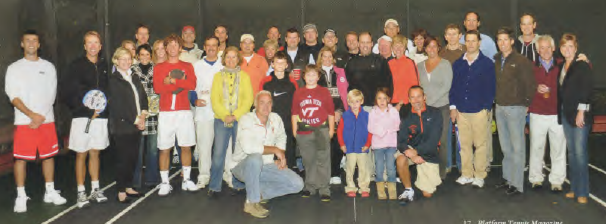
Courtia Worth put together a paddle morning, mid-day lunch and shotgun golf tournament on Monday, October 4th at the Hartford Golf Club in Hartford Golf Club in Hartford, CT. Among the many reasons to attend were the opportunities for raffle trips, an open bar and delightful dinner and finally an opportunity to celebrate the life of Hall-of-Famer, Winnie Hatch.

Players from five states assembled at the five paddle courts for three hours of casual play as many of Winnie’s former partners and friends kicked off the 2010-2011 season. Sprinkled amongst the twenty plus players were former champions; Sig Buckmeyer, George Lynch, Jack Westerfield, Bob Brown, Bill Childs, Ted and Nanny Hoehn, Sharon and Herb Hummers and Rich Lombard.

Several of the Hartford seniors mixed in with the outing players including one 70+ player who strapped on his oxygen tank and proceeded to race around the court to the amazement of all players and spectators.

The golf tournament drew nine foursomes (three dropped out due to threatening weather which the paddle gods short circuited) and all who played raved about a first rate course. For $20 you could buy as many mulligan as you felt necessary, resulting in six teams tying for third with 63s. Two golfing foursomes, traveling by ferry from Bridgehampton, showed how the game should be played, sans mulligan and walked off with the prizes as did Nanny Hoehn who won longest drive and closest to the pin. [enlarge image to read more]

Spreading the word to Chapel Hill, NC

Nestled underneath the brick façade of an athletic building on the University of North Carolina Campus approximately one hundred yards from the Dean Dome Basketball Stadium sits an unlikely sight – three platform tennis courts. On October 10th, an even more unlikely sight occurred, all three courts filled to capacity, four pro ambassadors teaching clinics, spectators watching from outside the cages, and passers-by stopping to wonder what all the hoopla is about. [enlarge image to read the full story]

Big Sky, Big Paddle – APTA clinic brings the game to Bozeman, MT

APTA Clinic Brings Bozeman Out of the Jungle

When paddle came to Bozeman, Montana three years ago, very few had even heard of the sport. Despite this, a small group of tennis players, as well as people who had played paddle back east as kids, were pumped up to play a winter racquet sport. This was mainly due to the fact that it is winter for almost seven months a year in Big Sky country. [enlarge image to read full story]

Rob Coster – APTA Board Member and future APTA President

Residence: I have lived in Madison, CT for almost 30 years.

Years of Service: It’s a blur. I count the years by the Annual Meetings. I was voted in at the Chicago meeting, Long Island was after my first year, Atlanta was after my
second, so next the meeting will mark three years on the Board.

Family: My wife Barb is a Southern California transplant. I finally pried the tennis racket out of her hands a few years ago and put a paddle in its place. She now loves the game almost as much as I do. And this past season, she had the opportunity to play on the Region 2 President’s Cup team.

My oldest son Rory attended a prep school that had PT courts. He and his buddies would head out many nights after study hall and play a few sets. At college in Schenectady, NY he was almost arrested for trespassing when sneaking on to a private club’s courts in the middle of the night. And he’s now “unwinding” from his college years out in Jackson Hole, WY where Dick Reilly tried kicking him off his courts at Snow King last winter. I guess Dick had recognized my name as an APTA Board member and gave him and his friends full guest privileges. [enlarge image to read full profile]

Richmond, VA hosts Premier Cup and APTA Exhibitions

Screen Shot 2013-06-03 at 10.35.58 AM

Early each summer, David Dodge and Jason Gray sit down to discuss how they are going to out-do their previous year’s Premier Cup tournament competition. Dodge is the owner and founder of Premier Platform Tennis Courts. Gray is the Director of Racquet Sports at the Four Bridges Country Club in Cincinnati but moonlights as the consummate promoter of all things platform tennis.

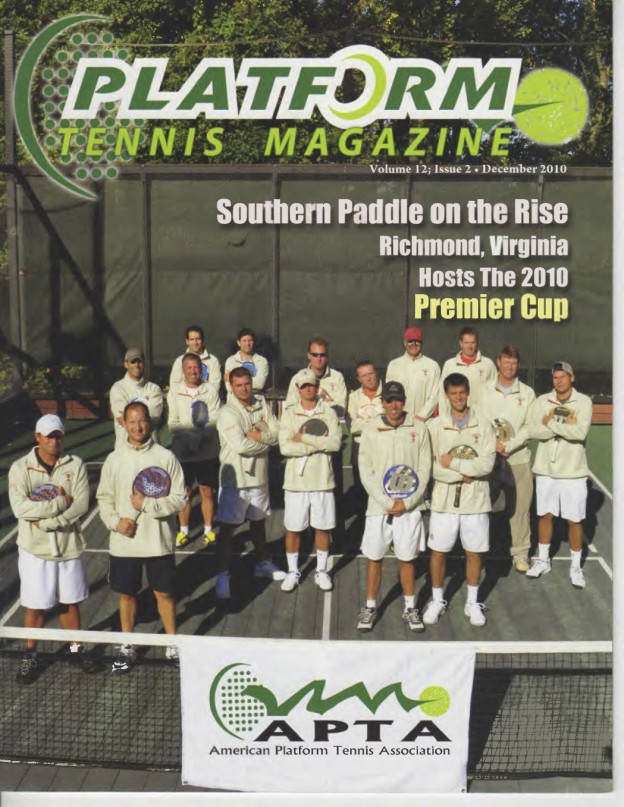
Over the past several seasons, many cities have been host to the Premier Cup – a $5,000 invitation-only, elite paddle tournament. Who gets to play? The top eight men’s teams in the country are invited. If anyone cannot participate, the #9 team will be invited, and so on.

The 2010 Cup was set up a little different than those of past seasons. This year, the event took place in southern “virgin” paddle territory – Richmond, Virginia.

To kick off the three-day festivities, the American Platform Tennis Association organized a Friday night kick-off party featuring an APTA clinic and exhibition set to reggae music and the smell of grilled burgers.

Booths were provided by both the APTA and Wilson Racquet Sports – allowing spectators the opportunity to view the latest in platform technology and to learn more about the APTA.

Over 50 members of the Country Club of Virginia came out to watch top-ranked teams Peter Berka and Drew Eberly (of Chicago) play against Denny English and Brian Heil (of Columbus).

Following the play, all spectators were encouraged to grab their paddles and join the “pros” for an evening of social play.

At 9 a.m. on Saturday, the eight nationally-ranked “Premier” teams assembled at the Country Club of Virginia. The weather was a replay from Friday – sunny and 75 degrees. Players and spectators alike preferred the non-seasonal high temperature.

Jason Gray read aloud the rules of engagement: Two four-team divisions, each playing a three-set round robin against each other. The top two teams would advance to semi-final play on Sunday.

Over the course of the day, spectators cheered on the 16 competitors. Two Chicago teams went undefeated in round robin play – Mike Marino / Dane Schmidgall and Peter Berka / Drew Eberly. Steve Derose / John Lubow and Drew Broderick / Guy Moore went 3-1 and 2-2, respectfully, to advance to Sunday play. All-in-all, players represented Baltimore, Chicago, Cincinnati, Columbus, Connecticut, Richmond, New Jersey, and New York.

Attendance grew each day of the event leading up to the semi-finals and finals on Sunday morning. Spectators came from as far as two hours away and as far north as Washington, DC.

In one semi-final, Berka and Eberly defeated Broderick and Moore 6-4, 7-5. Marino and Schmidgall defeated Derose and Lubow 7-6, 6-2 in the second semi-final.

As play progressed, players mingled with the spectators and helped provide great excitement and better understanding on how the game is played.

Representatives from area country clubs attended and expressed interest in potential new court growth.

In the finals, Schmidgall and Marino defeated Berka and Eberly in a two-set thriller.

Marino said, “I thought Dane and I stayed mentally tough throughout, and his shotmaking ability from both his forehand and backhand made the difference.” Marino added, “The Premier Cup was, as usual, a great event. The hospitality at the Country Club of Virginia was excellent, the weather was great, and the paddle was extremely competitive.”

Although the players won $5,000 in prize money, the real winners were the residents of Richmond. Club member Peyton Lawson said, “I was fortunate enough to be a part of the entire weekend festivities and Ihave never been more hooked on platform tennis. I had the opportunity to play against Berka/Eberly on Friday. I think we had them on the ropes for a few minutes! What I experienced this past weekend has encouraged me to get out and play more and travel to other tournaments that I hesitated on going to in the past.”

His interest was shared by scores of spectators. Premier Cup participant and Richmond resident, Andy Todd said, “I am very appreciative for having the opportunity to bring the 2010 Premier Cup to our area and help grow the sport in Richmond. Jason Gray and David Dodge, along with our very talented and organized committee, created one of the best events we have ever had and also provided an incredible atmosphere on and off the court, southern style.”

It was clear that the platform tennis interest has never been higher in Richmond. Dodge and the APTA are both hopeful to see the continued growth of paddle in Richmond and further into the south.

Source: Platform Tennis Magazine, Vol. 12, Issue 2, December, 2010

APTA Exhibition jump-starts new Florida facility

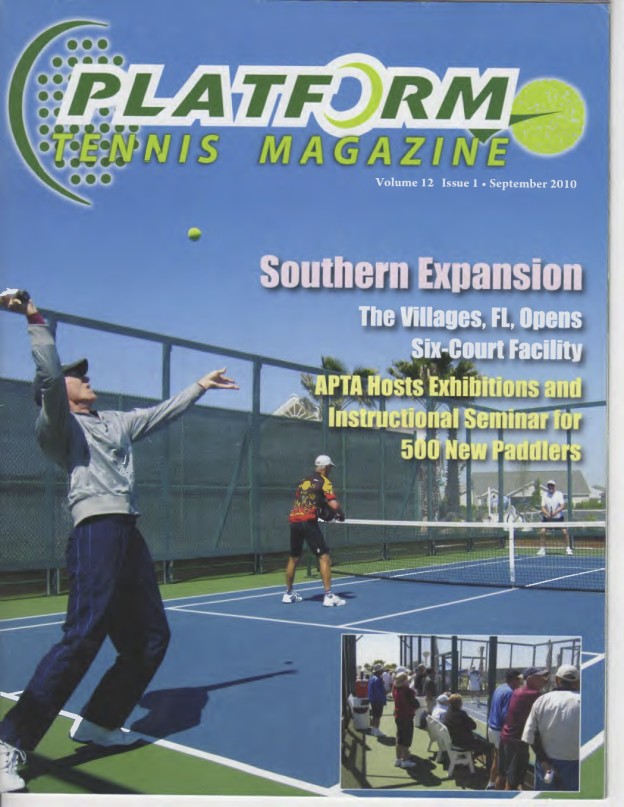
On March 30th, the growth of Platform Tennis continued its seemingly inexorable journey south. Thanks to the vision and efforts of Joe Russo, The Villages in Florida decided to install six grade-level courts. The Villages, located 60 miles northwest of Orlando, is a retirement community of almost 80,000 people.

Coming on the heels of APTA-assisted projects in Chapel Hill, North Carolina and Atlanta, Georgia, The Villages is a privately- funded project masterminded by Joe Russo. Joe previously had been responsible for the installation of four courts in Ocean Pines, Maryland. Preliminary plans for the addition of twelve more courts are being discussed as the initial project is evaluated.

The Grand Opening at The Villages featured an exhibition and clinic hosted by APTA Board member Juan Pablo Arraya Martinez. Juan heads up the APTA Exhibition tour, having succeeded Todd Ward in May of 2010. Joining Juan were Mark Parsons, Anton Mavrin and Mark Fischl. After an initial demonstration of the game, Juan divided the players up into four courts focused on the following skills: One to learn (1) wire play, (2) volleys, (3) lobs and overheads and (4) serve and return of serve.

After completing the clinic, it was time for the spectators to enjoy an excellent exhibition. As the four players were warming up, the crowd continued to build, growing to approximately 350 people by the time play began. Several spectators were leaning on the wires. Mark Parsons quickly provided an education as to why this was a bad idea by knocking down an elderly woman as he slammed into the side wire for his patented two-handed backhand! There were numerous gasps as Juan began to destroy the myth that you can’t spin the ball on concrete surfaces.

Displaying an amazing array of volleys at the net, Juan had both Marks scrambling for his shots.

After the exhibition was done, open play commenced for all the residents. The four pros circulated through the courts playing points and giving advice. Several locals wanted to know how Mark Parsons was able to hit his backhand. Other asked why Juan was always jumping in front of Anton to volley.

Given the success of the day, one can only imagine how many courts The Villages will have in five years. Can the first tournament in the state of Florida be far away? Kudos to Joe Russo, Joe Bouthillette and the rest of the staff at The Villages for all their hard work organizing this spectacular event.

Source: Platform Tennis Magazine, Vol. 12, Issue 1, September, 2010

The Longest Game – Documentary highlights the game and friendship

Camille Thoman didn’t go to Dorset, Vermont expecting to make a movie about platform tennis, but when she and her mother stepped into the paddle hut at the Dorset Field Club, she found a group of senior players that she found irresistible.

“We walked in, and there were these old men there making fun of each other, bantering and sharing laughs around the sport,” Thoman said. “My mother said, ‘You should make your next film about these guys,’ and to be honest, I was charmed to my tippy toes by them.”

Thoman, an acclaimed director, who has worked with talent such as Tony nominee Mireille Enos, Oscar nominee Melissa Leo and Oscar winner Timothy Hutton, as well as produced her own one-woman theater pieces, flew with producer Elizabeth Yng-Wong to Vermont thinking they would be filming a short. They quickly found that they had something bigger on their hands.

“These are special people, inspiring people to be more active in their old age,” Thoman said. “These guys are incredibly inspiring. Because platform tennis is such a social sport, because of the smaller court set up for four, there’s so much laughter and banter in the sport. It works very well in our film.”

Currently in post-production, The Longest Game is expected to be completed sometime in 2012. [Update:The film is expected to debut in the Fall of 2013]

Thoman is hopeful about the prospect of a theatrical release – a feat not common for documentaries. However, the unique flavor of the film has people talking about it and wanting to see more. Because of its appeal, the filmmakers are also optimistic about its distribution potential, on television and in new media markets.

“Paddle is the glue, but it’s a film about memory age and time, and the perspective of being 87 years old, which isn’t always valued enough in today’s society,” Thoman said. “There’s this dark spot around old age. People seem to disappear from the media around 70. Everybody wants to see this movie and we’d be very interested in showing it around the country in paddle venues. We really feel strongly that these guys are the gold standard of how good life can be in their 80s, showing a whole generation of people to be more active in their old age.”

Charlie Ams, one of the subjects of the film, said The Longest Game isn’t his first foray into cinema, but being featured on camera was surprising.

“They did a piece on us for the Platform Tennis Hall of Fame, so we weren’t too surprised to see Camille here,” Ams said. “But, then again, a bunch of old fellas playing, it’s always surprising when someone’s interested in you.”

Ams has been playing at Dorset for about 15 years, and while the film portrays great friends and camaraderie, all of that stems from the game of platform tennis itself.

“It’s the game, for sure. We don’t all see each other socially, or play cards, it’s the game itself,” Ams said. “When you get here, and stay here all winter long, there’s a great deal going on. It’s a place to play and we have all sorts of people here.”

Ams said that his children and grandchildren, as well as the people at the club are all excited to see the finished film.

“[Camille] sent us a teaser on YouTube, and that passed around quite a bit,” he said. “My grandchildren and family are interested in seeing it, and the people in club, who want to see what we old fellas are doing why we’re still moving around.”

Thoman said it’s obvious that the game has brought them all together in a very special way.

“Chemistry is a big part of it with each other and the filmmakers. I think this particular group of people is extremely funny and eloquent. On the other hand, I do think because paddle is a sport that seniors play a lot of, and it’s a social sport, it does lend itself well to banter and humor as they play it, which is very cinematic and good on camera.”

Source: Mark Berton, Platform Tennis Magazine, Vol. 12, Issue 1, September, 2010

APTA offers grants to tennis facilities across the country

In an effort to spread an awareness of platform tennis across the country and grow the game, the APTA’s grant program awarded three grants this year totaling $35,000 to projects that otherwise would not have succeeded.

The awardees induded the Creve Coeur Racquet Club in St. Louis, Mo., North Park, a county run facility in the suburbs of Pittsburgh, Pa., and the YMCA in Wilton, Ct.

The first and largest will assist with the creation of a new platform tennis venue beginning with 2 courts at the Creve Coeur Racquet Club in St. Louis, a large, low cost, semi public indoor/outdoor tennis facility. The growth of Paddle in St. Louis has for years been hampered by a lack affordable access. Two years ago, Rick Randall, Frank Sant, Frank Childress and Bob Curtis formed the STL Platform Tennis Association to address the problem and the APTA is pleased to partner with this group of enthusiastic champions and assist their efforts to grow the game in St. Louis.

In North Park, the North Park Platform Tennis Association in Pittsburgh, needed help with the refurbishment of one of their old wooden courts. Ed Jaicks, NPPTA President and his team of volunteers have worked hard to keep a vibrant/public paddle program growing at North Park, despite a tough economy and funding environment in their county, coupled with some nasty storm damage this past year. The Board of the APTA believes strongly that public access, so common in tennis, is vital to the health and growth of platform tennis.[enlarge image to read more]

Highlights of APTA Board Meeting and Tim McAvoy on the Board members and mission

Financials:
Aila Main presented an overview of our income statement and balance sheet which showed our financial position as being very strong.

However, given the wide variety of initiatives the APTA is pursuing, it was proposed that we raise the league membership dues. Tim and Ann proactively reached out to many of the APTA league Presidents and the idea was agreed to by all of those people.

It was moved that we raise the APTA league member dues from $25 per year to $30. The motion carried unanimously.

Then, a variety of discretionary spending items were discussed resulting in the following actions:
It was moved that we put $15,000 into the budget for “Grow the Game” grants this year and each succeeding year. The motion carried unanimously.

It was moved that we transfer (one time) $40,000 from our cash on the balance sheet to the fund for grants for this coming year. The motion carried unanimously.

Exhibitions:
Proposed exhibitions for next season include Delaware (Wilmington CC); UNC Chapel Hill; The Villages in Orlando, Montana; the Wilton CT, YMCA; and Boston.

It was moved that we commit $15,000 for exhibitions this year. The motion carried unanimously.

Grow the Game (GtG):
Peter Lauer described the criteria the GtG committee uses to evaluate and score each grant applicant. Currently, there are 40+ grant requests on their list. Peter then reviewed the three grant requests which were selected as prime candidates for a grant.

It was moved that we fund all three recommended projects at the following levels: St Louis – $15,000, Wilton CT YMCA – $10,000, North Park – $10,000. The motion carried unanimously.

APTA Junior Tour:
The goal is to grow participation in Junior events. Tom Safford related some things that haven’t worked so well and some that have worked.

As part of this effort to grow participation we would like to get one or two persons from each Region to work with Tom to more formally organize and administer the Junior Tour.
It was also suggested that, if we had Regional Tournaments, the APTA could help support the top teams from each of those areas to encourage them to participate in the Nationals.

It was moved that we allocate $2,000 to continue to support the Junior Nationals next year and continue, at a minimum, that financial support in the years to come. The motion was carried unanimously.

Branding:
Hendy Dayton reviewed our efforts to celebrate our 75th anniversary with the poster and calendar, the articles in PTM, etc. Hendy also reviewed other branding efforts including the PPTA videos, the Nationals video, etc.

Going from last year into the new year, the theme will be moving from our history to how our sport results in “building community” — camaraderie, etc.

PPTA:
Action item: Paul will produce a short APTA intro/promo to go at the front end of all the PPTA videos.

It was moved that we allocate $2,000 for the creation of six PPTA videos provided they are in accordance with our agreements regarding branding, etc. The motion carried unanimously.

Executive Director Initiatives:
It was moved that we reduce the number of players required for a “league” designation from 75 players to 40 players. The motion carried unanimously.

It was moved that we give the ’70s men and women players an APTA rate of $25 per year, but then NOT send them the PTM. The motion carried unanimously.

It was moved to give each Regional President a budget of $500 to enable her/him to provide APTA support to various projects in their Region toward bringing in more leagues as APTA league members. The motion carried unanimously.

Platform Tennis Magazine:
Currently, there are 5 issues per year at 32 pages per issue.

It was moved that we spend up to $4,000 to expand two of the five issues of PTM from the usual 32 pages to 40 pages. The other three issues would stay at 32 pages. The motion was approved on a vote of 14 in favor and 1 opposed.

Rules:
It was decided that Rule 18(i) should remain unchanged: When a player is standing close to the net and his opponent hits a ball into the net such that the net then touches his paddle, body or clothing, then the person being touched by the net loses the point.

We want more compliance with or enforcement of Rule 3: We want the Rules Committee to approve any changes that manufacturers make to balls or paddles.

With the growth of the sport in the South, the committee is working to more clearly describe what court surfaces will be considered “official” (including brushed concrete and asphalt). However, snowboards at the bottom of the screens will remain as a design requirement to keep all the other playing surfaces consistent with the official court standards.

Intentional distractions: The more egregious forms of distraction are alluded to in the “Comment” paragraph in Rule 21 — Interference and it was decided that we did not need to expand that section. Therefore, the Rules Committee will add something on intentional distractions to Appendix D — The Etiquette of Platform Tennis.
Regarding Rule 18(j), it was moved that we approve the principle (with the final wording yet to come from the Rules Committee) that the ball having touched the back screen or corner, which then comes back across the net and lands either inside or outside the court, results in a loss of point for the team who hit that ball. The motion passed unanimously.

President’s Cup:
Starting with the 2011 Nationals in Chicago, we will run a two-year pilot where each P-Cup team will play the usual format but can have up to 12 players with the bottom 2 players serving as subs for others on the team so as to reduce the wear and tear on players prior to the Nationals.

Hall of Fame:
The following list of candidates for the Hall of Fame Committee were nominated: Bob Brown, Chair; Steve Baird, VP; Chuck Vasoll, Secretary; Scott Bondurant, Patty Hogan, Walt Peckinpaugh, Deirdre Redden and Tim McAvoy (ex-officio).

It was moved that we select the above proposed slate of candidates for the Hall of Fame Committee. The motion carried unanimously.

Nominations for candidates to be inducted into the Hall of Fame must be received by the Committee by September for a Board vote in January. Nominations must be based on playing accomplishments and/or what the candidate has given back to the game.

The HOF coffee table book will be published in October.

New Business:
We will form a Corporate Sponsorship Committee to begin a corporate fundraising effort at the national level.

Source: Platform Tennis Magazine, Vol. 12, Issue 1, September 2010