President’s Cup: Men’s Region III win 9th title and Women’s Region I win 4th straight

With defending Region IV champs missing several veteran players, the Region III dark-horse men’s team delivered a stunning victory in front of their hometown fans. After four rounds of competition, Region III had won 18 out of a possible 20 points, mathematically winning the Cup prior to the final round against a strong Region I (NY/NJ) squad.

Lead by the undefeated play of John Stefanik and Tim McAvoy at #1, Region III started strong and never let up, bringing the Cup back home for the first time since 2000, when Captain Pete Mathews led the team in Rochester.

As with every PC victory, this year was a total team effort. The up and coming rookie team of David Caldwell and Blake Cordish went 4-1 at #4. Also, Chris Gorman, another first-time PC player, joined forces with Fred Gumbinner in the #5 slot and also went 4-1. They too, went undefeated in their first four matches. The veteran teams of Scott Freund and John Horine at #2 and Larry Hyde and Bruce Redpath at #3, also delivered winning performances for the home team.

Region 1 dominated the Women’s Presidents Cup this year (New England, Long Island, and Connecticut) during the worst conditions ever to be seen on paddle courts! Rain, sleet, heavy hail, snow, and frigid temperatures never seemed to dampen any of the spirits of these girls. Never was there heard a complaint about the conditions.

President’s Cup is famous for always having lousy weather so I guess everyone thinks it comes with the territory. Region I defeated Regions 4, 5, and 6, by 5-0 shutouts. They won over Region 2 by a score of 4-1. Region 3 was spared since it was the last match of the day and nothing could not have changed the final outcome.

The evening was held at Overbrook Country Club with a fabulous sit down dinner and a special award given to Yvonne Hackenberg for the longest running participation in PC (since 1979).

Source: Platform Tennis Magazine, Vol. 4, Issue 5, May, 2003

Business Week features Platform Tennis

In the October 13, 2003 issue of Business Week, platform tennis got another plug. Staff writer Marilyn Harris wrote about the wintertime enjoyment that we look forward to in her article entitled, “Paddle, Anyone?”

The night air was beyond bitter, the wind cut like a buzz saw. Light flooded a metal platform enclosed by chicken wire, on which four figures, bundled in fleece, chased a yellow ball and smashed it across the net. A car screeched up, and out jumped a man. “She has been crying since you left!” he shouted. His wife dropped her graphite paddle with a clang, raced into the car, and as soon as she could peel away the layers, was nursing her infant daughter. A short while later, play resumed.

What would make a mom run out on her newborn? “Neither rain, nor snow, nor crying babies keep me away from platform tennis,” says the athletic mother of three. Male or female, old or young, if you’re hooked, you’re hooked. “It’s like a cult sport,” says Patty Hogan, the over-40 national women’s champion and a teaching pro based in Summit, N.J. “Anybody who plays it, loves it.”

The season for platform tennis — called paddle, for short — is coming up fast. By tradition, the game is played in fall and winter, and for aficionados who like to defy the weather, the colder the better. The court measures 44 by 20 feet and resembles a miniature tennis court, made of aluminum and coated with a sandpaper-like finish, for better traction.

Paddle is so easy to learn that the tournaments run by the American Platform Tennis Assn. (www.platformtennis.org) feature players as young as 8. Equipment is minimal. A paddle, about 18 inches long and made of a composite material with aerodynamic holes drilled in the head, costs roughly $100. Three balls — solid rubber and spongy — cost about $10. The only other special gear you may need is a fleece mitt that fits over your hand and paddle handle for when the weather is frigid. As for rules, they’re essentially the same as in tennis, except paddle allows only one serve, and serves that touch the net are played. You can also hit the ball off the wire walls, similar to what you do in squash.

The major challenge for newcomers is finding a place to play. Most of the 4,000 or so courts in the U.S. are at private country clubs and resorts, including Snow King Resort in Jackson Hole, Wyo., and Shelter Harbor Inn in Westerly, R.I. Some public courts are available, mostly in metro New York and Chicago, and parts of California, Colorado, and Wisconsin. And new adult communities are increasingly building courts to attract buyers.

Paddle is largely a doubles game, marked by rapid volleying at the net. “There’s no better way to get some exercise on a cold winter’s day,” says New York banker Roger Bredder. “Fast-paced action, great competition, no long drive to a ski resort. Plus you can keep your tennis in shape without having to play in a bubble.” Hey, who couldn’t love a sport that makes it fun to be outdoors in nasty weather?

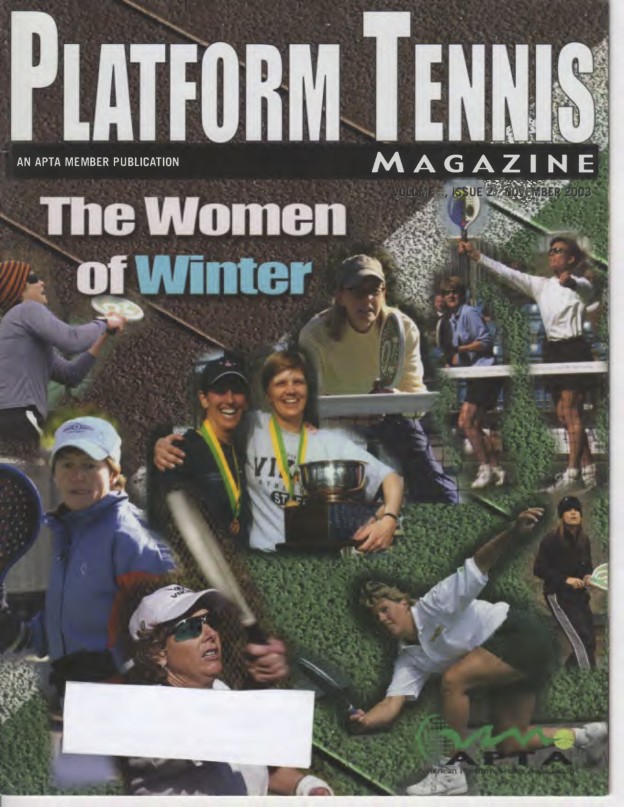
PTM celebrates The Women of Winter

PTM Editor Wayne Dollard had these observations:

This issue is a tribute to women and their changing role in platform tennis. When I first jumped on the tournament scene in 1997, I was amazed at the talent level among the top women players. As a newcomer to tournaments, it helped me to improve by watching their form, technique, preparation, and intensity. Gerri Viant showed me the ready position I use today. Patty Hogan drilled a steady and more compact volley out of me. And Sue Aery taught me that consistent groundstrokes are more valuable than powerful ones.

Looking back through the pages of paddle history, women such as Charlotte Lee, Hilary Hilton, and Robin Fulton have also added so much to the sport. Powerful one- handed backhands, backflips off the screens, blitzing the net, and more. These women showed the paddle community that they could do it all. The women of yesterday can still compete (and win) against today’s younger generation. As a matter of fact, eight of the top 18 women ranked in the 2003 APTA Women’s Open Division were also ranked in the APTA Women’s 40+ Division.

Today, younger players such as Lauren Zink, Sally Cottingham, and Chris Sheldon offer tremendous power and consistent groundstrokes while veterans Patty Hogan,
Bobo Delaney, and Tonia Mangan counter with near-perfect volleys. Then there are players such as Gerri Viant and Mary Doten who offer all-around consistency and make for outstanding deuce-court players. And let’s not forget the APTA Women’s Ranking Champions, Kerri Delmonico and Shelley Morse, who demonstrated best all-around play over the 2002-2003 season. Kerri is matched only by Hilary Debbs as being the most colorful player on tour. Last but now least, when looking for talent, look to the future with Susie Mascarin-Keane – formerly a top world-ranked tennis player and 2003 APTA Women’s Open National Champion (with Mary Doten).
Legends retire and new ones are made. That’s how it’s always been and how it will always be. In the past, platform tennis has had its share of colorful and talented women, however, the future is safe and secure with The Women of Today.

Source: Platform Tennis Magazine, Vol. 5, Issue 2, November, 2003

Junior Profiles: Liam Butanone and Terry Keegan

Terry (Fairfield, CT) and Liam (Westport, CT) are headed into their third year as partners on the junior circuit. Both competitive tennis players, Liam has given up playing competitive hockey to be able to play more paddle. He still plays baseball and soccer, but paddle is his favorite! He loves the different tournaments on the Viking junior circuit and getting the chance to meet other juniors from outside his region.

Terry spends plenty of his time playing many sports including soccer and water polo. He is currently in training for his first triathlon and figures the 3-mile run will be the hardest part. His favorite athlete is Andre Agassi and he loves the Yankees. His favorite classes are gym and geography, while Liam enjoys math class the most and says Arthur Ashe is his favorite athlete!

Terry and Liam played many of the Viking junior events last year and look forward to playing even more this year. Besides their win at The Nationals last season, they also won The Patterson Tournament and The Fox Meadow Tournament.

Liam thinks his Viking championship chair was the coolest trophy he ever won in his life and uses it daily when sitting at his computer. Terry’s chair is in his room but gets used mostly for his laundry. Both have their gold medals prominently displayed on the walls in their rooms.

Source: Platform Tennis Magazine, Vol. 5, Issue 2, November, 2003

Gary Horvath steps down as PPTA President

Gary led the way for the first five years of the Association’s existence and with his energy and leadership the PPTA had made great strides in its mission of raising the standards of teaching platform tennis as a profession and increasing interest and awareness of the sport. Patty Hogan stepped in to fill his shoes.

Junior Profiles: Henry Burchenal and John Donnally

Henry Burchenal (Summit, NJ) and John Donnally (Madison, NJ) have played together now for three years. Henry • and John won the 12-and-under Nationals in 2002 and lost in the semi-finals of the 14-and-under Nationals in 2003.

They are both 8th graders who also excel in tennis, hockey and lacrosse. They are looking to improve on their semi-final finish in last year’s nationals by practicing more before this year’s tournament!

Henry plays the ad court but his strength is at the net where he loves to hit his favorite shot, which is his backhand volley. John’s strength from the deuce court is his return of serve. Both players love the challenge of difficult screen shots.

Henry keeps his 2002 Viking National Championship chair in his room along with his gold medal prominently displayed. John doesn’t know where his gold medal is and thinks his brother traded him something for the chair.

Henry’s favorite subject in school is history while John’s is a toss-up between gym and lunch. They are both big NJ Devils fans and have gotten to see the Stanley Cup in person!

Source: Platform Tennis Magazine, Vol. 5, Issue 1, September, 2003

Viking Kids Day – Viking continues to build the game through junior participation

Viking Athletics announced Viking Kids’ Day 2003 would take place Friday, October 31st at the Chicago Charities Platform Tennis Tournament.

Dave Ohlmuller, National Sales Manager, Viking Athletics had this to say:

“Viking Kids’ Day is going to be a wonderful experience for all the kids that participate in the event. We are thrilled to have such incredible support from the top regional and national teaching professionals and top ranked players for this event. The extent of the player commitment is a testament to what a worthwhile experience Kids’ Day is going to be for the participants. The kids will have the opportunity to receive instruction from many of the top instructors and players in the game of platform tennis.”

The following Viking Professionals and top players committed to participate in the Viking Kids’ Day:

Mike Rahaley, Mike Marino, Tim Mangan, John Milbank, Scott Mansager, Mary Doten, Lauren Zink, Marina Ohlmuller, Flip Goodspeed, Chris Gambino, Greg Stipa, George Zink.

Source: Platform Tennis Magazine, Vol. 5, Issue 1, September, 2003

Hall of Fame Inductees: Dick Squires and Bob Kingsbury

Bob Kingsbury and Dick Squires, both of whom were major achievers and contributors in the 1960’s and 1970’s.

Because their achievements and contributions were better known to players in those decades, it was decided to hold the induction ceremonies at the Senior Nationals dinner at Sleepy Hollow in March of 2003, where there was a large, enthusiastic, and appreciative crowd of peers.

Brook Kindred presented the induction speech for Bob Kingsbury and Steve Baird delivered the presentation for Dick Squires.

Source: Platform Tennis Magazine, Vol. 5, Issue 1, September, 2003

APTA Board endorses Umpire’s Association and Promotions Committee

APTA President John Horine covered the developments in the From the APTA… section of PTM:

At the APTA Board meeting in May, we heard from Rob LeBuhn who wanted to organize and formally train umpires so that the Nationals and each region will have certified umpires for all of its events. The Board whole-heartedly supported Rob and his idea.

The Board also formally approved the Promotions Committee, a group of Board members, players, court and equipment manufacturers who have gathered to brainstorm ideas of how to grow the game in dominant areas of the country.

Source: Platform Tennis Magazine, Vol. 5, Issue 1, September, 2003