APTA Board selects new logo

The APTA started looking for a simple new logo during the latter half of 2002 and a contest was announced with the winning designer earning an individual life membership to the APTA.

At the May Board meeting the logo designs submitted in response to the search for a more modern logo were reviewed and the one submitted by Connie Welch was selected. The new logo was to be be the new masthead for the organization.

The original logo for the APTA had been designed by John Ware in the early 1960s and had been replaced in late 1977 as part of the celebration of 50th anniversary of the game in 1978.

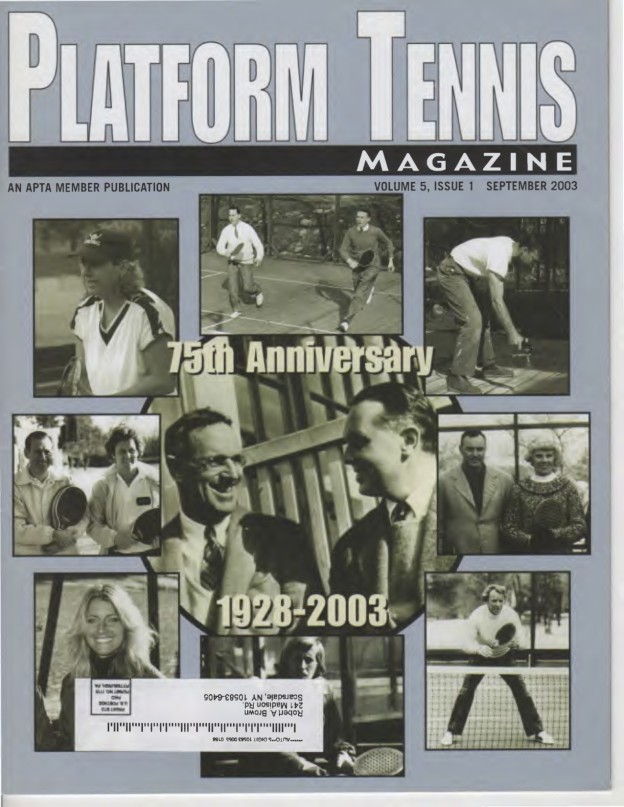
Platform Tennis marks it’s 75th anniversary

The first platform was built in Scarsdale, NY and was ready for play in late November, 1928.

Initially it was used for badminton and deck tennis but the discovery, soon afterwards, of the racquets and balls used in paddle tennis1 lead to the creation of the game we know today.

Despite a number of experiments with modifying the physical dimensions of the court over the years the court configuration adopted by the Founders has stood the test of time, as did the one-serve rule and playing the ball off the wires.

For more details on the initial experiments with the game please see The Early Years 1928-1934.

Note 1: Paddle Tennis was developed by the Reverend Frank P. Beal as a child in Albion MI. Later in life when he had moved to New York City and was the Associate Minister of the Judson Memorial Church he introduced the game to New York City playgrounds in the early 1920s

Securing the future of the game – growing junior participation

Gary Horvath paid tribute to those that made it happen:

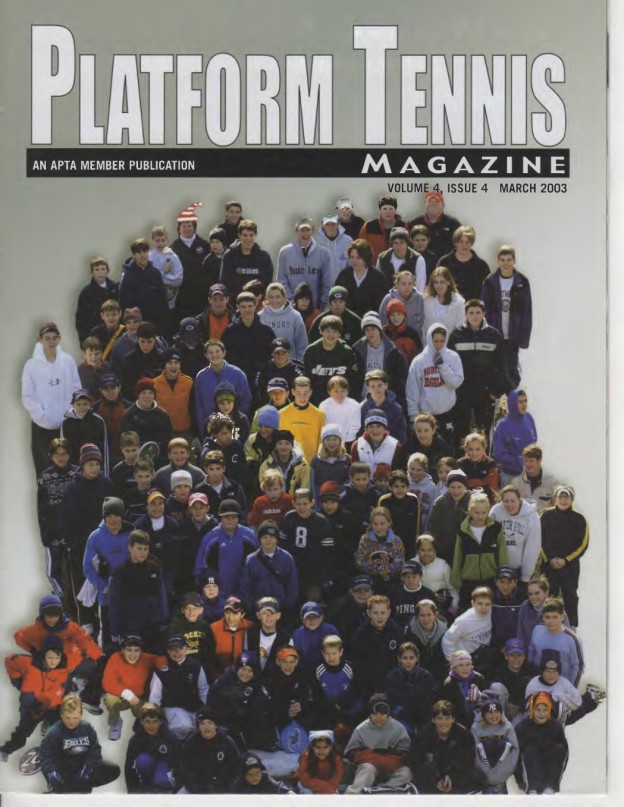
The quiet resurrection of the junior circuit has to be included in this list of events that will shape the game in the years ahead. Junior paddle has seen its rebirth as a result of renewed support for the APTA Junior Nationals, increased programming by teaching professionals, and the creation of the Viking Cup and Viking Junior Tour. This season, over 180 players participated in the Junior Nationals. Patty Hogan, Junior Nationals Tournament Director, was impressed both with the level of enthusiasm and the improvement in the level of play.

This season also marked the first year of the Viking Junior Tour. There have been four junior tournaments held so far this season with over 350 participants. Two more are definitely scheduled and two additional tournaments are tentatively scheduled for this season.

A year after entering the platform tennis industry, Viking sponsored the first Viking Cup. This is a series of 18 tournaments held throughout the country in November. The subtly named Child/Adult event wants to place the emphasis on the junior players. While it is possible for junior players to play with their parents, it is also possible for them to play with other adults. This past season, the events had 206 total participants – an increase from 75 the first year.

David Kjeldsen of Viking, the major sponsor of junior events, said, “I think the participation in junior paddle has doubled in the past three years. We have again reached the point where some of the juniors are starting to play multiple tournaments in a season.” Kjeldsen also agreed strongly with Hogan’s sentiment that the caliber of play has risen dramatically each year. Kjeldsen added, “All of the
juniors are fun to watch. Seeing Peter Hissey and Lauren Cash, two great juniors who can hit backhands out of the wires all day without missing, one knows the future of platform is in good hands.”

The importance of the junior game became more evident to me when I asked myself the question, “How many of the people who I play against learned to play platform tennis as a junior?” Most of my peers learned to play after they were out of college. Hats off to Patty Hogan, Viking, the professionals who run junior programs, the parents who are involved in various ways, and most importantly to the juniors who will ultimately introduce this great sport to the next generation.

Source: Platform Tennis Magazine, Vol. 4, Issue 4, March 2003

Junior Nationals participation at all-time high

What activity can you do with kids in the middle of winter when its 15 degrees out?

Put them on the paddle courts of course! That is exactly what happened January 11, as 184 players took to the courts for the 2003 Junior National Championships hosted by the Beacon Hill Club in Summit, New Jersey.

Seven area clubs, 28 courts in all, saw non-stop action as a record number of players battled it out in hopes of winning a National Title. At day’s end, four teams left with championships medals and “Champion’s Chairs” while the other 88 teams left with the satisfaction of knowing they competed their best.

The winners in the 10-and-Under championship were Will Burchenal and Thomas Killian (Summit, NJ). They topped Ryan Hissey and Scotty “THRASH” Safford (West Chester,PA) 6-2, 6-3 in the finals.

Terry Keegan (Fairfield, CT) and Liam Bohannon (Westport, CT) won the 12- and-Under championship by beating Alex Christ (Rochester, NY) and Sean Welch (Pittsford, NY) in a roller coaster match by the scores of 4-6, 6-0, 7-5.

Eric D’Elia (Fairfield, CT) and Marc Powers (Stamford, CT) displayed plenty of skill and maturity in winning the 14- and-Under National title. They beat the team of Peter Hissey (West Chester, PA) and Tom McAvoy (Phoenixville, PA) 7- 6, 6-1 to take home the honors.

The 18-and-Under National Title went to Tyler Gaffney (Madison, NJ) and Diego Rodriguez (Kenneth Square, PA) for the second year in a row. They topped the team of Brandon Kuchta (Lloyd Harbor, NY) and Lauren Cash (Upper Saddle River, NJ) by the scores of 6-4, 6-1.

Source: Platform Tennis Magazine, Vol. 4, Issue 4, March 2003

Fatal court explosion in NH

On January 5, 2003, a fatal propane gas explosion occurred on a platform tennis court at the Eastham Residential Community in Grantham, New Hampshire.

A suspected gas leak caused the explosion that killed 64- year-old James Owen (husband and father of one) and injured three others.

Source: Platform Tennis Magazine Vol. 4, Issue 4, March 2003

APTA approves term limits for Directors

APTA by-laws required that Directors be elected for a term of one year with no restriction on the number of terms served.

At the Annual Meeting in May 2002 the Board amended the by-laws limiting the amount of time a person could serve to two three-year terms. In addition the revised by-laws stipulated that a past Director could not be re-elected until two years after the end of his/her last term.

Chicago Charities – Chris Gambino and David Ohlmuller successfully defend and Kerri Delmonico and Shelly Mores win their first title

Another year for the charities goes off without a hitch thanks to the leadership of John Noble and Company. This November, 296 players competed in four events: The Men’s Open, Women’s Open, Men’s 45+, and Men’s 55+.

In the women’s open tournament, last season’s finalists Aery/Viant and Fulton/Prendergast were no-shows. Therefore, the draw was ripe for the picking. The biggest quarter-final upsets came when 5th seeded Kerri Delmonico and Shelly Morse upset the top-seeded team of Tonia Mangan and Bobo Delaney. They proceeded to defeat Jane McNitt and Leslie Hough (who defeated 3rd seeded Hilary Debbs and Patty Hogan) in a three-set semi-final match. In the other half of the draw, 2nd seeded Mary Doten and Julia Sierks held their ground to reach the finals. Kerri and Shelly won the finals (their first Charities Title) in a hard-fought match.

In the men’s draw, the top seeds proceeded to the semis with only a few minor upsets…that is if you ignore the fact that the 10th seeded team of Mike Stulac (Toronto) and Scott Bondurant (Chicago) defeated Cosimano/Stipa in the 16s, Goodspeed/Mansager (6-2,6-2) in the quarters, and Estes/Mackesy(4-6,6-0,7-6) in the semis…not to mention Dollard/Hallet(7-6, 6-7,7-6?) in the 32’s! On the other half of the draw, defending champs Chris Gambino and David Ohlmuller defeated Hough/Uihlein in the Semis and Kaufman/Milbank in the quarters to reach the finals. The 7-6, 6-4 final match-up was a battle with the defending champions prevailing.

Source: Platform Tennis Magazine, Vol. 4, Issue 3, January, 2003

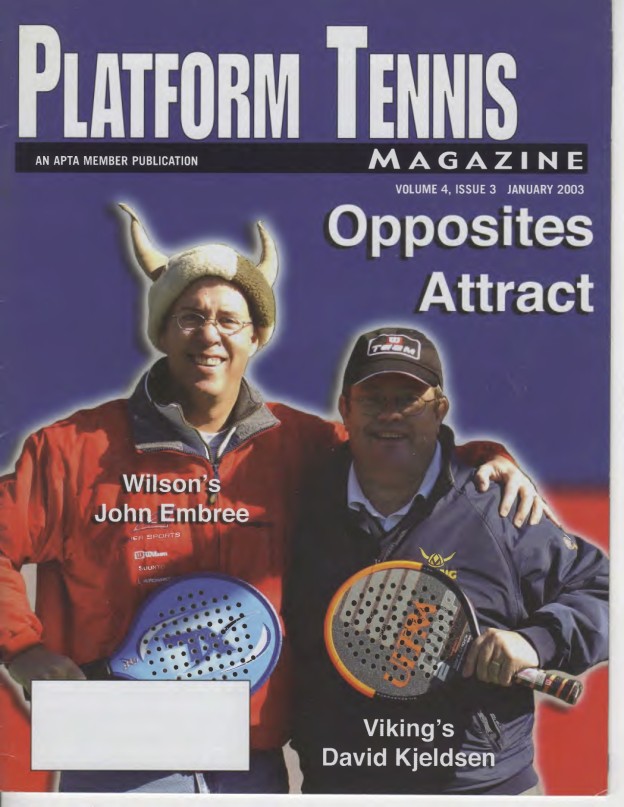
Player Profiles: John Embree and David Kjeldsen

John Embree has been involved in sports, and more importantly – racquet sports, since he was a child. In college, John was a four-year letterman in both soccer and tennis. He was even voted MVP and senior athlete of the year.

In the early 70s, John went on various professional tennis tours, included in this was his participation in the 1976 Australian Open. John’s enthusiasm for tennis was recognized by the USTA when they hired him in 1980. John soon after developed and implemented the new USTA League Program. Today, John’s baby has 400,000 annual participants.

Wilson saw John’s potential and hired him soon after. He worked his way up to become the V.P. and G.M. for Wilson Racquet Sports. One day in 1994, Wilson’s President asked John if he knew of any new business ventures the company could get involved with. Citing service and quality-related problems from platform tennis’ primary manufacturer, Marcraft, John got Wilson involved in the paddle market with the plan to utilize their existing sales reps. Wilson’s initial paddles were the first full-graphite composites made. The paddles were superior to the previous paddles; however, the abundance of power coming from the paddles caused Wilson to switch from graphite to EVA foam in 1997. John chose to get involved in the ball market because the existing Vittert balls were too lively. Wilson bought out Vittert and softened the balls. With lack of consumer support and a small market not large enough to be divided, Wilson sold off the ball market to Viking in 2001.

John’s future commitment to platform tennis is as strong today as it was ten years ago. Aside from paddles, Wilson’s “Surround The Athlete” philosophy includes offering shoes, gloves, hats, bags, grips, etc. “I will continue to support platform tennis as long as I am at Wilson,” John stated. He added, “I am certainly committed to the future. This sport is less than 1/1,000 of Wilson’s racquet business; however, it is something I am passionate about.” As a result, Wilson’s paddle business has increased 20% per year since 1999. Wilson endorses the Performance Paddle Camps, Connecticut Classic, and Chicago Charities Events. As a player, John won the 1995 Illinois States and 1999 45+ Charities Open. John has been ranked nationally in the APTA’s top-ten list several times.

David Kjeldsen: There he was, the world’s biggest couch potato, out on the platform tennis court for the first time playing mixed doubles on a Friday night. Paddle in one hand, cigar in his mouth, a beer in the other hand. Who would have thought that thirteen years later David Kjeldsen would be the largest supplier of balls and paddles in the world?

Friday night platform outings got David’s interest piqued. He started playing platform every Saturday in his club’s morning round robins and then in a league. Through it all, he was using up balls as if they were free. At $15 per sleeve he knew there had to be a better way! He called Hedstrom Corporation, the manufacturer of the Vittert ball, and asked if he could purchase balls by the case. Sure enough, they shipped him an order. When his platform partner heard about his purchase, he asked if he wouldn’t mind getting him and his wife a few cases. When David phoned Hedstrom to order more balls, they informed him that he was now eligible for discount pricing. Shortly thereafter, David ordered a paddle for a friend. Marcraft, without hesitation, supplied David dealer pricing. By 1990, David was officially in the platform tennis business.

In February 1996, David formed Viking Athletics, Ltd., with the sole mission of supplying the highest quality platform tennis equipment available. David claims that at the 2002 APTA National Championships, over 80% of the players used Viking paddles.

Six years ago David introduced the Viking ball and in 2001 he monopolized the market when he bought out Wilson’s ball business. David doesn’t believe that his top accomplishment is his ball monopoly. He proudly recalls one weekend where he reached the finals of an APTA-sanctioned Men’s National Ranking Tournament. If you must know where and when, he’ll be happy to personally give you the details.

Today, Viking is involved in every aspect of the game, from manufacturing balls and paddles, to silk-screening and embroidering hats, shirts, team uniforms, etc., for tournaments, to custom imprinting balls and supplying free tournament draw sheets. Viking supplies everything but the refreshments…and David takes solace in the fact that his headquarters is in an old brewery.

Source: Platform Tennis Magazine, Vol. 4, Issue 3, January, 2003

Take away the platform!

Dick Squires had some thoughts on how court construction should change to grow the game:

The November, 2002 edition of Platform Tennis Magazine was primarily concerned about where our lovely sport is going…or not going. We should all be concerned.

The premier tennis court in America was built less than 50 years before the first
paddle court. Why did that sport experience widespread, meteoric growth not only in this country, but around the world? The tennis court consumes four times the amount of land and it too was initially a recreational activity for the wealthy, yet, it took off like a Southern California forest fire. How come?

It is truly a mystery why a rather boorish game like racquetball could experience astronomical growth during the late 70’s. Even though participation eventually leveled off almost as fast as it grew in the ensuing years, there are millions still playing racquetball regularly today. And this sport was `invented’ 25 years after platform tennis!

As we all know, platform tennis is the best of the racquet/paddle and ball sports, including tennis. It is fun, healthy, social, easy-to-learn and difficult-to-master, offers exciting and extended rallies, has several built-in equalizers (single serve, small court, the screens), the equipment is relatively inexpensive, etc., blah, blah. Why then aren’t there 100,000 courts spread out across the States and a few million paddlers enjoying its proven, built-in pleasures?

Certainly one of the reasons is because, as Gary Horvath wrote in his fine article, “The Future of Platform Tennis,” it has been a well-kept secret. There is only a handful of Americans who have any knowledge about the sport, seen it played, and fewer who have actually been on a court. This wonderful game is given absolutely zero coverage or exposure in the media. No one is aggressively promoting it as an ideal athletic, recreational facility for colleges, resorts, upscale retirement communities, ski resorts, country clubs or any place that now has (frequently used) tennis courts.

What is desperately needed is a change in mind-set for those that play and govern the sport. Although its heritage is a pleasurable pastime played outdoors in the winter months installed at county clubs, in actuality platform tennis could and should be enjoyed anywhere and any time of the year.

Yes, one of its distinct attractions and advantages is that it can be played outdoors in cold weather, but its true appeal and benefits far transcend this traditional point of view held and espoused by insular purists. Such a theory is tantamount to the attitude of every tennis pioneer who believed real tennis had to be played outdoors and on grass. Thank God they didn’t win out.

A $50,000 aluminum court with a heated deck built on piers is a wonderful luxury and necessary for courts sited in chilly, snowy climates and hilly terrain, but for most of the geographical areas of the country such an expensive structure is total overkill and stifles the game’s expansion. Take the raised platform out of the court
and substitute a ground-level, hard playing surface perhaps made with a little latex mixed in with the final coat pitch it slightly for drainage, and add an easily-assembled and installed superstructure (the essence of the game) and voila, you’ve got all the court components necessary to play platform tennis. The snow gates would remain as leaf or debris gates. In the same area of one tennis court, three paddle courts could be laid out, including a club house for viewing and displaying paddle equipment and attire – no longer called a warming hut.

The individuals who love to play and those who administrate platform tennis have to stop “preaching to the choir” and start telling their friends at other clubs, their town’s rec. directors, community developers in the neighborhood, architects, resort owners, and university athletic directors that platform tennis represents the ideal athletic pastime for fitness and healthy competition 12 months a year. Continuing to be a well-kept secret and building courts in the air is a sure-fire way to precipitate the ultimate and sad demise of this great game that offers so much for everybody.

Not-so-incidentally, that other game, paddle tennis, played without the wires, has two governing bodies overseeing two different versions (East and West Coast), the United States Paddle Tennis Association and the American Paddle Tennis League. Our APTA could be renamed the American Paddle Tennis Association without infringing or even having to change it’s logo!

It took the USTA almost 100 years to drop the “L” (for Lawn) from it’s acronym. Someone finally discovered that 99% of the tennis courts were clay, hard, or composition. Grass was too expensive to lay down and maintain. Hello? Hopefully, in the near future there will be as few raised platform tennis courts under construction as there are new grass tennis courts being installed today. Then we will know for sure that our sport is on its way to realizing the widespread popularity it deserves.

Source: Platform Tennis Magazine, Vol. 4, Issue 3, January, 2003

Paddlepro.com. Paddle’s hotest new site

Westchester native Bob Considine teamed up with famed Chicago web designer Geoffrey Johnson (Lands End, JCrew) in late 2001 to create what was to become the hottest platform tennis web site of 2002 – paddlepro.com.

Considine originally intended for the web site to simply be a value-added service to the men and women he taught paddle to; however, the Westchester Platform Tennis Association saw the in-progress site and requested to have their league/tournament information included. The Sound Shore Invitational soon after became the first tournament to register 100% of player entries through the web via credit card.

Shortly after the WPTL signed on, members began requests for an online paddle store to purchase items such as balls, paddles, trophies, and team logo-printed clothing. “We will continue to expand the website as long as it is positively adopted by the paddle community and people wish to financially support it through the online store,” Considine explained. He added, “In other words, if people continue to support paddlepro, we will continue to improve it.”

Source: Platform Tennis Magazine, Vol. 4, Issue 2, November, 2002