



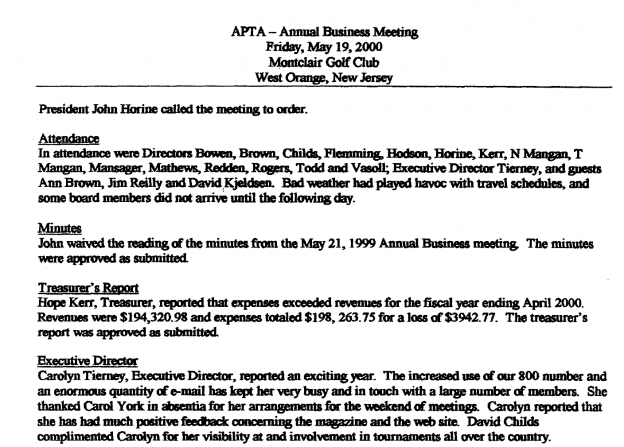
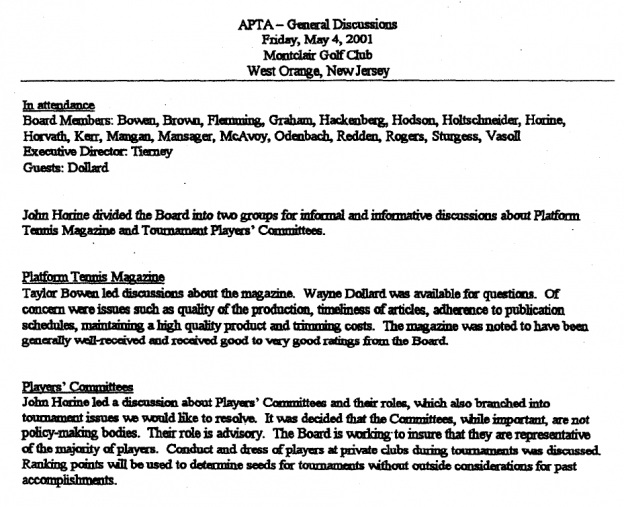
Annual Meeting & BOD Meeting and Working Sessions

APTA hires Associate Editor/Writer
We are proud to announce that Nindy Pike of Haverhill, Massachusetts, will be joining our team as associate editor/writer.
This new part-time position has been created because of the steady growth of platform tennis and the increased need for APTA member communication.
Pike was chosen from more than 50 qualified applicants from across the country.
PTMHOFF makes progress towards “virtual museum”
The PTMHOFF established revised goals in 2011 after an arrangement for housing a physical museum fell through. A significant part of 2012 was spent in pursuing Phase 1 of the new plan:
Phase I: Create a “virtual” museum and Hall of Fame with the first step being a dramatic upgrade to original web site. The revised site would have three features – an illustrated history of the game, a completely new look and feel for the Hall of Fame with extensive biographies, and a “Search and Explore” section which would house all of the memorabilia collected in digital formats and allow visitors to browse the artifacts by various search keys (by name, for instance).
This phase which is the foundation and heart of the revised mission, was now about 75% complete with the collection and digitization of artifacts, the development of the illustrated time-line history and the revised and expanded Hall of Fame sections essentially complete.
The collection and digitization of historical artifacts was a much bigger undertaking than originally anticipated and our collection now included almost all APTA newsletters (1969-2012), APTA historical documents (annual meeting minutes, correspondence, etc.) many magazine and newspaper articles, photographs, film footage going back to 1962, and much more. This material has been extensively used to create the illustrated time-line history and upgrade the biographies of Hall of Fame members.
The big remaining step was the complete the Search and Explore segment.
All of this had taken considerable effort and resources and would not have been possible without the support of the “paddle community”
Options for Museum and Hall of Fame explored
The initial thrust of the PTMHOFF was to create a “bricks and mortar” facility, but as they pursued this goal they realized that the history of the game could also be told by a “virtual museum”. Many traditional museums were moving in this direction as they saw opportunities to deliver content in a more visually exciting and interactive way with the added benefit of attracting “visitors” without the need for them to be physically at the museum.
The revised approach was developed during 2011 and comprised three phases:
Phase I: Create a “virtual” museum and Hall of Fame with the first step being a dramatic upgrade to original web site. The revised site would have three features – an illustrated history of the game, a completely new look and feel for the Hall of Fame with extensive biographies, and a “Search and Explore” section which would house all of the memorabilia collected in digital formats and allow visitors to browse the artifacts by various search keys (by name, for instance).
Phase II: Create a physical presence but with a significantly reduced foot-print by combining the material from Phase I with the more traditional elements of a museum – physical displays. The work in this phase will also include seeing how we can repurpose the material developed for a “travelling/pop-up museum and Hall of Fame” that could be used at major National Championships.
Phase III: Build an app which would be the digital equivalent of our coffee table book Passing Shots: A pictorial History of Platform Tennis, containing all the elements of the “virtual” museum
What is the President’s Cup??
You are excused if you don’t know the answer to that question. The President’s Cup has been a part of the APTA Nationals for years, and is a hotly contested event, but there are few people outside of die-hard tournament players who know what it is. It was established in 1978, when the sport was becoming professionalized, as a national competition for amateur players. It’s success kept it going after money left the sport.
Each region fields a set of teams based in large part on President’s Cup Qualifier points accumulated at regional tournaments. Players seeded in the top 8 nationally may not participate but otherwise each region fields the strongest players it can. Sometimes a region cannot field a complete team and players are borrowed from other regions to fill out the roster, or two regions may combine to form one team.
The President’s Cup is a grueling day long round robin event. Each region’s #1 team “line 1” in Cincinnati parlance – plays a round robin match with the #1 team from each other region. #2 plays the other #2s, and so on. This year each team fielded five doubles teams.
They get to spend a lot more time together on and off the court than they would in the regular course of a tournament, playing opponents of similar ability and pushing their games while vying for regional bragging rights and claim to the big silver cup.[enlarge image to read more]

“Spirit of the Game” Award – Louisa Randazzo, first recipient
Meet the APTA Junior Nationals finalist who plays with great integrity……
One serve. The wires. Playing lets. These are among the most commonly cited features that distinguish platform tennis from similar games. However, as anyone who has played our sport for even just a couple of seasons knows, there is another element that makes platform tennis special—something that is rarely found in many sports today, but is, oh, so essential. It’s what I like to call the “Spirit of the Game.”
Some say it’s simply good sportsmanship. Yes, that’s part of it. Others say it’s nothing more than etiquette and good manners. Agreed, but there’s still more to it than that. While platform tennis is a keenly competitive sport, by tradition, good sportsmanship, integrity, and respect for your partner and opponents are key elements of the sport.
At the 2013 Junior Nationals, New Jersey fifth-grader Louisa Randazzo was recognized by Tournament Director Tom Safford and his team of volunteer hut commanders, from among over 200 competitors, as best exhibiting the behaviors and traits that make her the first-ever recipient of the APTA Junior Nationals “Spirit of the Game” award. While demonstrating the good sportsmanship, integrity and respect that goes with the honor, Randazzo and her partner, Mary Margaret Schroeder, also demonstrated excellent skills on the court as they made it all the way to the finals in the Girls 10s. [enlarge image to read more]
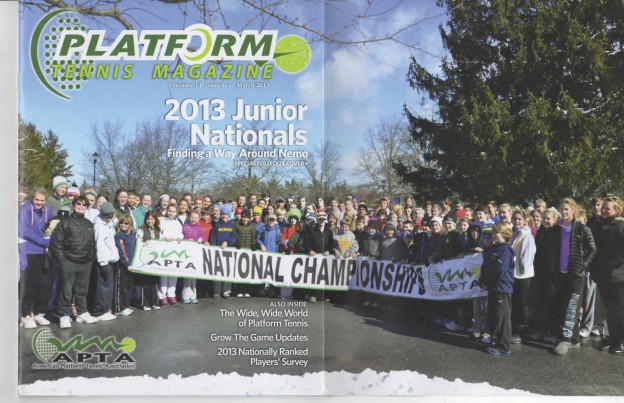
Coverage of Junior Nationals at Waynesborough Country Club
Camaraderie and Victories on the Courts Despite Wicked Weather
by Mark Berton
For this year’s APTA Junior Nationals, getting there was half the battle. If you were coming from the West, driving and flying into Philadelphia was a relatively benign process. But the draw sheet demonstrated just how hard the traveling was for anyone coming in from the North and the East, as numerous last-minute cancellations whittled away players.
At the hosting club, Waynesborough Country Club, workers were out early clearing three inches of snow from the walks, and while temperatures hovered in the low 30s, the wind chill was in the low teens.
On the courts, though, you wouldn’t know it, as kids who were shivering and putting on layers hut-side, quickly discarded layers as their games warmed up.
Boys and Girls 10s
Boys and Girls 12s Ben Delaney took his second gold at the Junior Nationals, as the Boys 10s 2011 champ and his partner, Desmond Paperello, defeated Francis Randazzo and Billy Schroeder. On the girl’s side, Tori Blundin and Cann Haarmann won over Claire Dardis and Mimi Shay, 6-3, 7-5. For Delaney and Paperello, their victory was very special to them — each took a ball from the semis and finals, signed and dated them and have them now sitting next to their medals.
Delaney also said that his older twin brothers, Will and Pat, who got to the quarterfinals for Boys 14s, have encouraged him to play and he now appreciates all the tough shots they have hit at him over the years. Paperello said having Tastykake sponsor the event and supply goodies was a great touch, and meeting players from around the country was exciting.
“It was really fun to meet all the other kids who came from far away,” he said. ‘And it was awesome that we won a new Viking paddle. It’s my first new one ever.”
Blundin said winning after three years of competing in the Junior Nationals was a very exciting thing.
“It was a great day of paddle,” she said. “We met lots of different players with different abilities and strategies, which made each match challenging but really fun:’
Haarmann said she too was excited with the win, and draws inspiration from her mother and Bobo Delaney, who had them out on the court Thursday before the tournament for shifting practice.
After winning the New Jersey State Championship earlier this year, Haarmann said she most enjoyed just playing with her friend, Tori.
Boys and Girls 14s Will Cannon, a Junior Nationals 2009 Boys 10s champion, and Henry Fishman defeated Henry DeCoster and Will Graham, 6-4, 7-5; while sister act and 2012 Girls 12s champions, Callie and Catie Burkhart prevailed over Emily Dardis and Alexandra Shay, 6-4, 416, 7-6.
Fishman said the field was extremely talented, with their semi- and quarter-final matches being particularly challenging for them.
“We knew we needed to play well in order to win. The other teams were both extremely talented,” he said. “Our biggest challenge was in the finals, after hours of play, we were all very fatigued, and I was struggling to get my serve in. We knew the team well since we had just played them last week in the Connecticut Open Finals, and we knew what we needed to do to offset their strengths in order to win again.”
Fishman said the team strategy was to lob a lot, but that quickly changed for them.
“With the windy conditions, we changed our game plan accordingly where we drove the ball more and became more cautious with our lobs,” he said.
Boys and Girls 18s Brian Faig and Will Kleeman defeated Will Burger and Gardner Tregellas, 4-6, 6-4, 6-3. Kleeman was runner-up to Burger-Tregellas in the 2010 Boys 14s, but he and Faig dug deep, breaking between sets for water, Gatorade and to drop layer after layer of clothing until the match looked like it was being played on a June evening instead of the evening after an historic February Northeastern blizzard. The teams both artfully changed up their strokes and rhythms for the most watched game inside the hut.
Faig said that the finals were the culminations of a day of good play for himself and Kleeman.
“The other matches, they were competitive, but we played well over the course of the day. At a result, we didn’t have any really close matches,” he said. “[Burger and Tregallas] are really strong all around, and they have really strong games. My strategy was to play consistent, give my partner opportunities to drive the ball, mix it up and never give them the same look twice.”
Kleeman said defending the serve was key for him.
“Our opponents were strong servers and had good hands. This took away one of our greatest strengths — return of serve: he said. “We took what we got and lobbed the ball deep to start off the point neutral. Our opponents were good at digging balls out of the screens, and lobbed well, setting up Tregallas’ forehand lurking in the middle of the court. “
As a runner-up to Gardner-Tregellas in the Boys 14s, Kleeman said this victory was a dream rematch
“The scores from three years ago were identical, with similar changes in momentum, and a different outcome: he said. “It could have gone either way both times. Our competitors are highly competitive and have a similar skill level, making this finals match a true challenge.”
Faig and Kleeman said they both intend to compete in the APTA Nationals with the grant money from the anonymous donor. “We’re definitely planning on taking offer, and I’d like to thank the donor: Faig said. “That’s a great opportunity that they gave us and we’re going to try our best over there:’
Meghan Foster and Hannah Kratky, both Girls 14s champions in 2011, defeated Ashley Lyon and Stephanie Webster, 3-6, 6-1, 6-3.
“This win definitely feels good. With it only being our second year in the 18s, it was nice to grab this win. We are looking forward to playing in the Girls 18 & Under Nationals next year as well,” Kratky said. “Meghan and I are extremely excited about the opportunity to play in the Women’s Nationals. We will definitely take up that offer if
our schedules allow it.”
Foster said that the team was able to practice together more this year, which helped them.
“It seems each year the competition just gets stronger and the draws are larger: she said. “There was definitely a lot more competition then we’ve had in the past. I was really glad we played who we played in the finals. They were great paddle players, and it was really frustrating to play them. They had amazing lobs: Foster emphasized. “We hadn’t really had lobs all day from anyone else. They had great lobs and also
great drives which were difficult to handle.”
Kratky said, despite some competitive play in the semi-finals, the finals was the biggest test of the day for them.
“After losing the first set fairly fast, I knew Lyon and Webster were going to be a very hard team to beat. It was really hard to pinpoint any weaknesses they had: she said. “Lyon’s drives and Webster’s lobs were a really hard combination to beat. After the first set Meghan and I took some time to regroup and talk. We decided that it was going to be a battle of consistency; it was a matter of who cracked first. Meghan and I got the win, but it definitely was not easy”
Senior player profile – Helen Garrett
Paddle is her balance. Just back from a weekend on Long Beach Island, and having spent two weeks skiing in Sun Valley, Idaho, it was pure luck to find Helen Garrett with some time to talk. No moss grows on Garrett, the perennial senior tournament winner, with 16 APTA Senior Championships and eight “silvers,” as she puts it. She plays both women’s and mixed tournaments, enjoying the differences of each game. And she very much enjoyed the team concept of the President’s Cup. Garrett played in the very first one in 1986, and was on the Region III team for several years.
Garrett and long-time partner Sandy Simmers won the Women’s 70+ Nationals in Scarsdale, New York, this past December. Both players are from the Washington, DC area, and Garrett really enjoys the time they spend together, whether in the car traveling to tournaments or on the court. “Neither of us has a big forehand or big backhand, but we just bore people to death with our game. Of course we have some skills, mostly strategy, and we can place soft screen shots.”
When playing mixed, Garrett seems to land some of the bigger fish in paddle, notably Bob Brown, Bill Childs, and Scott Estes, Sr. “I’ve had great partners. And I’ve learned so much strategy from all of them. I think in order to get better at any game, you have to be a student” One of her few disappointments is that “I didn’t get to play in the recent Mixed 60+ or Women’s 60+ Nationals,” Garrett laments. This was her first time missing each tournament in ten years, but she couldn’t fit traveling to Florida or Chicago into her demanding schedule. [enlarge image to read more]
Update on APTA’s efforts to grow the game
The following clubs were fortunate to receive grant money from the APTA to help fund new or refurbished courts in the 2012-2013 paddle season. Here are some details of their programs. From the rocky coast of Maine to the peachy state of Georgia, our game is growing!
Windward Lake Club, Alpharetta, GA
Two refurbished courts were installed. The grand opening event in December had a turnout of almost 100 players. They held a beginner instructional class in the morning and an intermediate/advanced class in the afternoon. In between classes, there was a women’s exhibition with Sue Aery, Agata Cioroch, Lisa Teer and Sharon LeRoux and a men’s exhibition by Jay Bailey, Peter Lauer, Scott Kaufman and Graham McNerney. Peachtree Paddle League will now include Windward in their functions and organized league play. In addition, the club will offer recreational play on Monday, Wednesday and Friday nights, and junior play on Thursday afternoons.
Amy Riley, Club Director, stated, “We look forward to growing platform tennis in the South. The grand opening event wouldn’t have been nearly as successful without Rob and Didi Chapdelaine. Their enthusiasm is catching!”
Guilford Racquet and Swim Club, Guildford, CT
The club opened two brand new courts in October. There are groups at all levels, as they are offering clinics for adults and juniors. Three PPTA professionals, Steve Godiksen and Steve and Trish Griggs, are on staff. Several contract courts are meeting weekly and the hope is to launch adult leagues soon. In January, Guilford hosted both a men’s and women’s tournament. Manager Sarah Boone said, “We are very excited!”
York Paddle Tennis Club, York, ME
A second court was added onto their grounds in November and an open house was held to entice new members. Pro Dan McCormick ran several clinics to increase awareness of the improvements at the club. Membership has grown to 55 players over the past five years.
Member Greg Campbell said, “Since we added the second court, the level of play has gone up about 50 percent and we are holding more events.”
Delaware Tennis and Paddle Club, Newark, DE
Through APTA and MAPTA grants, the club was able to resurface both paddle courts, get two new nets, and upgrade the existing lighting, making the courts playable day and night.
DTPC has an organized platform tennis program that plays at Deerfield Country Club. The two courts host over 200 players and guests in the community, who play in leagues, round robins, tournaments, team practices, “Discover Paddle” days, and social pick-up games during paddle season.
DTPC currently has four women’s teams and three men’s teams involved in the MAPTA league.
Elysium Tennis, Columbus, OH
Elysium Tennis has two platform tennis courts completed (of a proposed four). Three of the four PPTA pros in Columbus, Brian Heil, Kevin Hornik and Katya Yergina, are on staff.
Adult and junior programs are offered every day of the week and turnout has been great so far. All expectations are that this is only the beginning of something big.
 © 2026 Platform Tennis Museum and Hall of Fame Foundation, All Rights Reserved.