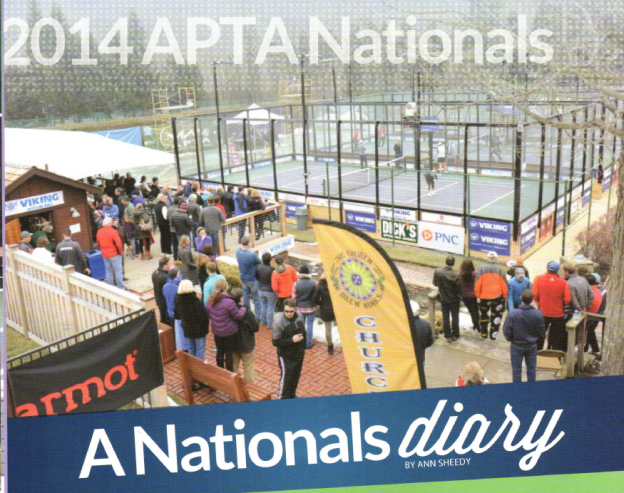
Ann Sheedy’s Nationals Diary – reflections on running a Nationals

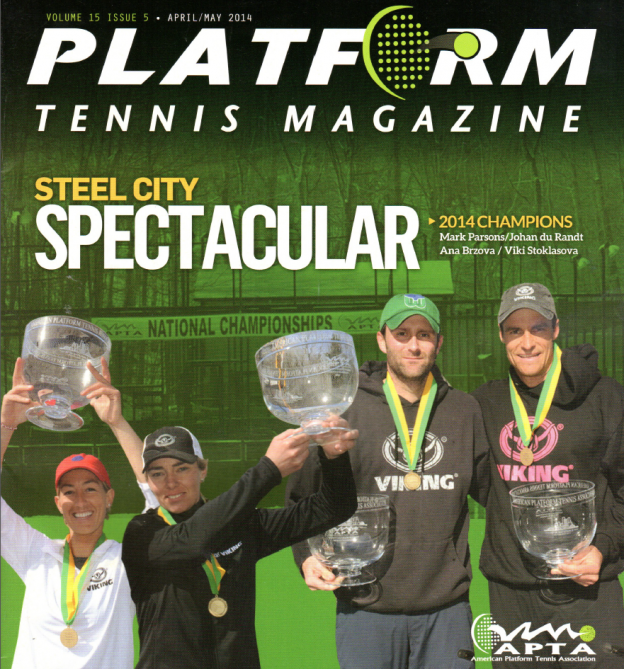
Ann Sheedy, the Executive Director of the APTA, was deeply involved in running the Nationals which were held in her home town, Pittsburgh.

She filed a report with PTM on the activities leading up to the event and some thoughts on when all was said and done.

Preparation (March 2013)

The 2014 APTA Nationals are only a year away! We have our Executive Committee and
we have asked the clubs for the use of their courts. We’ve made a list of potential sponsors and we have a sponsorship brochure. Looks like we are on our way.

Piece by piece we’ve added to our committee. We found a volunteer to be in charge of but food, then someone to recruit but monitors, then a housing chair and a hotel coordinator. We already had a draw guru on the Executive Committee so we are set there. We need a parking and shuttle committee head as well as someone to be in charge of selling merchandise. Prizes must be selected and purchased, the President’s Cup has to be coordinated, and photographers need to be found. Lunches and dinners need to be planned and budgeted. Live Scoring and Live Streaming, not part of the two previous Pittsburgh Nationals, have to be staffed and we must find someone to be in charge of the player’s gift bag. A program needs to be designed and printed. Facility information needs to be gathered and volunteer manuals have to be written.

So many decisions! What clubs to use, what favors to buy are the first we tackle. Then the questions pour in. •How many banners does a Gold Level sponsor get? Tent or no tent? Who gets to park where? Where is lunch and how many people will be at each location? How do we move the favors and gift bags between clubs for registration Wednesday and Thursday night? How many XXL jackets should we order? (This is always tricky because you have to order the clothing before all the registrations are in.) How many hours should the shuttle run? Will we sell merchandise and, if so, how much should we order? How many balls do we need and how do they get divided? Do we give lanyards or those rubber bracelets to the players so they can get into meals? How big should the bleachers be? Etc., etc …

Funding is always the scariest part. It’s somewhat scary to make commitments in December to spend money if it’s unclear if we will have the money in March. We’ve taken the strategy to start with a tight budget and expand it as (we hope) money comes in.

Pittsburgh does not have the luxury of an overabundance of courts so we know that getting temporary courts is crucial. Thanks to the APTA and Total Platform Tennis, we’ve gotten the three temporary courts we need.

It’s almost here! March 2014

Under the heading of “Of course we didn’t panic (much) … ” A huge snowfall is expected right after the temporary courts are painted. The paint needs time and the proper temperature to cure and snow is not part of that formula.

Thanks to a Fox Chapel Racquet Club employee, who got up in the middle of the night to change the propane tanks under the temporary courts, and a bit of help from the weather gods because we didn’t get the six to eight inches of snow forecasted, the courts are ready on time.

Lots of little details to finish: parking passes need to be distributed, programs and draw sheets printed and delivered to registration. Signs at club entrances are to be printed and put in place. We have changed our minds several times about the location and set up of registration and merchandise but I think we nailed it.

Rats, turns out that there is a charity run at North Park that might disrupt players’ ability to get to the courts. Hope we don’t have to cancel the use of those courts; their volunteers are so eager to host some National matches. Good, no problem, next issue …. Okay, someone needs to pick up the microphones.

Wednesday night – President’s Cup Registration (March 5, 2014)

The Fox Chapel Racquet Club looks wonderful with the fireplace blazing and the lights twinkling, creating a festive atmosphere. Food is tasty and registration is going well.

Reflection (April 2013)

It is hard to believe that after all those months of work it is over. Players have given us their thanks and praise. I guess besides the amazing level of talent I witnessed, I will remember the people who helped us pull this off. Martin Sturgess was a knowledgeable, decisive, and calm Tournament Director. I know the hours he spent pushing and pulling the budget to be sure we could make it work. We can’t thank the staff of the Fox Chapel Racquet Club enough for the unbelievable hours they put in to make the tournament a success.

To say we had great volunteers is to underestimate their contribution. Just a few examples, our Hut Food Chair got more than 80 ladies to make baked goods for the huts. Our draw guru spent hours refining the times and locations to optimize our court situation and use of Live Streaming and then handled the tournament desk with her usual aplomb. Registration ran as smoothly as any I have seen, thanks to a well planned and executed process. We heard nothing but compliments about the food and the venues. The ladies running the merchandise area spent so much time at their posts I thought the club was going to charge them rent. I heard that our hut monitors were friendly and helpful. Even by mentioning a few examples I fear that I am shortchanging the others who contributed so greatly. I could continue to thank the Prize Chair, the Players’ Gift Bag Chair, the Facilities Chair, the Housing & Hotel Chairs, the Sign Chair.

It’s hard to stop. Yes, there were some glitches and, yes, there were a few things I might do differently, but all in all I think we did a pretty darn good job and I am so proud of the hundreds of Pittsburgh paddle players who stepped up and were part of the PNC 2014 APTA Pittsburgh Nationals.

Source: Platform Tennis Magazine, Vol. 15, Issue 5 April/May 2014
National Championship results and coverage of Men’s and Women’s Nationals

Open & Seniors 2014

2014 Juniors

Ann Sheedy, Executive Director of the APTA, had her reflections on the President’s Cup and the Men’s and Women’s Nationals in her A Nationals Diary printed in PTM.
Screen Shot 2014-08-04 at 11.00.10 AM

Thursday – President’s Cup (March 6, 2014)

The women are in Sewickley today playing the President’s Cup and the men are in Fox Chapel. Not surprisingly, the Region II men took the title and the Region V women were the champs. Both regions were pretty darn loaded. Oops, we blew a breaker panel and the electrician has to come back and give us more power. As usual, the President’s Cup ran late and I had to keep asking the Pittsburgh Field Club to hold off serving dinner as most of the players were still on court. During dinner I heard the news that two women’s teams might have to drop out of the Nationals, due to injury and illness. Took a while to confirm the withdrawals but luckily we had some happy replacements on the waiting list.

Friday – Nationals Play begins (March 7, 2014)

Screen Shot 2014-08-04 at 11.05.14 AM
Three hundred and eighty-four players will start to play today in the PNC APTA Pittsburgh Nationals. I am hoping that all those pesky details have been thought of and
the correct decisions have been made. We have more than 200 volunteers to help this run smoothly. The only thing we can’t control is the weather. Good grief, the Live Scoring site has crashed. This is out of our control but is really maddening. Thankfully, Isabel Cabanne is here to take charge.

The play is awesome, what can I say. I don’t get to see as much as I would like because I am sort of a gofer today. Only one upset, a Region IV team, Nancy Budde and Tracy Glassmeyer, surprise the #15 seeds Susan Rudd and Wendy Yang and make it all the way to the Round of 16. I’m bummed because I want to watch both the Mary Doten/Chelsea Nusslock versus Jane McNitt/Wendy Schpiz match and the Cindy Prendergast/Lauren Zink versus Ana Brzova/ Viki Stoklasova match but they are at different parts of the club. I guess it is fitting that Mary and Chelsea win this one to go with Mary’s Hall of Fame induction this evening.

There doesn’t seem to be an issue with the parking, the Live Streaming is going well, the Live Scoring is backup, we have enough water, Gatorade, and balls, I think, and the weather is cooperating. Much to my surprise (okay, I admit I was wrong on this) we are selling lots of merchandise. I haven’t heard of anyone getting lost and the venues seem to be somewhat on time.

My big concern is tonight. If everyone comes that says they are coming to the dinner it will be 416 people. That will be really tight. I told the club 400 so we shall see … The Fox Chapel Golf Club has a spectacular high ceiling, decorative columns, and is awash in the Steelers colors. The club looks beautiful.

The dinner honoring Mary Doten and Susie Keane is great. The speeches put into perspective the time, effort, and passion everyone involved puts into the game. It is wonderful to see so many Hall of Famers in attendance. More than 90 national titles are held by those luminaries. Only downside of the evening is that probably only 350 people showed up and we have to pay for 400. Hmm, wish there was a better way.

Saturday – Nationals Play continues (March 8, 2014)
Screen Shot 2014-08-04 at 11.10.44 AM
Pretty amazing matches this morning. Roxy Erica and Martina Ondrejkova, who are the seventh seed, take out the number second-seeded team, perennial contenders Cynthia Dardis and Amy Shay. Ken Flynn and Sue Tarzian come through the quarters as expected as do Doten and Nusslock and defending champions Brzova and Stoklasova. So we have the first, third, fourth and seventh seeds in the semis. Should be great fun to watch!

I feel like a kid in a candy shop. S0000 many great players to watch. The men’s seeds hold into the Round of 16 except for 14th seeds Brett Englesberg and Jeff McMaster, who fell to eight-time National Champion Scott Mansager and his partner Chris Struck in the round of 32.

Both women’s semifinals were hard fought matches. Flynn and Tarzian squeak by Enica/ Ondrejkova in three sets to gain their first Women’s Open finals and in a reprise of last year’s final Brzova and Stoklasova beat Doten and Nusslock in three sets.

I love the format that the Philly Nationals created, which is to have the four men’s quarterfinals staggered two at a time Saturday afternoon and evening. A barbecue truck, free beer and wine, and awesome paddle, is this great or what? The men’s quarterfinals offers up all the fun you would expect. Mike Cochrane and Scott Estes, Jr., versus Johan du Randt and Mark Parsons. The rain is a bit of a downer, particularly for the players and umpire but the tent is great for the spectators and you can see the play from the clubhouse. The party continued inside with a DJ and more food and drink. I hear after the clubhouse closed, the party moved on to various local establishments.

Sunday – Nationals Semifinals and Finals (March 9, 2014)
Screen Shot 2014-08-04 at 11.08.37 AM
Argh, the weather pulled a fast one on us and there was ice on the courts this morning. Things are delayed for a bit while the courts are worked on. First up, the men’s semifinals. Great anticipation for the du Randt and Parsons versus Juan Arraya and Alex Bancila match. Those guys can do amazing things with the ball. I asked Johan if he hears the laughs of amazement when he hits a crazy shot. He smiled and said he tries not to. Juan Arraya can also hit those shots but I didn’t get a chance to ask him. The reigning champs won somewhat handily. This will be du Randt’s fourth fmal in a row. The other semi-final, Drew Broderick and Chris Gambino against Flip Goodspeed and Rob Bakker, was expected to be a long one because at least three out of the four players were willing and likely to stay out all day. It was good to see Goodspeed, Hall of Famer and eight-time National Champion, return to Sunday play. Flip played Johan four years ago in the final in Philadelphia.

The women’s final is one of the best in recent memory. Probably the expectation is that Brzova and Stoklasova would have a relatively easy time of it since they have been so dominant on the circuit since their victory at the Nationals last year. However, Flynn and Tarzian are blitzing and retrieving well, and force the defending champs to go to three sets. Good thing the umpire knows that the third set of the finals of the Nationals has to be played out. What is it with Pittsburgh? In 1997, Goodspeed and Mansager won 14-12 in the third set. I am getting texts from people who are watching the finals and saying that Gerri Viant and Patty Hogan are super commentators; I can’t wait to watch the match later on my computer. Viki and Ana win 5-7, 6-3, 10-8, and are gracious champions. Keri and Sue have to be very proud of the way they played and competed.

While the men’s final isn’t as competitive as the women’s, it is a joy to watch. Broderick is unbelievably quick around the court and Chris is a rock. Mark Parson’s backhand is as good as advertised and Johan is often the most dominant force ever seen on a paddle court. The score was lopsided at 6-2, 6 2, but the entertainment value high.

Source: Platform Tennis Magazine, Vol. 15, Issue 5 April/May 2014

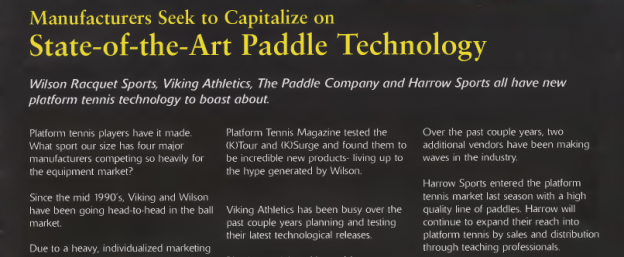
It may have been “The Year of the Ball” but there was plenty of paddle innovation for such a small sport, and four suppliers

Platform tennis players have it made.

What sport our size has four major manufacturers competing so heavily for the equipment market?

Since the mid 1990’s, Viking and Wilson have been going head-to-head in the ball market.

Due to a heavy, individualized marketing effort by owner David Kjeldsen, Viking was able to secure a substantial market majority through the 1990’s.

In April of 1999, Kjeldsen bought out Wilson’s ball market share for an undisclosed figure and term limit. Since then, Wilson’s former promotional Director John Embree began to focus on the paddle market, particularly in the Midwest and amongst women. Two years ago, Jim Burda replaced Embree to direct the platform tennis program. His duties included detailing paddle specification, testing equipment and then marketing to players and instructors across the northeastern states.

Burda’s success was evident last year when Wilson sold out their entire new paddle line less than one month into the season. With the success of last season in hand, Wilson has kept their top four 2006 models and launched two new (K)Factor paddles, based on their tennis racquet products. The paddles are an exciting addition to a sport filled with amazing technological advances for a sport so small.

The K-Factor paddles feature: a large hitting surface, (K)ore Foam that Wilson says provides a more stable hitting surface, and (K)ontour Rim – an enhanced stiffness for improved stability and (K)ontrol.

Platform Tennis Magazine tested the (K)Tour and (K)Surge and found them to be incredible new products- living up to the hype generated by Wilson.

Viking Athletics has been busy over the past couple years planning and testing their latest technological releases. Billed as paddles with precision, power and passion, the new line features Viking’s new VASTT” technology system.
Some of the technology is “under-the-hood”, and some is “visible technology”.

Variable Tempered Rims match rim temper to core densities that Viking says will optimize power and control. Surtar2TM and Tempered ImpactTM bonding technology match bonding levels to core densities.

Viking’s Core Impact TechnologyTM matches paddle “skins” to paddle “cores”. You won’t see them but Viking swears that players will notice the performance differences.

What does all this mean? It means that Viking has matched up variations of foam cores, rims and surface materials to create paddles with great variances in power, feel and flexibility. On two of Viking’s paddles, the Ignite and the Pro V-1, you will see a Shock Absorbing Ring billed to provide extra shock protection while not limiting power.

Over the past couple years, two additional vendors have been making waves in the industry.

Harrow Sports entered the platform tennis market last season with a high quality line of paddles. Harrow will continue to expand their reach into platform tennis by sales and distribution through teaching professionals.

At the same time, The Paddle Company has continued to expand their market share with their “body friendly” equipment (i.e. Soft, one-piece paddles with reduced shock).

Harrow Sports and The Paddle Company remain heavily invested in platform tennis; but, due to the launch of several new paddles in 2006 (and a new ball from the Paddle Company this summer), no new products have been released this season from these two manufacturers.

2007 – The Year of the Ball. The Paddle Company introduced new balls and Wilson Racquet Sports re-entered the market

Although there were some incredible new paddle technologies being released, 2007 may very well be membered as “The Year of the Ball”

A problem for our sport from the manufacturer’s standpoint – the ball has always been a loser. Not economical from any standpoint, the situation has come to a head in the last couple of years as the APTA asked, “What are our alternatives to the conventional platform tennis ball?”

Our ball has to endure up to 100-degree variations in heat, increasing amounts of grit applied to paddles, and the ability to be seen at night under the lights. Is it time we ask ourselves “Are we asking too much from this yellow piece of rubber?”

The volume of balls manufactured yearly (less than 200,000) is minuscule compared to balls for other sports.

The health concerns alone for the workers who apply the flocking to the ball are enough to make your hair stand on end.

Consistency in bounce, right amount of bounce, right color, and getting the flocking to stay on the ball are all factors contributing to the reluctance in manufacturers to even attempt to make a ball in the first place, given the small amount of numbers that need to be produced every year compared to tennis balls.

Is our unwillingness to change the ball inhibiting our sport’s ability to grow? Do we absolutely have to have this ball? What are our alternatives?

The Paddle Company, Wilson and Viking Athletics can tell you how hard it is to manufacture a ball. However, no ball, no sport. Someone has to take on the job to enable platform tennis to thrive.

The Paddle Company has surprised the manufacturing market by producing its first new batch of balls in years.

In March, 2007, CEOs Jerry Brown and Clark Reed sent out three different ball samples to platform tennis teaching professionals and top-ranked players. The balls were tested and compared to the existing Viking ball. The result is a new, brighter Paddle Company ball with a consistent bounce.

Wilson Racquet Sports also has just officially launched their reentry into the platform tennis ball market. Having bowed out of the market in April of 19991, an equipment sales surge has convinced the powers that be that the time to invest is now.

With Viking’s estimated 95 percent hold on the ball market share, Wilson felt that it was important to their overall platform tennis strategy to guarantee a stable environment by investing in their own product.

Terri Graham, Wilson’s Business Director of Indoor Racquet Sports said, “Jim Burda spearheaded our pursuit back into the ball market. We agreed that in having only one major ball manufacturer, we were posed with the question, ‘How would the sport suffer in the event something happens to them?”

Graham added, “We have taken a very aggressive forecast in our ball market re-entry. We have a long-term, better yet, call it a life-time agreement with the factory to produce balls.”

How will the new APTA Approved balls be different that those of Viking and The Paddle Company? Graham answered, “Our flocking is extra thick for added durability and spin.” She added, “This is a game of spin, and our ball will fit in perfectly.”

The three new balls are all excellent. They are very similar, yet subtly different in color, bounce and flocking. The manufacturer that succeeds in the best marketing approach will gain the upper hand in the ball market.

NOTE 1: Viking had acquired the Wilson ball business in 2000 but the five year non-compete restriction had elapsed

Source: Platform Tennis Magazine, Vol. 9, Issue 1, October 2007

Draw procedure for seeded players in tournaments reviewed; APTA updates “How to Conduct a Tournament Draw”

The Rules and Equipment Committee had been working on an update of the booklet on “How to Conduct a Tournament Draw”, and had reached the point of a final draft.

However, before going to press, Bob Brown had become aware of a difference of opinion among some Directors and members of Players Committees regarding the procedure for placing the seeds in the draw.

Ultimately the extant procedure was maintained

Screen Shot 2014-01-26 at 11.04.34 AM
How to Conduct a Tournament Draw

Is there an advantage to service?

During his tenure as the chair of the APTA Rules and Equipment Committee Robert A Brown had conducted a number of surveys of service holds and breaks, in part because of the no-let decision in the late 1990s. In 2003 he updated his earlier work with and analysis on the 20003 Senior Men’s 50+, 60+ and 70+ championships and filed the following report with PTM.

In discussions with players about the “pros” and “cons” of the no-Jet on net cord serve rule, the conversation usually progresses to a question as to whether the server In platform tennis has an advantage in serving. The “con” proponent will generally comment that this is the case and that the no-let rule further favors the server. While there Is a modicum of truth to the latter comment, It is not a significant factor, since most of the net-cord serves are returnable and the Incidence of the “dribbler” occurs on less than one-half of one percent of the serves delivered.

Regarding the question as to whether the no-let rule does, or should, help the server, maybe a case can be made that such help Is needed. Research has shown that service holds and service breaks In platform tennis are roughly 50/50, with some variation for men and women. The usual reaction to this fact: “That’s hard to believe!” That is a natural reaction from players· whose exposure to tennis over the years reflects the known dominance of the server In tennis – the result of having two serves, improved equipment and no wires. In platform tennis, with one serve and friendly wires, it’s a different story.

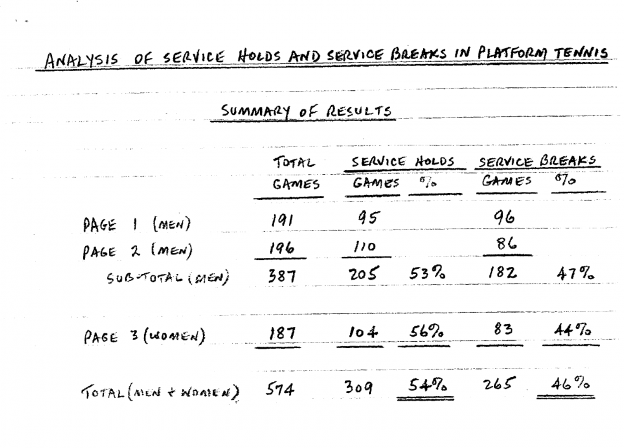
In a (limited) update of prior research, the chair umpire’s score cards for the championship matches in the 2003 Senior Men’s 50+; 60+ and 70+ tournaments were analyzed and yielded the following results:

In the 50+ final, Jean Kempner / Jim McNitt vs Steve Nycum / John Stefanik, a total of 30 games were played In three sets. There were 13 service holds and 17 service breaks.

In the 60+ final, Alan Graham / Stu Opdycke vs. Roy Anderson / Joe Holmes,a total of 17 games were played in two sets. There were 8 service holds and 9 service breaks.

In the 70+ final, Bob Brown / Dave Childs vs. Herb Bascome / Blair LeRoy, a total of 34 games were played in three sets. There were 17 holds and 17 breaks of service.

Grand total for the three matches: 81 total games (a pretty good sample), 38 service holds, 43 service breaks. (47% holds, 53% breaks)

These results seem to be typical of results in prior research for the men. Prior studies on the women indicated a higher percentage of service holds (56%) and a lower percentage of breaks (44%) which may be a reflection of a generally less offensive serve returns (?).

What about the average players, or players of lesser ability? While their performance has not been studied, It Is likely that we would find similar results or possibly an even lower percentage of service holds, since serves are weaker, providing as added advantage to the returner, and faults are more frequent.

So, aside from the matter of consistency between the net-cord on service and the net-cord during a rally, considering the generally poor service-hold performance, what’s wrong with giving the server a little help?

Platform Tennis Museum and Hall of Fame Foundation (PTMHOFF) application for 501 (c) (3) status finally approved; fundraising can begin

The APTA had financed and supported the creation of the PTMHOFF1 as an independent 501 (C) (3) entity. With the IRS finally granting exempt status effective February 19, 2004 the Foundation could now embark on a fundraising effort to “realize the dream”

Because the Foundation was a newly created corporation the approval was an “advance ruling” and was only effective through December 31, 20082.

NOTE 1: APTA President John Horine was the driving force to accomplish this and had worked closely with Andrew Giannella of ulmer berne llp of Cincinnati, OH to incorporate the Foundation and file the application for non-profit status. [See Also]
NOTE 2: This was subsequently extended

APTA applies for incorporation of the Platform Tennis Museum and Hall of Fame Foundation

A significant development occurred during the first half of the year after many years of discussion within the APTA. Under the leadership of APTA President John Horine the Platform Tennis Museum and Hall of Fame (PTMHOFF) became incorporated as a 501(c)(3) tax-deductible organization thanks to the work of Cincinnati player/attorney, Andy Giannella.

The PTMHOFF now stood alone from the APTA with its own Board and fund raising capabilities, although the latter had to wait of IRS approval of the 501 (c) (3) status.