The Chalmers Family – St. James the Less, Scarsdale Inquirer, Junior Wightman Cup, and APTA National Champion

The Reverend Alan Reid Chalmers was the rector of St. James the Less from 1920 – 1940 and was a keen tennis player and apparently the person to beat in singles. The July 8, 1922 edition of the Scarsdale Inquirer reported on the Men’s Singles and said the “the most noteworthy event… was the defeat of Rev. Alan R. Chalmers, who was on his way to being the club’s perpetual and universal champion.”

Born in Cambridge, MA, Chalmers was the son of an Episcopal minister who served the Church of the Holy Trinity in New York City for 27 years before his death. He was educated at St. Paul’s School, Garden city, LI and Princeton (1908). After a short business career he attended the Episcopal Theological School in Cambridge MA and graduated in 1913. Upon graduation he married the former Ruth Nash, a Vassar graduate, and served as a missionary in Cody, WY before moving to Scarsdale in 1920.

Ruth Nash Chalmers started a long career as editor of the Scarsdale Inquirer in 1926 and retired in 1957. Her retirement was covered in a special edition of the Scarsdale Inquirer captioned The Scarsdale Chalmers

The Chalmers had four daughters and one, Ruth, remained a long-time member of the club. She was a graduate of Scarsdale High School and Smith College, and was a ranking junior tennis player and a member of the Junior Wightman Cup Squad. She also toured in England with the Camp Merestead field hockey team and later as manager of the U.S. women’s lacrosse association touring team to Great Britain and Ireland. In 1957, she and Richard Hebard of Scarsdale won the National Mixed Doubles Championship of the American Platform Tennis Association.

Club now obliged to vacate leased land immediately upon sale. Theodore C. Jessup elected FMTC President (1921); courts remain on leased land but pressure grows

Theodore C Jessup (1892-1955) was a graduate of Hamilton and served as an Army Captain in WWI.

After the war he had a short business career in New York City and then became head of the Ridgefield Boys School in Ridgefield, CT in 1922. Poor health forced him into early retirement.

SI April 23 1921
Scarsdale Inquirer April 23, 1921

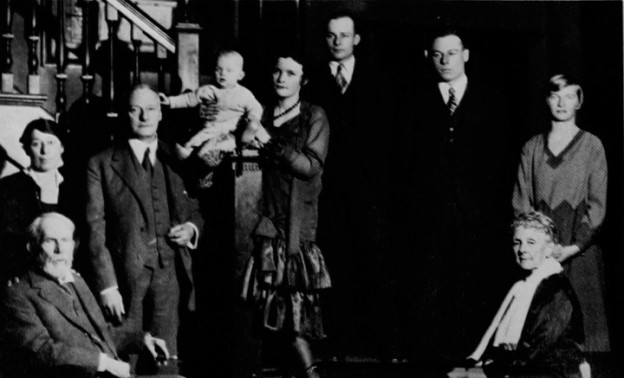
Forty-five years after the founding of the Club, first President Thomas Burgess stands at left for a family portrait in Colonel Alexander B. Crane’s entrance hall.  

A new era dawns with the opening of the new clubhouse in 1927

Club Secretary Hynson spoke of a “renewal of activity worthy of the traditions of the oldest tennis club in Westchester County.” By June 1927 the directors were able to report: “On the strength of the new clubhouse and the good management of our officers, we have obtained about twenty-five or thirty additional active members” for a total of about one hundred active members. The plan was for a club of between 125 and 150 members “to guarantee us an income sufficient to pay the fixed charges and relieve us of the necessity of selling more property.”

Sally Jackson Rasmussen, who grew up in the new Jackson house on Church Lane, says that it always seemed to her to be sunny and peaceful at Fox Meadow Tennis Club. From the house, the Jacksons could see not only the Club, but the cows and sheep grazing next to it on Crane Meadow.

“There was nothing but sheep, cows, and the windmill,” Rasmussen recalls. “It was just too lovely. Richard Crane used to cavort along the meadow on his horse.”

Though life-styles were changing and life’s tempo increasing, the pace was still more leisurely than it is today. Sally Rasmussen remembers the Edmund Pearsons, good friends of her parents, who on Sundays would pack a lunch, walk to Scarsdale from their apartment in the Riverdale section of New York, and play tennis and picnic at Fox Meadow. Small and informal, the Club was still an oasis of tradition and time-honored formalities. Tennis whites were to be worn on the courts. And in 1927, shortly after the clubhouse opened, the Fox Meadow Tennis Club announced that it would hold a tea for members on Wednesday afternoons.

Source: Diana Reische, Fox Meadow Tennis Club – The First Hundred Years, 1983

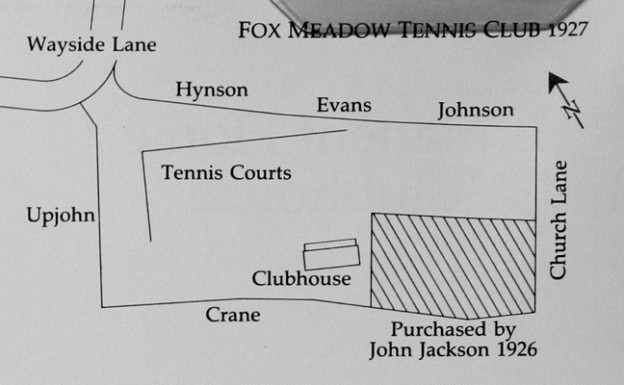
FMTC property, 1927, showing land purchased from Emily Butler in 1923 and parcel sold to John Jackson in 1926

A clubhouse needed but raising money difficult; controversial land sale in 1926 to raise funds resulted in a number of member resignations but ultimately made the clubhouse a reality

For four years the Club tried to raise enough money for a clubhouse by selling stock, but it was unsuccessful. At the 1926 meeting of the Tennis Club, John Jackson proposed another means of getting cash: He moved that up to an acre of the Club’s property be sold to raise money to build a clubhouse and new tennis courts.

It is clear that the proposed land sale provoked considerable debate. Four of seven directors of the Tennis Realty Corporation, among them President Pfeiffer, Jackson, Kent, and Stowell, resigned from the board. Although resignations signed by Jackson and Stowell dated July 26, 1926, are in the minute’s books, both are listed as present for a special meeting of the Tennis Realty Corporation on that date. A draft of the minutes says the board discussed an offer of $10,000 from John Jackson to buy the southern half of land facing Church Lane, which he would use as a home-site. (The official minutes do not mention the offer.)

In September, a reshuffled Board of Directors accepted Jackson’s bid. It also authorized the president to sell a second half-acre of land on Church Lane. This decision was followed by another round of resignations from the boards of both the corporation and the Club, and the corporation’s board finally decided not to sell any more land.

The $10,000 sale to Jackson in 1926 made it possible at last for Fox Meadow Tennis Club to plan a clubhouse. Financing was completed by consolidating the old mortgage with a new loan in a note of $20,000 at six percent. Walter Collet, a Scarsdale contractor who built dozens of homes in the community, built the clubhouse, designed by Walter Pleuthner, for $9,000. The new clubhouse was a small stone building with a roofed porch along one side and a large stone chimney. Small and spare, it set a modest tone for the Club. With no bar and no dining room, the clubhouse helped establish the unpretentious family atmosphere that typifies Fox Meadow even today.

A committee of Mrs. Rudolph Culver, wife of the Club president; Edith Wilson; and Harriet Mason chose wicker and stained oak furniture for the new building.

Source: Diana Reische, Fox Meadow Tennis Club – The First Hundred Years, 1983

Alfred W. Haywood. President, 1925

Alfred W. Haywood elected FMTC President (1925)

Haywood was a native of North Carolina and studied law at the University of North Carolina and at Columbia University. He move to Scarsdale in the early 1920s and lived at 1000 Post Road. He became a member of the New York City law firm Moore, Hall, Swan & Cunningham in 1929 (Warren Cunningham served as mayor of Scarsdale and was also a FMTC member).

In 1933 Haywood, who had been a member Scarsdale Board of Education since 1926, was elected President and oversaw the building of the new Scarsdale High School during his tenure.

At the time of his election to President of FMTC the Scarsdale Inquirer of March 14, 1925 reported “the report of the treasurer showed the club in fine financial condition with a balance of $900 in the bank.”