The Official Rules of Platform Tennis published

First Platform Tennis Rule Book published

Bill Ballard spearheaded this initiative with assistance from Bob Brown.

Prior to the publication of this book the guidance on platform tennis rules simply stated: “The rules of platform tennis are the same as for tennis except for the one serve rule and play off the wires etc.” The new Rule Book provided a comprehensive review of all the rules and regulations governing play.

The book was so well received that the first printing run of 6,000 copies quickly disappeared, necessitating a second printing in 1975.

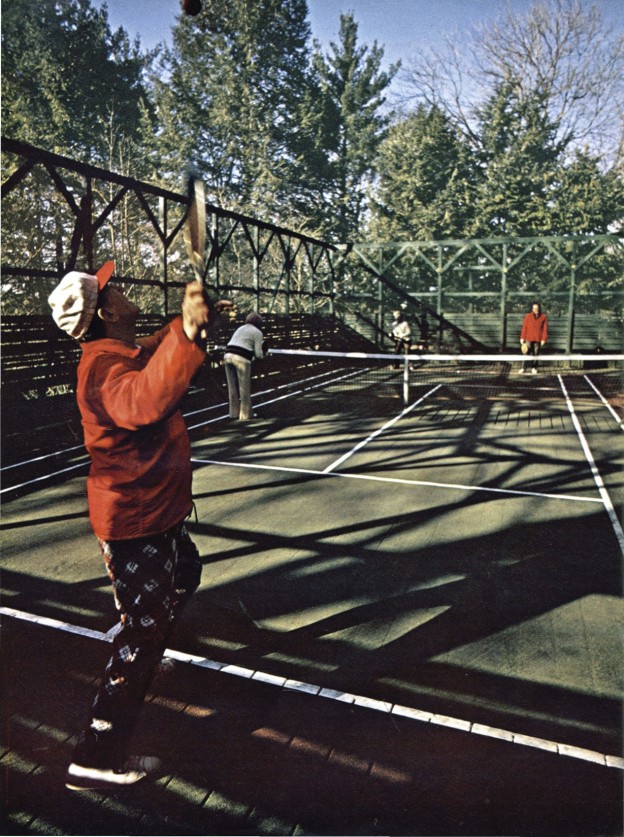
The rules allowed a let to be played if a ball hit the crossbar, the angular beam between the side screen and the back screen which were standard on courts at the time. Eagle-eyed umpires who spotted an apparent ambiguity on this position involving Rules 2, 13, and 19, were informed that the overriding ruling was to be found at 13 (d), to wit, if the ball hits a crossbar, play a let.

The Rule Book also indicated that the standards for holes in paddles might be waived, so if a paddle didn’t have between 52 and 74 holes, that didn’t necessarily, make it illegal.

Sources: Off The Wire, Vol. 6 No. 1 and No. 3, and Robert A. Brown, personal communication
APTA’s ball standards revised

The APTA reported that all four of the approved ball suppliers met the new, tougher standards and that they now had their own testing capability, so if any balls became sub-standard during the season they could be “unapproved.”

The new balls were lighter and less bouncy and a yellow ball was approved for night play.

The approved suppliers were Barr, Vittert, Beconta, Inc. (a division of Puma), and Marcraft.

The APTA set forth the new ball standards:

I. BOUNCE TEST FOR REBOUND
Balls are conditioned at 70 degrees for 24 hours, then dropped from
90 inches to a concrete slab, and the rebound is measured.

Standard Rebound: 40 inches; Acceptable Tolerance: 38″ to 42″

II. WEIGHT TEST
Standard Weight: 72.5 Grams; Acceptable Tolerance: 70 to 75 grams

III. DIAMETER TEST
Measure diameter along two perpendicular axes of the ball. Both
readings must be within tolerance.

Standard Diameter: 2 ½” inches; Acceptable Tolerance: 2 ½” – 2 19/32″

Source: Off The Wire, Vol. 6 No. 1<.small>

What’s in a name? Platform Tennis, Paddle Tennis are they the same?

In 1974, several letters to the editor of The New York Times surfaced about the name confusion between platform tennis and paddle tennis.

Burling Lowrey of Washington, D.C., and Dick Squires exchanged pecks as proponents for their respective games. The exchange, however, was broader in scope than just the name conflict.

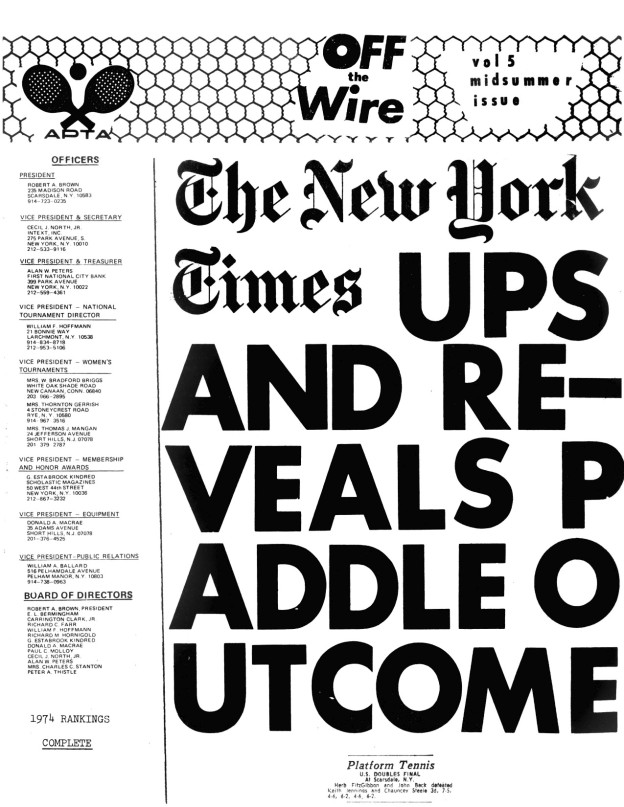
The Mid-Summer edition of the APTA newsletter, Off The Wire, had this to say:

It is not the intent of the APTA to enter the crossfire, but simply to set the record straight for our readers who may have read one or both of the letters, because both gentlemen are guilty of errors of fact.

Mr. Lowrey referred to the invention of platform tennis by a “group of Scarsdale millionaires,” one of the standard forms of jabs at platform tennis’ supposed snobbishness. In fact, neither Blanchard nor Cogswell were millionaires. Far from attempting to foster an aura of snobbery, the APTA was doing more each year to balance the game.

Mr. Squires, in turn, stated, “the fault lies with the purist platform tennis players as well as the present officials of the APTA. They insist on calling platform tennis paddle tennis, but mainly out of habit rather than any insidious desire to obliterate paddle tennis.” As regards to the public, it is probably true that it will be a long time before typical platform tennis players can be swayed from the conversationally- easy “let’s go play some paddle.” Regarding the APTA, however, all possible stress has been placed on the correct term platform tennis. In responding to telephone calls and written inquiries, and in promotional efforts such as last December’s press luncheon, in interviews and in editing drafts of articles about the game, all APTA officers strive for factual accuracy. Unfortunately, we are not always given the opportunity to review every item about platform tennis, hence the perpetuation of the erroneous name. Some people have suggested that we call our game “screen tennis” or “wire tennis” or “rebound tennis” among other names. What do you think? If you have an opinion on the subject, let us hear from you.

Source: Off The Wire, Vol. 5, Mid-Summer 1974

Ball draws criticism – more controversial than foot-faults!

The APTA Newsletter Off The Wire reported that the most controversial issue during the previous season (and that included foot-faults!) was the differences among the four APTA approved balls.

The article continued, “This one bounces too lively, that one warms up too slowly, the next one comes apart at the seams, etc. etc. etc. The Marcraft ball seems to have won high marks for playability, and some of the women’s tournaments actually publicized that ‘by popular demand’ the event was using Marcraft balls. Well, hold on to your prejudices, because we’re about to start a whole new ball game. Don Macrae, Grand Vizier of Equipment, has tightened up the specs for the coming season, and the manufacturers have all been advised to make a ball that is both lighter and less bouncy. Several of them have already submitted new batches for testing, and Don reports that the suppliers are being most cooperative.”

Source: Off The Wire, Mid-Summer 1974

APTA expands National Ranking

The Board approved the recommendation of the Ranking Committee to expand the National Rankings to include all nine categories in which National Championships were played. Previously, rankings had been determined only for the Men’s and Women’s categories.

The Mid-Summer edition of Off The Wire provided the expanded list of rankings, and details on the ranking procedure used for the 1973-74 season.

Source: Off The Wire, Vol. 5, Mid-Summer 1974

APTA develops a Tournament Sponsorship policy

The APTA adopted a policy of receptiveness to proposals for commercial sponsorship of tournaments other than National Championships.

A committee studied the issue and developed a detailed policy statement that was approved by the Board. The policy broadly provided for an APTA review of a proposed sponsor’s tournament format and, if approved, APTA assistance in locating a site, scheduling, tournament organization, and officiating.

The APTA would receive a fee from the sponsor, a portion of which would be passed on to the host organization, to assure that it remained in the black.

Source: Off The Wire, Mid-Summer 1974

Ethel Kennedy (center) presents the trophy at a tournament in Chevy Chase, Maryland, to (from left) B. J. Debree, Gloria Dillenbeck, Peggy Stanton, and Charlotte Lee.

Gloria Dillenbeck named first Executive Secretary

The APTA named Gloria Dillenbeck as the first full-time Executive Secretary. Raised in Montclair, NJ, Dillenbeck began playing platform tennis in 1966 and had been a star varsity tennis player at Swarthmore College.

With her partner, B.J. Debree, they were the first team to challenge the dynasty of Charlotte Lee and Peggy Stanton (National Champions 1967-1970) and won the Nationals in three successive years—1971, 1972, and 1973.

Gloria Dillenbeck Dodd was inducted into the Hall of Fame in 2007.

Screen Shot 2014-02-26 at 1.09.09 PM

APTA moves to hire an Executive Director

The thriving growth of the game resulted in a rapidly rising management load for APTA officers. The scope of activity and responsibility of some of the key functions, such as Tournaments, Treasurers, Secretarial, Equipment, Public Relations and the President, had increased to the point, in some cases, of exceeding the limits of “volunteer” or “spare time” effort.

President Robert A Brown summarized the decision in the Mid-Summer issue of Off The Wire: “The Board has therefore decided that the APTA will hire an Executive Director. Provision will be made in the 1974-75 operating budget for a salary for the Executive Director and secretarial and other expenses in connection with the job. In our budgetary planning, a number of income-generating steps are being considered, including the tournament sponsorship item discussed below.

The duties and responsibilities of the Executive Director have been defined in a detailed job description. In brief, this person will take on major management responsibilities, including certain portions of several officers’ jobs, and will handle all telephone and letter inquiries other than those that require the special attention of an officer. At the beginning it is expected that this job will be part-time, but is likely to grow with time. If any member is interested in discussing the position, or if you would like to suggest a candidate you consider suitable, you are welcome to contact Secretary Mike North or me. A knowledge of, and active participation in, platform tennis is desirable; management capabilities are essential.

Source: Off The Wire, Mid-Summer 1974

It’s not tennis, it’s not ping-pong, and its booming. Article written by John Ware for Travel & Leisure

APTA approves nine-point tiebreak

The tiebreak was to be played at 6-all. The APTA newsletter, Off The Wire, carried the details:

“1. The nine-point tiebreak is played when games reach 6-all.

2. The player whose turn it is to serve the next regular game is the first server. This is always the same player who started serving the set.

3. The team that wins 5 points is the winner of the set. The set is scored 7-6.

4. Each player must serve from the same end of the court in the tiebreak that he or she has served from during the set. (Note that this alters the sequence of serving by the partners on the second serving team.)

For illustration, with the serving team designated as Players A and B, and their opponents as C and D, the service order is as follows:

Points 1 & 2 are served by player A. Player A is always the player who started serving the set.

TEAMS DO NOT CHANGE COURTS

Points 3 & 4 are served by player D (out of normal sequence, but the
player who normally served from that end. )

Points 5 & 6 are served by player B.

Points 7 & 8 are served by player C.

Point 9 is served, if necessary, by player C, if the point score reaches 4-all. For this point only, the receiving team has the choice of receiving in either right or left court.

5. To begin the next set, “Stay for one” after the tiebreak. The team that did not serve first in the tiebreak serves first in the next set. Note that this rule continues to apply no matter how many sets in a match are decided by tiebreak.”

Source: Off The Wire, Vol. 5 No. 2

: Shirley Babington (left) and Marti Cavanaugh from Tenafly, New Jersey, won the Women’s Nationals in 1974. The sister team was runner-up in 1973, 1975, and 1977.

APTA takes position on use of tiebreak

The APTA newsletter, Off The Wire, reported on the APTA’s position on the tiebreak.

“The tiebreak is being used more and more in platform tennis tournaments. The APTA takes the following position on use of the tiebreak:

(1) For National Championships – The APTA will decide prior to each tournament whether the tiebreak will be used and, if so, for how many rounds.

(2) For all other Sanctioned Tournaments – The decision on whether to use the tiebreak or not is up to the tournament committee.

Where the tiebreak is used, the APTA recommended the nine-point tiebreak.”

Source: Off The Wire, Vol. 5 No. 2