Foot-Fault deliberations

Paul Malloy, Chair of the APTA Umpires Committee reflected on recent deliberations in the August edition of Paddle Talk:

A very controversial subject in the game of paddle is the “foot-fault rule.” Everyone understands that a player may not touch the baseline or step into the court before making contact with the ball. Most people also are aware that a player may swing his foot over the baseline during the service as long as the foot doesn’t touch the court prior to striking the ball. Gordon Gray, during his championship years with Sam Sammis, used to give foot-fault judges fits because the swinging foot was practically on the deck as he struck the ball. He has since modified his delivery and no longer swings the foot over the line.

The most troublesome area of the Foot-fault rule comes under Rule 7 (a), which says ,”The server shall throughout the delivery of the service: Not change his position by walking or running.” As stated above, we certainly would be able to deal with the “running jumpers” in paddle. Unfortunately, the rules of Tennis, to which we adhere very closely, added an interpretation from the International Federation on July 9, 1958. The interpretation says that “the server shall not, by slight movements of the feet which do not materially affect the location originally taken up by him, be deemed to change his position by walking or running.” The key word above would seem to be “materially.” How far can a server move before he is deemed to have “materially” changed his position? Two inches? Twenty-two inches? More? Less? In my opinion, the interpretation stated above was probably instituted so as not to penalize the player whose front foot slides inadvertently two or three inches, without touching the line during his service. It cannot have been meant to allow a player to take one, two or three steps and then launch himself into the air and into the court while striking the ball.

In past years I have many times been responsible for gathering volunteer linesmen. Almost without exception it has been impossible to get volunteer linesmen to call a foot-fault for anything other than its violation of the baseline. Understandably, they are reluctant to accept the responsibility for administering a rule which is, at.best, ill-defined

A committee to study the foot-fault rule was formed about three years ago by Bob Brown, president of the APTA at that time, consisting of Bob, John Beck, Bradley Drowne, Dick Squires, and myself. In addition, we sent a questionnaire to twenty-five top players for their opinions. After several meetings and many recommendations we zeroed in on wording that said “one foot must maintain contact with the deck at the moment of delivery.” With this change in effect, it wouldn’t matter how many steps a server took as long as he had to stop and hit the ball with one foot on the deck.

It turned out that this was not to be the ultimate cure-all. Upon subsequent study of some slow motion films of two classic servers, Dick Squires and Sam Sammis, it was observed that at the moment of impact of ball and racket, the extension of their arms pulled them off the deck by approximately one inch. We would have ended up with base linesmen down on their hands and knees trying to see if the server remained anchored to the deck. It was decided to leave the rule as is. A combination of sufficient public comment, trained linesmen and APTA directive might cause this rule to be more properly administered.

Source: Paddle Talk, No. 5 (August)
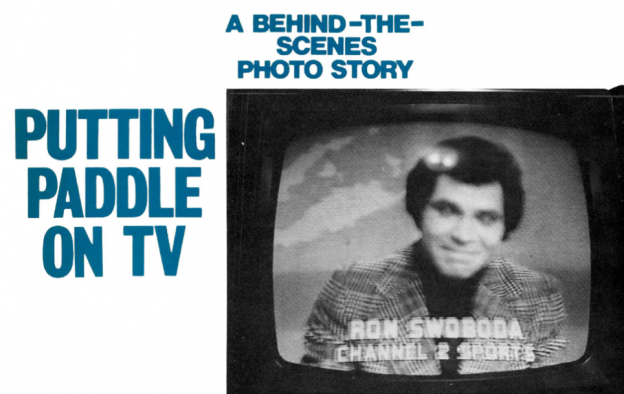
The challenges of capturing paddle for TV

Paddle had special challenges for the TV producer. The chicken wire screen made it a challenge to film for one thing, and with continuous play, it was difficult to find time for slow motion replays.

To tape the Nationals at Fox Meadow, cameras were placed at two corners of court #1, on top of the screens, and on a scaffolding structure on a hill behind the court. A mobile camera completed the setup. It was also necessary to place a dark green backcloth at the end of the court.

The Nationals aired on March 28 in New York, New Jersey, and Connecticut.

The first time that Al Steele, Executive Producer at Connecticut Public Television, and his team covered platform tennis was for the Mixed Nationals at Hartford in 1975. “Public television is always looking for new and different sports,” said Steele, “and as I’m an enthusiast myself, it was easy to decide on platform tennis. With the help of Skip Gengras of Hartford, we got started on the Mixed.”

The Nationals and Tribuno Championships were natural next steps for the year. A good deal of preparation went into the televising of an event like the Nationals. Steele worked with John Ware of Fox Meadow and Gloria Dillenbeck of the APTA to make the arrangements and calculate costs. Bob Kingsbury of the APTA arranged for Tribuno to underwrite the program. “We had really excellent cooperation from Fox Meadow,” said Steele, “and the team really enjoyed working with the people at the club. It was a lot of fun.” The production was offered to PBS stations nationwide as part of the Eastern Educational Network and Detroit; Phoenix and Cleveland sent inquiries.

Source: Paddle Talk, No. 4 (May)

APTA faces Issues with the tournament system

Carl S. Forsythe III sounded off in the Issues section of the May edition of Paddle Talk about a system that appeared to be creating incentives and recognition for a small group of elite teams at the expense of the broader tournament playing population.

“If the game of paddle tennis is to maintain a healthy depth and broad base of interest, a number of changes should be made next year in the manner in which the men’s tournament schedule is set up.

Generally, the current procedures discourage all but the top 15 or 20 teams, to whom they accord such a position of honor that teams below this group tend to become discouraged and drop ‘off the circuit.’

This causes a lack of depth in APTA draws and is, to some extent, responsible for the regularity with which the top teams march into the 16’s and quarters of the draw. In the long run it is neither in the interests of the top players nor the game of platform tennis generally to perpetuate a system which creates incentive and recognition for only a small group of elite teams.

This year’s Tribuno point system as applied to the 10 men’s ranking tournaments has aggravated a situation that was already deteriorating. The ‘best five’ system creates an incentive for every top team to enter every tournament, thus adding to the boring and monotonous nature of the draws and the discouragement of any team which cannot accumulate enough ‘points’ early in the season to be in the running for the top sixteen group.”

Forsythe went on to make a few suggestions for improvement.

Source: Paddle Talk, No. 4 (May)

The trials and tribulations of the Umpire’s Committee

Finding experienced umpires and linesmen was a challenge and cold weather made it worse. Paul Molloy reported on the challenges.

He wrote the following article for the May edition of the APTA newsletter Paddle Talk:

“The APTA created an arm known as the Umpires Committee approximately three years ago. Bob Brown, the APTA president, called a meeting of players interested and experienced in paddle and tennis officiating. Two of those in attendance were Paul Sullivan and myself, both members of the Eastern Tennis Umpires Association (ETUA). A committee was formed for the purpose of providing consistent and experienced officials at all APTA sanctioned and ranking tournaments. Paul Sullivan as Chairman and I as Secretary, sought out qualified Chair Umpires in Cleveland, Pittsburgh, Hartford, Long Island, and the other sanctioned tournament locations.

We also recruited some ETUA members, such as Jack Stahr, Mike Dunne, Adrian Clark, Lee Jackson and Judy Lessing, who have many years of Forest Hills and Wimbledon work among their credits. Prior to the start of the following paddle season, an Umpire-in-Chief was appointed for each men’s and women’s tournament. In return for a modest fee, the Umpire was charged with the responsibility of securing officials for the final and semi-final matches. This involved contacting the tournament Chairman well ahead of the event and working with him, or her to secure linesmen in advance.

To be a good linesman, one needs a certain amount of dedication and training, as well as good eyesight. Trying to find seven or eight such people on a twenty-degree Sunday afternoon in New Canaan, Short Hills or wherever is no easy task. Not many are willing to endure both the cold and the responsibility involved. We usually had to twist a few arms and often ended up with insufficient coverage and several unskilled linesmen.”

Source: Paddle Talk, No. 4 (May)

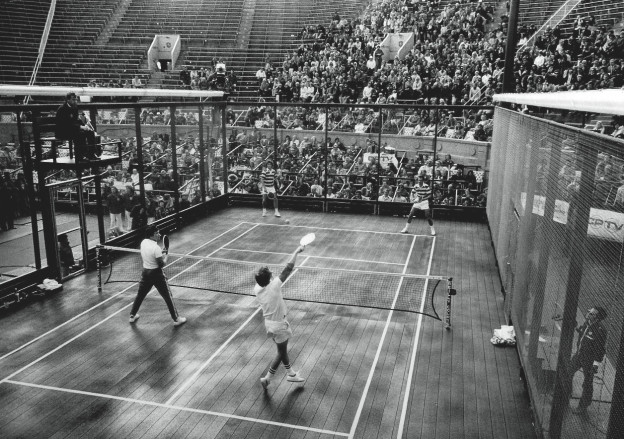
Doug Russell (left, far side) and Gordon Gray defeat Steve Baird and Chip Baird (right, near side) in five sets at the West Side Tennis Club in Forest Hills, Queens

Russell and Gray capture Tribuno Championships. They get the prize money but not the trophy

Paddle Talk head-lined the finals:

To cries of “Whoa-ho, Gordo!,” Russell and Gray became the First Tribuno World Paddle Champions, coming back from 4-6, 3-6 down after the first two sets to beat National Champions Steve and Chip Baird, with scores of 6-1, 6-3, 6-2 in the later sets.

Russell summed up the match afterwards, “Patience and power have given us the edge. The power is Gordon’s and the patience is mine.” In a season in which Gordon Gray and Doug Russell had vied with the Bairds for the top spot, it was indeed a tremendously popular victory.

Between 2,500 and 3,000 spectators were at Forest Hills to watch the semifinals, finals and pro-celebrity tournament on a cold, blustery but sunny day. Russell and Gray received a check for $4,000 and the promise of a trophy1 from Charlie Millard, Chairman of Coca-Cola Bottling Company of New York, for their victory in the climactic tournament of the Tribuno tour.

Adding fun and excitement to the festival of paddle were the celebrities and pros who participated in the benefit event for the National Council on Alcoholism. In the final, Barbara Wachenfeld and Charlie Gogolak defeated Manny Hill and Clark Graebner. Both Gogolak and Graebner played platform tennis in addition to their more renowned sporting activities.

Umpire Howard Cosell provided expert and hilarious commentary for the event, which featured New Jersey Governor Brendan Byrne, writer George Plimpton, designer Oleg Cassini, and Doug Johnson and Bill Beutel of Channel 7, among others, playing various shades of platform tennis with the top women players.

All in all, the day was a huge success, and a tribute to the game, players and their first major sponsor, Coca-Cola Bottling Company of New York.

Source: Paddle Talk, No. 4 (May)

Note 1: Coca-Cola had commissioned Jay O’Meilia to do create the Tribuno Championship Trophy and smaller version would be given to the winners (see below). Because of a shipping mistake the trophies never made it to the event.

Screen Shot 2014-02-12 at 8.58.33 AM

Tribuno World Paddle Championships

The World Championships [Tournament Brochure] were the culmination of the Tribuno Men’s Circuit and included a women’s event. Forest Hills hosted the event on April 2-3.

Tribuno Wines raised prize money to $82,900 for the 1976–77 Tribuno Men’s Circuit, which consisted of nine events in Cleveland, Hartford, Rye, NY, Short Hills NJ, Chicago, New Canaan, CT, Washington, DC, and Scarsdale. The prize money for each of the first seven tournaments was $4,200, while the Scarsdale Nationals prize money was $6,500. On April 1 and 2, 1976, the tour culminated at the Tribuno Platform Tennis World Championship, held at Forest Hills, Queens, NY. Tribuno put up $15,000 for both the men’s and women’s events, with the winners earning $5,000, the largest purse in the sport. Without a doubt, this event was the pinnacle of commercially-sponsored platform tennis competition.

On a clear, beautiful day, platform tennis enthusiasts gathered at the famous tennis stadium to witness a historic event at center court. About five hundred spectators were in attendance, with general admission seats costing $6 and courtside box seats, $25. As stated in the media guide, “this world championship helped propel the sport into national prominence.”

A sculpture was commissioned to be the trophy for the event. However, Jay O’Meilia, a noted sports artist from Tulsa, Oklahoma, did not complete the trophy by the date of the championship final. Instead, he was to send a plaster model to Forest Hills for the presentation. Unfortunately, the airline lost it.

The May 1976 issue of Paddle Talk stated, “Russell and Gray received a check for $4,000 and the promise of a trophy for their victory in the climactic tournament of the Tribuno tour.”1

Also on the program, between the semis and the final, was a pro-celebrity event in which sportscaster Howard Cosell provided commentary on the cold and blustery day while holding tightly on to his hat and his hairpiece.

Note 1: See Jay O’Meilia sculpture

Screen Shot 2014-02-10 at 1.40.05 PM

In 1976, for the first time, stringent qualifying criteria were applied to entrants to limit the draw to a manageable number. The event could be followed on television as PBS, courtesy of Tribuno, filmed it. In the Men’s, the Baird brothers defeated defending champions Jennings and Steele. This was the first of ten Men’s titles for Steve Baird. Wendy Chase and Linda Wolf defeated BJ DeBree and Fay Gambee for the Women’s title. DeBree then teamed with Herb Fitz Gibbon to win their second straight Mixed title. In the Senior events, Baird and Lankenau lost their bid for a hat-trick in the 45+, losing to Don Miller and Dick Squires, but did capture the 50+ championship.

National Championships. Sellout crowd of 2000 witnesses dramatic Men’s at Fox Meadow, filmed for TV by PBS

1976-Rev1

In 1976, for the first time, stringent qualifying criteria were applied to entrants to limit the Men’s draw to a manageable number. The event could be followed on television as PBS, courtesy of Tribuno, filmed it. Commentary was by Billy Talbert and Dick Squires
Screen Shot 2013-12-24 at 4.05.43 PM
The gang’s all here to watch as Chip and Steve Baird, receiving, win the 1976 Nationals. Note the cameraman with his overview from the cat bird’s seat!

By 11:30 on Sunday the ticket allocation of 2000 had been sold. Most spectators found seats in the stands on three sides of the Court 1 and others climbed tress or hung from the roof and pipes of the clubhouse.

In the Men’s, the Baird brothers defeated defending champions Jennings and Steele in four sets that included a dramatic ending when Steve passed out for a moment. This was the first of ten Men’s titles for Steve Baird.
Screen Shot 2014-02-12 at 11.01.56 AM

Wendy Chase and Linda Wolf defeated B.J. DeBree and Fay Gambee for the Women’s title. DeBree then teamed with Herb Fitz Gibbon to win their second straight Mixed title.
Screen Shot 2014-02-12 at 11.05.52 AM

Paddle Talk carried the full Men’s And Women’s draws.

In the Senior events, Chuck Baird and Roger Lankenau lost their bid for a hat-trick in the 45+, losing to Don Miller and Dick Squires, but did capture the 50+ championship, making it five in a row for Chuck.