
[click to enlarge]





[click to enlarge]
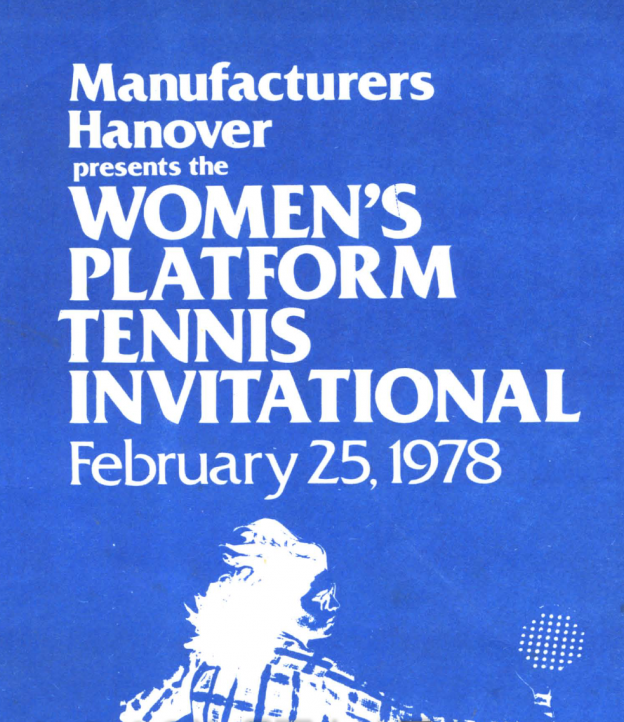
The Manhattan Platform Tennis Club on East 48th Street in New York City was the venue. Eight teams competed for $4,000 in prize money.
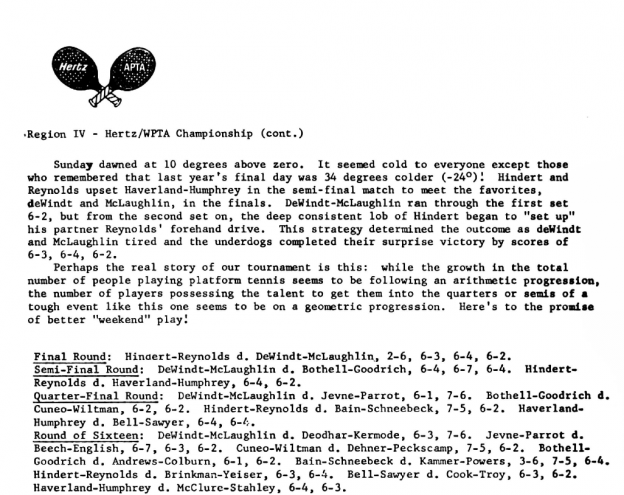
The APTA/Hertz publication Off the Wires covered the Presidents’ Cup and Regional tournaments
On September 29th, the Region IV Board approved the change of its title from the Western Platform Tennis Association to the Midwest Platform Tennis Association.
The new APTA Region V designated the Western Platform Tennis Association, included Arizona, California, Colorado, Idaho, Nevada, New Mexico, Montana, Oregon, Utah, Washington and Wyoming.
Source: Paddle Talk, Vol. 4 No. 2 (Jan 1979) and Paddle World Vol. 4 Dec/Jan 1978/79
The APTA had been asked many times why the singles game never developed in platform tennis. Singles offered certain advantages: it was more physically demanding; it appealed to the younger player; and, matches were easier to arrange.
The APTA held National Singles Championships from 1935-1938, so the idea of singles play was not new. They based the decision to abandon singles on the severe physical demands involved. However, since APTA ball specifications now allowed for a livelier ball and wire tension was greater, it was easier to reach an opponent’s shot.
As a result, the APTA Board decided that the time for singles had come. As a first step, the APTA held a singles workshop at the Apple Club in New York City on September 23. A group of top-ranked men and women players tried out several suggested formats. Two formats emerged as the most popular types. Both would be tested during the season at various clubs and paddle centers around the country, with a decision on which to proceed with made at the end of the season.
Source: Paddle Talk, Vol. 4 No. 1 (November)
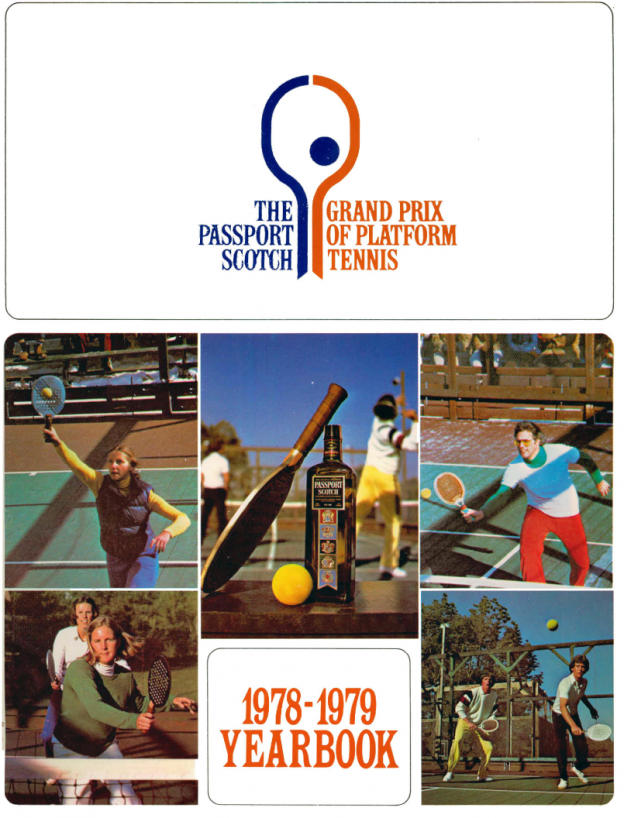
Calvert Distillers, a division of Joseph E. Seagram & Son. Inc., renewed its sponsorship of professional men’s and women’s platform tennis for the season.
The 1978-79 Passport Scotch Grand Prix of Platform Tennis featured the highest prize money in the sport’s 50 year history, a total of $169,400 for both men’s and women’s circuits.

Thanks to creative marketing, ample prize money, and the foresight of the APTA Board, platform tennis continued to grow. By 1978, it was estimated that four hundred thousand enthusiasts played platform tennis across the United States.
Hilton was invited by CBS to compete against five world-class racquet athletes in the World Racquets Championships.

Kingsbury was active in the APTA and served as President when paddle grew from a game to a sport to a business. He was instrumental in developing sponsors for the game when many top players were tennis and platform tennis professionals. He knew that prize money was essential for growth, but he also knew that the health of the game relied on keeping the average player involved and interested. This was a difficult balancing act, which he handled with perfection.
Kingsbury managed to get Coca Cola and Seagrams to make financial contributions to the game at the national ranking level. Following that, he enlisted the Hertz Corporation to underwrite events for club level players, culminating in a two-day President’s Cup that was extremely popular.
Source: Gannett Westchester Newspapers, January 1979
The top 20 “weekend player” teams from the APTA’s four regions gathered at the Montclair Golf Club in New Jersey on April 1 and 2 to compete in the first Presidents’ Cup Championship.
The format was a round robin, with teams positioned one through five in each region playing comparable teams from every other region. Each victory was worth one point toward the region’s total score.
Region IV (Mid-West and West) captured the first President’s Cup with a resounding record of 13 wins and 2 losses. Region III (Mid-Atlantic and South) finished second.
While the competitive play provided the focal point of the tournament, the social aspects were equally important. A genuine team spirit developed among the players from each region.
They scouted the opposition for each other, practiced between matches, and shouted encouragement to teammates during lengthy matches. The dinner dance on Saturday evening was rated a fabulous musical and sensory success by the 150 players and wives, former APTA Presidents, and Hertz Corporation executives in attendance.
Source: Paddle Talk, Vol. 3 No. 6 (July-June)
 © 2026 Platform Tennis Museum and Hall of Fame Foundation, All Rights Reserved.