


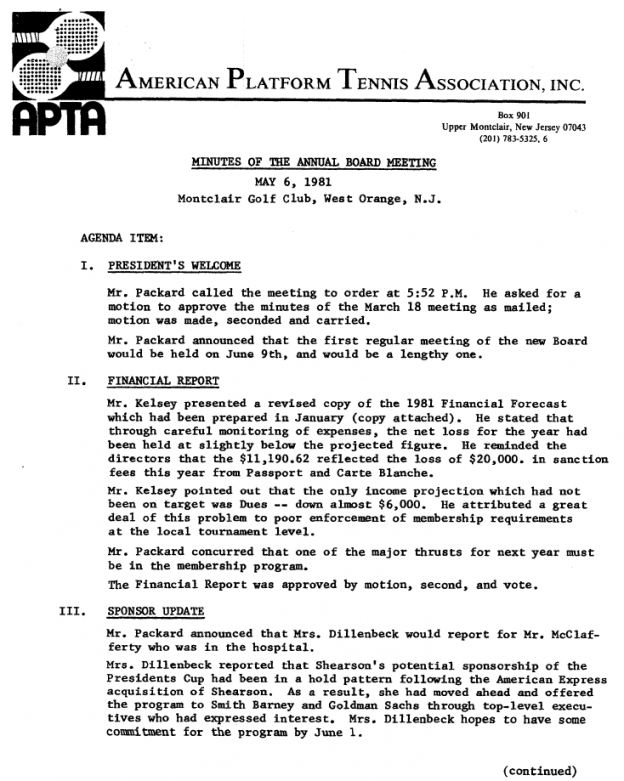
APTA Annual Meeting Minutes

The Minutes highlights:

Financial situation impacted by loss of sponsorship and decline in dues due to poor enforcement of membership requirements at local tournaments. The loss for the year was $11,191

Six issues of Platform Tennis News (PTN) to be published with Passport Scotch to be offered logo identification if they continued sponsorship of PTN ($7,500). More regional results were requested

The current crisis in tournament play was discussed and ways to encourage broader participation beyond the “pro circuit”. The Presidents’ Cup was a key part of this and expanding the number of teams from 4 to 8 was proposed

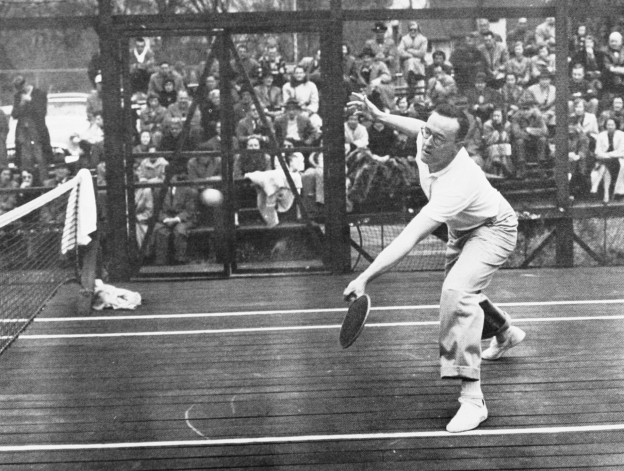
John R. Moses playing at Fox Meadow Tennis Club

John R. Moses ( – 1981)

Moses was one of the earliest good “young” players of the game in the early 1940s and ‘50s.

He had been the #1 ranked junior tennis player in the nation and, at nineteen, he was the youngest person ever to be a finalist in the APTA National men’s doubles.

He won the APTA Men’s doubles title at the age of 23, again the youngest ever to attain that distinction. He was inducted into the Hall of Fame in 1976.

At the time of his death after a long illness, John had retired to East Boothbay, Maine, in the same area where his family had summered for several generations.

Source: Platform Tennis News, January 1982

Two serves or not two serves? That is the question

The APTA offered players an opportunity to use January and February as a 60-day trial period to test a two-serve option at different playing levels in various club events. Feedback via Platform Tennis News was requested.

The May-June issue of the magazine carried the results. There were 19 yes votes to change to two-serves, and 141 voting no, indicating strongly that the change was not favored.

Some of the reasons were:
…..it would ruin the game. We don’t want it like tennis

…..leave the game alone, it is an amateur’s game enjoyed as is

…..how about two returns?

Source: Platform Tennis News, November 1981 and May-June 1982

Emphasis starts to shifts to social roots of the game

In addition to APTA sanctioned events, local and regional tournaments, which often supported a charity, and social get-togethers at the clubs became increasingly popular.

Playing for recognition, rather than for money, was the order of the next dozen years until the Lineal Group stepped in briefly in the early 1990s to underwrite a series of events called the Lineal Group Grand Prix.

APTA increases amateur tournaments

During the 1980s and 1990s, the APTA sanctioned a record number of events each year around the country, including junior and senior age group tournaments.

Major events usually occurred over several days and often included an elegant cocktail party or dinner dance where the social component attracted more league players and filled up draws nationwide.

The pros and cons of aluminum decks

Although R.J. Reilly introduced the aluminum deck in the early 1970s, many of the courts built prior to the 1980s had wood decks. These decks were relatively inexpensive to install, yet became difficult to maintain as active play and the elements took their toll. Aluminum decking not only extended the life of a platform tennis court, but builders now had the ability to install heaters beneath the courts that would warm the decks and eliminate thin layers of snow or ice that would prohibit play.

Aluminum decking revolutionized the court-building industry, yet it had an unforeseen impact on the accessibility of courts outside the more privileged country club scene. Wooden courts around the country that had been decommissioned, particularly in communities, municipalities, and schools, were simply not replaced because, though aluminum courts are less expensive to maintain, they were much more expensive to install.

The boom in court building during the 1970s slowed considerably with the trend toward aluminum courts in the 1980s, and by the 1990s most activity was firmly back in the private club arena.

Gregg Brents, Men's Nationals finalist in 1981, with Greg Moore

National Championships

1981wWomen's Singles

In the Men’s, Steve Baird and Rich Maier won their second title (the third for Baird who had won in 1976 with his brother Chip).

Yvonne Hackenberg and Hilary Hilton won their second title (the fifth for Hilton and the third for Hackenberg).

Hilary Hilton and Doug Russell completed their hat-trick in the Mixed and their fourth overall.

Doug Russell captured his second straight Singles and the Boy’s 18 and under was won by the future 1994 National Champions Art Williams and Pete Gruenberg.

Robin Rich Fulton won the Women’s Singles1

Chuck Baird won his third straight Mens 55+ with his third different partner, Roger Lankenau.

Note 1: There is some controversy as to how many National Women’s Singles were played after the APTA had sanctioned a Men’s event beginning in 1980. Women were participating in men’s singles events because they had difficulty getting enough teams to play. Both Men’s and Women’s National Singles Championship had been played from 1935-1937 when both were discontinued. The APTA Tournament Schedules for 1980-1981 as well as 1981-1982 indicate that both Men’s and Women’s Singles were scheduled for New York City. The 1982-1983 Tournament Schedule also suggests that both events were to be held. After that only Men’s Singles were scheduled.

Age eligibility for tournaments

The APTA had been fielding many requests on age eligibility. A preliminary ruling of a cutoff date of May 1 was repealed in favor of leaving the established calendar year “as is” for the balance of the season.

For example, if one attained age 45 in a given calendar year, one was eligible to play in any 45 tournaments during that year.