



Wood was the second woman president of Fox Meadow, following Hopeton D. Atterbury, later Mrs. William Quaid, who served in 1907 and 1909.
A history of Platform Tennis?
The Spring edition of Platform Tennis News carried the following article from an anonymous paddler from Troy, NY who was obviously unaware that the eminent historian and Old Army Athlete C. Alison Scully had already provided a history of the game to Fess Blanchard in 1935 for an article Blanchard had been asked to write for Esquire (See Tracing the Origins of Paddle Tennis).
The History of Platform Tennis:
THE EARLIEST SIGNS
Carbon dating has fixed earliest known relics of platform tennis around 40,000 B.C. Signs at the tundra town of Jhurk, have unearthed early paddles, probably made of caribou or whale skin, laminated by placing under eskimos. Over what must have been a precipice have been found thousands of round, resilient projectiles, leather around packed fur, which were called furballs.
Piles of rock forming the perimeter of a rectangle were originally thought to be a ceremonial ground, then a sacrificial area, an early solar calculator, or a platform playing ground. Most archeologists are willing to accept that all of these are essentially the same thing.
Computer calculation of the sun’s position 40,000 years ago determined that in the spring, as the tundra thawed, the rock mounds were used to elevate platforms. Present hypothesis is that the softening tundra no longer allowed the furballs to bounce.
This discovery sparked a branching of thought in platform archeology academia. Since the softening tundra would not allow a ball to bounce, while one group thought of the platform solution, a second group of lhurks applied their neolithic imaginations to develop a new game. They would put the ball on the ground-or elevated a little above it on a bone shard-and using the same clubs they used to brain their early arctic meals, would hit the ball, seeing how far they could make it go. The proliferation of prized penguin pellets indicates that wagering often accompanied this latter game. The debate rages about which game came first.
Source: Platform Tennis News, Spring 1989
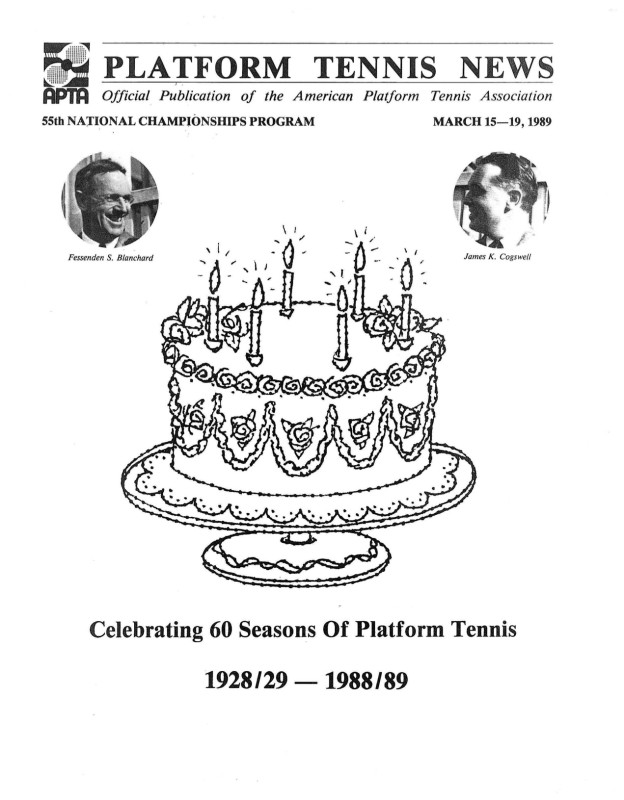
National Championships – and what it took to run the Men’s and Women’s Nationals and Presidents Cups
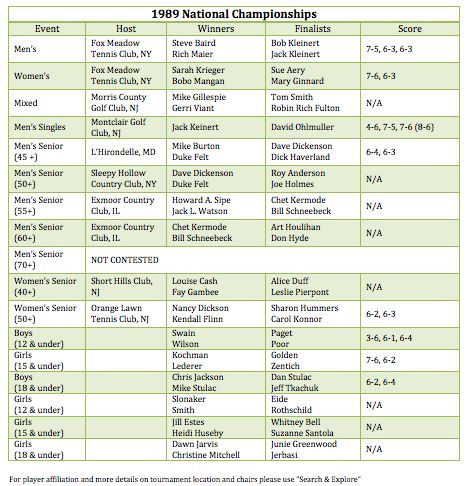
PTN Spring 1989 had the coverage of the Men’s and Women’s Nationals.
The top two seeds never saw the light of day in the Women’s Nationals finals, as Bobo Mangan and Sarah Krieger rose from their third-seeded position to lay claim to the title of Women’s National Champions for 1988-89.
Before a sun-drenched crowd at the “Home of Platform Tennis” at Fox Meadow in Scarsdale, NY, Mangan and Krieger eked out a 7-6, 6-3 triumph over fellow up-setters Sue Aery and Mary Ginnard, who had overcome one of the strongest women’s teams in recent years, Robin Fulton and Diane Tucker, in the semis.
After a year beset by change in the world of men’s platform tennis, the National Championships changed all that by going according to form. In a grueling, almost three-hour final, top-seeded and six-time champions Rich Maier and Steve Baird overcame the rising brother combo of Bob and Jack Kleinert, 7-5, 6-3, 6-3 in a best-of-five final. Baird and Maier took everything one of the strongest Nationals fields ever could throw at them, and refused to yield. They never lost a set and lost just 11 games in 10 sets prior to the final.
Source: Platform Tennis News, Spring 1989
Paul Molloy’s thoughts on players and matches
When Paddle Tennis News asked about the memorable matches he saw, this was his response. These recollections appeared in the March edition of PTN:
“I wish I had some vivid recollections of the classic matches involving Hebard, Carver, Pardoe, Harrison, O’Hearn and others. They were all great. Ted Winpenny comes to mind as the cagiest player I ever saw. Very steady and sneaky good.
Of the players I have umpired for over the last 16 years, there are several that stand out in my mind. Bob Kingsbury gave the most effort. I wish I had a dollar for every time he scraped himself up going for and usually getting an impossible shot.
Greg Brents was the fastest I ever saw. There was no way you could send a ball past him that he couldn’t get back and retrieve. Watching Hank Irvine was a joy. He has great style and no one ever covered his partner as he did. Herb Fitz Gibbon’s serve return and Keith Jennings backhand off the side wire were the best.
From where I sit, Doug Russell doesn’t get the credit he deserves. Only Dick Hebard rivals Russell for partnering so many championship caliber teams. Over a period of about 15 years, he won big matches and championships with Dick Squires, Graebner, Gray, Bob Kleinert and probably some others I have missed.
My nomination for the best all around player of the last decade would have to be Rich Maier. Consistent, aggressive, and punishing. He keeps coming at you, always applying pressure and forcing errors.
My favorite match was the win by Irvine and Greg Moore in the Nationals three years ago. To see Hank come back and win after being out of the game for a few years was tremendously popular and exciting.”
Source: Platform Tennis News, March 1989
Put a clock on it!
Probably the worst match Paul Molloy ever worked was at Rye, between Herb Fitz Gibbon and Hank Irvine against Gordon Gray and Doug Russell that went to 18-16 in the fifth set on a Super Bowl Sunday. After the match, Molloy met with the rules committee and got them to agree to play tiebreakers all the way.
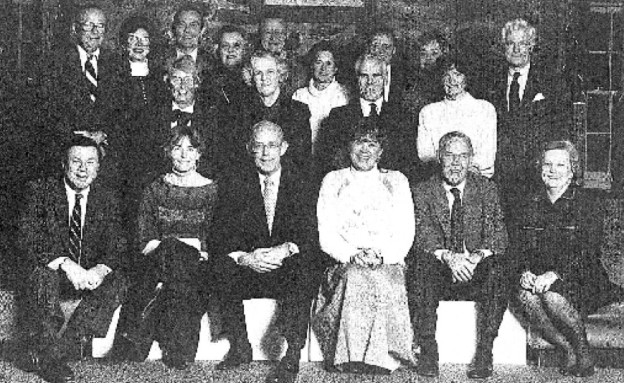
Fox Meadow hosts both Men’s and Women’s Nationals, and President’s Cups
The event marked the 60th anniversary of the game and was the 55th Nationals. The Men’s was chaired by Bob Brown and the Women’s by Judy Macy.
The tournament program carried the following letter from the Tournament Coordinator:
Welcome to the 1989 Women’s and Men’s National Championships and the President’s Cup team competitions:
How time flies!
It was 20 years ago this month that I first ran the Men’s Nationals at Fox Meadow and it seems like only yesterday. I have many vivid and pleasant memories of that event (won by Gordon Gray and Jesse Sammis over Brad Drowne and Bill Scarlett 6-1, 7-5, 3-6, 8 6), as well as the many other exciting championship matches at the club in the years since.
In those days, the finals were played on Court #2 before a cozy crowd. During the 1970’s, as the game’s popularity boomed, the finals were shifted to Court #1 in order to surround the court with stands for spectators. In the peak years of the mid and late 1970’s, the tournament was run over three days with a draw of 128 teams, and entrants had to qualify. Spectator interest grew and, in 1975-76, the capacity of Fox Meadow to accommodate fans was stretched to the point where it was necessary to turn some away at the gate. Although interest has waned some with the coming of the 1980’s, there are now signs that modest growth is again taking place.
This year is the 13th time in the last 21 years that Fox Meadow has hosted the Men’s Nationals. And while there have been many years in which we have also held the Women’s Semis and Finals on the final Sunday, in conjunction with the Men’s events, this year marks the first time that both the Women’s and Men’s Nationals are being held at Fox Meadow in their entirety (Cleveland and Rochester also did this successfully in each of the past two years). The Women’s and Men’s President’s Cup events are also being
played here during what has been designated as “National Platform Tennis Week”.
In view of the size of this task, a “veteran” committee has been assembled. It includes many people who have served before, and it is notable that 7 people on the committee have served as a Tournament Chairman of a National Championship in previous years.
It is my hope that the close relationship between Fox Meadow, Scarsdale (the birthplace of Platform Tennis), and the APT A Nationals will always continue. I have felt that tennis lost something when the Westside Tennis Club in Forrest Hills and the U.S. Open parted ways. While it is logical that the platform tennis championships should move to other locations to encourage and foster the game, I hope the sense of “coming home” whenever the tournament(s) return to Fox Meadow will continue.
We extend a warm welcome to all participants in this week’s events and to spectators and friends. The tournament also wishes to express its appreciation to sponsors and advertisers who have contributed to the financial success of the event.
I extend my personal thanks to the committee people who have worked hard to make this a success, to Hank Otto and the Fox Meadow Tennis Club, to Chuck Vasoll, Gina Ohlmuller, and the APTA for their assistance, cooperation, and support.
Robert A. Brown
Tournament Coordinator
Source: Platform Tennis News, March 1989 (Nationals Program)
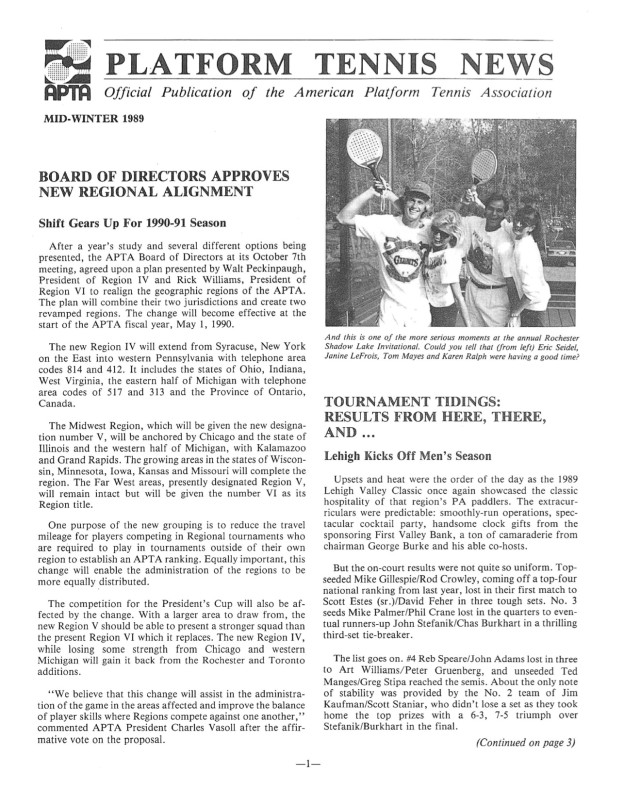
APTA Board approves new regional alignment
After a year’s study and the presentation of several different options, the APTA Board of Directors, at its October 7th meeting, agreed upon a plan presented by Walt Peckinpaugh and Rick Williams, presidents of Regions IV and VI, respectively, to realign the group’s geographic regions. The plan combined their two jurisdictions and created two revamped regions. The change became effective at the start of the APTA fiscal year, May 1, 1990.
The new Region IV extended from Syracuse, New York, on the East, into telephone area codes 814 and 412 in western Pennsylvania. It included the states of Ohio, Indiana, and West Virginia, the eastern half of Michigan with telephone area codes 517 and 313, and the Province of Ontario, Canada.
The Midwest Region, which was given the new designation number V, was anchored by Chicago and the state of Illinois, and the western half of Michigan, with Kalamazoo and Grand Rapids. The growing areas in the states of Wisconsin, Minnesota, Iowa, Kansas, and Missouri completed the region.
The Far West area, presently designated Region V, remained intact but was given the number VI as its Region title.
One purpose of the new grouping was to reduce the travel mileage for players competing in Regional tournaments, who are required to play in tournaments outside of their own region to establish an APTA ranking. Equally important, the change enabled the administration of the regions to be more equally distributed.
The competition for the President’s Cup was also affected by the change. With a larger area to draw from, the new Region V should be able to present a stronger squad than the present Region VI that it replaced. The new Region IV, while losing some strength from Chicago and western Michigan would gain it back from the Rochester and Toronto additions.
Source: Platform Tennis News Mid Winter 1989
 © 2026 Platform Tennis Museum and Hall of Fame Foundation, All Rights Reserved.