The game comes to Montana courtesy of Richard J Reilly, Jr

In 1993, court builder Dick Reilly (Hall of Fame 1974) moved west to Montana, put up a court, and ran a small tournament. Moving to another Montana location, the town of Eureka, Reilly erected two courts and brought out professional Hank Irvine (Hall of Fame 1995) to run a paddle camp each fall. Partly because there was little else for campers to do in their off hours in Eureka, Reilly moved the camp to Jackson Hole, Wyoming, where it continues. Initially, three courts were erected on a tennis court on a dude ranch to house the camp. After a year, the camp was moved to its present location on courts at the Snow King Resort.

At one of the camps, Reilly, Irvine, and Gary Horvath talked about the need to re-institute an organization for teaching professionals. The trio produced the conceptual foundation for establishing the USA Professional Platform Tennis Association (PPTA).

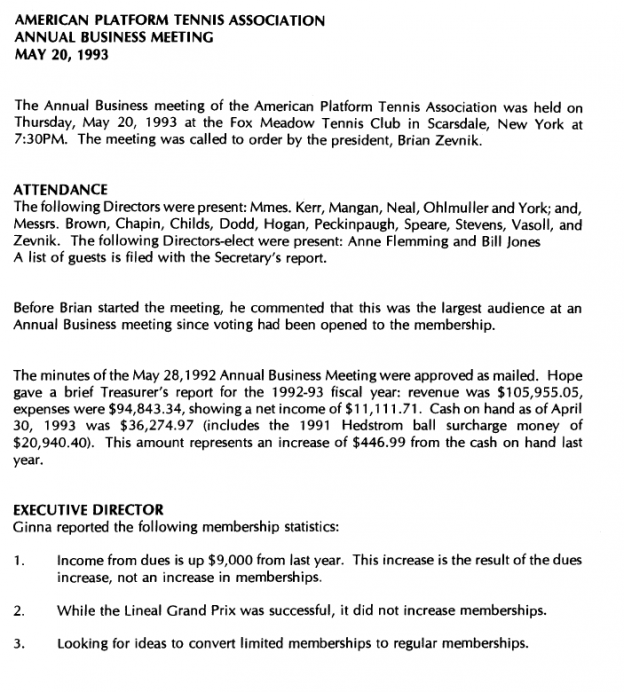
APTA Annual Business and Board Meetings

The Rules & Equipment Committee had been busy with the ARD ball, a new paddle from Marcraft, and had been updating the Rules Book, The Etiquette of Paddle and How to Conduct a Tournament Draw. Bob Brown also provided the Board with a copy of a position statement supporting the change of “playing lets on serve”

The Board reaffirmed that the President’s Cup was not intended for top ranked players and agreed to eliminate from President’s Cup competition any player who had reached the quarter finals of the Nationals in the last two years or who was one of the top eight ranked women’s teams or top sixteen ranked men’s teams

Rich Maier, Inventor redux

Maier was still not through with innovating (he had founded Skymar in 1983) and started Advanced Recreational Design (ARD) in 1993, along with Gary Whalen, a friend from Rich’s college days in Jacksonville, FL.

ARD produced three new paddles and introduced a new ball that lasted much longer (six sets was not unusual) than the balls being sold at the time, primarily by Vittert. The ball had been developed with the aid of a manufacturer in Taiwan.

Source: Private communication with Rich Maier

Platform Tennis News carried the good news

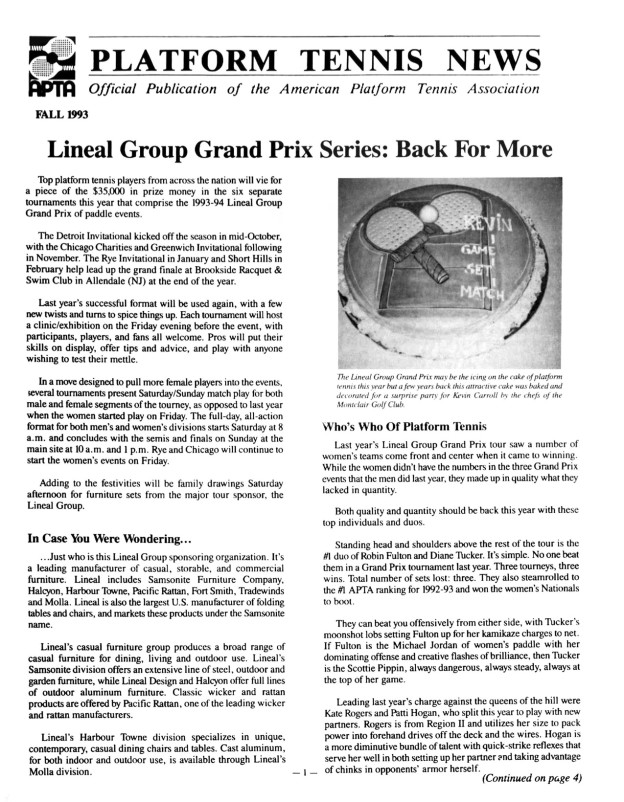
Lineal Group re-ups for 1993-1994 season

Top platform tennis players from across the nation vied for a piece of the $35,000 in prize money at stake in the six separate tournaments that comprised the 1993-94 Lineal Group Grand Prix of paddle events.

The Detroit Invitational kicked off the season in mid-October, with the Chicago Charities and Greenwich Invitational following in November. The Rye Invitational scheduled in January and Short Hills in February help lead up to the grand finale at Brookside Racquet & Swim Club in Allendale, NJ, at the end of the season.

The previous year’s successful format was used again, with a few new twists and turns to spice things up. Each tournament hosted a clinic/exhibition on the Friday evening before the event, with participants, players, and fans all welcome. Pros put their skills on display, offered tips and advice, and played with anyone wishing to test their mettle. In a move designed to pull more female players into the events, several tournaments had Saturday/Sunday match play for both male and female segments of the tourney, as opposed to when the women started play on Friday.

Source: Platform Tennis News, Fall 1993

The way it used to be

Back to the basics for President’s Cup

Over the years, the President’s Cup event had developed from the proverbial backyard barbecue into an all-out regional holy war.

Participants had come from some of the strongest teams in each Region, as opposed to the more “club-oriented” atmosphere that once existed.

Each year as well, the APTA discussed how to steer the PC more firmly down its original path, which is explained in the accompanying material from an article written in 1978.

To that end, the new restrictions included the members of the top eight ranked women’s teams from 1992-93, and the members of the top 16 ranked men’s teams. These teams were now ineligible for President’s Cup consideration.

Also, any player who had reached the quarterfinals of either of the two previous APTA National Championships (Long Island or Cleveland) was ineligible.

In order to earn PC points for a region, a player must be a member of the APTA before he or she played in a PC qualifying event. No member, no points.

The aim was to encourage more mid-level and club paddlers to play their way onto a regional team and enjoy the competition and team spirit that accompanied such an achievement.

Source: Platform Tennis News, Summer 1993

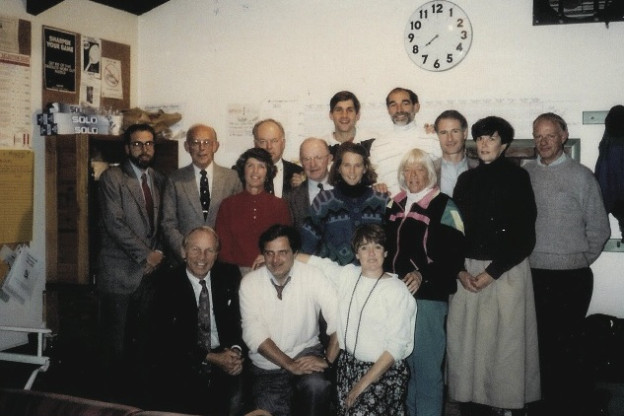
A 1993–94 APTA Board of Directors meeting at the Montclair Golf Club Paddle Hut. Standing back row: Reb Speare, Bob Brown, Chuck Vasoll, Peter Dodd, Walt Peckinpaugh, Pete McCormick, Carol York, and Bill Childs. Standing second row: Hope Kerr, Charley Stevens, Claudia Neal, and Nancy Mangan. Kneeling: Howard Sipe, Brian Zevnik, and Ginna Ohlmuller.

LETS Committee files a report

Despite a century-long period during which the inconsistent rules pertaining to let cord situations (serve or during play of point) had been perpetuated, the recently formed committee came out strongly in favor of consistent treatment – i.e., play should be continuous on all let cords which, after striking the net, land fairly in the opponent’s court, whether it be on service or during play after the service.

The committee’s rationale for this recommendation were:

1. The rules with regard to the play of all lets should be consistent.

2. The recommended change would speed up the game.

3. There would be no further disputes over whether a let on service was indeed a let (heard by one, but not by others).

4. One less official (the let cord judge) would be required in matches that are officiated.

5. Playing the let on service will add interest to the game.

6. Over the long run, points won or lost on lets on service will probably even out between server and receiver. The let service that just dribbles over the net into the receiver’s service court will usually be a winner for the server. On the other hand, the let cord service that pops up high and drops into the receiver’s service court will often result in an easy winning return for the receiver. The bulk of the let services that just graze the net cord will be routinely returned by the receiver.

The committee recommended a two-year trial period for the new rule, during which all matches had to be played using the new rule. This was a period long enough to permit players to adapt to, and become comfortable with the rule, thereby avoiding the natural human tendency to react negatively to change without giving it a try. This trial period recommendation was tabled by the APTA Board until 1996, when it was again considered and finally adopted. After the two-year trial period ended in 1998, the “no-let” rule was approved and became official in all play.

Source: Platform Tennis News, Summer & Fall 1993

New experiment: Local and APTA joint membership

In the latest attempt to encourage “average league players” to become APTA members, the Board of Directors approved an agreement with the Long Island Platform Tennis Association, as a one year experiment, to provide all of its members with full APTA membership at a reduced rate.

The experiment brought in 700 family members, and other areas expressed interest in the program.

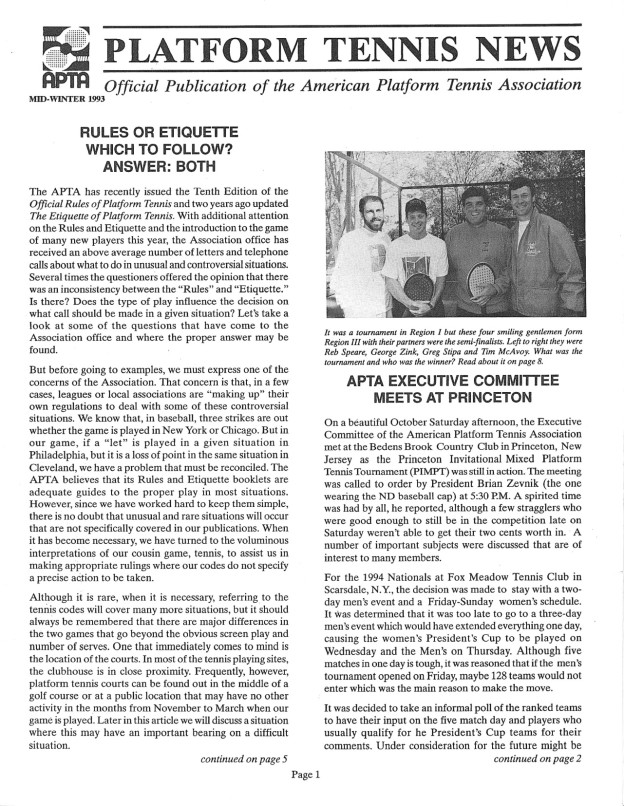
Mid-Winter edition of Platform Tennis News

Official Rules updated

The new edition was more than a reprint of existing text. With input from all the directors of the Association, and suggestions from members, Rules Committee, Director Bob Brown did a major rewriting of the text.

One of the seemingly simple, but really arduous tasks was to remove all the male pronouns (he, his, him) from the rules, in line with current practice.

The second major effort was to clarify rules for certain play situations that were not specified, but were understood to be accepted practice in actual court action. For example, the circumstances surrounding the ball hitting a net post were defined much more clearly than in the prior edition of the Official Rules.

Source: Platform Tennis News, Summer 1993

James W. Carlisle (1912-1993)

Carlisle served as President of the APTA from 1957 through 1959. Prior to that, he was Secretary of the Association from 1955 to 1957.

With Richard Herbard, he was a National Champion in 1955 and 1958. They were also Finalists in the National Championships in 1954 and 1959.

For his service to platform tennis, and his skills on the court, Carlisle was recognized with the APTA Honor Award in 1966.

He also served as President of the Fox Meadow Tennis Club, where he was elected as an Honorary Member.