The end of Lineal Sponsorship after three years of commitment

After three years of supporting the game of platform tennis, including the commitment of tens of thousands of dollars in tournament prize money and raffle drawings, the Lineal Group announced that it would no longer be able to sponsor the Lineal Group Grand Prix Series. Several executive, as well as business, changes had occurred at the company and thus it became necessary to end its successful relationship with competitive paddle tennis.

Ginna Ohlmuller, Executive Director of the APTA, commented on the development: “The Lineal Group provided a real boost to the game of paddle tennis over the last three years and they were a pleasure to work with.”

Ohlmuller made special mention of Arnie Ditri1, head of Ditri Associates, and John Balch, Lineal’s senior marketing manager. “Mr. Ditri had a genuine interest in the game of paddle and committed substantial time and effort to help the game graduate to the next level and John gave up numerous weekends over years to attend the tournaments, as well as spending innumerable hours in the office organizing the financial details, in order to make the relationship a first class one.”

Balch made the following statement:

“The Lineal Group is grateful for the opportunity we have had to sponsor our ‘Grand Prix’ tournament series. For three seasons, these events have been a good means of increasing awareness of our furniture brands and, quite frankly, we had a lot of fun in that endeavor.”

Diane Tucker, who along with Robin Fulton, finished the 1994-1995 season at the top of the Lineal Group Championship Series, provided a view from the women’s tour:

“The Lineal Group brought the men’s and women’s games together, and I got to know a lot more players because of their sponsorship. There was an added level of excitement when there was money on the line. The players felt a little more pressure and had something a little higher to aim for.”

Source: Platform Tennis News, Fall 1995

Note 1: Arnold E Ditri was President and Chief Executive Officer of Hedstrom Corporation, a manufacturer and marketer of children’s leisure and activity products, from March 1993 to December 2000. He was non-executive Chairman of Hedstrom from January 2001 to July 2001. Mr. Ditri served as President of Ditri Associates, Inc. from 1981 until 1994, which company, with a number of financial partners, specialized in acquiring and building under-achieving companies with Mr. Ditri serving as Chief Executive Officer of the acquired companies.

“Code of Conduct For Platform Tennis Players” established

Responding to the occasional “bad apple in the bushel,” the APTA released a statement that describes the expected conduct of competitors in its tournaments and the penalties that may be enforced against violators.

The “Code of Conduct for Platform Tennis Players” below appeared in the Tournament Schedule as “a constant reminder to participants of what is expected of them when they enter sanctioned events.”

Players shall not engage in unsportsmanlike conduct. At no time, but especially during the course of a match, shall a player engage in:

a) verbal or physical abuse of any persons connected with the game or spectators;

b) use of visible or audible profanity;

c) mistreatment of the equipment, the court or its fixtures;

d) behavior that reflects a failure to accept the decisions of officials and/or disregard for the rules and spirit of the game.

Any official or player may report conduct considered improper on the part of a player to the Tournament Director and/or the office of the American Platform Tennis Association for investigation by its Conduct Review Committee. The Committee shall report its findings to the Board of Directors of the Association, which will assess penalties as it deems appropriate.

The penalties may range from refusal to accept an individual’s or team entry in a future tournament at the same venue, to suspension from sanctioned tournaments for 12 months.

Source: Platform Tennis News, Summer 1995

The new specifications

New equipment specifications

As the result of new manufacturing techniques, the Equipment Committee, headed by former APTA President Robert A. Brown, was asked to review the APTA paddle specifications.

The Board approved a recommended change to make the total maximum length of the paddle 18″, and eliminate the separate handle/play length designation.

It also approved a change in the edge (or rim) that will allow a 1/8″ height wraparound of a maximum 1/2″, in addition to the flush-with-face surface that was previously the only one allowed.

Source: Platform Tennis News, Summer 1995

Leagues improve APTA finances

Treasurer Hope Kerr reported at the Board’s May meeting that the revenues of the Association for the 1994/95 fiscal year exceeded expenses by $14,815.81.

This was the best year for the Association in some time, and reflected a good increase in membership as the result of the joining en masse of several leagues.

Platform Tennis News, Spring 1995

Lineal Group Grand Prix

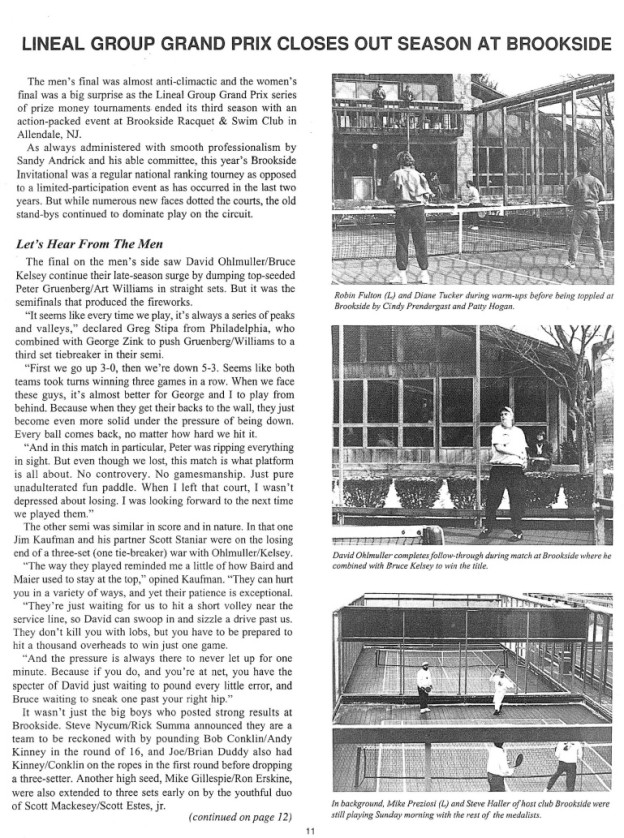
The men’s final was almost anti-climactic and the women’s final was a big surprise as the Lineal Group Grand Prix series of prize money tournaments ended its third season with an action-packed event at Brookside Racquet & Swim Club in Allendale, NJ.

The final on the men’s side saw David Ohlmuller/Bruce Kelsey continue their late-season surge by dumping top-seeded Peter Gruenberg/Art Williams in straight sets. But it was the semi-finals that produced the fireworks with Greg Stipa and George Zink pushing Gruenberg and Williams to a third set tiebreaker, and Jim Kaufman and Scott Staniar to three sets against Ohlmuller and Kelsey.

Some people were starting to complain that women’s tournaments had become too predictable, with the same teams dominating from start to finish. Jersey’s Patti Hogan and Delaware’s Cindy Prendergast helped squelch that attitude at Brookside by knocking off heavy favorites Diane Tucker/Robin Fulton in fairly routine fashion.

Source: Platform Tennis News, Spring 1995

Dave Kjeldsen, founder of A2Z (later renamed Viking Athletics), with his familiar horned hat and cigar

A2Z acquires the assets of Marcraft Recreation Corporation

There was a new/old “player” in the manufacturing ranks of the platform world. A2Z, headed by President David Kjeldsen, had transformed itself from Marcraft ‘s largest retail distributor into a manufacturer/wholesaler of platform equipment, by purchasing the assets of Marcraft Recreation Corporation’s domestic platform tennis division in April 1995.

At the time Marcraft was just a paddle manufacturer. They had been a ball manufacturer for a while in the 1970s (Big M yellow and red balls) but had stopped production and had become a reseller of the game’s dominant ball, Hedstom’s Vittert V30.

When Hedstrom sold their ball manufacturing business to Wilson – see Wilson Acquires Hedstrom Ball Business – this created an issue for A2Z (renamed Viking Athletics in 1996) as Wilson refused to allow them to continue selling the V30 ball as they were now a competitor in the paddle market. This forced A2Z to develop their own ball

Platform Tennis News covered the induction ceremony (summer 1995 issue)

APTA Honor Awards: Drowne, Irvine and Ware

Bradley Drowne: Bradley Drowne served as the National Tournament director for the APTA for many years and pioneered the rankings system employed today. He was “Mr. Steady” as a player and won the National Men’s in 1968, the Mixed in 1969 and 1974, and his first Men’s 45+ in 1973 over Baird and Lankenau.

Hank Irvine: Hank Irvine was a player who changed the game and was always exciting to watch. His shot-making and control of the ball set new standards, and he had great hands and ease of stroke, coupled with economy of body movement and consistency. He started playing and teaching the game in 1973, when he became head pro at the Short Hills Club after immigrating from Rhodesia (now Zimbabwe). By 1997, he had won his first National Men’s with Herb Fitz Gibbon; they repeated the following year. Six years later, he again won back-to-back Men’s nationals in 1986 and 1987. In the senior events he won the 50+ once, the 55+ four times, the 60+ three times and the 65+ once. Hank was a wonderful ambassador for the sport as a teacher and devoted much time to the development of juniors. (Short Hills Club).

John Ware: John P. Ware’s first achievement was changing the color of the original white ball, which was hard to see, into an orange one with the use of spray paint. Eventually,he got the ball to be manufactured that way, until the change to yellow took place. He served as Secretary of the APTA from 1959 to 1961, and as President from 1961 to 1963. He inaugurated the first APTA Junior Boys National Championships in 1963, and designed the crossed paddles and ball that was used on stationery, trophies, ties, scarves, and everything that represented the APTA for years. As Blanchard’s son-in-law, Ware became the game’s historian, writing numerous articles on the game and helping to publish books. With his wife, Molly Blanchard Ware, he put together the first and only – and truly magnificent – slide show presentation on the history of platform tennis. It was shown first at the Princeton Club in October 1976.

Garden State Nationals, March 23 - 26, 1995

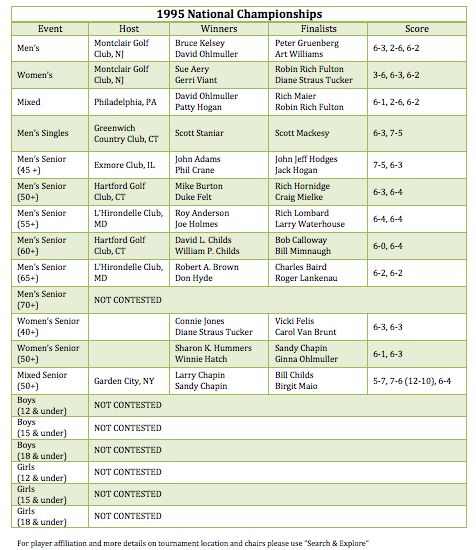
National Championships and coverage of the Men’s and Women’s Nationals

1995

PTN Spring 1995 covered the Men’s and Women’s Nationals:

For one 96-hour period, all platform tennis roads led to New Jersey, as the Garden State Nationals and concurrent President’s Cup events were hosted to perfection by Montclair Golf Club and Short Hills Club.

Players and spectators came from every point of the compass, and play reached its usual outstanding levels. But there were differences this year. For one, the Children’s Specialized Hospital of Mountaindale (NJ) was the recipient of the generosity of the sponsors and advertisers who supported this year’s Nationals, and received in excess of $10,000.

Another new wrinkle at this year’s event was the presence of the omnipresent eye – television. Spearheaded by sports editor Paul Spychala, Suburban Cablevision taped both the men’s and women’s finals for showing to some 2.5 million subscribers on its system. The tapes were also made available to outlets in several other regions, including Philadelphia and Boston.

On the court, there were upsets galore, top teams rose to the top, and three-set matches and tight finishes were commonplace. David Ohlmuller and Bruce Kelsey continued their late season surge and staked their claim to the title of “platform’s best” by dumping defending champions Peter Gruenberg and Art Williams in a match that had a little bit of everything.

For the second year in a row, Nyack’s (NY) Gerri Viant and Plainfield’s (NJ) Sue Aery confounded the status quo and knocked off the top-seeded duo of Robin Fulton and Diane Tucker. All season long it seemed like those two teams were at loggerheads when push came to shove in the finals of various events.

Source: Platform Tennis News, Spring & Summer 1995

Nationals draw now overseen by APTA office

1995 marked the first year that the draw was prepared by the APTA office, rather than by the National Championship Committee at the host site.

Local input on the ability of unknown teams was still sought by the draw committee, but otherwise the selections were to be made in strict conformance to the guidelines published by the APTA.

Charity dinners are out; Paddle tournaments are in

Instead of gala balls and celebrity-studded formals, charities around the country are finding that platform tennis can be an important vehicle for both raising funds and enhancing their visibility and image.

Paul Delaney, who played out of Bronxville, arranged a mixed tournament to support the Visiting Nurses Services of Westchester and received lots of positive reaction because of the good cause and the popularity of mixed events in Westchester. He hoped to make this an annual event, and it still is.

Source: Platform Tennis News, Winter 1995