Platform Tennis News, Winter 1995

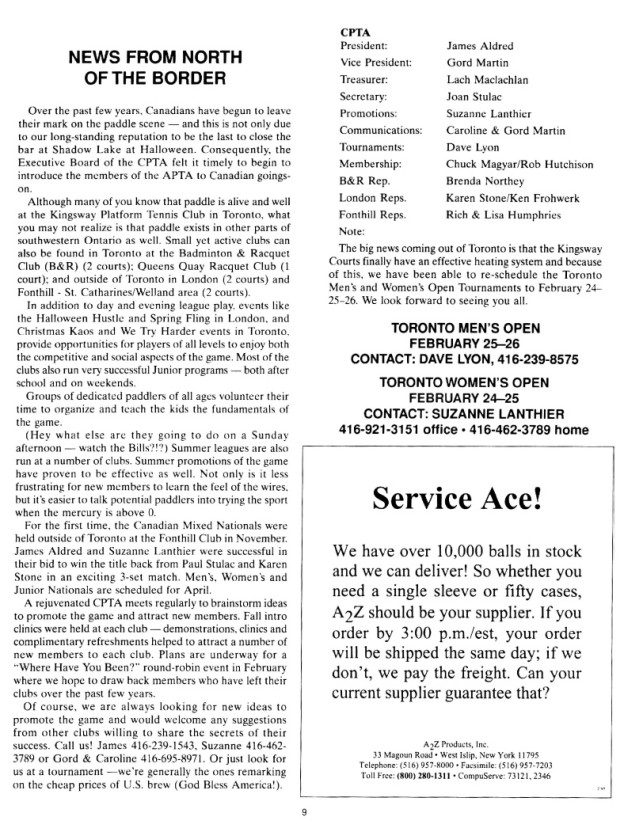
News from north of the border

Over the past few years, Canadians had begun to leave their mark on the paddle scene, and not just due to their long-standing reputation to be the last to close the bar at Shadow Lake (Penfield, NY, near Rochester) at Halloween.

Consequently, the Executive Board of the Canadian Platform Tennis Association (CPTA) felt it timely to begin to introduce the members of the APTA to Canadian goings-on.

[Note: Hall of Fame inductee Chuck Baird had spent some years in Toronto when he was with International Nickel Company of Canada (INCO) in the 1970s and had served on the Canadian Platform Tennis Association and was instrumental in getting them to join the APTA]

The Winter edition of Platform Tennis News ran the report from the CPTA.

Source: Platform Tennis News, Winter 1995

APTA Board again struggles to address foot-faults

In the continuing struggle to contend with the foot-fault violation, and possibly clarify the foot-fault rule, the APTA Board again considered the matter.

The discussion focused on two questions: (1) What could be done to control/reduce the incidence of foot-faulting among players? and (2) Should there be any change or changes in the foot-fault rules?

It was decided that, starting with the 1995 season, all National Championships should have a foot-fault judge in all matches from the quarterfinals on, unless there was a chair umpire. While it was recognized by the APTA that this would be a difficult chore for both the committee and the appointee, it was felt that it can and should be done in order to further curb the incidence of foot-faulting.

With regard to the second question, the discussion focused on the current wording of the foot-fault rule (Rule II) in the Rules Book. The rule states that the server, throughout the delivery of the service. may not “change position by walking or running,” but the rule goes on to state that the server is not deemed to be walking or running as a result of “slight movements of the feet which do not materially affect the location originally taken by the server.” In focusing on what is a “slight movement,” the Board considered changing the rule to be more specific, but decided to defer this decision and think further about it during the season.

The APTA had also received suggestions that the rule specify that the forward foot must maintain its original position, thus disallowing any movement, although “pivoting” of the forward foot would be allowed. It was deemed that such a regulation would be even more difficult to enforce than the current violation of simply stepping on the line, so the Board also deferred consideration of this suggestion.

Source: Platform Tennis News, Winter 1995

Experimental clinic report recommends “no-let” be implemented

The committee (Robert A. Brown, Walter Peckinpaugh, Charles J. Stevens and Charles E. Vasoll) recommended that the APTA Board consider implementing the “no-let” rule in the 1996-1997 season; that the diagonal corner screens were not a practical innovation the Board should consider further; and, that the no-ad rule, which had been favorably received, should be given further consideration.

A full report on the experimental clinic was included in the Mid-Winter edition of Platform Tennis News.

Source: Platform Tennis News, Mid-Winter 1995

APTA Board approves experimental clinic to explore changes to the game

Bob Brown, reporting for the Rules Committee, requested and obtained approval for an experimental rules clinic at the Fox Meadow Tennis Club in Scarsdale, NY.

The most intriguing proposal involved the modification of the court by placing diagonal screens in the four corners. The Board approved an expenditure of $1,000.00 for this program, which included the manufacture and installation of the temporary screens to experiment with this suggestion.

Other proposed rule change suggestions, including no-let on serve, and different scoring procedures, were also to be given an experimental test.

Source: Platform Tennis News, Mid-Winter 1995