Viking Cup Adult/Junior Tournament

An Adult/Junior platform tennis tournament was conceived by Robin Rich Fulton following her experience running the National Junior Championships the previous season at the Wee Burn Country Club in Darien, Connecticut. She enlisted the assistance of Bob Callaway in the venture, and had the support of David Kjeldsen of Viking Athletics as the title sponsor.

The goal of the tournament was to promote the game among the younger set by giving them an opportunity to play with adult partners; learn from them; enjoy the camaraderie and ambiance of a tournament; and inspire juniors to continue to practice and play. The National Junior Championship would follow the event on the APTA schedule. The concept was to have regional play in as many locations as interest could be generated. Four sites had already signed up and winning teams from these locations would be invited to a central location play-off for the Viking Cup.

Each team would be composed of one junior (male or female) under 18 years of age and an adult, also male or female, but the combined ages of the team had to be a minimum of 43 years. Viking Athletics would donate a permanent “Cup” plus appropriate prizes.

Source: Platform Tennis News, Summer 1996
Foot-Fault awareness

Foot-fault 1996

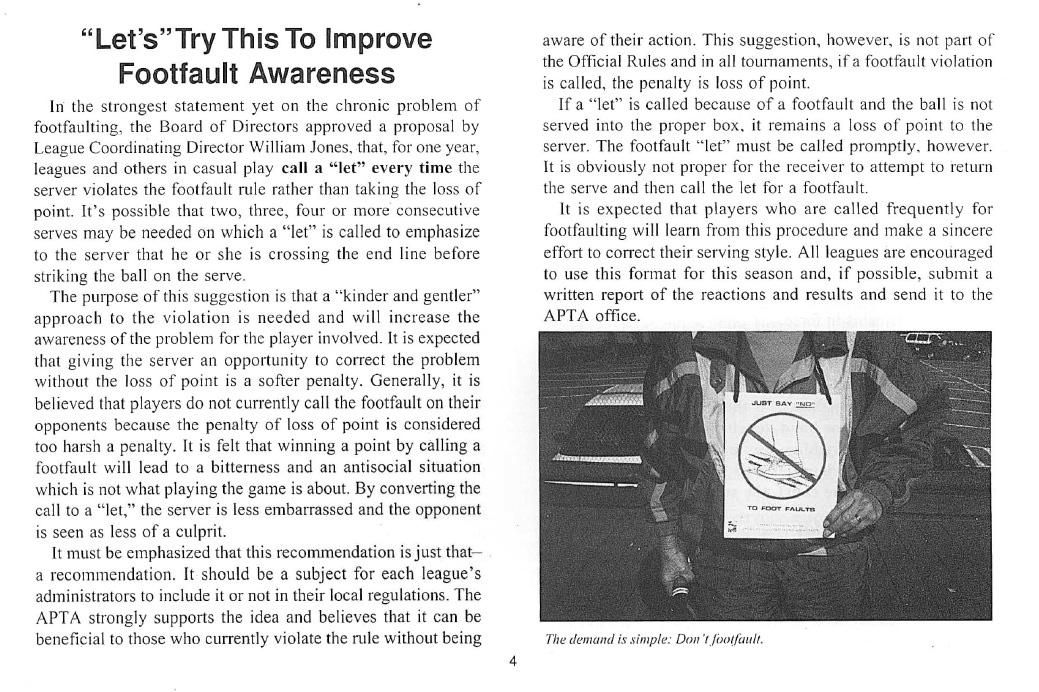
In the strongest statement yet on the chronic problem of foot-faulting, the Board of Directors approved a proposal by League Coordinating Director William Jones, that, for one year, leagues and others in casual play may call a “let” every time the server violated the foot-fault rule rather than taking the loss of point.

The purpose of the suggestion was that a “kinder and gentler” approach to the violation was needed and would increase the awareness of the problem for the player involved.

Source: Platform Tennis News, Summer 1996
Platform Tennis News, Summer 1996

No-Let serve started – two year trial period to assess player reaction

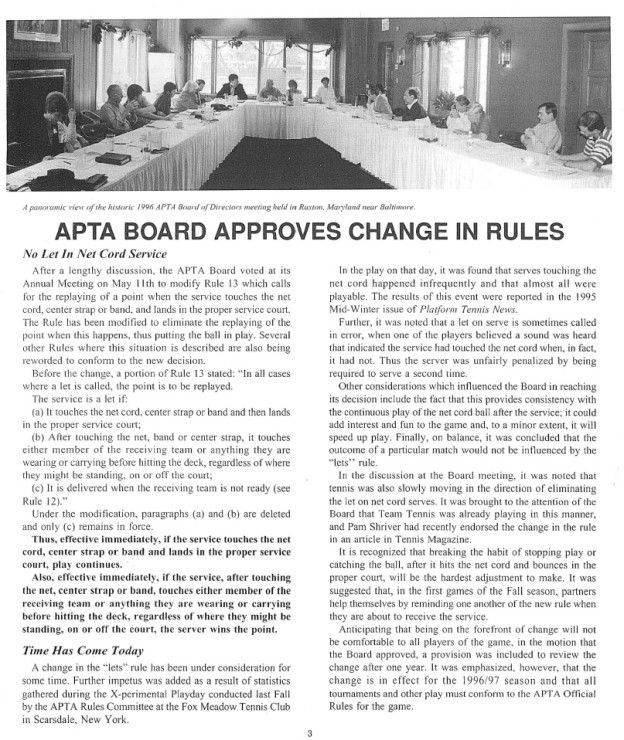
After a lengthy discussion and extensive presentation by Bob Brown at the Annual Meeting on May 11, 1996, the APTA Board voted to modify Rule 13, which called for the replaying of a point when the service touched the net cord, center strap or band, and landed in the proper service court. The rule was modified to eliminate the replaying of the point when this happens, thus putting the ball in play.

Several other rules where this situation could be described were also reworded to conform to the new decision.

Before the change, a portion of Rule 13 stated:

“In all cases where a let is called, the point is to be replayed. The service is a let if:
(a) It touches the net cord, center strap or band and then lands in the proper
service court;
(b) After touching the net, band or center strap, it touches either member of
the receiving team or anything they are wearing or carrying before
hitting the deck, regardless of where they might be standing, on or off the
court;
(c) It is delivered when the receiving team is not ready (see Rule 12).”

Under the modification, paragraphs (a) and (b) were deleted and only (c) remained in force. Thus, if the service touched the net cord, center strap or band and landed in the proper service court, play continued. Also, if the service, after touching the net, center strap or band, touched either member of the receiving team or anything they are wearing or carrying before hitting the deck, regardless of where they might be standing, on or off the court, the server won the point.

This decision in 1996 was enacted as a two-year trial period, after which player reactions would be surveyed, and permanency considered by the Board.

Source: Platform Tennis News, Summer 1996
R.J. Reilly, Inc. to the rescue

Just a couple of weeks before the Men’s and Women ‘s National Championships, and despite altering schedules and expanding play to Friday night for the first time in years, it was realized that one more court would be needed. That’s when Jim Reilly of R.J. Reilly stepped into help.

His company had put up the extra “stadium” courts at the host Shadow Lake Club, where the main matches were to be played, but it was apparent one more was needed. “Jim really hit a home run for us this time,” said co-chair Fritz Odenbach. “He not only came through with his usual timeliness and quality on the two courts we originally contracted for, but he went out of his way to get us that one additional court that made all the difference in our eventual schedule. To be honest, he and his organization deserve one of those APTA medals for being a winner here at Rochester, because that’s exactly what he is.”

Source: Platform Tennis News, Spring 1996

1996 National Championsips, Rochester, NY, March 20 - 24, 1996

National Championships and coverage of Men’s and Women’s

1996

PTN Spring 1996 covered the Men’s and Women’s Nationals:

The old Post Office adage of “neither rain nor sleet, etc.” came into full force at the 1996 men’s and women’s APTA National Championships, and it turned out to be true. Nothing prevented the hardy paddlers from completing their appointed rounds and matches in Rochester. With over 150 sponsors, Fritz Odenbach and his team were able to run a Nationals the way he thought it should be run: with the emphasis not just on the play, but on the playing afterwards. The lunches, the parties, the President ‘s Cup events, even the informal get-togethers at the Shadow Lake bar, all added up to an unforgettable event.

Michigan’s Scott Mansager combined with fellow Wolverine Flip Goodspeed to snatch the men’s title with a steamroll run to the championship that included not a single lost set all weekend. Mansager’s firepower from the forehand and Goodspeed’s nearly errorless overall performance helped them lose a mere 24 games over six matches in 12 sets. Their opponents in the final were more of a surprise, as lower-seeded George Zink from the Philadelphia area and Bill Fiedler from Chicago, combined for only the second time in a major event all year. Their exceptional athleticism and deft racket skills propelled them to the final, also without the loss of a set. But they were no match for the Michigan machine, despite a host of long points and incredible “gets” that had the crowd gasping with astonishment—and participating in the first recorded “wave” in platform history!

On the women’s side, form held true as Robin Fulton and Diane Tucker raced out early and held on late to knock off Patti Hogan and Cindy Prendergast in a tightly contested women’s final. Fulton and Tucker refused to give Prendergast a chance to unleash her lethal forehand, and teased her just enough with side angle shots on the screen to keep her from getting into the offensive flow.

Source: Platform Tennis News, Spring 1996

President’s Cup – Region I Men and Region IV Women

Two unexpected regions walked away with the President’s Cup Championships.

In the Men’s event, Region I edged Region V by five points, despite a makeshift line-up that changed constantly almost up to the last minute.

In the Women’s, the “local” triumph for Region IV, which included Rochester, was feted all weekend with numerous cocktails and toasts to the team members.

Kilmarx won the inagural Men's National Championship in 1935 with Kip Couch

Platform loses an original; “Killy” Kilmarx

Sumner “Killy” Kilmarx, one of the very first national men’s doubles platform tennis champions, died on March 2, 1996, in Scarsdale, NY. He was 96. With his long-time paddle partner, Clifford Couch, he won the first national men’s tournament held at the Fox Meadow Tennis Club in 1935.

The 1935 final was one of the longer matches in National Men’s play, a 4-6 , 6-4, 6-3, 2-6, 9-7 victory over later champion James Hynson and Charles O’Hearn, who defeated them in the 1937 National finals. But Kilmarx and Couch were victorious again in their return finals in 1939. Kilmarx was recognized by the unusual steadiness of his play and the debonair style of his attire on the court.

He was an honorary member of Fox Meadow for many years, having contributed to the development and the popularity of the early game.

Source: Platform Tennis News, Summer 1996

Platform Tennis News, Summer 1996

David Kjeldsen – the game’s mover and shaker extrordinaire

In the mid 1980s he was one of the world’s most dedicated couch potatoes. Then one Friday evening his sedentary existence miraculously became a thing of the past.

David Kjeldsen was invited to play mixed doubles on a small, elevated court surrounded by chicken wire. With the paddle he was given in one hand, a can of beer in the other, and a cigar between his lips, Kjeldsen was a poster child for sports enthusiasm. He got hooked on the game and started playing more and more, but it was getting expensive with a sleeve of balls costing $10.

He found out that Hedstrom, out in Ohio, was selling the Vittert balls he was using and arranged to buy case loads directly from them at a discount for distribution to friends and for use in tournaments. Hedstrom was delighted with the increase in business and offered further discounts.

Finally, Kjeldsen began thinking: “Why not set up a distributorship for a broad range of platform products?” That led to the formation of A2Z Products, and an arrangement with the only platform paddle manufacturer, Marcraft Recreation Corporation, to sell its line at dealer pricing.

Overnight, he was in business. He sold the first paddle at his Club in 1989, and then expanded his sales to players across Long Island, eventually developing retail accounts nationwide.

By the time he purchased Marcraft’s domestic platform tennis production facility in April of ’95, Kjeldsen was its largest customer.

Kjeldsen’s extraordinary support of the game and to Junior programs over many years lead to his induction into the Hall of Fame in 2008

Source: Platform Tennis News, Summer 1996

Ball used in tournaments

With the exception of National Championship Events, where the APTA Board makes the determination as to which ball will be used, Tournament Chairs of APTA Sanctioned Events could choose any APTA-approved ball, though only one brand was to be used throughout the tournament. Any player or players substituting another ball would be disqualified.

In addition, in National Ranking and Regional Ranking tournaments, no points would be awarded to those players who are disqualified.

It was reported that, whenever possible, the choice of ball should be indicated on the tournament entry form.

Source: Platform Tennis News, Winter 1996