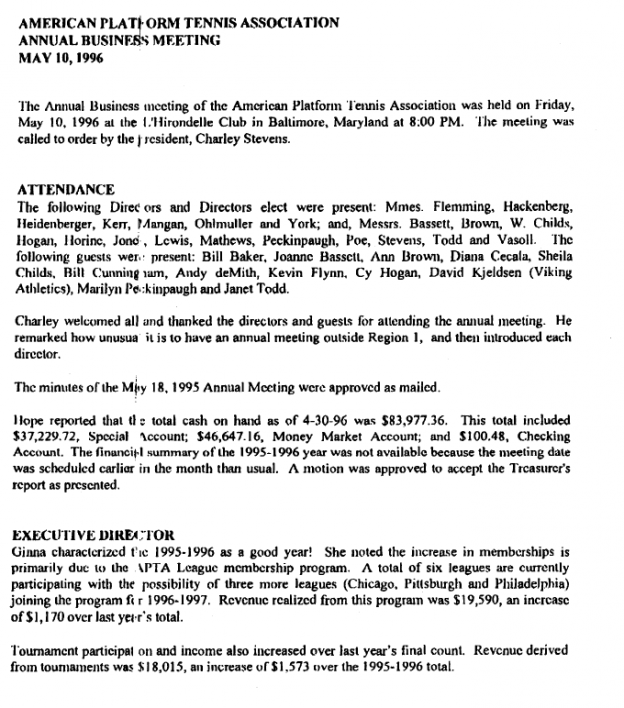
APTA Annual Business and Board Meetings

The BOD Minutes reflected the vote to approve designating all present recipients of the APTA Honor Award as Charter members of the newly created APTA Hall of Fame.

It was also minuted that:

“The current APTA office does not have enough morn to display the memorabilia that has been collected over the years, and which resides in Walt’s (Peckinpaugh) garage and various other locations.

The idea of a Hall of Fame was considered by the Fox Meadow Terms Club about 25 years ago.

The Board passed a motion to designate Chuck (Vasoll) as the point person charged with researching and writing a proposal for a Hall of Fame that will address a site (temporary and long term locations), fundraising requirements and curator arrangements.”

Establishment of the Platform Tennis Hall of Fame that now replaces Honor Award

In 1996, the APTA Board, on the recommendation by President Charley Stevens, formally established the Platform Tennis Hall of Fame to replace the Honor Award designation established in 1965 to recognize outstanding achievement in platform tennis.

At its meeting at Short Hills, halfway through the season, the Board acted to officially change the designation of the “Honor Award” to recognize recipients as inductees into the Platform Tennis Hall of Fame.

All those who had won the award were automatically members of the new “Hall of Fame.”

It was the opinion of the Directors that the new name was more distinctive and indicative of achievement, and more easily recognized and understood by everyone.

By decision duly made and seconded, the Board unanimously approved formally inducting all previous Honor Award recipients into the Platform Tennis Hall of Fame.

Apparent the topic was re-discussed at the Annual Meeting as The APTA Board Meeting summary provided by Chuck Vasoll in Platform Tennis News, Summer 1996 stated:

“On a motion by Bob Brown, the name of the ” Honor Award” was officially changed to “Hall of Fame” and the new designation extended to all past recipients. Brown was also asked to work with Jack Randall who has been attempting to create an office, Hall of Fame and platform tennis stadium in Greenburgh, NY. Also working on a home for the Hall of Fame, Director Chuck Vasoll was assigned to confer with the Fox Meadow Tennis Club about establishing an extension of their clubhouse for this purpose.”

Source: Platform Tennis News, Spring and Summer 1996

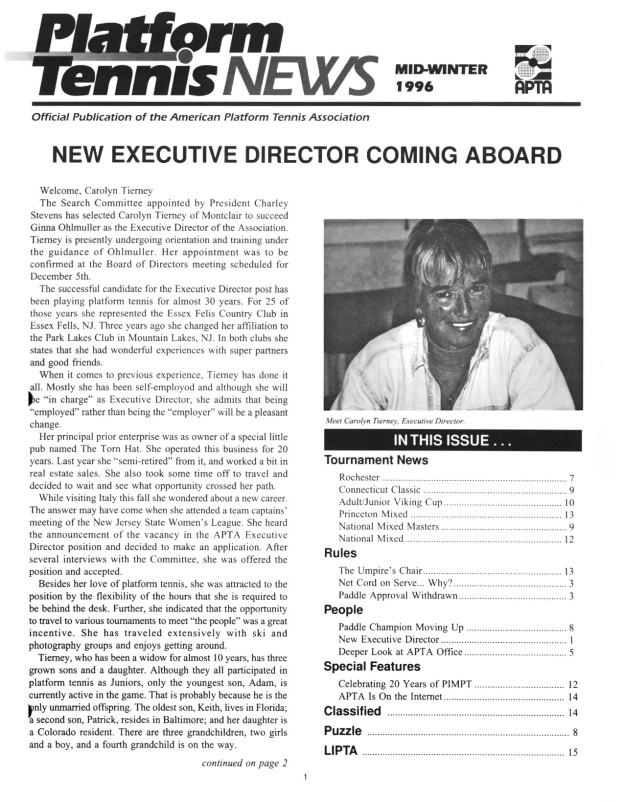
Platform Tennis News welcomes Carolyn Tierney

New Executive Director for APTA – Carolyn Tierney

The Search Committee, appointed by President Charley Stevens, selected Carolyn Tierney of Montclair to succeed Ginna Ohlmuller as the Executive Director of the Association.

At the time, Tierney had been playing platform tennis for almost 30 years. For 25 of those years, she represented the Essex Fells Country Club in Essex Fells, NJ. Three years prior, she changed her affiliation to the Park Lakes Club in Mountain Lakes, NJ. In both clubs she had wonderful experiences with super partners and good friends.

Source: Platform Tennis News, Mid-Winter 1996

A National Platform Tennis Center is proposed

Jack Randall, a long-time player, coach and supporter of the game had a dream: that a national platform tennis center could be developed.

His vision:

“I’m convinced people everywhere will love paddle once they have a chance to know what it is and have had a chance to play it. This cannot be done strictly through private clubs. The solution: A National Platform Tennis Center at a public facility is needed to accomplish this. A place important enough to the media to give it some exposure – especially on TV – along with an offer to come down to the center and try the game for free. We make it easy; newcomers try it ‘indoors’ and comfortably. Once they like it, they move with their friends outdoors. It seems natural to locate such a center in the heart of the area where the sport originated … a place with a large population, in a major media market and in an active area of play .. a place where players will talk about the center, tell others, and will come visit, assuring the center’s success and adding incentive to the media to cover this new sport phenomenon.”

Source: Platform Tennis News, Fall 1996 and APTA BOD May 1994 Meeting Minutes

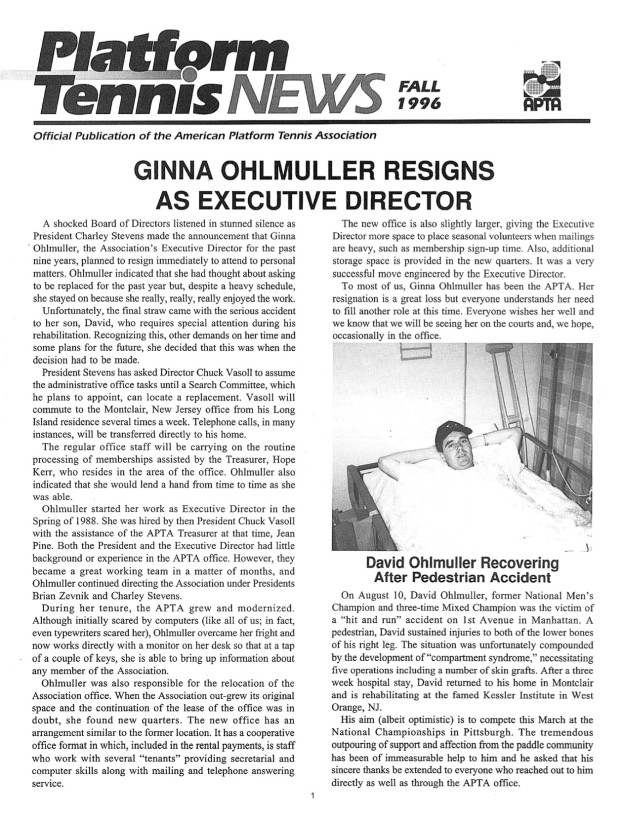
A serious accident to her son required Ginna to resign after nine successful years as Executive Director

Ginna Ohlmuller resigns as Executive Director

A shocked Board of Directors listened in stunned silence as President Charley Stevens made the announcement that, after nine successful years, a serious accident involving her son David had precipitated Ohlmuller’s decision to resign. David, a National Men’s Champion and a three-time Mixed Champion, had been the victim of a “hit and run accident” on First Avenue in Manhattan, NYC.

Ohlmuller started as Executive Director in the spring of 1988. She was hired by then President Chuck Vasoll with the assistance of Jean Pine, the APTA Treasurer at that time. Both the President and the Executive Director had little background or experience in the APTA office. However, they became a great working team in a matter of months, and Ohlmuller continued directing the Association under Presidents Brian Zevnik and Charley Stevens.

During her tenure the APTA entered the electronic age despite the fact that even typewriters scared her and she was responsible for modernizing many procedures. She was spearheaded the relocation of the Association office.

Source: Platform Tennis News, Fall 1996

Eleventh edition of the Official Rules issued

All the talk as the paddle season opened was about the change in the Official Rules under which play would continue on a net cord service.

Some changes in wording were necessary to emphasize that, although many paddle tennis rules were derived from tennis, there were situations where they were different in certain respects.However, there were a few substantive changes in the Eleventh Edition of the Official Rules.

The Rules Committee, under direction from the Board of Directors, had been asked to make the calling of lines by players in an un-officiated match, less “hard and fast” and more “forgiving.” This was accomplished by expanding the comment following Rule 10 by incorporating most of the wording from the “The Etiquette of Platform Tennis.”

The “Continuous Play” regulation found in Rule 24 had a new paragraph (c) inserted which read: “During a service game, the server is permitted a maximum of 20 seconds between the finish of play on a point and the delivery of the next service.” While rarely an issue, it was determined that, on some occasions, players may be exceedingly deliberate or talkative between points, to the extent that play was slowed and the delay was sometimes used as a tactic to upset opponents.

Finally, in Appendix B, a new diagram was added to illustrate the new standards for racquets with wrap-around rims. This enabled new manufacturing techniques to be used in the production of (possibly better) paddles for the game.

Source: Platform Tennis News, Fall 1996

Region V’s Jack Hogan

During his tenure as president of Region V, Hogan was a mover and shaker in growing participation in his home city of Indianapolis and throughout the Region. He saw his role as being “to develop a stronger and wider membership base and provide services to all players, at every level of the game.”

Hogan instituted creative tactics to grow the sport locally. Upon noticing that many area players were not APTA members, he incorporated APTA membership into the Indianapolis chapter membership program. The league he started in 1989 with 32 players had grown to more than 200 APTA/IPTA members by 1996. The building of several new courts at the Indianapolis Racquet Club had helped the boom in play.

Hogan noted, “Not only do we need to expose more people to the game, at the same time we must provide facilities on which they can play. All those players (especially young people) who can’t afford or decide not to join a private club need access to facilities. Inaccessibility and cost may be reasons we are losing members in the East. My goal is to make more courts available to the general public.”

Source: Platform Tennis News, Summer 1996

Midwest paddle booms

Although the sport was born and bred in the Northeast, fifty years later the rebirth of paddle was taking place in America’s heartland. The Midwest had witnessed a surge in paddle over the past five years, signaling good news for the health and well- being of the sport.

Growth in the region’s paddle community was evidenced by strength of play and players. As opposed to years past, many of the top-ranking competitors were from points west (Mansager and Goodspeed, men’s double champs from Michigan and ranking contender Bill Fiedler from Chicago, to name a few).

Tournament participation was up, as well as the number of mid-west-based facilities. The APTA now had five board members from mid-western states. Most telling was the fact that APTA membership in the Midwest had outpaced that in the East.

Yet, while the numbers proved a point, they did not tell the whole story. Growth came through the hard work and dedication of leaders in the Mid-west paddle community.

APTA Executive Director Ginna Ohlmuller explained, “This is not a sport that easily runs itself. To flourish, paddle needs strong organization and a catalyst.”

Source: Platform Tennis News, Summer 1996