APTA Annual Business and Board Meetings

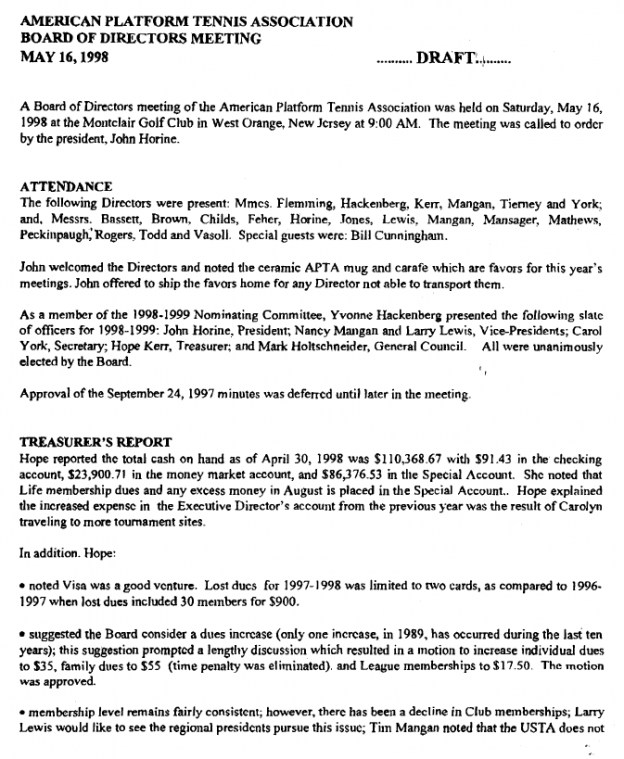
More ball issues were discussed but the big decision was the vote on “No-Let”

“Also, after two years of trial use, the NO-LET rule on service was voted in as a permanent rule. Prior to the vote, all members were polled, and the results of the APTA survey were discussed. The Board did not act on a suggestion to address the “dribbler” factor, a major complaint against the no-let rule where a loss of point is due to a “dribbler”.

Growing the Game: North Carolina Exhibition & Clinic

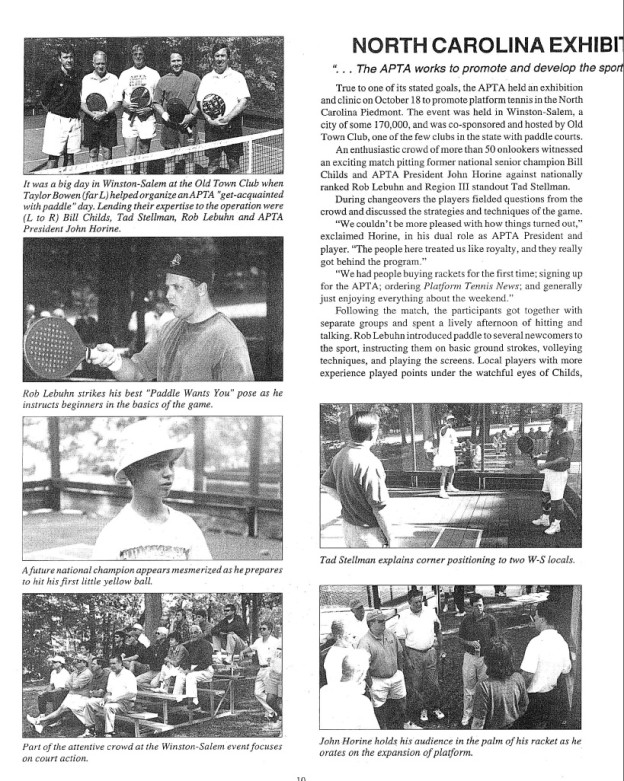
True to one of its stated goals, the APTA held an exhibition and clinic on October 18, 1998, to promote platform tennis in the North Carolina Piedmont.

The event, co-sponsored by APTA and Old Town Club in Winston-Salem, was a big success. The event was held in Winston-Salem, a city of some 170,000, and was co-sponsored and hosted by the Old Town Club, one of the few clubs in the state with paddle courts. An enthusiastic crowd of more than 50 onlookers witnessed an exciting match, pitting former national senior champion Bill Childs and APTA President John Horine against nationally-ranked Rob Lebuhn and Region III standout Tad Stellman. During changeovers, the players fielded questions from the crowd and discussed the strategies and techniques of the game.

“We couldn’t be more pleased with how things turned out,” exclaimed Horine, in his dual role as APTA President and player. “The people here treated us like royalty, and they really got behind the program. We had people buying rackets for the first time, signing up for the APTA, ordering Platform Tennis News, and generally just enjoying everything about the weekend.”

Source: Platform Tennis News, Fall 1998

Viking Cup Adult/Child Event is emblematic of the spirit of the game

Credit went to David Kjeldsen, CEO of Viking Athletics for supporting the event that had become immensely popular and a breeding ground for future top players.

Carly Swain covered the event for Platform Tennis News.

“There is always one moment in childhood when the door opens and lets the future in.”Graham Greene

David Kjeldsen, CEO of Viking Athletics has opened that door for junior paddle players and for the future of the sport. For three consecutive years, David has been the moving force that has turned the Viking Cup Adult/Child Tournament into a major national event on the paddle scene. During the month of October, 10 local tournaments were held in six different states. Two hundred fifty juniors and seniors participated in these local “play-downs.” Entries were up 20% from 1997. Each individual who entered received a Viking T-shirt and hat as well as a copy of “How to Play Platform Tennis” by Dick Squires. Viking Athletics also gave balls for all tournament play. The winners from each site came together at the Fox Meadow Club in Scarsdale, NY in November for the finals.

Fox Meadow is known as the “home of platform tennis” and seems to have now also become the “home of the Viking Cup.” It is centrally located to several other area clubs, has eight courts that the membership generously gives up for the day, and boasts a warm and friendly clubhouse where breakfast and lunch can be served. Newly added to the finals this year were winners from Baltimore and Pittsburgh. The largest local play-down (all 12- and-under) was held at Navesink Country Club in New Jersey by teaching pro Chris Gambino. And they therefore got to send the biggest contingent of winners to Fox Meadow. Representatives from all the sites and age divisions displayed excellent competitive skills. In the end, however, all the top honors went to junior/senior teams from the Philadelphia area. All three age divisions were won by players from the well subscribed Aronomink tournament, organized by Laurie Hissey.

Source: Platform Tennis News, Mid-Winter 1999, article by Carly Swain

In the same issue, Laurie Hissey reflected on David’s contribution to junior paddle:

“While sitting at Fox Meadow watching the Third Annual Viking Cup, the impact David Kjeldsen has had on junior paddle really hit me. David has sponsored the Viking Cup for the last three years, and this wonderful event is one of the big reasons my children are so “into” paddle. Before this event, there was no “reason,” no goal, for the kids to work toward. We have had so much fun getting ready for game days, that now we get out throughout the season. Whenever you see a successful event, you know there is someone behind the scenes keeping everything on track. This is definitely the case here. Robin Fulton and Caryl Swain do a fabulous job coordinating and running the local and national events. But any time there was a problem or question, David Kjeldsen came through. Nothing fazed him. Dave, once again, I want to thank you for your enthusiasm, your commitment, and your support. You have truly been a catalyst for junior paddle. Good job.”

Source: Platform Tennis News, Mid-Winter 1999, Letter from Laurie Hissey

Paddle Huts – an important part of the social aspect of the game

Early on it was recognized that a place for players to gather to watch play and socialize was an important part of the game. They started off as simple shacks, but have slowly blossomed into fancy edifices.

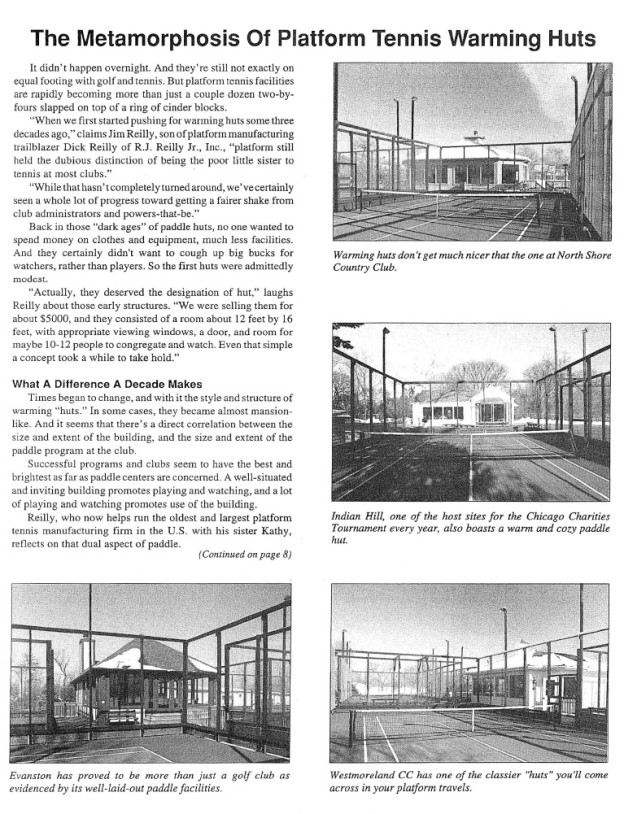
It didn’t happen overnight. And they’re still not exactly on equal footing with golf and tennis clubs. But platform tennis facilities were rapidly becoming more than just a few dozen two-by-fours slapped on top of a ring of cinder blocks.

“When we first started pushing for warming huts some three decades ago,” claims Jim Reilly, son of platform manufacturing trailblazer Dick Reilly of R.J. Reilly Jr., Inc., “platform still held the dubious distinction of being the poor little sister to tennis at most clubs.While that hasn’t completely turned around, we’ve certainly seen a whole lot of progress toward getting a fairer shake from club administrators and powers-that-be.”

Back in those “dark ages” of paddle huts, no one wanted to spend money on clothes and equipment, much less facilities. And they certainly didn’t want to cough up big bucks for watchers, rather than players. So the first huts were admittedly modest.

“Actually, they deserved the designation of hut,” laughs Reilly about those early structures. “We were selling them for about $5,000, and they consisted of a room about 12 feet by 16 feet, with appropriate viewing windows, a door, and room for maybe 10-12 people to congregate and watch. Even that simple a concept took a while to take hold.”

What A Difference A Decade Makes.
Times began to change, and with it the style and structure of warming “huts.” In some cases, they became almost mansion-like. And it seems that there’s a direct correlation between the size and extent of the building, and the size and extent of the paddle program at the club.

Successful programs and clubs seem to have the best and brightest, as far as paddle centers are concerned. A well-situated and inviting building promotes playing and watching, and a lot of playing and watching promotes use of the building.

Reilly, who now helps run the oldest and largest platform tennis manufacturing firm in the U.S. with his sister Kathy, reflects on that dual aspect of paddle. “We all know how important the social aspect of the game of platform is,” remarks Reilly in analyzing the changing nature of warming huts. “As Hemingway might say, a clean, well-lighted place is a necessity for the important side aspects of the game, joining together for drinks and discussion and watching others enjoy the game.”

Some of the oldest paddle centers are found in the East, which makes sense since that’s where the game first began. While many clubs boast solid facilities, “new” and “growing” are not words often associated with most club venues. Especially in the earlier paddle days, capital investments were hard to come by for erecting facilities, and more effort and money was focused on the courts themselves, rather than the ancillary areas. As paddle spread and new hot spots erupted, however, the entire paddle package became a concern.

Midwest Boasts A Bevy Of Beauties.
Clubs in different sections of the country, including the upper Northeast and Midwest especially, learned their lessons well from the early-day creations and began fashioning facilities that were complete entertainment packages. Now it’s not unlikely to see bathrooms, kitchens, wet bars, televisions, fireplaces, even hot tubs at the newer palatial paddle places.

“While the Midwest doesn’t have an exclusive on impressive facilities, it does have a host of them,” explains Reilly, speaking from first-hand experience. “We’ve been lucky in being asked to erect some really well-thought-out and sometimes quite expensive ‘huts.’ Some of these structures are going for $200,000 to $300,000 and are really elaborate, with upper stories and stone fireplaces and magnificent light fixtures.”

But the size of the hut doesn’t matter to most paddlers as much as the warmth within. While strong structures contribute to strong programs, it’s the people involved in those programs that really make them go.

Source: Platform Tennis News, Fall 1998

Growing the game—Wilson Racket Sports supports “Paddle Camps”

The concept was a natural offshoot of the APTA attempts to expand the game.

“It’s a win-win situation for everyone,” beamed women’s National Champ Gerri Viant of Nyack, as she explained the series of “paddle camps” that she and partner Sue Aery have been conducting under the sponsorship of Wilson Racket Sports. “The whole concept is a natural off-shoot of the APTA’s attempts to expand the game, create a larger and more professional teaching core group, and ignite interest in different segments of the country,” she continued. “Sue has been doing it for awhile, and when John Embree and Wilson got behind us, the whole camp thing just sort of exploded. We expected to do a half dozen or so, but we’re already in double figures all over Connecticut, Jersey and New York, and we’re looking to spread the word in Philly, Washington, Chicago … anywhere they’ll have us.”

” The goals of the camps are multiple, “according to Viant. “They’re not intended to replace local pros, but to enhance them. The camps are conducted with the local pro, or a tennis teaching pro who wants to get into the paddle racket, as the moving force.” Since both Viant and Aery teach platform for a living, as well as play regularly on the tour, the teaching pros are exposed to an intense, six-hour compendium of trade secrets, exercises, and programs that they can carryover into the regular teaching season. The participants are treated to a day on the course with the top women’s team from a year ago, and gain the pointers and knowledge that helped that duo reach the top. And, Wilson, the sponsor, gets to showcase its line of rackets, balls and apparel. So as Viant claims, it’s a win-win-win situation.

Source: Platform Tennis News, Fall 1998

APTA website goes live

In 1998, the APTA launched its own web site. www.platformtennis.org

Along with the rules of the game, the tournament schedule and results, the web site established an area where members could subscribe to receive a “News Blast”” from the world of platform tennis.

As things developed during the season, they could now receive the “latest” news along with their e-mail.

Subscribing was easy to do and it was free!

Source: Platform Tennis News, Fall 1998

An ace for the APTA Treasurer

Hope Kerr scored a hole-in-one with a nine iron on the 103 yard 11th hole of the Hendricks Field Club in Belleville, NJ.

Most golfers go an entire lifetime without such a feat, and Hope did it after only three years on the links.

Don Hyde (1926 – 1998)

Just 118 days earlier, Don had won the Men’s 70+ Nationals.

The “Hyde Cup” was anonymously gifted to the APTA in his memory.

He had been battling cancer for many years, but always found a way to bounce back after various operations to win nine Senior National titles in the 60+, 65+, and 70+ between 1988 and 1999.

He had been an outstanding athlete at Lawrenceville School and Princeton, and excelled at tennis.

He had been awarded the Bronze Star for heroism in the Battle of the Bulge in WW II.

Source: Platform Tennis News, Summer & Fall 1998

Twelfth edition of Official Rules published

Though most modifications were grammatical or technical in nature, the new booklet added the revised ball bounce specification and a definition and procedure for no-ad scoring, and a description of scoring in singles.

The no-let on serve procedure had already been included during the two-year trial period.