



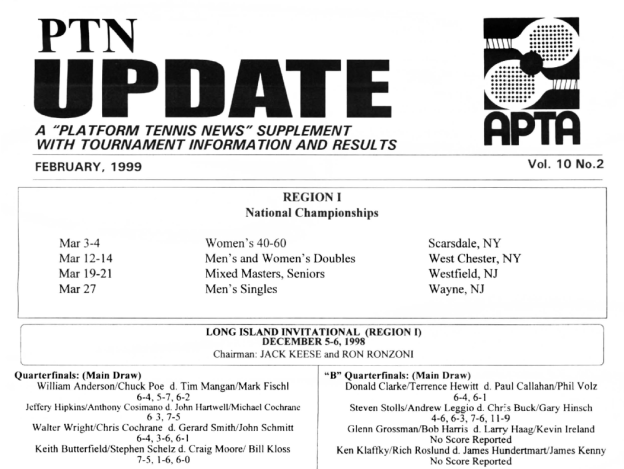
PTN UPDATE – Tournament Information & Results
Viking Cup Adult/Child Tournament has over 230 participants
The Viking Cup adult/child paddle tennis tournament is quickly becoming the APTA’s largest paddle tournament! This year over 230 adults and children participated in playoffs at 13 sites over an eight state area.The Viking Cup adult/child paddle tennis tournament is quickly becoming the APTA’s largest paddle tournament! This year over 230 adults and children participated in playoffs at 13 sites over an eight state area.
David Kjeldson, CEO of Viking Athletics and the primary sponsor for the Viking Cup, has continued his support of junior paddle development across the country. This adult-child format has been well received and has been well received and has been a great goal for the children.
In October, the local play-downs determined the draw for the national competition at the Fox Meadow Tennis Club in Scarsdale, New York. All participants received a Viking t-shirt and hat, as well as a copy of Dick Squires book, “How to Play Platform Tennis.” Viking Athletics also donated balls for all tournament play.
Five new clubs participated in local action. They included Sleepy Hollow Country Club in New York, New Canaan Field Club, Field Club of Longmeadow, Mass., Glenview Country Club in Chicago, and our host club for the nationals, Fox Meadow Club in Scarsdale, N.Y. Congratulations to Patti Hogan at the Beacon Hill Club for generating the largest number of entries, 28 Teams!!!
The Fox Meadow Club was again the generous host for the national competition on November 16. The facility was an excellent hub for all of the activity and the members were most generous for sharing their club.
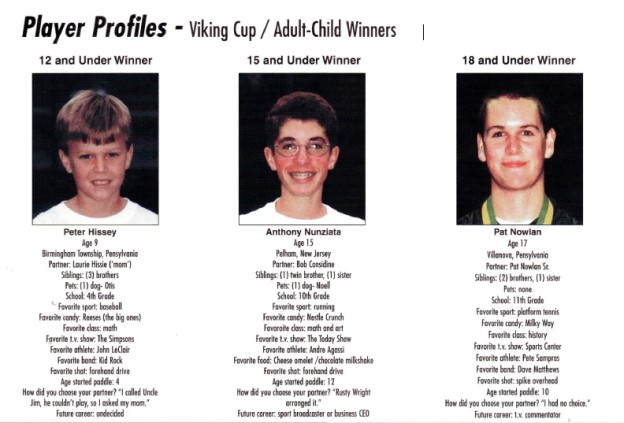
Play was strong from morning through dusk, with the Philadelphia region again taking top honors in two of the three categories! In the eighteen and under competition the father-son team of Pat and Patrick Nowlan faced off against fellow Philadelphians, Jon and Ben Holskin, for the second year in a row. Team Nowlan-Nowlan notched their third national Viking Cup Championship by outlasting the Holskins 6-4,6-4.
The fifteen and under title was captured by the local team of Bob Considine and Anthony Nunziata. Considine-Nunziata defeated the father-son team of Phil and Tyler Gaffney who hail from the Beacon Hill Club in Summit, New Jersey. Considine-Nunziata won the event for the second year defeating Gaffney-Gaffney 6-4,6-4 in the final.
The twelve and under draw saw nine year old Peter Hissey, from the Philadelphia area, team up with his mother Laurie, to regain the 12 and under title for the second year in a row. Last year Peter teamed up with his Uncle, Tim McAvoy. In the finals, team Hissey-Hissey defeated Marie Minnick and Brandon Kuchta from Long Island, New York, 6-4,6-4.
The Viking Cup success resulted from the dedicated efforts and organizational skills of Caryl Swain and Robin Fulton.
Source: Platform Tennis Magazine, Issue 3, January, 2000
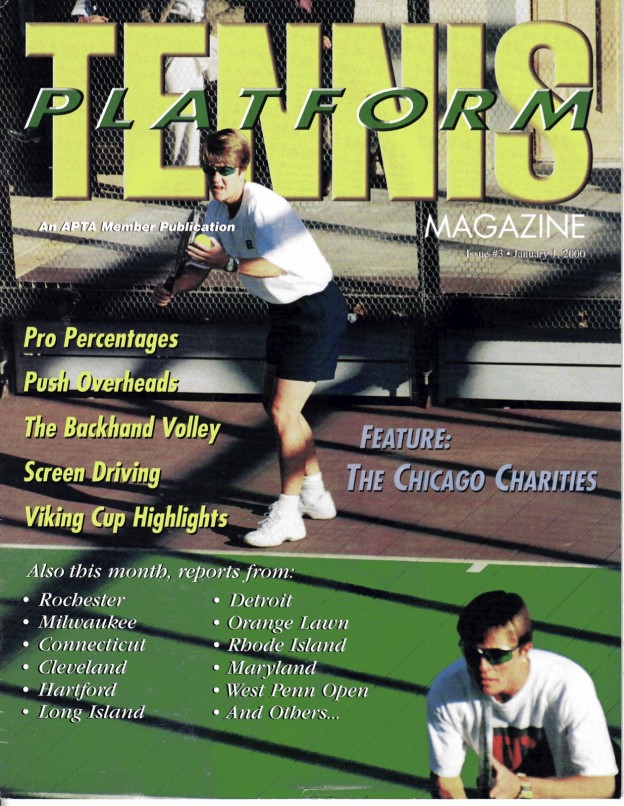
Chicago Charities ends millennium with a bang
The final Chicago Charities Tournament of the decade/century/millennium was played on a perfect autumn weekend and showcased the top talent in the game. Over 150 teams, competing in four divisions, converged to do battle in one Tournament of the decade/century/millennium was played on a perfect autumn weekend and showcased the top talent in the game. Over 150 teams, competing in four divisions, converged to do battle in one of the most competitive fields ever assembled at an APTA tournament event.
Headquartered at Glen View Club’s new “paddle palace”, the tournament provided some upsets and some near upsets. David Ohlmuller and Chris Gambino, the nation’s number one ranked team, came in from the east to defeat Chicago’s Bill Fiedler and Scott Bondurant (two-time defending champions) in a three set men’s final, displaying some of the finest driving and net play ever. The Chicago team had come off a tight three set semi with four-time defending national champions Scott Mansager and Flip Goodspeed and gave way to the young but savvy Gambino-Ohlmuller who beat Anthony Cosimano and Steve Haller in an “All-Jersey” semi.
While the men’s seeds held mostly true to form, that was not the case in the women’s tournament. Current national champions Patti Hogan and Cindy Prendergast went out in the round of 16 to Cincinnati’s Linda Thompson and Lindy Ward. Sue Aery and Gerri Viant prevailed over Robin Fulton and Sarah Krieger in the Sunday final, but not before overcoming two up-start Chicago teams in their respective semis. Wendy Robbins and Liz Richards-Hayward (the best paddle player in Phoenix) gave Aery and Viant all they could handle in their semi. Mary Doten and Julie Sierks also came up short in the other semi against Fulton and Krieger.
The men’s 45+ saw Hank Irvine pick up right where he left off years ago when he and Wilson’s John Embree defeated former 45’s national champs Jedd (Dr. Detroit) Hodges and Indy’s Jack Hogan in a well-played three set final. The indomitable team of Tom Beach and Peter Morrow bettered Chicago’s Jim Bishop and Rochester’s Mike Hannah in the men’s 55’s to cap off the great three-day event.
Tournament co-chairs Sally Cottingham and Kip Read made sure that things went off as smoothly as David Ohlmuller’s footwork and directed everything from scheduling, to the Saturday night party, to Sunday’s final matches, to a seamless conclusion, and making a huge effort look easy.
As always, the CPTC is indebted to its generous sponsors, players, and many volunteers who make this tournament a continued success year after year. The final budget has not been completed for the event, but the ‘rough estimate’ is that donations to this year’s charity, the Lydia Home Association, will be approximately $5,000.
Sponsors of the event were: APTA, Wilson, Viking, R. J. Reilly Platform Tennis Courts, and Jean Wright Real Estate.
Source: Platform Tennis Magazine, Issue 3, January, 2000
Kansas City here we come! Growing the game
APTA President, John Horine, reported:
“I would like to relay an exciting experience I had in early November. On November 12th, 11-time National Champion Bill Childs and I flew to Kansas City at the request of APTA member Peter McHugh for an exhibition and clinic. When we arrived at the Carriage Club on Saturday morning we were greeted by the tennis/platform pro Kirkland Gates. Both Bill and I were amazed at the enthusiasm of the players we met that day. All of the players that we met were eager to learn more about the game and how they could improve their skills.
We were on the court for over seven hours! The program in Kansas City is admittedly small in comparison to other areas of the country, but their hearts and excitement for the game are as big as anywhere!
Before the call from Peter McHugh, few people knew platform tennis was played in Kansas City. Now, hopefully they will be a host for a state championship next season! My point is, as it always has been, if there is an area of the country with an interest in the game and the courts, we should try to encourage competition and camaraderie in the form of leagues and tournaments, no matter how small the following!”
Source: From the APTA, Platform Tennis Magazine, Issue #3, January, 2000

Paddles old and new
Viking and Wilson provided some insights into how paddles have evolved over the years:
“Paddle technology has come a long way. When platform tennis was first played in 1928 the paddles had square, wooden faces, had no holes and were lightweight (about eight ounces). As the sport grew in popularity, the paddles changed. Stronger woods were tried, but the extra strength resulted in added weight. Holes were then added to reduce weight and created the added benefit of allowing ‘spin’ to enter the game.
Metal edges were added in the 1960s to reduce wear. But, with the introduction of the metal edge came the “paddle rattle”. In the 1970s, manufacturers experimented with Lexan and aluminum paddles. The first open throat paddle appeared and was made with an aluminum yoke. Fiberglass and acrylic skins were added to reduce warping, increase power, and reduce weight. The new surface materials allowed the paddle face to become slightly textured and the holes sharper, giving more bite on the ball.
During the 1980s, the face of the paddle grew. Oversized and multicore paddles were developed. Paddles were made with plywood-like structures featuring layers of exotic woods plastics that created variations in hitting response. The early 1990’saw the introduction of a ‘foam core’ paddle, the Rich Maier ‘Force’ signature model. The design of the Force combined three core materials: a wood frame, a foam core center, and a fiberglass skin. The paddle was an instant success and the forerunner of today’s paddles. The new core allowed for real shock absorption and more power.
Today, wood has all but disappeared as a main ingredient for a paddle. Paddles are made of state-of-the-art, high-tech, space-age materials. Titanium, Kevlar, graphite, bi-axial cross-linked polymers, and EVA (a co polymer of ethylene and vinyl acetate) foam are standard components.
EVA is a soft cushioning material that reduces shock and vibration and provides optimal comfort. This type of foam can be produced at different densities depending on the desired level of control. Additionally, EVA will create a larger sweetspot for enhanced comfort over a bigger portion of the hitting surface. Prior to 1999, paddles were constructed primarily with molded graphite, which is ideal for players who want maximum power with a firm feel. EVA now has the best of everything, with a larger, softer sweetspot.
One of the advantages of working with EVA foam, from a manufacturing standpoint, is that sharp edges can be produced around the holes. How? A fiberglass sheet is put over the EVA foam, which can be cut cleanly during production. The end result is more “bite” on the ball for greater control and increased spin, even in snowy/rainy conditions.
Paddles are still getting lighter. Six years ago, the average paddles were 15 to 18 ounces. Today, most paddles are less than 14 ounces. There is even an 11-ounce prototype being tested that has air as its core!”
Source: Platform Tennis Magazine, Issue #2, November, 1999
APTA offers help for tournament directors
The From the APTA … section of PTM provided the details:
“The APTA office has a new publication to assist tournament directors. From running a club event to coordinating a national championship, we have compiled some tools and tips to make sure your event runs smoothly. Whether you are running your first tournament or if you are a seasoned director (in need of some help) please call the APTA office so we can assist you.”
Source: From the APTA, Platform Tennis Magazine, Issue #2, November, 1999

The APTA looks at foot-faults yet again
APTA President, John Horine, made the point in the From the APTA section of PTM
“At our teleconference in September, the APTA Board decided to put our foot down on foot faults. This season there will be roaming foot fault judges at each APTA sanctioned tournament. PLEASE read and abide by the rule book. Do not foot fault. You have been duly warned.”

R. J. Reilly, Inc. pioneers metal halide court lighting systems
PTM carried the following story on the new development:
How strong are your powers of observation? Have you noticed a different look on some platform tennis courts recently? If you attended the 1999 Nationals at the New York Athletic Club, you saw it on the showpiece courts, which R.J. Reilly provided for the event. The traditional quartz iodine lights, which have sat perched atop the twenty foot light poles for as long as most players can remember, are slowly being replaced by slightly larger metal halide fixtures.
Why the change? Energy efficiency and advanced optics are the main reasons. The 400 watt metal halide fixtures only use about one third of the energy that the traditional 1500 watt quartz iodine fixtures use. This provides a cost savings to the owner and is easier on our environmental resources (paddle players are conservation minded too). Furthermore, only a 110 amp power service is required as opposed to the 220 required for the quartz iodine system. The bulbs used in these fixtures last up to ten times longer than their quartz iodine counterparts.
Because of improved optics and reflectors, the new metal halide fixtures can better direct the light where you want it. To you, this means more consistent light on the court and less spillover outside the court.
How does this type of lighting stack up in actual use? There are many different types of metal halide fixtures available, and the lighting varies for each one. However Jim Reilly, Vice President of R.J. Reilly, says that the fixtures they have installed, at a variety of courts in different regions of the country, seem to be universally preferred over the traditional quartz iodine. “We took several years to research and test a variety of metal halide fixtures,” says Jim. “We finally found a top quality shoebox style fixture which, with some customization, provides the best platform tennis lighting system we have seen. It provides minimal spillover, virtually no shadows on the court, and a shade of light that players indicate they prefer to the quartz iodine. It sometimes takes an adjustment period to get used to the new lights, but we have not yet encountered anyone who prefers the old style after playing several times with our new metal halide system.”
Source: Platform Tennis Magazine, Issue #2, November, 1999
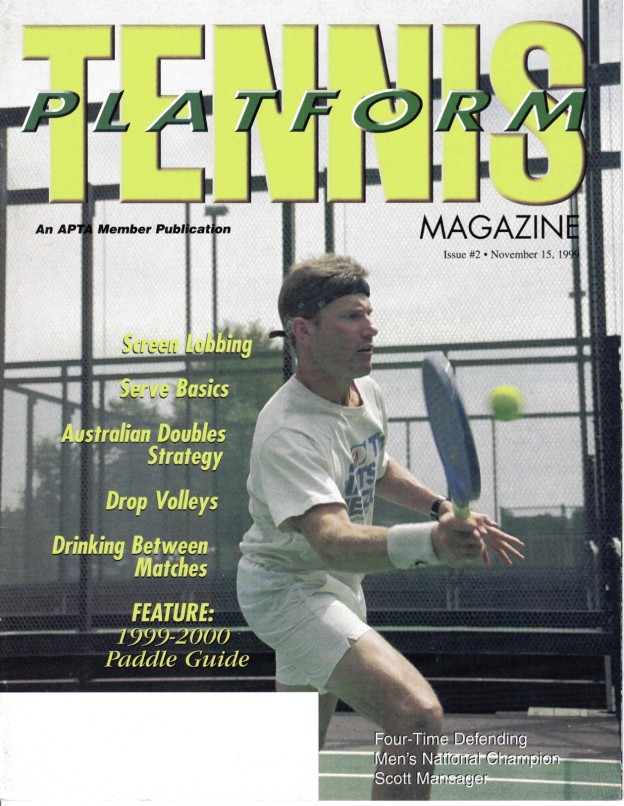
Platform Tennis Magazine (PTM) off to a great start
The second issue of PTM carried some positive feedback and some complaints on delivery timeliness.
In the From the APTA … section APTA President John Horine had this to say:
“Our first issue was a smashing success. A heartfelt thanks to Wayne Dollard and APTA Board members Pete Mathews and Mark Holtschneider. Your summer efforts have resulted in a fantastic magazine. Wayne must have put 10,000 miles on his car this summer crisscrossing the country collecting pictures and articles for this seasons issues.”
Horine’s comments were echoed in the Letters to the Editor section:
“Just read your first issue cover to cover and wanted to congratulate you on a wonderful job! Forty-eight pages of interesting paddle reading…who could ask for anything more? Wishing you continued success in this worthwhile venture!”
Sally Rogers / Scarsdale, New York
“Thank you for the wonderful publication. Your history piece was particularly special and accurate. So many times I have read otherwise. Johnny (Ware) would be proud of you for your new Platform Tennis Magazine.”
Molly Blanchard Ware / Scarsdale, New York
However there were some issues, as with any new undertaking:
“As of today’s mail, I still have not received the first copy of the magazine except for the ten copies that you sent to me as a director of the APTA. This was an important issue with which to make a good impression, particularly because the APTA did not issue a tournament schedule and gave it exclusively to you for publication. I am deeply disappointed and I hope that this is not a harbinger of the remaining issues.”
Charles Vasoll/Cold Spring Harbor, New York
To which Dollard replied:
“Sorry about the two week delay in receiving issue #1. 1 did it the best 1 could and 1 did it by the book. As it tums out, the U.S. Postal Service mislabeled our magazines, lost them, and then stored them away for two weeks. Through numerous phone calls and complaints, I was told that resistance was useless. I am thankful that the magazines arrived late, rather than not at all. I am also thankful that the magazines came out as well as I had hoped. You never know what you’re going to get with a new printer and press department. We could have had a real train wreck on our hands for even the slightest graphics mistake. Finally, with help from my new ‘buddies’ at the postal service, I anticipate the mailing of PTM to go smoother for our future issues.”
Source: From the APTA, and Letters to the Editor, Platform Tennis Magazine, Issue #2, November, 1999
 © 2026 Platform Tennis Museum and Hall of Fame Foundation, All Rights Reserved.