PPTA reaches a milestone – over 100 certified pros in 18 states

What started out five years ago as a handful of pros teaching platform tennis has grown into a record 115 certified pros in 18 different states.

Illinois leads the way with 34 certified pros.

The numbers are a reflection of the growth of the game and the acknowledgement that teaching platform tennis is a viable profession that can help club professionals establish themselves in year-round teaching positions.

Source: Platform Tennis Magazine, Vol.6, Issue 5, April, 2005

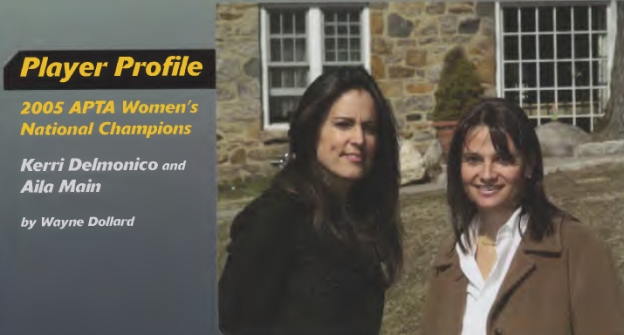
Player Profiles: Kerri Delmonico and Aila Main

When longtime platform tennis player and friend Dan McCormick introduced Kern Delmonico to platform tennis eight years ago, she had no idea of the sport’s addicting nature. Coming from a family with two brothers and one sister Kern grew up in a competitive environment. She explained, “In platform tennis, I enjoy the team aspect, but in the end it’s all about the competition!”” Kern had a few consistent partners and would achieve a consistent top five ranking year by year. I feel that I have stepped up a level this past year,” Kern commented. She added, “Aside from reading the player tips and strategy in Platform Tennis Magazine, I think the biggest factor to my success is that my boyfriend Mike (Stulac) is rubbing off on me.” Mike (the 2005 Men’s Open Champion) and Kern have been dating for the past two years. In addition to platform, Kern is an accomplished tennis player. She discussed the differences she sees between the two sports. “Platform tennis requires patience! About 90 percent of platform points are lost outright as opposed to tennis where you can hit a winning forehand and quickly end the point.” She added, “Be humble and listen to experienced paddle players… You can’t expect to immediately be number 1 in the country lust because you have experienced tremendous success in tennis. Paddle demands patience’

Aila Main grew up playing highly competitive tennis in Zagreb, Yugoslavia. As a junior she played the Fed Cup for Croatia. After moving to the states, Aila graduated from Princeton University and Hastings Law and moved to New York City. Three years ago, Kerrie and Aila met at lunch through a mutual friend. Having become best of friends, they laugh as they recall their first impression dislike of each other. Kerrie recalled, “We began playing together at Town Tennis for the next couple of years before we decided to become partners.” Although Aila was an instant success on the court, she credits friends for her rapid improvement. “I have been lucky enough to play with people who are a lot better than me, who have been willing to give me advice, and there is no faster way to learn.” When asked about the carry-over from tennis Aila explained, “I am still relatively new to platform tennis, so I am still working out the strategic similarities and differences From tennis. The obvious major difference is the way the points set up. The instinct to try to put the ball away is very strong for most tennis players, and you have to forget that in platform. It really feels like more of a chess match sometimes the move that wins or loses the point happened three or four shots prior” She added, “This game is a great sport for tennis players of all levels. I would recommend that tennis pros and avid players find a fun group of people and just get out there and play!” She concluded, “Personally, I play because I love the people, I love being outside in winter, and I enjoy the competition. Paddle seems to attract a singularly terrific group of people, and I feel very fortunate to be involved in the sport.”

When asked about the future, Kerrie answered, “I would love to win another national championship but if I do nothing more than just compete well that’s good enough for me.” Aila concurred, “My goal is simply to play the game as long as I can. I just love it.”

Source: Platform Tennis Magazine, Vol. 6, Issue 5, April, 2005

President’s Cup winners: Region V Men and Region IV Women

For the first time since Region I claimed the 2002 President’s Cup in Long Island, the hosting women’s region won the event The women of Region IV hadn’t taken home the Cup since 1996 (Rochester). Congratulations to Region IV team players: Jessica Guyaux and Kelly Fischer, Lissy Hill and Janet Mazzola, Holly Peck and Karen Henke, Nathalie Lemieux and Ann Wagner and Nancy Budde and Heather Hairston-Prop.

The Men of Region V have claimed the President’s Cup for the first time since dominating the competition in their region (in the 1998 Chicago Nationals). The ten-man team deprived Region IV of a President’s Cup sweep by defeating them by one set. Congratulations to Region five teams: Jay Woldenberg and Mike Sullivan, Michael Chabraja and John Noble, Ben McKnight and DanWilliams, Peter Berka and Ed Granger and Mike Marino and Mike Rahaley.

To gap or not to gap?? A new method for aiding service line calls

As competitive play increases in platform tennis, so does the need for accurate line calls. Platform tennis courts are smaller than tennis courts and line calls are typically easier to make, with the exception of where the singles line meets the service box. To solve this issue Jason Gray (Beckett Ridge Country Club in West Chester, OH) and David Dodge (Premier Platform Tennis) implemented an idea used in tennis which is to leave a three inch gap in the singles line. Jason had mentioned this idea to David two years ago but with ‘The Battle of Beckett’ during the Cincinnati Midwesterns, and the Premier Purple introduction, the service gap issue was unintentionally neglected until the idea surfaced by John Stefanik, a private court owner from Philadelphia. John wants the service gap incorporated in his court when he resurfaces with Premier Purple this spring 2005. Jason put this new idea into play and got positive feedback from his players with renewed excitement for competitive play. Again, this innovative introduction gained national attention when it was incorporated in the stadium court in the 2005 APTA National tournament in Pittsburgh.

Source: Platform Tennis Magazine, Vol. 6, Issue 5, April 2005

APTA President Mark Fischl reports on his first year in office

On behalf of the American Platform Tennis Association I would like to thank you for another terrific season. As I close my first year as President I want to reflect on some of the initiatives the Board and I set out for this season.

Our two main goals for the year were to be in the black financially and have a web site that provided additional member services. On the financial front it looks like we will return to profitability. The Web site provided a bit more of a challenge, but with the never-ending help of Marjorie Hodson, our Executive Director, and Jim Ingle of the Revere Group, we seem to be headed in the right direction. Building a web site is always a work in progress, with the first year being especially difficult. Fortunately, we have the infrastructure to continue the building process.

Our secondary goals were marketing the sport through exhibitions and other promotional ideas as well as the National League Championship. The two exhibitions we did in Atlanta and Kansas City were greeted with great enthusiasm. Thanks to the PPTA and all its professionals who contributed to their success. Our bumper sticker seems to be a big hit. It is always nice to pull into a tournament parking lot and see multiple cars with the PT sticker.

[enlarge image to read full report]

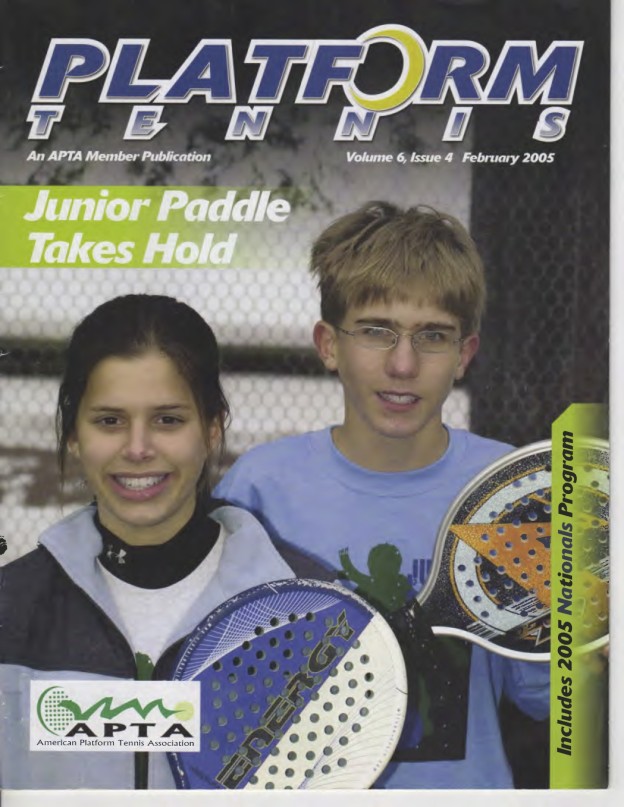
Junior paddle, past and present – a short history of the ups and downs. Kudos to David Kjeldsen, Robin Fulton and Patty Hogan for revitalizing the junior game

Maura Judkis provided a summary of efforts to grow junior paddle over the past decades

One of Whitney Snyder’s most poignant memories from his childhood in Sewickley, Penn., is the slow scratch of a shovel being dragged across a snow-covered aluminum floor. While his weeks were filled with middle school, his weekends were devoted to platform tennis. Instead of waking up early on wintry Saturday mornings for cartoons, Snyder would go to the paddle courts at 7 a.m. and hear the scraping shovel that signified the beginning of his early morning group lesson.

The 1970s generated junior paddle leagues across the country. Both Snyder and his friend Bill Hallett recalled their junior paddle days as being sponsored by enthusiastic parents who were willing to teach the game and send their children to the Junior Nationals by the bus load. “There really weren’t pros teaching the game,” said Hallett, who recalled playing at the local YMCA. “Most of us were just introduced to it by our parents. Even I taught clinics to younger kids when I was in high school”

“The parents really do get credit for organizing it,” said Snyder, who described the paddle craze as “very contagious,” and a typical part of an after school routine. “Since girls and boys played together, it broke the ice socially for those awkward teenage years,’ he said.

Junior paddle in the 1970’s provided not only a social activity, but also a forum for real competition. Both players recalled bus rides to tournaments in Detroit, Indianapolis, and Cleveland, among others. The Junior Nationals were even held in Pittsburgh once during their high school years.

However, transitions in paddle corresponded with transitions in the young players’ lives. As kids graduated and moved away to college, programs began to diminish, and disappeared altogether by the 1980s in Pittsburgh. Nationals, too, became a memory when Hank Irvine, longtime organizer of the Junior Nationals, resigned. Paddle for juniors entered a latency period, and interested kids were left with nowhere to turn but a few lessons with parents on whatever court time they could spare.

Even though kids were interested, there was no official means for play until the Viking Cup Parent-Child tournament, sponsored by David Kjeldsen and Robin Fulton. The tournament, held in 1996, began the rebirth of a dormant Junior Nationals. Following the tournament, Fulton revived nationals for a few years, before resigning her position to Patty Hogan.

Junior Nationals would not be the only program Patty Hogan would have built from next to nothing. Hogan’s junior paddle organization at the Beacon Hill Country Club in Summit, NJ, began with only three kids, but soon grew to 80.

Results of National Championships and coverage of Men’s and Women’s Nationals and President’s Cups. The Tennis Channel films Men’s finals

2005O&S
2005J

PTM Editor Wayne Dollard reported on both events from Pittsburgh:

Pittsburgh, Pennsylvania — When it came to surprises and unanticipated drama the 2005 Marsh APTA Nationals delivered where no other championship had in recent memory.

On Thursday, March 17, sixty of the top women platform tennis players in the world kicked off the four-day competition by vying for the 2005 President’s Cup. The Region I women (Downstate New York New Jersey and Fairfield County, Connecticut) had won the competition each year since starting a four-year run in their own backyard with the APTA New Jersey Nationals in 2001. This year’s team was led by returning champions Susan Lovejoy, Susan Trizian and Kerith Flynn. With the absence of six 2004 nationally ranked playing veterans including the #2 national ranked player Aila Main, Region I was at a disadvantage. Waiting to take advantage was the hosting team, Region IV (Ohio, Western Pennsylvania Rochester and Toronto). The six women’s regions battled from the start of the morning into to the early evening hours, At the end of the day, the Region IV ladies Jessica Guyoux, Kelly Fischer, Lissy Hill, Janet Mazzola, Holly Peck Karen Henke, Natalie Lemieux, Ann Wagner, Nancy Budde and Heather Hairston Prop took home the Cup. The win for the Region IV women tied them with Region V ladies with seven President’s Cup titles since the event began in 1983.

On Friday morning the Women’s Main Draw matches began as did the Men’s President’s Cup tournament. Pittsburgh had 18 hosting sites and 52 courts at their disposal for the events. The Fox Chapel Racquet Club was known as – Paddle Central” for the 2005 National Championships with six courts, two viewing facilities, the draw and merchandise tent, a featured dining facility and two grandstand stadium courts.

The Edgeworth Club, located in the Pittsburgh suburb of Sewickley, hosted five competing men’s regions (Region VI, the far west, did not field a team). Since the men’s President’s Cup began in 1978, Region IV has been the king of the competition with 10 titles; Region III is second with nine Cup victories. Like the women’s team, the Region I men went into the competition as the defending champions with their win at the 2004 Cleveland Nationals. With seven returning veterans the odds were on Region I to win the Cup.

However, in as deep a draw as seen in recent memory, all five regions came out with loaded teams Nationally ranked players and new tennis talent filled the five doubles spots from nearly every team on every region. At the end of the day, Region V beat out the hosting Region IV team by one set to earn the title, their first since 1998 and fourth over the past 13 years. The Region V team consisted of Jay Woldenberg, Mike Sullivan, Michael Chabraja, John Noble, Ben McKnight, Dan Williams, Peter Berka, Ed Granger, Mike Marino and Mike Rahaley.

As the men were wrapping up their President’s Cup, the women were playing their second and third rounds of the main draw. Perhaps the match of the day occurred in the women’s round-of-16 when the two-time defending champions Susie Keane and Mary Doten lost a tight straight-set match to Chicago friends and rivals Terri Miller and Nancy O’Sullivan. Like Susie Keane (formerly Susie Mascarin, a top 20 world-ranked tennis play) Miller recently left the top of the women’s tour and has since become addicted to platform tennis.

The quarter-finals saw plenty of action for the 400+ spectators who came out to watch. The top-seeded team of Sue Aery and Gerri Viant lost to the #7 team of Cynthia Dardis
and Amy Shay 6-2, 4-6, 6-2. In the other quarter-final match-ups, the #2 seeded team of Kerrie Delmonico and Aila Main defeated the eighth-seeded Nancy Budde and Susan Rudd 6-2, 6-1; Miller and O’Sullivan defeated a third Chicago duo 5th seeds Sally Cottingham and Chris Sheldon 6-2, 4-6, 6-3; and Bobo Delaney and Tonia Mangan (3rd seeds) lost to the 2002 National finalists Cindy Prendergast and Lauren Zink (two months back from having a baby).

The semi-finals were played on Saturday morning on the stadium courts in front of a packed crowd. The higher-seeded teams of Delmonico-Main and Prendergast-Zink advanced, each in three-set battles over Miller/O’Sullivan and Dardis/Shay. By 1:00 p.m., the temperature had reached 40 degrees with mostly cloudy skies filling the air above, perfect platform tennis weather.

Fresh off their victory in Short Hills, New Jersey, Delmonico and Main felt that they had a mental advantage over their competition. After squeezing out a nail-biting first set
tiebreaker, Delmonico and Main broke serve three times in the second set and went on to win it 6-2. this victory was both the first Women’s Open National Championship finals appearance and title for the newly formed team. We can expect great things from them over the years to come.

While Delmonico and Main were concluding their match, the 2005 Marsh APTA Men’s Nationals were in full swing with a deep 104-team draw. The first-day draw highlights were dominated by the new team of Mike Cochrane and Mike Marino (seeded #7). After two solid early round straight-set performances, Cochrane and Marino ran into the 2nd seeded team of David Ohlmuller and Chris Gambino in the quarter-finals. The match generated great crowd interest and a palpable high level of tension. With precision drives and patient control Cochrane and Marino defeated the 2002 Nationals Champions 6-3, 6-3. At the same time in the other quarter-final matches, Anthony Cosimano and Steve Haller (#4) advanced over Scott Estes and Scott Mackesy (#5) 0-6, 6-2, 6-1; Scott Mansager and Flip Goodspeed (#1) defeated Charlie Usher and James Goldman (unseeded) 6-0, 6-2; and Mike Stulac and Bill Anderson were victorious over Bill Fiedler and George Zink (#11) 7-6, 6-1.

The Sunday morning semi-finals provided two awesome three-set matches. Anderson and Stulac upset the top-seeded Goodspeed and Mansager 3-6, 6-2, 6-4. Their victory earned them their second time in the National finals in three years (The pair did not compete in the 2004 Nationals because Stulac’s flight was delayed due to weather).

On the other side of the draw, Cochrane and Marino continued their run. With steady play from Mike Marino and two-handed strokes cracking from both sides by Mike Cochrane the team upset Cosimano and Haller 6-1, 1-6, 6-3. The stage was set for the finals at the Fox Chapel Racquet Club’s stadium court

At 1:00 on Sunday March 20, Mike Stulac and Bill Anderson shook hands with Mike Marino and Mike Cochrane and began their final event warm-up. No matter the outcome, it was guaranteed that there would be new APTA Men’s Open National Champions. Over 500 spectators filled the stadium bleachers surrounding the center court anticipating a tense, taut match.

On hand, tournament Co-Chairmen Wayne Dollard, Ann Sheedy and Martin Sturgess had arranged with The Tennis Channel to have the match filmed and post-edited for an April broadcasting to their eight million household audience. Sturgess commented, ‘To my knowledge, this is the first time in platform tennis history that the APTA Championships will be broadcast on national television [Note 1]. It is a great thing for the APTA and it is a great thing for the sport.” Sheedy added, ‘With three production video cameras, cameramen, video scaffolding and on-court microphones the scene provided a possible glimpse of the future publicity and marketing of the sport. We’re pleased that our platinum sponsors Marsh, Sedgman, Whit Productions, Premier and Wilson pulled through for this historic eventA s the match started, there was a sense of surprise bordering on letdown/deflation as Cochrane and Marino dominated point after point. Tournament umpire Steve Nycum called out, “One game to zero, two games, three games to zero, four games to zero.” Within 30 minutes, Stulac and Anderson were down 6-0, 3-0, 30-15. Stulac recalled, “At that point we wanted to stay on the court as long as we could. Mike (Cochrane) was pounding the ball and Mike (Marino) volleyed everything. Bill and I felt that we needed to be more aggressive ourselves.” After forcing three missed volleys, Stulac and Anderson were on the board at 1-3 in the second set. Anderson explained, “Who would have expected so much excitement from the local audience when we earned our first game at 0-6, 1-3! We didn’t want to let them down.” The excitement was not in vain as the backcourt became a blasting area for Stulac’s backhands from the deuce court and Anderson’s forehands from the ad court.

Having been down the first nine games, Anderson and Stulac came back to win 12 of the final 17 games by a final score of 0-6, 6-4, 6-4. Cochrane and Marino were true gentlemen and ambassadors for platform tennis as they thanked the crowd and their opponents over the recorded broadcast for The Tennis Channel.

Note 1: Sturgess was incorrect. A number of matches had been filmed for TV in the 1960s and 1970s, with the first being in 1962.

Source: Platform Tennis Magazine, Vol. 6, Issue 5, April, 2005