PTM Publisher Wayne Dollard opines on the state of the game in Chicago

It seems that Chicago has been getting more and more attention lately in the platform tennis world. No disrespect to the East or West coasts, but I would say this is rightfully so.

Although only 2-3% of the known platform tennis courts are in the Chicago area, their’s is the largest organized league in the country with approximately 3,000 players.

Also, over the past seven years, seven Chicago men and women have captured ten of the 14 National Men’s and Women’s Nationals( Susie Keane, Mary Doten, Scott Mansager, David Keevins, Brian Uihlein, David Ohlmuller and Chris Gambino). [enlarge image to read more]

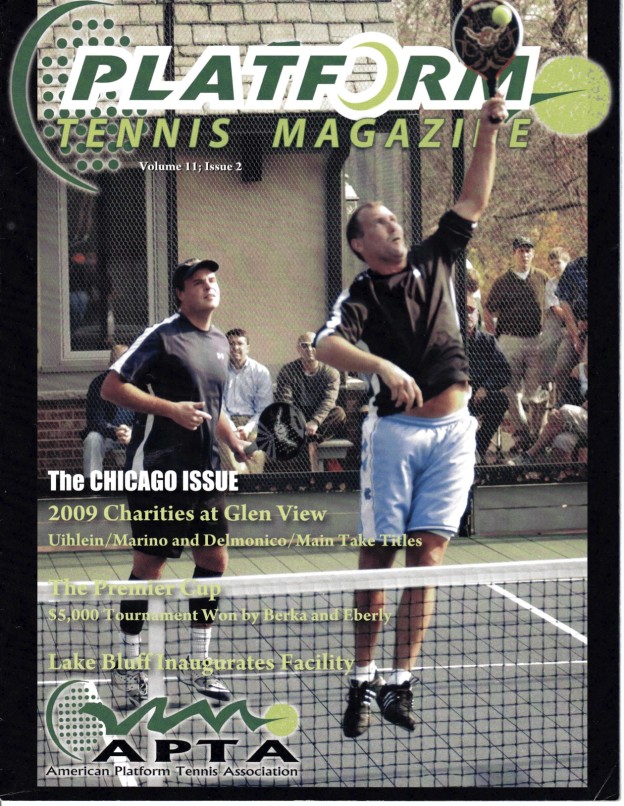
Chicago Charities coverage – Uihlein and Marino take the Men’s and Delmonico and Main the Women’s

Uihlein and Marino Team Up to Take Men’s Title…..Delmonico and Main Win Women’s Charities………

It was a beautiful platform tennis day and the play was outstanding when the women took to the courts at the Chicago Charities.

The 2009 women’s draw was missing many of the big-name players such as Lauren Zink, Cindy Prendergast, Laura Parsons and Susie Keane; however, the talent level was still exceptional compared to most other ranking tournaments.

Kerri Delmonico and Aila Main worked their way through the draw defeating Sally Cottingham and Liz Hayward in the quarter-finals and then Bobo Delaney and Tonia Mangan in the semi-finals on their way to the final.
http://youtu.be/HiPJbZWsHUA

Quarter Final Prop-Schneebeck & Doten-Schwartz.3rd set tie break – Prop-Schneebeck are up in the breaker 6-1. Ad-hoc commentary provided by energized viewers in the hut

Heather Prop and Lynne Schneebeck clinched the other half of the draw with wins over Doten and Schwartz in the quarter-finals and then OhlmuUer and Sheldon in the semi-finals. The finals was patient yet fast-paced. After a tough battle, Kerri Delmonico and Aila Main earned the top spot over Heather Prop and Lynne Schneebeck in the Chicago Charities Women’s Open.

http://youtu.be/UWqmTAqug4g
A typical point in Men’s Final – this being Chicago, gun shots can be heard but they were from nearby skeet range!

Congratultions to Mike Marino and Brian Uihlein for their victory over Mike Cochrane and Scott Estes in the finals of the 2009 Chicago Charities. The play, under a cloudless and unusually warm sky, was lively and spring-like as all the men’s draws-were played out at the Glen View Club. The final was an intense three-set match played to a large crowd of spectators.

The depth of talent at the 2009 Charities was impressive. Missing only a few familiar names, the seeded teams at this year’s tournament covered two complete generations of paddle and an array of styles. There were masters of zen-like patience, big swinging drivers, loud ones, quiet ones, and one court amusing itself with how many times the guys could tag each other.

Fifteen of the sixteen men’s seeded teams made it to the round of 16. Full of past national champions and finalists, those eight matches were among the most exciting of the tournament.

The semis saw Peter Berka and Drew Eberle lose to Mike Cochrane and Scott Estes, and Mike Marino and Brian Uihlein defeating Scott Bondurant and Mark Johnson. This set up three-set final won by Marino and Uihlein over Estes and Cochrane.

Source: Platform Tennis Magazine, Vol. 11, Issue 2, 2009

Coming off a tough 2008, Wilson and Viking improve ball offerings

Last season was a nightmare for the platform tennis ball industry. Wilson was criticized for two reasons: their balls came out late and the ball wasn’t as bright as their Viking competition. On the other hand, the Wilson ball’s flocking held up much better in competition than Viking’s and it seemed that there were fewer Wilson “wobblers” (balls that were not properly balanced) than Viking wobblers.

Players will also notice changes to both the Viking and Wilson balls this season.

New equipment technology

Platform tennis technology continues to evolve, making the sport more enjoyable and easier to play. The key components to determine a paddle’s playability are: weight, density and composite materials, surface area, grit, hole sharpness, rim style and grip length.

Most of today’s paddles come standard with grit and sharp holes. It is the other things that will ultimately define an end-user’s preference in equipment.

With the introduction of EVA Foam paddles and the record sales of the Viking OZ back in the 90’s, manufacturers have committed to altering foam paddle core densities for new paddles.

Eleven of the 17 paddles comprising the 2009 lines are 2008 remakes. Three more are remakes with minor alterations.

While Viking comes out with major innovations every few years, Wilson’s new [K] line is the year’s greatest innovative change in 2009. Not necessarily better or worse than Viking’s line… just technologically new. The end users will determine which product they like best. [enlarge image to read full report]

APTA Court Grants proving successful in growing the game

The APTA is seeking new worthy platform tennis court projects from around the country to help fund – Are you interested?

Mindful that a stated mission of the APTA is to grow the great sport of platform tennis, as well as the quandary that it’s hard to justify courts if you don’t yet have players, and yet it’s hard to attract new players if you don’t have courts for them to play on, the Board of Directors of the APTA decided several years ago to experiment with a Grant Program. The concept was and is to solicit proposals for grants to help build publicly accessible platform tennis courts in areas where the sport has great growth potential.

The first grant was made in 2006 toward a pair of courts at the Chapel Hill Tennis Club. At the initiative of Rich Green, a NY transplant to this tennis rich area of North Carolina, this small and inexpensive tennis and swim club embraced Rich’s vision that they build courts and a program, as an experiment in adding a new wintertime activity. Three years later, by virtually any measure, the grant has proven wildly successful. Most encouraging, and as a direct result of Rich’s efforts, the University of North Carolina at Chapel Hill has just built 3 courts on their campus.[enlarge image to read full report]

APTA celebrate its 75th anniversary

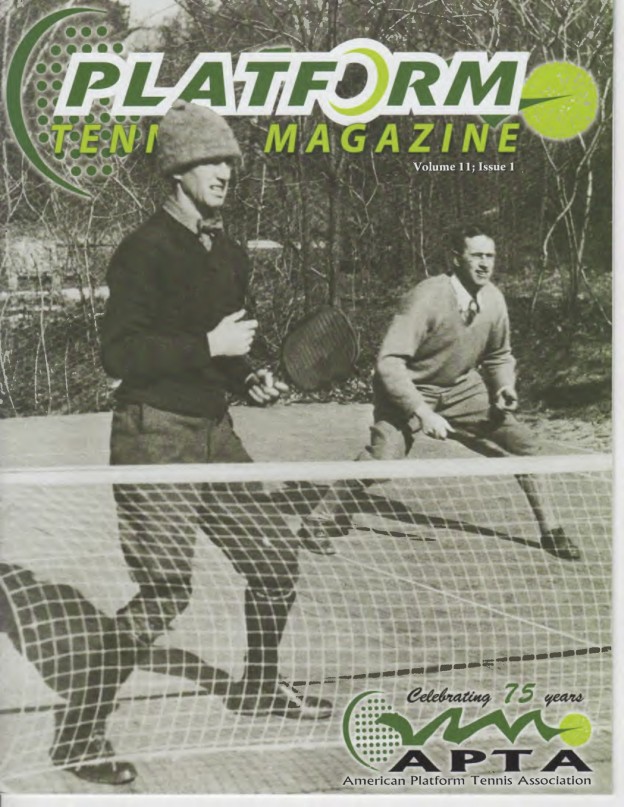
Today, 80 John Street in Lower Manhattan is a newly renovated art deco building offering loft apartments with steep rents. In 1934, it was the site of the founding of the American Platform Tennis Association. With the upcoming anniversary of the APTA, it’s fitting to highlight the origins of the organization that has overseen our sport for 75 years.

After the 1928 foundation of platform tennis by James Cogswell and Fessenden Blanchard, the game’s popularity grew rapidly. Within a few years, the founding fathers deemed it necessary to create an official organization that could oversee rules and equipment while shepherding the development of the game.

In November 1934, John C. Ten Eyck Jr. from Manursing Island Club in Rye, New York, organized a meeting of five of the sport’s leaders at his office at 80 John Street. The men represented three clubs that had been instrumental in developing the game: Fessenden Blanchard from Fox Meadow Tennis Club in Scarsdale; Warren A. Ransom and Grenville S. Sewall from Manursing; and Foster M. Hampton from the Field Club of Greenwich. Ten Eyck understood the importance of initiating ground rules in the development of a sport, as his father had been involved in the early years of the United States Golf Association. Blanchard became the APTA’s president, while Ten Eyck became the secretary-treasurer.

At that 1934 meeting, the members created a charter for the governing body of the “American Paddle Tennis Association.” (The name of the association and the sport was officially changed to “platform tennis” in 1950).

Their goal was to establish basic rules “to promote and make more enjoyable the game of paddle tennis.” Early efforts included overseeing the development of the game, planning and conducting national championships, organizing annual meetings, producing annual reports, answering inquiries, and overseeing rules, regulations and equipment.

Fortunately, the APTA didn’t waste any time attracting member clubs. By 1936, the original three clubs grew to eight, with the addition of Tremont Place Paddle Tennis Club (Orange, New Jersey), Ardsley Country Club (Ardsley-on-Hudson, New York), Bronxville Field Club (Bronxville, New York), American Yacht Club (Rye, New York), and Amackassin Tennis Club (Yonkers, New York).

By 1939 there were 15 member clubs, all of them in suburban New York. The APTA expanded geographically in 1941 when the Hartford Golf Club joined the Association and in 1942 St. Louis Country Club in Missouri became a member .

Platform tennis has come a long way since its humble beginnings in James Cogswell’s backyard. Originally played on a wooden platform without walls, today’s courts feature aluminum construction and high powered heaters. Wooden paddles imported from South America have been replaced by high tech evenly balanced foam core racquets. Unbalanced balls that once “chunked” now only occasionally wobble. Digging back into the history of this wonderful game, one discovers creative, enthusiastic players and entrepreneurs who were instrumental in developing platform tennis into the sport it is today.

Ever wonder how a platform tennis court’s unique features originated? Legend has it that tired of retrieving balls from surrounding snow banks, James Cogswell and Fessenden Blanchard added walls of chicken wire attached to a wooden frame to their backyard wooden platform. During a particularly heated match, a hard-hit ball lodged in the wire mesh. Both an innovator and natural competitor, Blanchard ran behind the fencing, smacked the ball as hard as he could and called the shot “good”. After some debate, the men agreed that the new off-the-wall rule was a good one, adding dimension to the game and broadening the skill set necessary for the sport.

Note: This is a oft repeated legend and is incorrect. In fact playing the ball off the wires was part of the game form the start and was called the “ground rule”. The incident that became the basis for the legend comes for Blanchard’s book Platform Paddle Tennis published in 1959 and was just some “color commentary” by Blanchard]

Evolution of the Platform
Over the next 30 years, standard wooden courts were erected quickly by anyone with some carpentry skills. Plans were available for $30 from the APTA.

Hall of Fame inductee, Dick Reilly, standardized the wood court in the early 1960’s and began what became an explosion of court construction through most of the 70’s. In 1976, there were over 18 full time court building companies. Dick Squires introduced a court made of a prefabricated plywood deck and steel superstructure in the early to mid 70’s. This was an inexpensive court and hundreds were installed in a few short years. But the plywood deck did not hold up like the aluminum deck Dick Reilly introduced the aluminum court in about 1972 [Note: Actually 1970- see link above] but it was still “experimental.” It was not until 1976 that the all aluminum court went into full production and solved the on-going problem of maintenance. Wooden courts rotted and warped over time. The design has changed very little since it was first introduced.

Evolution of the Racquets
Blanchard and Cogswell found their first racquets at the local sports store. Enthusiastic players soon looked elsewhere and the Dalton Manufacturing Company became an early assembler of paddles, including the popular Dalton P-1 paddle. It was constructed of five thin layers of rock maple plywood with a metal edge to protect the paddle from hits and scrapes as balls were retrieved off the wires. One of the problems with the early paddles was that the steel rim would loosen and create a rattling noise.

That led a few of the game’s top players to seek out a Brooklyn ping-pong paddle maker for customized paddles with betterfitting rims. That firm was Allied-Victor, which became Marcraft. Marcraft became Dalton’s biggest competitor until 1985 when, for a variety of reasons, Dalton discontinued their operations.

In the late 1980s, Hall of Fame inductee Rich Maier, a multi-time APTA National Champion, formed Advanced Recreation Design ARD) to build updated paddles and balls inspired by paddles that were being developed in South America for the sport of “padel” While the products were great for their time, the company did not stay in the marketplace for more than a few years.[Note: This is not completely accurate – see link above to Maier’s Hall of Fame biography. Maier’s first racquet, Skymar Proflight, was based on a patent issued in 1983 and was the fore-runner of composite construction for paddles. ARD was formed in 1993 to sell both paddles and a new ball that had been developed with a company in Taiwan and became the fore-runner of today’s balls] In 1992 Marcraft introduced the “FORCE” paddle, the first paddle, manufactured in the United States with a foam core. Marcraft put a foam insert into the center of a wood composite core and covered it with a fiberglass sheet. It was revolutionary for its time. In 1995, Marcraft introduced the “ACE” paddle. It was truly the first all foam core metal edged paddle manufactured in the United States. In addition, this paddle introduced a new style aluminum rim that functioned not only as edge protection but also as a key structural component of the paddle. This construction method is still in use today.

Foam core metal edged paddles added greater shock absorbency and springiness to shots. Additionally these paddles allowed for greater weight standards. When racquets were made primarily of wood, their weight could vary by as much as 4 ounces. Foam core paddles with aluminum rims have become lighter overall. Initially the elite men liked their “war clubs” which often weighed as much as 17 to 18 ounces. Today’s paddles are typically less than 14 ounces and getting lighter.

Source: Tina Kelly, Paul Wiggan (Issue 1) and Hendy Daton and Tina Kelly (Issue2), Platform Tennis Magazine, Vol. 11, Issues 1 & 2

Tim McAvoy elected President of the APTA

Focus, accountability, teamwork, and growing the game…….

It is a privilege and a pleasure to have been selected to lead the American Platform Tennis Association as we enter our 75th year as a not-for-profit association. I look forward to giving back to the sport that has introduced me to so many wonderful people across the country.

I am committed to the tradition and integrity of our sport and am also focused on the APTA’s mission to govern, grow and try to improve the sport we play and enjoy so much.

I was introduced to platform tennis as a child and started playing competitively in 1982. My mother helped bring the sport to the Philadelphia area in the early 1970’s and taught platform tennis to hundreds of players over the next two decades. Known as Mother Paddle in Philly, Lucie McAvoy was inducted into the Platform Tennis Hall of Fame in 1992.

I would like to first begin by tipping my hat to Mark Fischl and acknowledge the tremendous team of volunteers he helped assemble–your APTA Board of Directors.

I would also like to thank Ann Sheedy, the APTA Executive Director, for her positive attitude and tireless support of our members and Board initiatives. She is a shining star within our tremendous platform tennis community.

One of my first goals is to reinforce focus, accountability and teamwork within our Board. To this end, we have formalized Committees for each initiative we feel is critical to growing the game and/or adding value to our membership. Each Committee has a Chairperson and a team of volunteers, focused on delivering against agreed upon goals.

These Committees promote teamwork and a sharing of ideas among Board members. I encourage you to visit the APTA website at www.platformtennis org to view our Committees and stay current with what is happening in the world of platform tennis.

I am also focused on growing the game and adding value to our members. I view the APTA membership in terms of interclub players, open tournament players, Seniors and Juniors.

On the Juniors front, the segment of our membership that is the future of our sport, I am proud to announce the APTA Junior Tour for the upcoming season. The APTA Junior Tour will be lead by Tom Safford and will continue the tradition that David Kjeldsen started with the Viking Junior Tour. Again, check out the schedule of events as well as stories from the Junior Tour throughout the season on the APTA website.

One final comment—please note that future PTM articles in this space will come to you from different APTA Board Committee Chairpeople. I’d like folks on our team to showcase their key initiatives to you, our members.

I hope to see you on the courts this coming season and if you ever have an idea or issue that can help grow our game or add value to our membership, please reach out to me. I welcome your thoughts.

Tim McAvoy, APTA President

Premier Cup goes to Canada

The Fonthill Platform Tennis Club, just 25 minutes north of Niagara Falls, offers two platform tennis courts, a comfortable warming hut, players that welcome you with open arms, and a fridge full of beer. Basically a platform tennis player’s dream!

James Aldred, President of the club and event organizer, along with long-time friend and club member, Rich Humphries, put together the winter’s most anticipated event.

On March 28th 2009, the top Canadian platform tennis players came out to compete for the first prize money tournament ever in Canada. Club members all pitched in with home made food and baked goods, Lorenzo’s Fine Foods was on the grill, and Embroidery Plus donated jackets. The local Tribune newspaper touted articles and camera crews showed up to give the event television coverage.

David Dodge of Premier Platform tennis put up the prize money which was divided between winners of Division A and Division B (each division had 8 players) The results were Derek Thomas and Jay Smith being the winners of Division A and Neil Burke and Rich Allen winning Division B, with each player receiving $250 prize money. Each player also received a prize from the Fonthill Club. Prizes included, Bosch job site radios, 12 volt Bosch power tools, and gift certificates.

The event provided for great promotional weekend for all involved, loads of fun, and an even more anticipated event next March. David Dodge stated, “It is sometimes overwhelming to see how clubs’, their members, and local patrons can step up and pull together to make these events and our sport such a great success. I thank you for pulling together to keep our sport alive and growing!”

Source: Platform Tennis Magazine, Vol. 11, Issue 1, 2009

Peggy Stanton

Peggy Stanton (1924-2009)

Hall of Fame inductee, Margaret G. (“Peggy”) Stanton, died peacefully in her home in Quogue, New York, on June 17, 2009, at the age of 85.

Peggy was a major contributor to the advancement of women’s platform tennis and was also a distinguished player. She won the Women’s Nationals in 1967, 1968, 1969, and 1970, and was a finalist in 1971. She was also a finalist in the Mixed Nationals in 1969, and went on to win two Senior Women’s Nationals in 1974 and 1977 and was a finalist in 1976.

Peggy was an active promoter of platform tennis, an enthusiastic worker for the advancement of women’s platform tennis, a well known instructor, and played in many exhibitions. She was the first female Director on the APTA Board, in 1971, and served for three years as the women’s tournament director.

In recognition of her achievements, Peggy Stanton was inducted into the Platform Tennis Hall of Fame in 1979.

Source: Robert A. Brown, Platform Tennis Magazine, Vol. 11, Issue 1,

APTA Annual Meeting & Board Meeting and Working Sessions

Friday, May 8 The Annual APTA Board Meeting was called to order at 12:45 p.m.

The APTA website – overview and ideas for next steps:
Paul Wiggin gave a detailed report on the website and led a general discussion on APTA priorities for the next 12 months. The site is off to a great start and continues to grow in size, quality, viewership and in contribution to both the APTA membership and to the sport.

The Board agreed with Paul’s prioritization of the future initiatives and, in addition, emphasized certain action items:
1. Having worked out most of the bugs in the on-line tournament registration procedure, the APTA now wants to encourage Tournament Directors to use the APTA site for tournament registrations, at APTA sanctioned events, to ensure that the waiver is signed.
2. Put a “passive waiver” onto the draw sheets (e.g., “By signing up for this tournament and appearing on this draw, you waive … …”).
3. Fred Gumbinner will solicit Chris Kelly to discuss the idea of using “Facebook” as part of promoting social networking for platform tennis.
4. The APTA needs a Juniors link on the site for the APTA Junior Tour (in lieu of Viking).

The Board Members praised the huge progress made over the last 12 months thanks to the monumental efforts of Paul Wiggin and Isabel Cabanne, and to Scott Bondurant for his leadership.

Grant Proposal – Atlanta:
Peter Lauer presented a proposal to the APTA to grant $20,000 for a platform tennis program and courts at the Racquet Club of the South in Atlanta to help launch platform tennis in this large “public” tennis facility and to further the growth of the sport in the Atlanta area. This proposal met the APTA’s needs regarding “public access” (low fees and open to anyone who wants to join) and the fact that the Club is essentially a not-forprofit organization. The following motion was made: It was moved that we issue a $20,000 grant to the National Tennis Foundation for the construction of two platform tennis courts at The Racquet Club of the South with a condition subsequent whereby, if the Club is ever sold, we would receive $20,000 back and that we want an Annual Report each year for the next 3 years so that we can monitor the progress of the Club. The motion was carried unanimously.

Budget:
Sally Cottingham reported that the APTA is in a very solid cash position with $343,000 as of 5/7/09. The numbers in the budget look skewed because this is the year that we transitioned from Cash Accounting to Accrual Accounting. 2008-09 Actual Income is $4,800 up from budget. Actual expenses were down $3,000 from budget and Net Income +$7,800. Final 2009-10 budget discussion will be on Saturday.

Sally also said that Aila Main will become the new Treasurer and that Sally would work with Aila throughout the coming year as needed to ensure a smooth transition.

Bonuses:
The Board unanimously approved year-end bonuses for Ann Sheedy and Isabel Cabanne.

Exhibition Tour:
Todd Ward gave a report on last year’s exhibitions which included: Atlanta, Minneapolis, Flushing Meadow, Buffalo and Charlottesville, VA. Currently, the focus for next season is on Atlanta (the new facilities at RCS), Chapel Hill (UNC), Washington DC and St. Louis.

Rules:
The following changes in the Rules were proposed and voted on:
Rule #2: Court Fixtures – The rule will now include “any diagonal corner support beams within the enclosure”. This change was approved unanimously.
Rule #3: The Ball and Paddle – Add “All paddles and balls used in APTA tournaments must have been approved by the APTA rules committee”. This change was approved unanimously.
Rule #11: Footfault – After discussion, it was decided that Fred Gumbinner would look at the USTA rules and make a recommendation on new language to the Rules Committee Chair who would then propose a change to be voted by on the Board on the next conference call.
Rule #22: Scoring — A proposal was made to make changes in the scoring for the 3rd set of all APTA tournaments — or in the Finals of such tournaments and the possible use of the “super tiebreaker”. These concepts were discussed and the vote was to leave this rule unchanged.

Sportsmanship:
Discussion included a proposal to write a “preamble” to be added to the very beginning of the Rules which would emphasize the importance of sportsmanship, and language for an actual rule was proposed which would give tournament chairs and the APTA more authority to mete out penalties or sanctions for unsportsmanlike behavior. Bill O’Brien will give his recommended wording to Fritz Odenbach who will be chairing the Rules Committee and Fritz will finalize a proposal to be voted on during the June 16 conference call.

Saturday, May 9 – Continuation of 2009 Board Meeting

Election of Officers:
The following slate of officers was proposed, moved to be elected and unanimously approved:
Tim McAvoy for President
Fritz Odenbach for Vice-President
Aila Main for Treasurer
Bill O’Brien for Secretary

APTA Direction:
Tim McAvoy said that his priorities included:
– Bridging the gap and mending fences
– Being an ambassador for the game
– Growing the game in any public venue
– Strengthening the APTA “brand” and promoting goodwill among players
– Strengthening roles of the committees

Next Meeting:
The next annual Board Meeting will be in Atlanta on May 7 and 8. There will be a conference call of the Board on June 16 at 8:00 p.m. (EDT) plus further calls
on September 15 and October 13.

75th Anniversary:
Paul Wiggin will lead an effort to promote the APTA’s 75th anniversary. Amy Halstead, Tina Kelley and Hendy Dayton will work with Paul.

Printed Rules Books:
A motion was raised to print 500 copies of the Rules, once they are revised, and include a copy with each Club Gift. The motion was carried unanimously.

Rules Committee:
A motion was raised to appoint Fritz Odenbach to Chair the Rules Committee and to have him select the Committee. The motion carried unanimously.

PPTA:
Todd Ward will continue to be theBoard Liaison to the PPTA.

PTM:
A motion was made to appoint Amy Halstead to Chair the relationship with Platform Tennis Magazine. The motion carried
unanimously.

Juniors:
Tom Safford will administer the APTA Junior Tour, sponsored by Viking, and Tom will be the Chair for the Junior Committee. It was moved that the APTA contribute $2,000 to support the APTA Junior National Tournament. The motion was carried unanimously.

Seniors:
Tim Mangan led a discussion which included the following:
– The APTA has a healthy participation in Seniors events
– Region 1 held all the Senior Nationals this past season. It was agreed that the APTA needs to move the tournaments around.
– Reiterating last year’s resolution, local tournament directors can choose which combined age groupings they wanted for their tournaments — 90+, 95+, etc.
– The APTA will not have any new National Championships for combined age groups

It was moved that Tim Mangan be appointed as Chair for the Seniors Committee. The motion was carried unanimously.

Coffee Table Book:
It was moved that, to encourage completion of the “coffee table book” on the history of the game, the APTA will financially support it with up to a $30,000 loan or other form of support with the proceeds of the sale coming back to the APTA until we recoup our initial investment and with a target completion of September, 2010. The motion was carried unanimously.

It was also moved that Tina Kelley will chair this effort and will choose her own team. The motion was carried unanimously.

Schedule of National Championships:
The men’s and women’s open Nationals are currently scheduled as follows:
2010 – Philadelphia
2011 Chicago
2012 – Long Island
2013 – New Jersey
2014 — Pittsburgh
2015 – Rochester

Region Presidents’ Committee:
The purpose of the committee is to share best practices, raise communication within each Region, and help RP’s do a better job of being the face of the APTA in their Region. It was moved that Rob Coster will chair the Region Presidents’ Committee. The motion was carried unanimously.

College Program:
Rob Coster will continue to be the point person on this effort.

“Branding” Committee:
It was moved that Hendy Dayton chair the Branding Committee and the members will include Amy Halstead, Tina Kelly and Paul Wiggin. The motion was carried unanimously.

Players’ Committees:
The Men’s Players’ Committee will consist of Jerry Albrecht, Scott Bondurant, Mark Fischl, Rich Green, Tom Mayes, Fritz 0 denbach, Mike Marino, Mark Parsons, Todd Ward and Fred Gumbinner (Chair). This committee is expected to deal with any issues that come up regarding players including enforcement of backdraws, foot faulting, sportsmanship issues, and so on.

The Women’s Players Committee will be chaired by Alla Main and she will select her team.

It was moved that, if the Players’ Committee has an issue it needs to deal with, it should recommend the sanction(s) it wants to the Executive Committee of the Board and, if the player(s) appeal, then the Chairperson of the Committee will bring it to the entire Board. The motion was carried unanimously.

During a discussion regarding whether players must play in the 16 back-draw, it was moved that playing in the 16’s will be required for all APTA tournaments (which
continues the practice now in place). The motion was carried unanimously.

Fred Gumbinner will organize a conference call to deal with the protest launched by two players who did not play the 16’s back-draw at the 2009 Nationals.

Regarding foot faulting, we are asking Fred Gumbinner to continue with the roving foot fault judge effort for next season and put together a protocol for how to do it by the June 16 conference call.

We also want to reinforce, or reinstate (if it is missing), that all nationally ranked players must play in at least one NRT in some other Region.

Budget:
It was moved that the APTA provide trophies to the winners and runners-up of the main draw of the Men’s and Women’s National Championship tournaments The motion was carried by a vote of 8 in favor and 6 opposed.

It was moved that the APTA budget $3,000 for Club Gifts which will include the Nationals DVD, a Rules Book, the 75th anniversary poster, etc. The motion was carried unanimously.

It was moved, that the APTA approve $5,200 for the promotional DVD, plus $7,500 for exhibitions and then remove the $5,000 item for “website videos”. The motion was approved unanimously.

Tournament Eligibility:
It was moved that all players in National Championship tournaments must be APTA members and, if they are not, they must pay the back dues or they will not be eligible to play in the upcoming tournament. The motion was carried unanimously.

Legal Advice to the Board:
It was moved that the APTA ask Beach Kuhl to serve as an ex-officio “of counsel” to the Board and he will be a non-voting, non-paid member. The motion was carried unanimously.

Adjourn: The meeting was adjourned at 3:00 p.m.

Source: Platform Tennis Magazine, Vol. 11, Issue 1, 2009