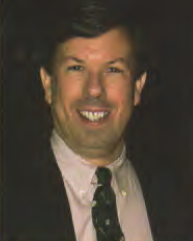
APTA President Tim McAvoy on planning for the 2010 Nationals

Planning for the 2010 APTA Men’s and Women’s Nationals began April 20, 2009 and culminated with the four day event taking place March 4-7th, 2010.

With Waynesborough Country Club as the host facility, our vision was to change the format of the evening parties and host the men and women on Friday night, instead of Saturday, and offer a “Come as you are” party on Saturday evening, to allow players and spectators to watch the men’s quarter final play, with beer flowing and a BBQ grille serving up chicken and burgers through the night.

We were rewarded by the tremendous turnout for the Friday night party (over 400 players/volunteers attended) as well as for the Saturday night men’s quarter final play (close to 400 players/spectators came to watch). [enlarge image to read full letter]

College Platform Tennis – Chris Kelley reports

Georgetown University – After eight years of playing paddle and three years of passionately promoting college platform tennis I offer some observations, advice, and optimism for the future of the sport at the college level. There has been a lot of talk about college platform tennis and, I’m pleased to say, something to show for it too.

At Yale University, Kate Macauley (Yale ’11) and Rob Coster (APTA College Program Chair) have done a great job securing two courts at a nearby country club, getting support from local players and enthusiasts, and holding weekly events for Yalies. After two years in the making, Yale Platform Tennis Club has 30 students of all abilities on the roster, and about ten players who play each week. Kate has been successful by recruiting Yale friends to play and has grown interest through club fair events at school. [enlarge image to read full report]

APTA Junior Nationals -“The future looks bright!” to Michael Gillespie

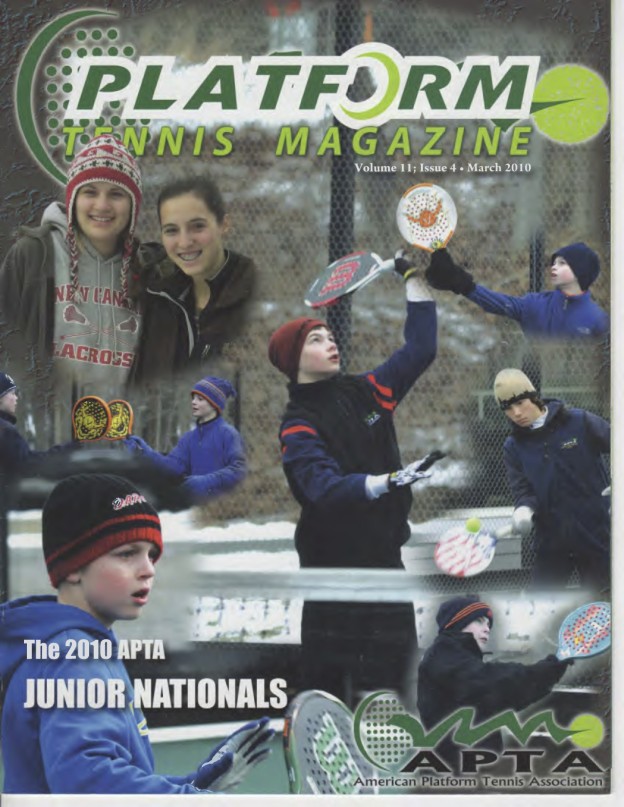
“The future of our sport is looking bright!” Those were the closing words that APTA Junior Nationals Tournament Director Michael Gillespie proclaimed after he draped the traditional medals around the necks of the last finalists and champions of the 2010 edition of this annual, day-long tournament.

Bright indeed. This year, 200 juniors participated in the annual junior championships, held on Saturday, January 30, in New Canaan, Connecticut, and hosted by members of the New Canaan Field Club. Teams traveled from as far away as Philadelphia and Pittsburgh, and even from Hinsdale and Highland Park, IL.

The weekend kicked off with the traditional Friday night “Welcome Party” for all participants. Each of the Field Club’s four courts were set up with a different activity: Court 1 featured nationally-ranked players Mark Parsons and Brian O’Connor taking on challenges from the juniors in a 10-point super tiebreak. Court 2 featured various skills contests where players tried to hits high lob to a specific target, hit soft overheads so they would drop into a basket, and return a variety of crazy spin serves from resident pro Mike
Gillespie.

The paddle carnival atmosphere continued on adjacent Court 3, which was featuring “Red Zone.” Bertan Cikigil of Sleepy Hollow Country Club set up two of the metal 2’x3′ targets and let the juniors loose to try out this fast-paced and exciting variant of platform tennis.

Roaming all of the courts and throughout the hut capturing the fun for a commemorative video was local paddle enthusiast and professional video producer George Hamilton. George and his crew from YYR Productions created a DVD featuring player interviews and highlights from many of the matches. This DVD is being made available to all the participants and the general public as well. (For information on how to order a copy, visit the APTA website at www.paddlepro.com.)

Early Saturday morning, the brigade of volunteer hut commanders recruited and organized by Tish Tregellas, arrived at the Field Club to pick up the favors, food, and draw sheets that they would need at their respective sites. While the early forecasts were calling for light snow showers, the precipitation stayed away; but just hours before the first ball was served, it was a chilly nine degrees Fahrenheit!

The early rounds were all Round-Robin format and were held at several nearby clubs. After lunch and the quarter- and semi-finals, all of the finalists returned to the New Canaan Field Club to play the finals of all the divisions. The finals even attracted the attention of the national media. National Public Radio journalist Craig LeMoult was at the Field Club and interviewed several players and spectators. The following Monday, his 3 1/2-minute primer on Platform Tennis aired on NPR’s Morning Edition. You can listen to his story online by going to www.npr.org/templates/story/story.php?storyId=123202058.

While all of the finals in each of the eight divisions had their own bits of drama, two matches in particular kept the spectators in the hut gripped in excitement. In the Boys 14 & Under, locals Will Burger and Gardner Tregellas held off a stiff challenge from Will Kleeman and Patrick Dellinger, who traveled from Sewickley, Pennsylvania, a suburb of Pittsburgh. Burger and Tregellas, who won a national title as 12-year olds and were finalists in last year’s 14s, were the slight favorite over the little-known duo from Western PA. After taking the first set by a closely fought score of 6-4, it looked as though they had the momentum going into the second set. However, Kleeman, who had been wanting to play in the Jr. Nationals for the past three years, and partner Dellinger, who is a talented tennis player relatively new to paddle, didn’t come this far to go down in straight sets. They evened the match by winning the second set, 6-4. In the third and deciding set, Burger and Tregellas came back from a 1-3 deficit to close out the match, 6-3.

After the B14 nail-biter, the dozens of spectators in the hut barely had time to recover because, over on Court 4, an incredible Girls 18 final was unfolding. In a repeat of last year’s G18 final, favorites Corey Delaney and Nicki Ross of Chatham, NJ, faced Margaret Souther and Rachel Whitney of Scarsdale, NY. As classic matches often do, this one came down to the deciding third set. Delaney and Ross found themselves down an early break to trail 2- 4. Later in the set, they faced several match points, but each time, were able to fight them off. In the end, Delaney and Ross successfully defended their title, 7-5 in the third.

At the end of the tournament, Gillespie told the audience, “It is such an honor for me to host the Junior Nationals. I remember when I began playing the junior “circuit” as a 14 year-old from Glen Ridge, NJ. I traveled to Philadelphia, Pittsburgh, New York, throughout New Jersey, and even up to New Canaan, CT. It’s fun for me to play adult tournaments now and run into players I competed against more than 30 years ago. This sport has given so much to me. I am so glad to have this opportunity to give a little something back”

I want to thank my excellent tournament committee and the many volunteers who helped throughout the weekend. The tournament also would not have been possible without the generous financial or in-kind contributionsfrom the following sponsors: Prince/Viking Athletics, Orthopaedic & Neurosurgery Specialists of Greenwich, Wilson Racquet Sports, the Fairfield County Platform Tennis League, the Center for Advanced Pediatrics, Tennis General Store, Pinocchio Pizza, Kelly Daniel of William Raveis Realtors, New Canaan Racquet Club, New Canaan Field Club, BeBands, The Switch Beverage Co., Poland Spring Natural Spring Water, and Comma Home Furnishings.

In closing, I’d like to encourage all tournament directors out there to consider adding a junior event to their calendar next year. The caliber of play of our juniors is clearly on the rise. Let’s keep that momentum going. The kids are doing their part. Let’s do what we can to keep the future of our sport bright!

Source: Michael Gillespie, Platform Tennis Magazine, Vol. 11, Issue 4, March, 2010

APTA Senior Women’s 70+ Nationals

On January 13th, Helen Garrett and Mary Jane Parks, newcomers to the 70s, swept to victory by defeating Nancy Libby and Gail Reifsnyder in the finals of the 70+ Women’s Nationals, 6-1, 6-0. Helen and Mary Jane have the habit of winning their 1st eligible age year. Congratulations.

Nancy Libby has the distinction of being in the finals four years in a row and five out of the last six.

The draw was the magic number of eight as required by the APTA. We had perfect weather and the entrants are a fit and fun group. We always look forward to the competition and sharing the day with our age group.

Source: Ann Brown, Tournament Chair, Platform Tennis Magazine, Vol. 11, Issue 4, March, 2010

Progress at the Platform Tennis Museum and Hall of Fame

Although the platform tennis season is winding down, the full flame is still burning at the Platform Tennis Hall of Fame Museum. Another year has passed, and while progress has been slow, there continues to be good progress toward the realization of the dream of a “bricks and mortar” home for display of the memorabilia of the sport and a place to honor those elected to its Hall of Fame.

The Foundation’s Chairman, Bob Brown, and Museum Curator, Jim McCready, have worked with museum consultant Ed Puches to develop a model of a display case featuring the 1970’s decade. It is pictured below. Mr. Puches of Irvington, NY has developed projects at Harvard University and IBM. Eight similar display cases will be included in the museum to highlight other decades since the sport’s invention in 1928. A great deal of the memorabilia has been collected, but more is still welcomed by the Committee. [enlarge image to read more]

2010 APTA Board Nominees – Juan Araya, Katie Bliss, Mark Kebe and Tina Houlihan Kelly

Juan Araya is from Buenos Aires, Argentina, has been playing platform tennis for four years and tennis since he was five years old. He was in the top five in Buenos Aires, and in the top 10 of Argentina, playing with people like Gaston Gaudio (#5 in the World), Guillermo Canas (#12), Mariano Puerta (Finalist of the French Open) and others.

In December 1991, he competed at the Orange Bowl in Miami, Florida, reaching the quarter-finals and losing to Norman Magnus, former #2 of the ATP Tour. He also played every tournament in the COSAT circuit, reaching the semifinals of the Pascuas Bowl in Asuncion, Paraguay. At the age of 18, he played the South American professional tour, reaching several semifinals and quarterfinals.

Later, at the Universidad de Belgrano, he got his degree in Management Information Systems. While at UB, he worked for different companies as a software developer while he was helping the Argentinian Tennis Association, where he used to play with the “Future Stars” as a hitting partner.

In February 2002, Juan and his family decided to move to the United States. His first job was in New Jersey at the Pascack Valley Tennis Center as a tennis professional. For two summers he worked at the Belle Haven Club in Greenwich, CT, then at the Greenwich Country Club where he directed and coordinated all aspects of the women’s and junior’s programs. Currently, he is the Director of Racquet Sports at the Aspetuck Valley Country Club located in Weston, CT.

Juan won several APTA National Ranking tournaments in 2009. He is certified in both PPTA and USPTA. He is also the developer of the new interactive Men’s Ranking program on the APTA website.

Juan lives in Riverside, CT with his wife Roxana and their two young daughters Abril (9) and Lola (3) and newborn son Timoteo.

Katie Bliss is a self -professed ‘enthusiastic B player’. Her love for the game began at the now-defunct Apple Platform Tennis Club in New York City, where she met her future husband, Mark. She is the past president of the New Jersey Women’s Platform Tennis League, whose membership includes over 800 women from throughout the state playing weekly from October to February. During her 10 years on the NJWPTL Board, Katie served in several capacities besides her presidency, including Tournament Director of the state tournament. She has also been involved in running the Short Hills Platform Tennis Invitational, the nation’s oldest national ranking and PCQ tournament, for close to ten years; three as the Tournament Director.

A past contributor to the Platform Tennis Magazine, Katie acknowledges that the smartest financial investment she ever madewas her life-time Membership to the APTA in 1990. She resides in Maplewood, NJ, with her husband Mark, also a long time paddle player, and two children.

Mark Kebe grew up in Pittsburgh, where he was introduced to the great sport of platform tennis by Jay Smith. Jay is a commercial painter who created the Peter’s Creek Paddle Club—a club consisting of two courts and a warming hut—behind his paint shop. Mark was in high school at the time and worked two summers on Jay’s painting crews. He learned the game at Peter’s Creek by showing up every Sunday morning to get thumped by the Division 1 and 2 men’s league players. He also was given the opportunity to learn how to scrape, paint and apply grit to the decks (wood planks at the time) and to tighten the screens. He has a true appreciation for the sport.

Mark graduated from the University of Cincinnati with a Bachelors Degree in Accounting/Finance. Immediately after college, he played at a local racquet dub where he began introducing friends (includinghis future wife) to the game, as well as meeting a number of the local club players. The game was just beginning to take off in Cincinnati. Since then, he has played in the Cincinnati Men’s League where the participation has grown from less than 100 players to the current level of over 600 players. He has been involved with The Midwesterns, Region N’s National Ranking tournament, for 15 years, acting as Tournament Chairman the last 10 years. The Midwesterns attracts over 200 participants each year. He also was part of the 2009 Nationals Committee.

Mark is still enthusiastic about bringing new people into the sport and when he is not playing paddle or traveling to volleyball tournaments to watch his daughter play, he works as a crisis manager/turnaround consultant assisting companies experiencing various degrees of financial distress. Mark lives in Cincinnati, where he enjoys spending time with his wife, Sharon, and their daughter, Paige.

Christina (Houlihan) Kelly grew up in Westchester, New York, in an enthusiastic platform tennis family, that includes her older brother, Tom, and father, Art. Tina won the 15-and-under Junior Nationals (1978) and 18-and-under Junior Nationals (1980). She graduated from Vassar College (where she played tennis) and received an MFA from the Iowa Writers’ Workshop at the University of Iowa.

A former magazine editor and writer, associate producer of film, and college English professor, she is now a free-lance writer and cruciverbalist (she’s had nine crossword puzzles published in “The New York Times”). Tina has served on the APTA board since 2007 and is an active member of the Branding and the Web Site committees. She writes and designs regional APTA newsletters, edits and creates articles and marketing materials, and even uses her creativity to fashion APTA ads.

She is currently working with the Platform Tennis Hall of Fame Foundation and writing a coffee table book about the history of platform tennis which will be published in Fall 2010. Tina, her husband, Bill, and their Boston Terrier, Gussie, live in Ossining, New York She has two stepdaughters and five grandchildren.

John Embree – a great supporter of the game

John Embree has had a long and storied history in the world of racquet sports. Growing up in Chicago, he moved back to his home town in the Windy City to take a position with Wilson Sporting Goods. He remained there for 17 years, rising to the title of Vice President and General Manager of Wilson’s global racquet sports. He subsequently left Wilson to become part owner of tennis apparel manufacturer Balle de Match.

“I went to Balle de Match because the owner needed marketing and sales help,” Embree said. “I thought I could use my tennis connections to grow the business. Wended up tripling sales in three years.” That firestorm of sales helped Embree get his next position, as he was tapped by Prince CEO George Napier in March of 2009.

“When I started with Prince, the economy was in a trend heading south and consumers stopped their spending,” Embree said “Consumers are now changing their spending habits. ”

Broadening their platform tennis base, Prince bought out Long Island-based Viking Athletics. Embree said the acquisition was a “natural extension” for Prince. [enlarge image to read full story]

PTM interviews past APTA President John Horine

John Horine

Age: 48
Family: Wife: Paige; Daughters: Devon, Amelia
Residence: Baltimore, MD
APTA President: 1998-2004

John Horine was the President of the American Platform Tennis Association from 1998 through 2004. His presidency will always be associated with improving communications between the APTA Board and its Members

During his tenure, John was responsible for contracting with Dollard Publishing to bring the APTA members Platform Tennis Magazine in 1999. He also was instrumental in getting the Board of Directors to create an official website The site, www.platformtennis.org has gone through a few revisions over the past few years, and has evolved to be a great source for current and archived news and information.

We sat down with John Horine to catch up on his thoughts on the new directions taken by the APTA.

Can you tell our readers what you have been doing on and off the court since your term as APTA President expired in 2004?

“Off the courts, I’ve been coaching my older daughter Devon’s soccer team. I’ve immersed myself in my daughters’ activities. I’d been running the business, I’d always had — a retirement home — and I started a home-care business. On the court, I’m still playing some tournaments and running the Maryland State Men’s Division, as I have for the past 22 years.”

You appointed the last APTA president, Mark Fischl, and his legacy will certainly involve his initiatives to grow the game in the south through clinics, exhibitions and grant funding. Do you, or any other past presidents, consult with current board members or the APTA president about new initiatives?

“I talked with Mark for the first six months, until the season got started. Once the season got started in October and November, he was off and running. He knew what he wanted to do. Past presidents don’t get together formally It would be great if we did. It would keep some history in the game. History is important. Personally, I look to Bob Brown to keep history in the game, and I don’t want to forget the past. That’s why I pushed for a bricks and mortar hall of fame ”

How have you seen the role of the APTA change over the past 15 years and what directions would you like to see the APTA take moving forward?

“Not having been involved in the last five years, I know they’ve done a lot of promotion and building of the game in the south and other areas, which is great. In the last 15 years, we worked with the magazine, and we did a lot of things with the professional teaching association, which brought around qualified umpires. The website took off, and the office has moved from the New York/New Jersey area to Pittsburgh. That’s great If I could improve one thing, I’d like to see more done to gain national sponsorship. I tried to take advantage of the fact that Wilson and John Embree were active in the sport, and to use their names to build credibility and get sponsorship in other markets. I’d like to see the APTA somehow use its clout to help tournaments secure sponsors in any way. National type sponsors. Marsh was there for a little bit. But I also understand that that’s almost a full time job in itself to go after these people. Having the APTA’s assistance [for smaller tournaments] should come down from the top, and I’d like to see
the APTA secure sponsorship money for national and local tournaments ”

Every five years, the APTA elects a new President. Other Board Members can rotate in and out, serving up to two three-year terms. With the current structure of Directors coming and going so often, do you see this as an opportunity for equal representation across the regions or as not enough time for a Board to unite to work together?

“When it was instituted, I was president, and we talked about [term length]. Some decisions were made after I went off the board. It was difficult, because there was no succession plan for the presidency. I loved it, but after six years, I had to step back and there was no plan. Having members on the board, the first year, you’re sitting there and taking it all in. It doesn’t give whoever’s being president much time with getting a grip with what’s going on and implementing what they want to do. Having said that, it makes regions shuffle the deck and get some new ideas in there. I think there needs to be time. On a board that meets two or three times a year, it’s hard to get things done on a national level in just a couple of years ”

What qualities make for a successful APTA Board of Directors?
“Activity in the game and knowing the players on the local level. Know your own region and parts of the region, not just its nationally ranked players and so forth. The thoughts of the guys that play twice a week and the guys who play in the club mean as much as the nationally ranked players . I want to hear what they have to say. Be in touch
with the local, not just the tournament players ”

The new APTA president, Tim McAvoy is a friend of yours from your region, Region III. He is well-liked in the region, as well as all across the APTA men’s tournament circuit. As decisions are made, people develop strong opinions about new policies and those who make them. What advice do you have for the Tim?
“I guess it depends on what he’s proposing. My advice to him would be to just stand behind anything you implement. Be sure of the decisions you’re making and don’t take any flack because there will always be people who don’t agree Tim’s a strong guy People may be critical, but he’s very diplomatic. I’ve known him for 25 years, and seen him in lots of situations and he’s very sharp. He’ll be fine”

Do you have any regrets from your term as President or wish that you could have done something more?
“I think I was very fortunate in having a a lot of things that were controversial But the Board was supportive, so we got a lot of things done. I don’t look back and say, ‘Gosh, I wish we could have done this’.I had an agenda, got it done, and turned it over to someone new who could put their own touches on it ”

Source: Platform Tennis Magazine, Vol. 11, Issue 3, January, 2010

The Villages takes on Platform Tennis

Orlando Retirement Community to Build Six Platform Tennis Courts

The inaugural meeting for a Paddle Instructor Committee, or PIC, was held at the Villages in Orlando on Friday, Jan. 15, 2010. Anderson DaSilva, Manager of the Truman Recreation Center, hosted the meeting.

Village of Bonita resident, Joe Russo, Sr., volunteered to be the instructor. At the meeting, he discussed the following:
A. The new ground-level paddle court design used here
B. Demo of current play equipment
C. Sources of equipment
D. Membership in the APTA
E. Update of APTA Rules
F. A flyer on paddle in The Villages to be given to newcomers

Other discussions and activities included:
1. Outline of free teaching clinics, court play regulations and court times by Anderson
2. A 33 minute DVD on paddle (and ask for comments)
3. Question and answer period
4. Discuss next PIC meeting time and date
5. Enjoy picnic style lunch

The kickoff date for the new facility is currently being planned for early March. Platform Tennis Magazine will cover the festivies and report back in a future issue.