

2010 APTA National Championships: On-line Postings Provide Real Time Story
Thursday, March 4, 7:30 a.m. EST
We’re here at the Waynesborough Country Club in the Philadelphia suburbs for the 2010 APTA National Championship Competitions. I will be documenting the event and posting news and results every few hours.
Today, we will feature the Women’s and Men’s President’s Cups. Tomorrow will be the Women’s day one of the Nationals. The men will play some first round matches to open up more courts for Friday’s matches.
Thursday, March 4, 9:15 a.m. EST
Well, the team photos have been taken, and the Men’s and Women’s President’s Cup competitions are under way. Are you familiar with the President’s Cup? This special event is held every year immediately prior to the Nationals. Each APTA region selects five of their best teams (excluding the very top-ranked players), to compete in a round robin against other regions. All President’s Cup players also play in the Nationals, making for a grueling, but exciting, long weekend of paddle. Players compete throughout the tournament season to accumulate enough President’s Cup Qualifying Points to represent their regions. That’s what the PCQ marker on many tournaments is about.
Thursday, March 4, 1:55 p.m. EST The President’s Cup matches are into full swing on a beautiful sunny day. Jackets are off and people are sitting outside. Photographers are busy so we should have our first photos posted tonight.
This evening at Waynesborough CC there will be awards for the President’s Cup and check-in for men and women.
The women’s tournament starts Friday morning and the men play early round matches starting a little later in the day Friday.
Thursday, March 4, 10:00 p.m. EST
Congratulations to the Region 5 Men’s team and the Region 1 Women’s team for their victories in the President’s Cup.
Friday, March 5, 12:00 noon
The weather has been fantastic. Cool and sunny in the SOs with a few clouds floating in and out. The women’s seeds have held as the first few rounds are completed and people are breaking for lunch. Some of the chat revolves around the experience of being taken out by top seeds and whether of not it was a learning experience.
Updated draws are posted periodically.
We have posted a slide show from the President’s Cup on the APTA’s web site. Photos will be added throughout the day as we can drag ourselves away from watching matches.
Friday, March 5, 1:30 p.m.
The women’s round-of-16 matches are starting as everyone finishes lunch and regroups. In the main draw, 15 of the 16 seeds have progressed to the round of 16.
In the single upset so far, Heidenberger and Shelburne defeated 13th seeds Jones and MacKinnon in the round of 32.
The check-in desk continues to be busy as men arrive for check-in.
Friday, March 5, 5:15 p.m.
The women’s quarter-finals are well underway. The top four seeds made it through to the quarter-finals.
Men’s action is also into some second rounds.
Women’s Quarters:
Doten-Keane (1) vs. Flynn-Tarzian (9)
Lemery-Ohlmuller (12) vs. Delmonico-Main (4)
Dardis-Shay (3) vs. Prendergast-Zink (6)
Parsons-Sheldon (7) vs. Prop-Schneebeck (2)
Friday, March 5, 9:00 p.m.
This evening, the ladies finished up the quarter-final matches, setting up the semis which are scheduled to start tomorrow at 10 a.m.
Top seeds Mary Doten and Susie Keane face off against 4th seeds Kerri Delmonico and Aila Main. The second seeds, Heather Prop and Lynn
Schneebeck, play Cindy Prendergast and Lauren Zink. Should be a pair of excellent matches.
Saturday, March 6, 9:00 a.m.
At the party last might, semi-finalist Cynthia Prendergast was inducted into the Platform Tennis Hall of Fame, the highest honor in the sport. Her induction speech was written by former partner Patti Hogan and delivered by Tim McAvoy. Cindy will be playing the semis this morning.
Saturday, March 6, 1:00 p.m.
Wow, what a day! The weather has cooperated fully and the play has been spectacular at tournament central. Based on the scores coming in from all the locations, there have been a lot of very competitive matches played today in the backdraws.
In the APTA Women’s Nationals, the two semi-final matches were contested simultaneously on side-by-side courts, providing continuous action for a huge crowd of spectators. Both semis went to three sets, but while Prop-Schneebeck and Delmonico- Main fought hard for tickets to the final, in the end it was to be a repeat of last year. Newly inducted Hall of Famer Cindy Prendergast and partner Lauren Zink take to the main court to have another crack at 5- time National Champs Mary Doten and Susie Keane, trying to increase their own title counts.
Saturday, March 6, 4:00 p.m.
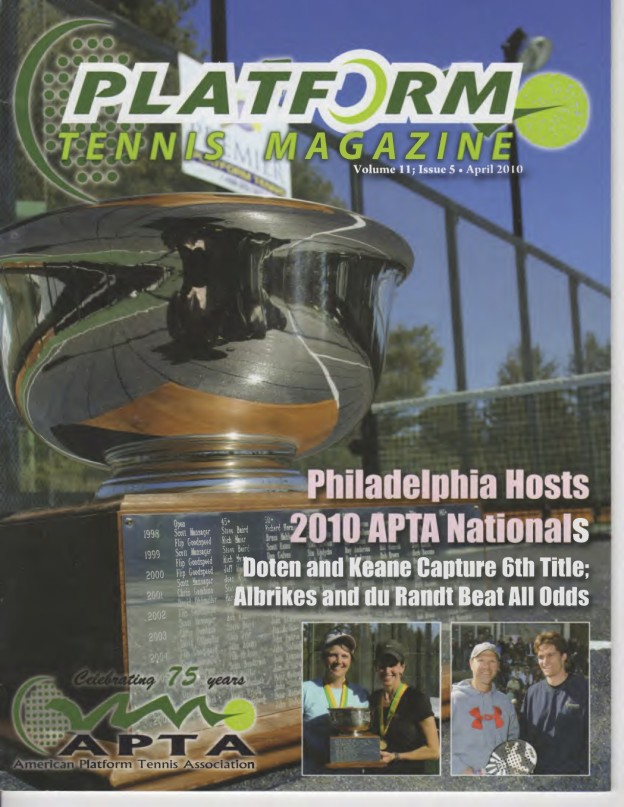
Despite the vocal support, a large home-area crowd, and many outstanding points, Prendergast and Zink fell to Doten Keane 6- 1, 7-5. Doten and Keane now hold six APTA Women’s National titles. They have won in six out of the last eight years, and have won every time they have reached the final.
After the match, Cindy Prendergast told Platform Tennis Magazine, “We started out shaky and then improved. The second set was a good one.” Lauren Zink added, “They certainly bring their ‘A’ game every time they play us. Since we lost to them again in the National finals, I think that we’ll take up beach paddle and play them next year in bikinis.”
When Susie Keane was asked how she felt, she said,”We had a tough semi and were warmed up to play a great first set in the finals It was a warm day and hard to keep the ball in the court. We all made unforced errors that we were unhappy with.” She added, “Eight years ago, Mary and I played our first Nationals together here at Waynesborough. We were unseeded and it was a balmy 60 degrees. Naturally, we were looking forward to a warm day again today for the semis and finals. We got what we hoped for.”
Mary Doten concluded, “We played well in the finals and never let up. A match like this can turn on a dime.”
The men have been keeping all the other courts in town busy. Some seeds started to fall in the round of 32, when Gillespie-Stulac took out 13th seeds English-Heil, Dana- Jonason defeated 9th seeds Caldwell- Cordish, McKnight-Rose bested 14th seeds Broderick-Moore, and Parsons-Schmidgall beat 15th seeds Arraya-LeFevre. The quarter-finals are scheduled at the Waynesborough stadium courts for 5 p.m. and 6 p.m., accompanying the evening festivities. Check draws for updates. We’re posting regularly.
Saturday, March 6, 9:00 p.m.
What an amazing night in Waynesborough! The men’s quarter-finals were, simply put, amazing. In summary, Cosimano and Haller defeated Cochrane and Estes; Albrikes and du Randt defeated Rothschild and Schmidt; Goodspeed and Mansager defeated Bondurant and Johnson; and, Marino and Uihlein defeated Berka and Eberly.
Sunday, March 7, 10:45 a.m.
All the action today is taking place at tournament central, Waynesborough CC. With five permanent and three temporary courts, there is enough court space to comfortably handle all of the late round matches.
On the stadium courts, the two semi-final matches started up at 9:30, to a large crowd of spectators. After a little over an hour, one semi is finished and one has just finished the first set.
Jerry Albrikes and Johan du Randt took care of business quickly, defeating Anthony Cosimano and Steve Haller 6-0, 6-2 in a fast paced slug-fest. At the same time, Flip Goodspeed and Scott Mansager crafted their way through Mike Marino and Brian Uihlein in a more traditional mix of patient set-up and quick attack.
This afternoon’s finals will feature the 8-time National Champions, Goodspeed and Mansager, against the dark horse 16- seeds, Albrikes and du Randt.
Sunday, March 7, 1:25 p.m.
All the back draws are complete and the crowd is buzzing in anticipation of the men’s final, scheduled to start momentarily. Check the draws for results for all of your pals. As soon as the final is over we’ll be posting the results. Then after your intrepid reporters and photographers have a chance to catch their flights home, well be posting more information and lots of photos.
Platform Tennis Magazine spoke with Scott Mansager before walking on the court for the finals. He said, “We have never played Johan or Jerry before. Flip and I hope that we can figure out a winning strategy during the match.”
Ironically, du Randt said the exact same thing.
Sunday, March 7, 3:30 p.m.
With hundreds of excited spectators on hand, Jerry Albrikes & Johan du Randt have claimed their first national title, defeating Flip Goodspeed and Scott Mansager 4-6, 6-1, 6-0.
The match may be a sign of things to come as du Randt displayed one of the most awesome exhibitions of offense in platform tennis history. Jerry Albrikes held his own and picked his opportunities carefully when to attack.
Source: Platform Tennis Magazine, Vol. 11, Issue 5, April, 2010






 © 2026 Platform Tennis Museum and Hall of Fame Foundation, All Rights Reserved.