President’s Cup Tournament Modifications

Changes in format will create a PC final and offer top men a spot on the teamEarlier this year, the Men’s and Women’s Players Committees submitted changes in the President’s Cup format to the APTA Board for their consideration and approval. The APTA Board has voted to move forward with the suggestions made by the Players Committees. For the upcoming President’s Cup competition in New Jersey this March, the following changes will be implemented on a trial basis:
1) Regional teams will consist of a minimum of ten players and a maximum of thirteen players.

2) Each team should consist of players who reside in that region. Cases where someone plays regularly in one region and lives in another will be considered on a case-by-case basis by the President’s Cup Committee.

3) If all seven regions enter a team, a team consisting of players who did not qualify for their regional team will form an eighth independent team.

4) The field of teams will be divided into two balanced pools and each team will play every team in its pool to determine seeding.

5) The top two teams from each pool will advance to a championship round with the remaining teams moving into a consolation round.

6) The Men’s Players Committee has determined that all players will be eligible to compete no matter what their national ranking. The Women’s Players Committee will continue to prohibit players ranked in the top eight nationally from participating.

7) The President’s Cup Committee, consisting of the current APTA President, the most recent past APTA President and the APTA Executive Director, will act as the sole group to interpret the guidelines as approved by the APTA Board and Players Committees, including the roster of the potential eighth independent team.

8) The format of match play will be forwarded to the Regional Presidents and their appointed President’s Cup captains by January 1st.

APTA President Rob Coster said, “I’m very excited about these changes and I sincerely thank both Players Committees for their efforts. I think it’s great that they have taken the initiative to take an already great event and make it potentially even better. The largest number of players ever will compete in the President’s Cup competition on March 7th in New Jersey. I look forward to what promises to be a hard-fought President’s Cup final showcased for the rest of the arriving Nationals players to see.”

What is the President’s Cup?

A team competition starts the ball rolling at Nationals

You may have seen the designation PCQnext to the name of many tournaments on the APTA tournament schedule and wondered what it meant. PCQ means President’s Cup Qualifier.

So what is President’s Cup? It is a region versus region tournament that takes place the day before the Nationals. The APTA divides the country into seven regions and each region sends a men’s team and a women’s team to the competition. This year there will be an 8th team, the Independent team, which will consist of players who did not qualify for their regional team.

Spots on each team are earned through season-long competition. Each region has its own rules regarding qualifications. Some require participation in three tournaments, some only two. Points are awarded on the basis of how a team or an individual does in a PCQ designated tournament. Many players plan their season around playing in a number of PCQ tournaments to earn enough points to qualify for their region’s President’s Cup team.

A few years ago, the maximum number of team members was increased from 10 to 12. This year that number is increased to 13. All members of the APTA can try to qualify for their regional team. Women members who end up ranked in the top eight after the Short Hills tournament cannot be selected for a PC team.

The President’s Cup competition starts early the day before the Nationals and consists of five lines from each region. Line one players play against line one players from the other regions; line two against the line two players and so on.

After a full day of excellent paddle and great camaraderie, all the President’s Cup players enjoy a reception and the awarding of the President’s Cup trophies. The unique team aspect of the President’s Cup makes it an extremely popular event and often the highlight of the paddle season for the participants.

APTA Board Member – George Douaire

Residence: Northfield, Illinois
Years of Service on the APTA Board: 2
Family: Three adult children: Amanda (27, married), Megan (26), and George (23)
Years Playing: 15 years

Have you ever won any major tournaments? Only in my mind. I’m there to be first-round cannon fodder and get the pullovers. I did win a first round match in the Nationals once and a back, backdraw in the Mixed Nationals several years ago.

[enlarge image to continue reading the profile]

The Longest Game – Documentary highlights the game and friendship

Camille Thoman didn’t go to Dorset, Vermont expecting to make a movie about platform tennis, but when she and her mother stepped into the paddle hut at the Dorset Field Club, she found a group of senior players that she found irresistible.

“We walked in, and there were these old men there making fun of each other, bantering and sharing laughs around the sport,” Thoman said. “My mother said, ‘You should make your next film about these guys,’ and to be honest, I was charmed to my tippy toes by them.”

Thoman, an acclaimed director, who has worked with talent such as Tony nominee Mireille Enos, Oscar nominee Melissa Leo and Oscar winner Timothy Hutton, as well as produced her own one-woman theater pieces, flew with producer Elizabeth Yng-Wong to Vermont thinking they would be filming a short. They quickly found that they had something bigger on their hands.

“These are special people, inspiring people to be more active in their old age,” Thoman said. “These guys are incredibly inspiring. Because platform tennis is such a social sport, because of the smaller court set up for four, there’s so much laughter and banter in the sport. It works very well in our film.”

Currently in post-production, The Longest Game is expected to be completed sometime in 2012. [Update:The film is expected to debut in the Fall of 2013]

Thoman is hopeful about the prospect of a theatrical release – a feat not common for documentaries. However, the unique flavor of the film has people talking about it and wanting to see more. Because of its appeal, the filmmakers are also optimistic about its distribution potential, on television and in new media markets.

“Paddle is the glue, but it’s a film about memory age and time, and the perspective of being 87 years old, which isn’t always valued enough in today’s society,” Thoman said. “There’s this dark spot around old age. People seem to disappear from the media around 70. Everybody wants to see this movie and we’d be very interested in showing it around the country in paddle venues. We really feel strongly that these guys are the gold standard of how good life can be in their 80s, showing a whole generation of people to be more active in their old age.”

Charlie Ams, one of the subjects of the film, said The Longest Game isn’t his first foray into cinema, but being featured on camera was surprising.

“They did a piece on us for the Platform Tennis Hall of Fame, so we weren’t too surprised to see Camille here,” Ams said. “But, then again, a bunch of old fellas playing, it’s always surprising when someone’s interested in you.”

Ams has been playing at Dorset for about 15 years, and while the film portrays great friends and camaraderie, all of that stems from the game of platform tennis itself.

“It’s the game, for sure. We don’t all see each other socially, or play cards, it’s the game itself,” Ams said. “When you get here, and stay here all winter long, there’s a great deal going on. It’s a place to play and we have all sorts of people here.”

Ams said that his children and grandchildren, as well as the people at the club are all excited to see the finished film.

“[Camille] sent us a teaser on YouTube, and that passed around quite a bit,” he said. “My grandchildren and family are interested in seeing it, and the people in club, who want to see what we old fellas are doing why we’re still moving around.”

Thoman said it’s obvious that the game has brought them all together in a very special way.

“Chemistry is a big part of it with each other and the filmmakers. I think this particular group of people is extremely funny and eloquent. On the other hand, I do think because paddle is a sport that seniors play a lot of, and it’s a social sport, it does lend itself well to banter and humor as they play it, which is very cinematic and good on camera.”

Source: Mark Berton, Platform Tennis Magazine, Vol. 12, Issue 1, September, 2010

Hall of Fame Inductee: David Ohlmuller

Among an audience of long-time friends, family members, and the best platform tennis players in the world, David Ohlmuller was lauded for his talent and his resilience. The night was filled with laughs and some deep emotions, as Ohlmuller’s story captivated the crowd.

Tim McAvoy, last year’s inductee and a member of the Hall of Fame Committee, introduced Ohlmuller.

The transcript of McAvoy’s induction speech is printed below in its entirety.

Tonight we honor a man who dominated the sport of platform tennis and then came back from a near death accident to reach the pinnacle of our sport for a second time.

Born in 1969, our inductee was introduced to the game by his mother, Ginna, who in addition to playing platform tennis was the Executive Director for the American Platform Tennis Association. In fact, in his early teenage days our inductee was bribed by his mother to play—hot chocolate in the warming hut after playing usually did the trick.

Ginna also included some more experienced players to help teach her son the basics of the game—and one of the early mentors was none other than Mike Gillespie, who is chairing the APTA Nationals this weekend. Ginna first competed in competitive mixed doubles events with her son in Philadelphia, in the mixed MAPTA, when her son was just 17 years old.

Her son showed early flashes of brilliance— as a finalist in the 18 and Under APTA Junior National Championships in 1987 and then in 1988, winning the 18 and Under APTA Junior Nationals with Danny Galves.

Ginna remembers 1988 from a slightly different perspective as she and her son won the New Jersey State Mixed Championships that year, beating Bobo Delaney and Bruce Kelsey in the final, in a 3rd set tiebreaker. In fact, she was quoted as saying, “You can only imagine how well my son had to play to carry that anvil (me!) to victory!”

Our inductee then graduated high school and set his sights on Loyola College in Baltimore. While at Loyola, however, he maintained his interest and aptitude for platform tennis. In 1990, in his sophomore year at age 20, his mother intervened again, to see if Patty Hogan would like to play with her son because he was too shy to ask. So Ginna brokered the partnership and what a team they made—Ginna’s son teamed with Patty Hogan to not only compete in the 1990 APTA National Mixed Championships … but win!

Over the next five years, David and Patty won the APTA National Mixed title twice (in 1991 and 1995) and were finalists twice (1992 and 1993). Three Mixed National Championships in six years—twice while in college! And did I mention he also held down the #1 singles and #1 doubles position on Loyola’s varsity tennis team… Wow!

And 1995 was an even more special year, as he added to his Mixed National Championship that year by winning the Men’s National Championship with Bruce Kelsey in Montclair, New Jersey.

As many of you know, Patty Hogan is an APTA Hall of Fame member. As a teammate with our inductee, Patty was not only impressed with his shot making but even more so with his maturity and understanding of the nuances of the game at such a young age. “He understood, at 20 years of age, that the sport was about minimizing your unforced errors and forcing your opponents to play their best in order to win:’

Personally, I competed against our inductee in the early 1990’s and the offense he brought to the court was unparalleled, both from his lethal forehand and his devastating two handed backhand. There literally wasn’t a safe shot to hit, especially in mixed. I was also fascinated to hear the top men and women talk about his shot making and when he went on the court to compete, most wanted to watch his next ‘amazing shot’!

He was one of the most dominating players in the Men’s game over that five-year period and during that time, he was the most dominating player in mixed-doubles.

Everything changed in 1996. The man we honor tonight was struck by a speeding car while crossing a street in Manhattan. The hit and run accident left him in the hospital for special surgery for 28 days. His tibia and fibula were each broken in seven different places and there was discussion of possible amputation in order to save his life.

Thanks to a great medical team, the doctors were able to save his life… and his leg. He then brought tremendous determination and a positive attitude to a grueling rehabilitation process. Within two years, he was back on the platform tennis court, working to see if he could again compete at the highest level.

In 1998, teaming up, again, with Patty Hogan, our inductee was a finalist in the National Mixed Doubles Championships and they repeated as finalists in 1999. On the men’s side, he teamed up with Chris Gambino and together they did indeed reach the top of the mountain, winning the Men’s National Championship in 2000 and 2004.

And the icing on the performance cake was his winning two Husband/Wife National Championships, with his bride Marina, in 2003 and 2005.

Add that all up and our inductee has won eight National Championship gold medals and six National Championship silver medals and while doing so, earned the respect of his peers for his on-court competitiveness and sportsmanship.

And now, in recognition of these accomplishments – he is the 79th recipient of the APTA’s highest honor – the Platform Tennis Hall of Fame Award is presented to David P. Ohlmuller.

National Championship results and coverage of Men’s and Women’s Nationals

2013 Open & Seniors

2013 Juniors

New Jersey Hosts the Best and Brightest in the Game

On the shores of Franklin Lake, New Jersey, players from all over the nation converged on the Indian Trail Club (and 17 other area clubs) in early March for the APTA Men’s and Women’s National Championships. They were met with cheerful faces and crisp lake breezes. APTA Men’s and Women’s

Day One: President’s Cup
Despite the best laid plans of organizers and Tournament Director Michael Gillespie, a driving wintery mix of snow, sleet and rain welcomed the participants to the Men’s and Women’s President’s Cup on Thursday morning, March 7th.

Coming off a two-year winning streak, the Region V (Chicago/Midwest) ladies had high expectations going into the President’s Cup. 2013, however, was not to be their year in the six-region match-up. In round-robin play, Region I dominated Pool A and Region III in Pool B. In a four-team playoff, Region I defeated Region V four matches to zero, and Region III defeated Region VII, 3-1. Region I (NJ/Eastern NY) would not be denied in the finals, as they defeated Region III, 3-1.

Like their regional sisters, the Region V men are no strangers to the President’s Cup — having won the title the past three consecutive years. Again, like their Midwest ladies, the men ran into a brick wall in New Jersey. In the two-pool round-robin format, Region III carried Pool A and Region II won Pool B. The two teams competed in the finals with Region II (New England), heavily laden with previous National champions and finalists, taking their first title since 2008.

Day Two and Three: Early Rounds Heat Up
On Friday morning, the women kicked off the early rounds of the 2013 National Championships. Over night, Mother Nature paid Northern Jersey another visit and left behind eight inches of wet winter wonderland.

Cynthia Dardis and Amy Shay came into the tournament as the nation’s top-ranked team and seeded first above the 96-team women’s field.

The Indian Trail Club was pulling for their home pro, Ana Brzova, with partner Viktoria Stoklasova, who were seeded second. Many spectators had their money on Lauren Zink and Cindy Prendergast, three-time and defending Women’s Open Champions (’08, T I and ’12), who were down the list as seventh seeds due to 2012-13 tournament inactivity. Liz Jaffe and Lisa Rudloff were Nationals finalists in 2011 and 2012 and were seeded third.

Kerri Delmonico and Sandra Birch-Krusos rounded out the fourth spot.

Throughout the challenge of unpredictable weather, 15 of the 16 seeded women’s teams reached the round of 16. The sole upset came when Suzanne Lemery and Kelly Rohrbach defeated Pam Ruoif and Kelly Van Calcar, seeded eleventh.

Six of the top-seeded teams advanced into the quarterfinals after Maria Manley and Lauren Cash (seeded sixth), were bested by perennial favorites Bobo Delaney and Tania Mangan. Jaffe and Rudloff were taken outbyAnia Kazakevich and Marina Ohlmuller.

Day Three: Quarterfinals and More
Saturday dawned bright and much warmer, a spectator’s delight, as the women’s quarter-finals began. Brzova and Stoklasova defeated Zink and Prendergast, Keri Flynn and Sue Tarzian outplayed Kazakevich and Ohlmuller, Mary Doten and Chelsea Nusslock overcame Birch-Krusos and Delmonico, and Dardis and Shay outlasted Delaney and Mangan.

In the afternoon, the semi-finals were highly watchable, which was good news for the hundreds of spectators. Chicago’s Doten was out to show the top-seeded Dardis and Shay how she s earned her previous six Nationals Open Titles (with Susie Keane).

For the third year in a row, she was partnered with hard-hitting Nusslock. After a tight 7-5 first set, Doten and Nusslock turned up the heat and took the second set 6-1, advancing them to the finals.

The other semi had the local crowd cheering for their pro, Brzova, and her partner Stoklasova over Flynn and Tarzian. The local favorites were perhaps a little nervous, dropping the first set in a tiebreaker.

Feeling the crowd’s energy, Brzova and Stoklasova rallied back 6-0 and 6-4 to make the trip to the finals.

On Friday afternoon, March 8th, the 128 men’s teams took to the courts. Last year’s champions, Drew Broderick and Chris Gambino, were looking for a repeat of the 2012 Nationals where they defeated Johan du Randt and Matt Porter, 7-6, 6-3, in the finals.

There was no rest for the “wicked” top seeds early on. With a full draw, no one was lucky enough to receive a bye. The first four rounds saw the usual suspects earn their spots into the round-of-16 where 11 of the top 12-seeded teams advanced.

Three unseeded teams—Rob Bakker and Doug Jones, Jerome Barnes and Rick Witsken, and Dan Rothschild and John Schmitt— scrapped their way in and deserved notice.

The quarterfinals provided the after-dark evening entertainment for hundreds of spectators.

Mark Parsons and du Randt advanced 6-2, 6-0, over Barnes and Witsken to earn their semi-final spot. Juan Arraya and Lennart Jonason outlasted Drew Eberly and Brian Uihlein 11-9 in a third set tie-breaker. Steve DeRose and Jon Lubow also had a marathon matchup but overcame Alex Bancila and Matt Porter. In the final quarter, looking for a 2012 repeat, Broderick and Gambino cruised past Ben McKnight and Peter Rose. The semis were set for Sunday.

Day Four: Semis and Finals
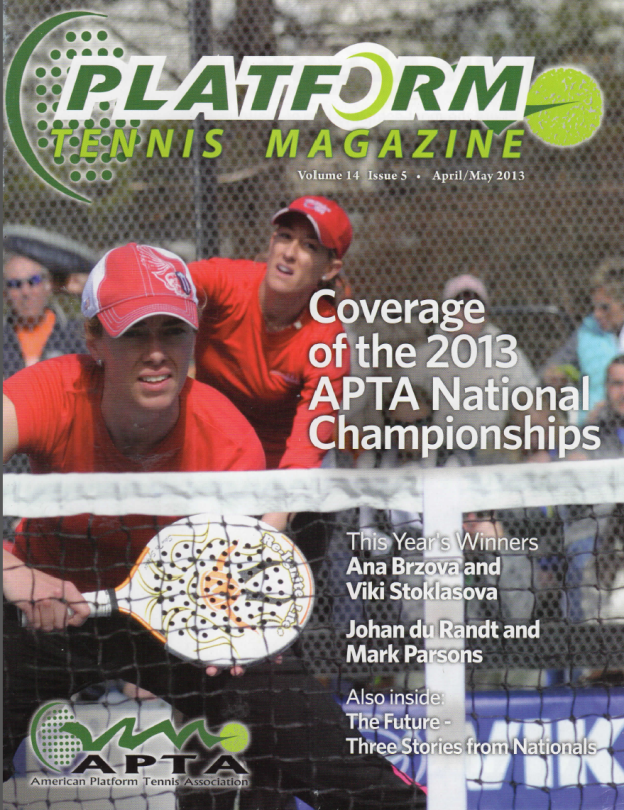
Spring arrived early for the women’s final, which were standing room only for a packed crowd of over 250. Doten and Nusslock had an early lead, but Brzova and Stoklasova made the most of their powerful groundstrokes and complemented them with touch and finesse at the net. The 7-5, 6-2 decision marked the first time two foreign-born women partnered to win the Women’s Championship.

Earlier that morning, the men’s semi-finals started up. On court one, du Randt (2010 champion and finalist in 2011 and 2012) was out to prove why most consider him the best player in the game. Partnered with Parsons (a contender for the top-player designation), the duo seemed unbeatable. Their semi-final matchup was with Arraya and Jonason. Arraya’s devastating spin overheads and Jonason’s aggressive backhands kept du Randt and Parsons on their heels. After two hours of blood, sweat, and tears, du Randt and Parsons took the match 7-6, 7-6, and walked one step closer to the finish line.

The second semi-final witnessed reigning champions Broderick and Gambino being taken on by DeRose and Lubow. Broderick and Gambino set aside their power game in exchange for long, controlled points with carefully selected offensive shots. DeRose and Lubow, on the other hand, took their chances with risky overheads, drop shots and aggressive groundstrokes. In the end, fortune favored the risk-takers as DeRose and Lubow won, 6-4, 7-5.

The finals were played just after the women had concluded their entertaining match. All four men wore smiles in the warm-up, which somehow never faded as the match began.

Point by point, du Randt hit crushing forehands while Parsons unleashed his trademark backhands. Whenever the match tightened up, it seemed that Parsons and du Randt would kick it into overdrive for a few points to regain the lead. DeRose and Lubow were outgunned on this day by a final score of 7-6, 6-3.

This year marked the first year that both the Men’s and Women’s National Champions were foreign-born. Brzova’s highly contagious energy seemed to be the hallmark of the Indian Trail Club. With ten courts, a grandstand center court, a two-story clubhouse with all the amenities, and an endless number of employees and volunteers on hand the 2013 Nationals was as memorable for the venue as the competition. Next year, the National Championships will go to the Golden Triangle in Pittsburgh, Pennsylvania.