Umpiring in the 70’s & 80’s – Past APTA President Paul Molloy reflects

In 1970, with no previous umpiring experience, I climbed into a chair to oversee a club championship match at Fox Meadow Tennis Club. After the first set, I was nearly frozen and climbed down.

In 1971, I secured the services of Jack Stahr, a renowned tennis umpire, to do the APTA Men’s Finals at FMTC. He later suggested that I get involved in tennis umpiring, obviously not based on my platform tennis performance.

Experienced Tennis Umpires Wanted
I still remember umpiring a match for Mary Carillo, age 16, at Orienta Beach Club in Mamaroneck, New York. Gradually, I worked myself up to become part of the Men’s International Professional Umpires Group and did chairs for John McEnroe, Bjorn Borg, Chris Evert, and many others at the U.S. Open, Wimbledon, Tokyo, and more……….

[Click on the image below to read more of Molloy’s experiences}

Screen Shot 2015-04-28 at 6.38.34 PM

Source:Platform Tennis Magazine, Vol.16 Issue 3 Jan./Feb 2015

Men’s National Rankings – Rules and Guidelines revised

The men’s ranking system has been revised for this season. In addition, the APTA has added Live Scoring to more tournaments, so rankings are now updated more frequently.

Men’s Doubles National Rankings will be published online after Chicago, Hinsdale, Cincinnati, Short Hills, and Nationals.

To receive an official end-of-the-year ranking, a team must play 3 events together, with one of those events outside of their home region. Nationals is considered an out-of-region event no matter its location and is the only NRT with this designation.

NRT points for a specific tournament exist for 12 months and are replaced by the following year’s event.

Removal of any earned NRT points due to rules infractions or punishment for player behavior will be enforced as instructed by the APTA Players Committee.

[Click image below to read more]

Rankings

Source: Platform Tennis Magazine, Vol. 16 Issue 2, 2014

Ardsley Country Club builds a court in response to APTA efforts to grow the game

The Ardsley Country Club in Ardsley-on-Hudson, NY was one of the first clubs to build a court based on the APTA’s grow the game initiative. Blanchard’s Scrapbook included a picture of the court being used in 1935 although the caption was Ardsley Racquet and Swim Club which had by then merged with the Ardsley Club2, an informal offshoot of The Ardsley Casino1, that year to form The Ardsley Country Club. Interestingly the player in the dark sweater is very likely Stuart R. Stevenson3, an avid racquets player, who was the club’s representative to the APTA. He was the grandson of one of the founder of the The Ardsley Casino in 1985, Amzi Lorenzo Barber “The Asphalt King”, and his wife Julia.

The courtIt was removed during WWII as the wood was rotting and could not be replaced due to lack of materials during the war.

Note 1: The Ardsley Casino was created through the support of some of the most notable and successful men in the US including Jay Gould, Cornelius Vanderbilt and J. Pierpont Morgan. The Casino was built overlooking the Hudson River and had a private dock to accommodate the yachts of members. In addition to a casino there were grass tennis courts that attracted top ranked players and the “finest and longest golf course in the world” designed by Willie Dunn who became the first gold professional. The Casino also had construct a large stable annex nearby from which a the stagecoach Tally-Ho left daily for the Hotel Brunswick on lower Fifth Avenue in New York City. The Casino clubhouse was torn down in 1936

Note 2: This offshoot had been formed in 1927 and had been using the stable complex built by The Ardsley Casino as a clubhouse.

Note 3: Stevenson was a Princeton graduate turned his sweater inside out when playing as it sported a “P’ logo but it was considered bad form to displayed it. He developed rheumatoid arthritis shortly after this picture was taken and become legally blind by 1940 when it spread to his eyes.

Viking’s new ball gets raves – but production issues always present

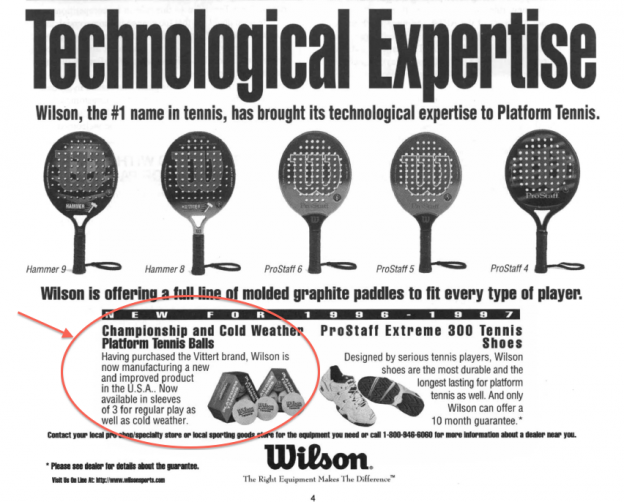
Viking had started making balls soon after they acquired the Marcraft platform tennis business in 1995. C0-incidentally, Wilson had acquired the Vittert V30 ball business from Hedstrom about the same time and decided to stop selling balls to Viking, which had been a long-time reseller, as they were a competitor.

The New Viking ball was well received and was used in the 1997 Men’s and Women’s Nationals but later batches were even better! They were on a roll.

However the ball manufacturing business was a difficult one and bad batches of balls had a habit of showing up unexpectedly.

David Kjeldsen recalls Viking’s experience just when he thought he had finally found the “perfect” ball……..

“No matter who the manufacturer was, there always seemed to surface a bad batch of balls. In the Hedstrom days bad would mean excessive “chunking”. In the early Viking days it would mean flocking that peeled off much like you would peel an orange or flocking that wore so poorly that you could only get a few games.

In our fifth or sixth year of supplying balls we had a batch of balls that were indestructible. Players were regularly reporting getting three or more sets with the balls still being playable at the end. We were very excited. I was getting pretty cocky that we had finally made the “perfect” ball.

As is necessary for proper delivery, we placed our order for balls for the following season in early April. We spent May developing a marketing plan wherein we would “guarantee” two sets of play from every ball. It would be a revolutionary guarantee for our sport. For reasons I cannot explain, in early July I decided to scrap the marketing plan and just promote the fact that were the largest supplier of balls in the industry.

Our first shipment of balls for the season were delivered in early August. The tractor trailer arrived. We always got excited when our August shipment of balls were delivered as it meant the start of the new season was only days away. When the driver opened the trailer doors a green cloud of dust appeared. I knew instantly the this was not good. I opened a case of balls that had fallen to the ground, took a ball from one of the sleeves and bounced it on the ground. My heart stopped. There on the ground was a perfect ring of optic yellow flock. It was going to be a very long season…….. and it was.”

Source: David Kjeldsen, private communication, 6/7/2012

Hedstrom stops production of the game’s dominant ball, Vittert V30. Wilson Sporting Goods acquires brand and production equipment

This was a sudden decision and likely related to the changes taking place at the Dimitri Associates’ group of companies that included Hedstrom and the Lineal Group, the sponsors of the Lineal Grand Prix. This decision provided Wilson Sporting Goods with the opportunity to acquire the Vittert brand and production equipment and started promoting Championship and Cold Weather Wilson balls in early 1996.

Source: Platform Tennis News, Mid-Winter, 1996

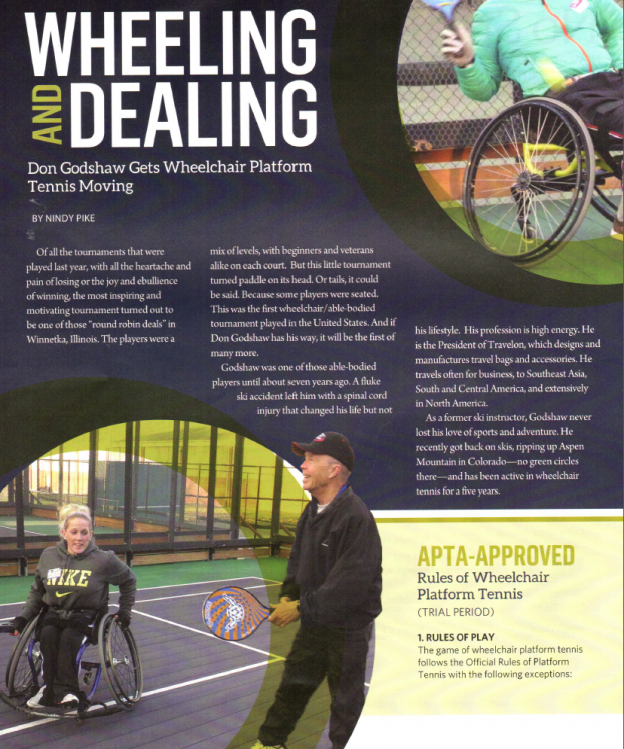
Don Godshaw Gets Wheelchair Platform Tennis Moving

>APTA Approved Rules of Wheelchair Platform Tennis (TRIAL PERIOD)

1. RULES OF PLAY
The game of wheelchair platform tennis follows the Official Rules of Platform Tennis with the following exceptions:

a) The Two Bounce Rule The wheelchair platform tennis player is allowed two bounces of the ball. The player must return the ball before it bounces a third time. The second bounce can be either in or out of the court boundaries and can be after the ball hits the screen.

b) The Wheelchair The wheelchair is considered part of the body and all applicable rules, which apply to a player’s body, shall apply to the wheelchair.

c) The Service The service shall be delivered in the following manner:

i. Immediately before commencing the service, the server shall be in a stationary position. The server shall then be allowed one push before striking the ball.
ii. The server shall throughout the delivery of the service not touch with any wheel, any area other than that behind the baseline within the imaginary extension of the center mark and sideline.
iii. If conventional methods for the service are physically impossible for a player, then the player or another individual may drop the ball for such a player and allow it to bounce before it is struck. If this is the case, the same method of serving must be used for the entire match.

d) Player Loses Point A player loses a point if:
i. The player fails to return the ball before it has bounced three times; or
ii. Subject to rule e) below the player uses any part of his feet or lower extremities against the ground or against any wheel while delivering service, striking a ball, turning or stopping while the ball is in play; or
iii. The player fails to keep one buttock in contact with his wheelchair seat when contacting the ball.

e) Propelling the Chair with the Foot
i. If due to lack of capacity a player is unable to propel the wheelchair via the wheel then he may propel the wheelchair using one foot.
ii. Even if in accordance with rule e) i. above a player is permitted to propel the chair using one foot, no part of the player’s foot may be in contact with the ground:
a) during the forward motion of the swing, including when the racket strikes the ball;
b) from the initiation of the service motion until the racket strikes the ball.
iii. A player in breach of this rule shall lose the point.

f) Wheelchair/Able-bodied Platform Tennis Where a wheelchair tennis player is playing with or against an able-bodied person in singles or doubles, the Rules of Wheelchair Platform Tennis shall apply for the wheelchair player while the Rules of Platform Tennis shall apply for the able-bodied player. In this instance, the wheelchair player is allowed two bounces while the able-bodied player is allowed only one bounce.

Of all the tournaments that were played last year, with all the heartache and pain of losing or the joy and ebullience of winning, the most inspiring and motivating tournament turned out to be one of those “round robin deals” in Winnetka, Illinois. The players were a mix of levels, with beginners and veterans alike on each court. But this little tournament turned paddle on its head. Or tails, it could be said. Because some players were seated. This was the first wheelchair/able-bodied tournament played in the United States. And if Don Godshaw has his way, it will be the first of many more.

Godshaw was one of those able-bodied players until about seven years ago. A fluke ski accident left him with a spinal cord injury that changed his life but not his lifestyle. His profession is high energy. He is the President of Travelon, which designs and manufactures travel bags and accessories. He travels often for business, to Southeast Asia, South and Central America, and extensively in North America.

As a former ski instructor, Godshaw never lost his love of sports and adventure. He recently got back on skis, ripping up Aspen Mountain in Colorado—no green circles there—and has been active in wheelchair tennis for a five years.

[click on images to read more]

Source: Platform Tennis Magazine, Vol. 15, Issue 1 Sept./Oct. 2013

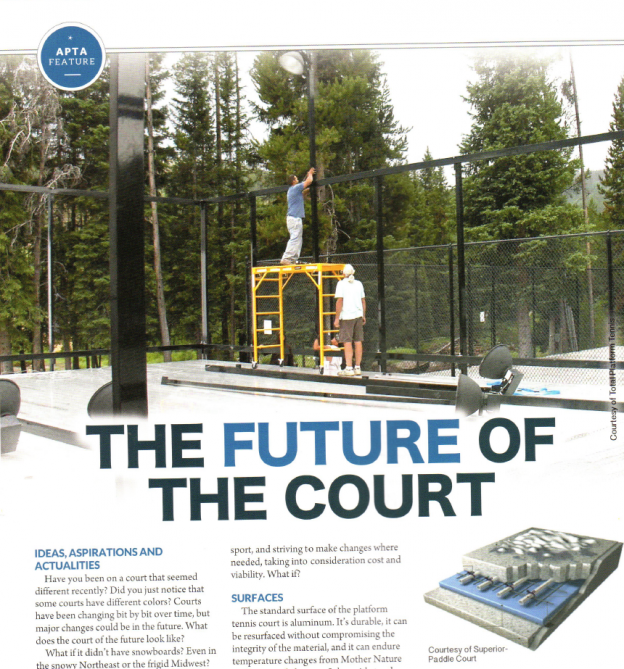
The future of the court – more innovation

Court construction has come along way from that first deck built in 1928. New technology is being put to work to make them better all the time. PTM had the update.

Ideas, Aspirations and Actualities

Have you been on a court that seemed different recently? Did you just notice that some courts have different colors? Courts have been changing bit by bit over time, but major changes could be in the future. What does the court of the future look like?

What if it didn’t have snowboards? Even in the snowy Northeast or the frigid Midwest? What if the courts weren’t aluminum? What if the surface didn’t have grit since it never got slippery from the snow? Can’t you hear the knees and backs out there applauding? All the other elements of the court—lights, door locks, wires, net posts—could be or have been reconceived as well.

There are innovators out there thinking aboUt the court materials for our growing sport, and striving to make changes where needed, taking into consideration cost and viability. What if?

Surfaces

The standard surface of the platform tennis court is aluminum. It’s durable, it can be resurfaced without compromising the integrity of the material, and it can endure temperature changes from Mother Nature and man-made heaters. It has withstood the test of time. Many of the first aluminum courts, built in the 1980s, show little sign of wear. So does it need to be changed?

When platform tennis migrated south, heaters were not a necessity and the courts didn’t have to be raised. Concrete was the first accepted alternative surface. As Bob Stratton, a player living in Atlanta, put it, “While I appreciate the ‘legacy of the game,’ we were able to move from wooden to aluminum courts. Why not other surfaces?”

Stratton, who is not a court builder, but a materials engineer and business owner, is interested in progress. When he travels to trade shows, he investigates different courtsurfaces and talks about them with different vendors. “There is an international sport out there that has championships played on four different surfaces. Why not ours?”

He has explored materials used on oil rigs, which has built-in grit and is non-conductive, important for outside work and play. The pultruded composite fiberglass decking is half the cost of similar aluminum. “You can customize the design to make it as flexible or stiff as you want. The grit level can also be customized,” Stratton explained. He also looked at the aircraft carrier surface. Sized in 2×2 tiles, it is made of a vacuum-formed plastic. Aircraft carriers use deicer when they need to get rid of snow and ice, and in Atlanta, bar the recent unusual spate of winter storms, they don’t need to de-ice too often. It is a surface that would work with radiant heat, another innovation being looked into for platform tennis courts.

Stratton’s contribution to the research and intelligence gathering extends to all facets of the court, but he’s just experimenting. He sees the possibilities outside of the standards. “Even the screen posts could be made of a different material. I think there is a whole lot that could be done on materials to lower costs. We need resources, grants, and to realize the possibilities,” Stratton opined. “If someone could purchase large volumes of the materials to get the cost down, and have the builders buy from that source, the courts would be standarized and the cost could be lower. Court cost, I believe, is an impediment to the growth of this sport.”

Jean Kempner, a teaching pro and player for over 30 years, who now lives in Las Vegas, has ideas about courts for the North. He, too, isn’t convinced that courts need to be raised anymore. “We don’t need heat on the courts– at least players don’t in order to stay warm; we need snow and ice melting capability. The propane heaters in place these days always have hot spots and cold spots and don’t offer thorough drying.”

Kempner is trying to convince people that building platform tennis courts with a cushioned tennis court surface, such as the US Open and Australian Open’s Plexicushion, is a good solution. “This helps reduce the hurt backs and bad knees that result from playing lots of paddle on unforgiving grit-coated courts,” Kempner stated, one of the main reasons he thinks new surfaces need to be explored. There would be no need for grit, which some believe causes injury. Kempner has created a whole concept court, which is patent pending, complete with removable net posts, so that the court can be used for other sports during downtime. [Look for Kempner’s Superior Court° system online.]

All of the “surfaces of the future” need about the same maintenance as today’s aluminum courts—resurfacing every three to five years—and cost about the same or less. Aluminum courts are tried and true because they last in the harsh elements of the North and Midwest for decades before they need replacing. “The aluminum courts we built in the early 1980s still look and play great,” said David Dodge of Total Platform Tennis.

Radiant Heat

The new surfaces described above would only work with a radiant heating system. There may be a radiant heat system that works on raised courts, also. While the expense of putting them in is high, they are more cost efficient over time.

Court builder Chris Casiraghi, of Reilly Green Mountain, talked about some heating systems they’ve tried. “Electric is the easiest to install for most clubs, but it is cost prohibitive to operate because of the high cost of electricity. It costs about $40,000 to install, but it keeps up with one inch of snow per hour. The other we’ve experimented with is a radiant heat using liquid glycol. This doesn’t freeze, but costs a lot to install on raised courts, since you have to have fittings for the tubes. It’s so close to the aluminum deck, [a downside is that] it sometimes flexes with the fittings, but once installed its really inexpensive to run.” Reilly Green Mountain has a testing plant in Orange, Connecticut, where they have set up a section of a court and leave it out all winter.

Speaking of inexpensive, installing propane heaters cost only $700 each, with an average of two heaters per court. However, the total bill for gas for the average four-court club reaches upward of $6,000 to $10,000.

Kempner is a proponent of hydronic radiant heat, which works well on helipads and hospital ramps. It would be embedded just below the court surface and would melt snow and ice, leaving a uniformly dry surface. He said, “The new technology in snow-melt solutions is revolutionary. It would also make
the courts more affordable. While it may cost the same to build, it would lessen the operating, in particular fuel, costs by half.”

Lighting

The technology is moving quickly, with tennis to thank for making big inroads in LED lights. Casiraghi stated, “Huts built in 2012 didn’t have LED; huts built in 2013 all have LED lights.” LED lights last much longer, about ten years, whereas metal halide, the previous standard, have to be changed every three to four years. Also, the LED uses less electricity, which cuts cost for users. As for the court lighting, array lighting may have its
use on our smaller courts, with directional lighting helping with those lost balls in the night sky.

Casigraghi said, “Right now, we have two clubs where we are testing two types of different wattage. Some of the questions are how bright the spot is and if you look at it, is it blinding? To test, we use computer analysis to see what should happen and compare that to what does happen on the court.”

Dodge has been working with stadium lighting for a few years, which offers much brighter night games. He said, “Although the stadium style fixtures have become the industry standard, we have been looking into and experimenting with LED for some time now. LED fixtures will offer greater energy savings and be maintenance free.”

Huts

Dodge stated, “Since the economy has loosened up, most projects are now two courts and a hut. There is a raised awareness, where clubs realize how the success of the sport benefits them.” Adding a well-outfitted but with new courts creates an instant mini club, which creates revenue. New huts have become multi-use facilities for clubs, who are willing to pay a premium for a well-designed building.

Wires

One of the industry frustrations is that the screen wire—with its particular gauge and tensile strength—is only available from Belgium. It used to be manufactured in Bridgeport, Connecticut, for prison camps, mostly. But after WWII, there wasn’t as much call for it. Dodge commented, “We are
begging someone to make our wire here.”

A player frustration is that there isn’t any uniformity regarding wire tension. David Meharg, of Putnam Tennis (newly partnered with Total Platform Tennis), is currently testing a tool that measures the consistency of wire tension. “Do you know how the builders test the screens? One of the crew members basically falls into the screens, putting all their weight into it and bounces off. One big sandwich at lunch might change how the wires are tightened! It’s not very scientific,” Meharg somewhat joked. “The screens have such a huge effect on the game. Some places the wires are dead, others loose, others just are right for you.”

Meharg invented a wire tension measuring device that reads the tension of the panels. When attached to the court, it gives a value to the tension of each screen panel. It quantifies a known amount, based on a scale of two criteria: deflection and balance. “The problem right now is, we don’t know what the best value should be,” Meharg explained. This will take player input and Meharg plans to arrange player testing after the winter season is over.

The extras you don’t really think about

Court Colors The surfaces are slightly more dynamic now, following in the footsteps of tennis courts. Gone are the brown and green that blended in to the natural surroundings. Courts are now blue and green or purple and green, with other options available. This has helped create contrast, particularly at night.

Door Closures Total Platform Tennis is a proponent of hydraulic closers. Dodge explained, “The old magnet ones stopped working well. We needed a magnet that worked well outside and couldn’t find one. The heat and cold doesn’t affect the new closers.”

What the game still needs

Meharg feels that the industry as a whole has to be more responsive with the delivery and installation of new courts. ‘We need to strike while the iron is hot. The faster we can build the courts, the faster people can get on them … there is a groundswell now and we need to take advantage! !” A collaboration between Putnam Tennis and Total Platform Tennis will hopefully increase their ability to manufacturer and deliver court systems and reduce the turn-around time on installations.

While new courts are being delivered in areas previously untouched, like New Mexico and Oregon, the mouse trap hasn’t changed since the 1970s.

Meharg, who has a technical background in the tennis industry, noted, “Most sports have constant improvement. The current court technology needs to be looked at and players have to be involved in the process. Surface technology has come a long way and the industry needs to comprehensively look at what the possibilities are and what is best for the players and the game.”

Dodge stated, “The growth of the sport is awesome – coast to coast, border to border.” Does innovation follow growth? If the builders and the innovators continue to invest in the game, there can only be a great future for the sport.

Source: Platform Tennis Magazine, Vol. 15, Issue 4 Feb/March 2014

Change made to number of sets played and use of tie-breakers. Men’s National Championship finals now just three sets.

The APTA moved to a best-of-three sets format for the men’s national ranking and National Championship events. Many ranking events had already adopted this format. The 12 point Tiebreak was recommended for all sets except for the third set in the finals of the Men’s, Women’s and Mixed National Championships which were to be played out.

See also 1984 rule change for Men’s National Championship

Source: Platform Tennis News, Summer 1989

First court built outside of U. S. in Nova Scotia

The court was constructed in Central Argyle, half an hour or so SSE of Yarmouth in Nova Scotia, on the property of the Ardnamurchan Club.

Ardnamurchan, named after the eponymous peninsular on the west coast of Scotland, is not a club in the traditional sense. During 1908-1909 many acres of land were purchased and a large shingled house built on waterfront property, solely for the purpose of being a summer gathering place for the Cox family, all originally from Philadelphia.

The incorporators of the Club included paddle tennis co-founder Fessenden Blanchard’s mother-in-law, Martha Cox Bryant, one of eight children.

Of course, with the Blanchard family as members, a paddle court was bound to follow and one was built in 1938, ten years after the sport’s invention.

The first court was very simple and the wires were not very good but still provided fun summer-time recreation. The court was improved later on but still built with local materials. It wasn’t until 1996 than the Club members voted to have a new court constructed professionally by a U.S. company.

The Ardnamurchan Club is still going strong with family members now numbering over 200 , and paddle tennis is still a popular part of their summer sports scene

Source: Molly Blanchard Ware, April, 2014