Dick Reilly reflects on 29 years of court building

In the Summer 1988 issue of Platform Tennis News, the veteran court builder shared the following observations:

Head Hunters and Architects
In 29 years of building platform tennis courts, you could say we’ve seen it all—or at least most of it—from:

• Lifting a court to the top of a city building by helicopter, to

• Having a building crew told not to stray far from the building site in Indonesia, lest they loose their heads, literally, to

• Building a six-court complex at the top of NYU’s library only to move it several years later because the building’s world-renowned architect was insulted that he was not consulted before the courts were put on “his” building.

When I first played paddle 30 years ago, I was immediately enamored of the game, but horrified at the poor quality of the courts we all played on. Being familiar with construction, and believing the game would be around for a while, I felt I could construct a better quality court (despite the fact that it would take away my excuse that the bad bounces and poor screens were the reasons for my poor performance).

The King Kong Kiln
The first challenge in building a consistent platform tennis court was what to do with the joints where the boards met end to end. The only solution was to have no joints in the entire playing area. Since the only place on the court that isn’t really part of the playing area is at the net line, it meant either shortening the length of the court to have normal 20 or 22-foot boards meet at the net line, or somehow finding 30 foot boards. I was told by an architect that even if we were able to find such boards, they would warp, twists, and cup so badly that they would make the court surface far worse than the joints of shorter boards currently did. The only way to avoid that would be to have the boards kiln dried, and of course there was no way we could ever find a kiln that was 30 feet long. But we not only found a mill that would make 30 foot boards, but came up with a 30 foot long kiln as well.

Walnut Shells and Aircraft Carriers
The next challenge was the traction surface. Sand had been the norm as long as platform tennis courts were in existence. But I was never a big norm lover. I didn’t like the grainy, inconsistent surface and the way sand wore off, leaving a slippery, dangerous surface in the wet and snowy weather. I became interested in what was used on aircraft carriers where it was a matter of life and death (not to mention millions of dollars), if the traction surface in that wet environment wasn’t up to par. My search led to the shipping docks in New York City where I was surprised to find that ground-up walnut shells were used for their non-skid surface. After listening to people joking with me that the only way this idea would work for paddle courts would be to put my children to work grinding walnut shells all day long (I considered that!), we found a supplier willing to work with us to come up with the right size walnut shell to apply to wood court surfaces.

Paddle Meets the Metal Age
We still weren’t satisfied with the checking, twisting, warping, and decaying of wood courts and the large amount of maintenance work required on them from year to year. Knowing we were searching for an improved product, Phil Osborn (who introduced platform tennis to Pittsburgh and was an executive of Alcoa Aluminum) suggested we develop an aluminum court. This time it was my turn to laugh. I should have known better!

After a couple years of research, development, and working closely with several architects and aluminum manufacturers, we came up with an all-aluminum court–that no one wanted. The idea of almost no maintenance costs, a court that would outlive its owners, a consistent playing surface, and the ability to heat the deck to help remove ice and snow, thereby allowing play in virtually all winter conditions, was great in theory. Suggesting that people play on a metal platform court 18 years ago, however, was like suggesting Babe Ruth should hit with an aluminum bat. It just wasn’t done.

Happily, paddle players are not so stuck in their ways that they can’t weigh advantages against any perceived disadvantages of a “strange” new concept. Today, aluminum courts are virtually the only type purchased by clubs and players, and the game is enjoyed on trouble-free surfaces in all varieties of weather. The die-hard wood court lovers (myself included) are finding that the well-designed, well-built aluminum court feels and sounds very much like wood. It is almost to the point where a wood platform tennis court is now considered an endangered species.

The game of paddle has gone through about as many changes as the court itself has. It’s the important things, though, that never change. The game—and the court—are for people to enjoy.

Source: Platform Tennis News, Summer 1988
Proposed rule changes defeated at Annual Meeting

At the annual meeting in May there was some spirited discussion on the following motions:
• Allow a let to be taken if a lob, once landing in the court, were to bounce out, over the screening.

• Allow a carry or double hit to be considered legal in paddle (currently illegal).

• Have the first server in a tiebreaker start from the deuce court ,rather than the ad court, which is now the case.

All were denied.

Source: Platform Tennis News, September 1984

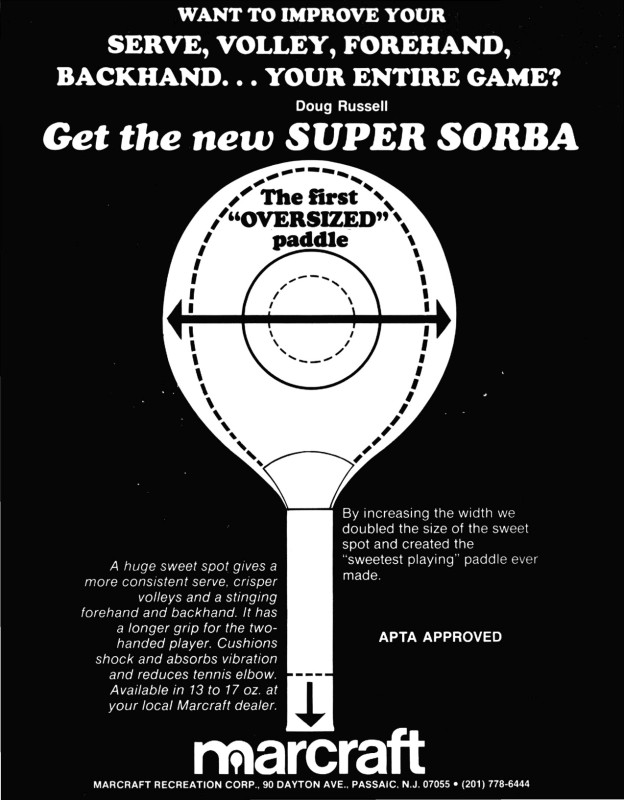
The first oversized paddle

Rule changes: Singles, Sets played in Men’s Nationals & 45+, and Paddle Specifications

The October 1984 edition of the Official Rules of Platform Tennis carried the following Board-approved changes:

Doubles and Singles
The rules are the same, except for the following: In Singles, the game is played within the standard singles court, two serves are allowed, and no-ad scoring is used*. The no-ad game point is served into whichever service court the receiver chooses. The Hi-Bounce ball is recommended for singles.

*(conditional 1-year trial rule – ’84-85)

Recommended Number of Sets
Men’s – Nationals: 2 out of 3 to the finals, then 3 out of 5. Fifth set played out

Men’s – 45: 2 out of 3, all the way

Platform Tennis Paddle Standards
Total Length: 18 1/16″ maximum
Width of Head (at widest point): 9 5/16″ maximum
Play Length (handle to outside edge of rim): 10 7/16″ maximum

Source: Platform Tennis News, November 1984

Should the service box be lengthened??

A platform tennis enthusiast and owner of Peters Creek Paddle Club in Library, PA, F. Jay Smith had given a great deal of study to the subject of the platform tennis serve. The APTA Board decided that his thoughts and his proposal for change merited consideration, and solicited feedback through Platform Tennis News.

Smith’s analysis suggested that the service box be lengthened a minimum of 6 inches and perhaps as much as 9-12 inches. He argued that the current size of 12′ x 8′ was too confining and, since it was possibly arrived at arbitrarily, it should be subject to change.

Of the more than 2,500 copies of the newsletter mailed to the membership, seven were returned to the APTA Office: five in favor of lengthening the service box, and two opposed. Based on such an underwhelming response to the proposal, the Board determined that there was not enough interest to warrant further consideration. Those who favored a change would just have to work on improving their serves!

Source: Platform Tennis News, November 1982 and June 1983

Men’s Nationals qualifications

For the last several years, the draw for this event has been below 64 teams and, to break even financially, this tournament had to have at least 90 teams participating. APTA Directors John Packard and Bradley Drowne volunteered to study the issue and recommended a change that they felt would get at least 96 teams participating. Their suggestion was to allow those who had reached the third round of an APTA-sanctioned tournament to be eligible to play.

Mr. Drowne, a five-year veteran of the men’s tournament committee, wrote a carefully considered explanation of the circumstances involved in this issue.

“The APTA introduced qualifying criteria for entering the Men’s Nationals in 1976 and prior to that the Men’s Nationals had always drawn 128 teams. There were three reasons why this was so:
• In the 1950’s and 1960’s, the Men’s Nationals were “virtually the only tournament open to newcomers.” Apart from this prestigious event, there were scrambles, closed state tournaments, and a very few invitationals that were extremely difficult to get into.
• Having nine courts, Fox Meadow Tennis Club, site of all Nationals except 1973’s, could handle 128 teams.
• The decision was made to hold the event over two weekends.

In 1975, the Men’s Tournament Committee began thinking about limiting the number of entries. There were several reasons. For one, there were many more tournaments around the country for every level of player and the feeling was that the Nationals should be reserved for the better players and it need not be a ‘proving ground’ for new players, since people could enter regional events. Further, it had become evident that the facilities of Fox Meadow were “inadequate” for 256 players and their wives. At the same time, it was felt that, for the good of the game, the Nationals should be moved every two or three years to other areas. Doing this would necessitate smaller draws to conform to the fewer courts at any other major site. The Men’s Tournament Committee also concluded in its mid-1970’s review that the Nationals should be held over a three-day weekend, rather than on two successive weekends, because of the complexities of the weather, travel plans and illness; this meant limiting the draw to less than 80 teams.

Limiting the draw for these reasons now appeared to be too restrictive, resulting in some good local teams not being eligible to play. Meanwhile, the better regional teams traditionally boycotted the Nationals because of the travel cost, even though they could easily qualify.”

Drowne believed that the proposed change offering eligibility to any player who reaches the third round of a sanctioned tournament represented a promising compromise. The qualifications would be relaxed enough to accommodate most of the talented players around the country who wished to compete.

The “Carry” still illegal

Among its bizarre ways, Team Tennis allowed the carry, or the catching or letting the ball come to rest on the racquet. This led to confusion on this point.

But Team Tennis died, while the more enduring racquet sports continued and still disallowed this bobble-hit.
Source: Platform Tennis News (October & December)

No-ad, two-serve experiment

The first formal tournament with a no-ad, two-serve format was held October 20-21 at the six-court Apple Club in New York City, where Doug Russell was the pro. This was a non-ranking Men’s Doubles Open that reflected a direct APTA response to requests from many for a trial of two new dimensions.

For some time players had wanted to see how tournament play would be affected by giving the server two tries rather than the traditional one. They were also intrigued with the implications of having the first point after deuce determine who won the game.

Some of the participants liked one or another of the options and several quickly saw that the changes could heighten interest in the sport for the new player, the spectator, and even potential sponsors. The two-serve proposal proved more popular than the no-ad format, but on balance, there was not enough enthusiasm to warrant any changes of this magnitude to the game.

Source: Platform Tennis News (October)

World’s First “un-platformed” court

The E.L. Wagner Company introduced the world’s first indoor “un-platformed” platform tennis court named “The Innovator.”

Their advertisement explained the benefits: “Now you can really enjoy your favorite sport, all year long, in any weather. Wagner’s inexpensive, new indoor court provides you with an ideal year round recreation center – perfect for your company, club or school gymnasium. Without a raised platform, Wagner’s indoor court can be installed quickly and easily, for considerably less than the cost of an outdoor court. Its special ‘Innovator’ playing surface assures you of a sure-footed grip and uniform bounce. And its superstructure is made of sturdy aluminum, to maintain taut, true wires.”

Source: Paddle Talk, Vol. 4 No. 2 (January)

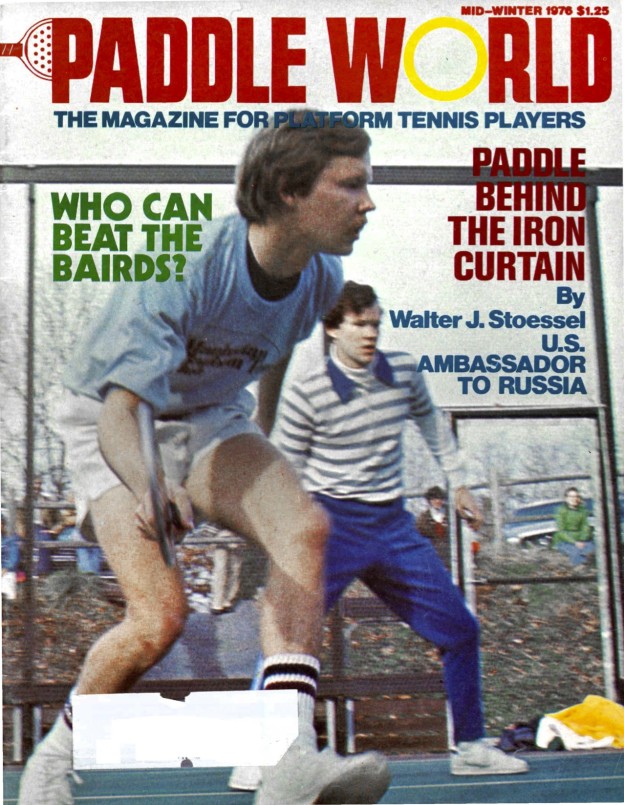
Who can beat the Bairds?

Changes needed to encourage spectator interest?

APTA President Mike North expressed his view at the Annual Meeting as part of a discussion on the growth of the game:

“The second necessary development is for the rules to be changed to encourage spectator interest. I agree with Dick Squires’ excellent article in a recent issue of Paddle World that urged reconsideration of the rules as proficiency increases. For instance, we should consider returning to a less lively ball, introducing the return of serve before the ball hits the screen, and the provision of a winning shot.”

Source: Paddle Talk, Vol. 2 No. 2 (December)

Foot-Fault deliberations

Paul Malloy, Chair of the APTA Umpires Committee reflected on recent deliberations in the August edition of Paddle Talk:

A very controversial subject in the game of paddle is the “foot-fault rule.” Everyone understands that a player may not touch the baseline or step into the court before making contact with the ball. Most people also are aware that a player may swing his foot over the baseline during the service as long as the foot doesn’t touch the court prior to striking the ball. Gordon Gray, during his championship years with Sam Sammis, used to give foot-fault judges fits because the swinging foot was practically on the deck as he struck the ball. He has since modified his delivery and no longer swings the foot over the line.

The most troublesome area of the Foot-fault rule comes under Rule 7 (a), which says ,”The server shall throughout the delivery of the service: Not change his position by walking or running.” As stated above, we certainly would be able to deal with the “running jumpers” in paddle. Unfortunately, the rules of Tennis, to which we adhere very closely, added an interpretation from the International Federation on July 9, 1958. The interpretation says that “the server shall not, by slight movements of the feet which do not materially affect the location originally taken up by him, be deemed to change his position by walking or running.” The key word above would seem to be “materially.” How far can a server move before he is deemed to have “materially” changed his position? Two inches? Twenty-two inches? More? Less? In my opinion, the interpretation stated above was probably instituted so as not to penalize the player whose front foot slides inadvertently two or three inches, without touching the line during his service. It cannot have been meant to allow a player to take one, two or three steps and then launch himself into the air and into the court while striking the ball.

In past years I have many times been responsible for gathering volunteer linesmen. Almost without exception it has been impossible to get volunteer linesmen to call a foot-fault for anything other than its violation of the baseline. Understandably, they are reluctant to accept the responsibility for administering a rule which is, at.best, ill-defined

A committee to study the foot-fault rule was formed about three years ago by Bob Brown, president of the APTA at that time, consisting of Bob, John Beck, Bradley Drowne, Dick Squires, and myself. In addition, we sent a questionnaire to twenty-five top players for their opinions. After several meetings and many recommendations we zeroed in on wording that said “one foot must maintain contact with the deck at the moment of delivery.” With this change in effect, it wouldn’t matter how many steps a server took as long as he had to stop and hit the ball with one foot on the deck.

It turned out that this was not to be the ultimate cure-all. Upon subsequent study of some slow motion films of two classic servers, Dick Squires and Sam Sammis, it was observed that at the moment of impact of ball and racket, the extension of their arms pulled them off the deck by approximately one inch. We would have ended up with base linesmen down on their hands and knees trying to see if the server remained anchored to the deck. It was decided to leave the rule as is. A combination of sufficient public comment, trained linesmen and APTA directive might cause this rule to be more properly administered.

Source: Paddle Talk, No. 5 (August)