The trials and tribulations of the Umpire’s Committee

Finding experienced umpires and linesmen was a challenge and cold weather made it worse. Paul Molloy reported on the challenges.

He wrote the following article for the May edition of the APTA newsletter Paddle Talk:

“The APTA created an arm known as the Umpires Committee approximately three years ago. Bob Brown, the APTA president, called a meeting of players interested and experienced in paddle and tennis officiating. Two of those in attendance were Paul Sullivan and myself, both members of the Eastern Tennis Umpires Association (ETUA). A committee was formed for the purpose of providing consistent and experienced officials at all APTA sanctioned and ranking tournaments. Paul Sullivan as Chairman and I as Secretary, sought out qualified Chair Umpires in Cleveland, Pittsburgh, Hartford, Long Island, and the other sanctioned tournament locations.

We also recruited some ETUA members, such as Jack Stahr, Mike Dunne, Adrian Clark, Lee Jackson and Judy Lessing, who have many years of Forest Hills and Wimbledon work among their credits. Prior to the start of the following paddle season, an Umpire-in-Chief was appointed for each men’s and women’s tournament. In return for a modest fee, the Umpire was charged with the responsibility of securing officials for the final and semi-final matches. This involved contacting the tournament Chairman well ahead of the event and working with him, or her to secure linesmen in advance.

To be a good linesman, one needs a certain amount of dedication and training, as well as good eyesight. Trying to find seven or eight such people on a twenty-degree Sunday afternoon in New Canaan, Short Hills or wherever is no easy task. Not many are willing to endure both the cold and the responsibility involved. We usually had to twist a few arms and often ended up with insufficient coverage and several unskilled linesmen.”

Source: Paddle Talk, No. 4 (May)

Paddle innovations drive APTA to revise specifications for number of holes allowed in paddles; balls also required to meet APTA specs.

The APTA Board accepted the Equipment Committee’s recommendations to update the standards at their June meeting.

Only balls and paddles certified by the Equipment Committee as meeting these specifications could be used in sanctioned or ranking tournaments. However, it was now not necessary for balls and paddles to be formally “APTA Approved”; this designation was awarded to equipment at a later date.

The rapid growth of the game the high expectation for its continued expansion had encouraged a number manufactures to produce paddles and this drove innovation. This innovation forced a change in the APTA paddle specifications, specifically with respect to the number of holes allowed. Up to late 1974 the had been a requirement that the paddle should have 63 holes with a tolerance of 52-74. the developments of the Play-morTM paddle which used an aluminum honeycomb core and had just 4 holes and the Marc II paddle by Marcraft which had 87 holes in 1974-1975 forced the APTA’s hand and paddles now could have “a maximum” of 87 holes.

NOTE: For the history of the paddle from the early days through early 1990s: Jim Tate’s article The Paddle Itself has a History Too!

[See APTA Official Rules for 1974 and 1975 for specific changes]

Screen Shot 2014-02-10 at 8.58.29 AM

HV5-37

HV5-34

APTA policy on use of racquets and balls

The APTA Paddle Newsletter reported on the policy that stated that only officially approved rackets and balls would be sanctioned for play at APTA Tournaments.

The only rackets approved for play at the time were manufactured by the Dalton Company, Marcraft and Craig & Simplex Co.

Official balls used at APTA Tournaments were those produced by the Barr Rubber Company.

The APTA told manufacturers, interested in getting their equipment approved, to contact the APTA concerning submission requirements.

Source: First edition of The APTA Paddle Newsletter

APTA reviews key rules- Foot-fault and ball hit out of court

The foot-fault revision was unofficially known as the “Kimberly Rule,” after Kim Kimberly who took a running leap at the ball, ignoring the baseline and violating most rules, however modified. He was fun to watch though!

The First APTA newsletter carried a discussion on foot-faults and the let rule if a ball was bounced out of the court.

“Foot-Faults
At a recent meeting of the Executive Committee, the foot fault rule was discussed ad infinitum due to the flagrant violation of it by numerous players who are beating their serve to the net. To reiterate, the APTA foot-fault rule is a direct copy of’ the USLTA rule:

The server shall throughout the delivery of’ the serve:
A. Not change his position by walking or running.

B. Not touch, with either foot, any area other than that behind the baseline within the imaginary extension of’ the center mark or sideline.

Section A was further clarified that slight movement is movement not in excess of two or three inches. Servers are permitted to jump in the process of serving so long as their feet do not touch the court before contact of racket and ball, but they may not take a forward step with either one or both feet prior to serving whether they jump during the serve or not.

Tournament Chairmen are asked to enforce this rule throughout all play and the rule will be enforced at all APTA Tournaments.

Ball Hit Out Of Court1
There has also been much discussion concerning the ball out of court – let point rule. It was decided at the aforementioned meeting that when a ball is hit out of’ court, the point shall be replayed. So the rule stands.

Points covered in defense of’ the rule were:
1. Points are hard enough to make without being penalized for hitting the ball out of’ court.

2. Balls hit out of’ court ·are so hit by players on the offensive and such players are not trying to lose their advantage by having to replay the point.

3. The object on offense is often to hit the ball high so that it drops down close to the wires making it more difficult to return. Such a shot might result in the ball being hit out of’ court, but that is never the objective of’ the player hitting such a shot.”

Note 1: This rule was revisited in 1975 when the present day rule was adopted which stipulated that a ball hit out of the court resulted in a loss of point

Source: First edition of The APTA Paddle Newsletter. Personal communication from Robert R. Kingsbury.

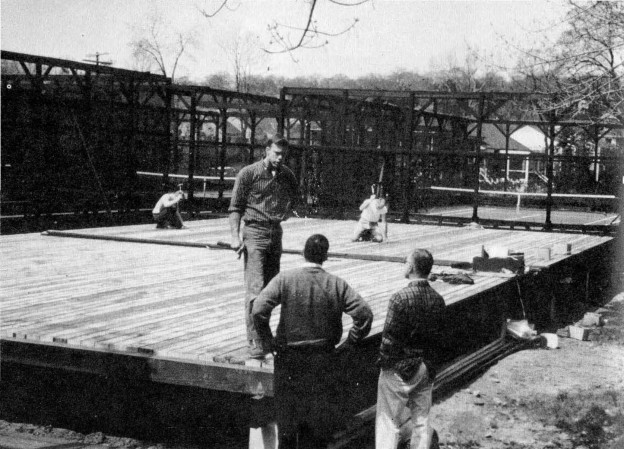
Reilly at work on a court

Richard J. Reilly, Jr. starts building courts

Dick Reilly had started building courts in 1965 and, by 1967, had built over sixty around the country. An enthusiastic player, Reilly developed many improvements in court construction that greatly enhanced durability and playability.

In the early 1970s, he pioneered the aluminum deck, which has become the standard.

Among the many improvements he made to court construction are:

• The use of thirty-foot, kiln-dried deck members, joining under the net, making the playing surface as technically perfect as is possible.

• A two-toned, green and red deck surface on which the white lines were two inches in width. This aided the players’ vision and promoted greater accuracy in a fast-paced rally.

• Hinged snow-boards which facilitated rapid clearing of the court.

• Quartz-iodine lighting for night play.

• The use of one-inch, hexangular, galvanized mesh with a gauge of sixteen, producing a truer rebound from the wire.

• Two-inch pipes in two-and-one-half-inch collars for the net posts, making them removable so that the court could be put to other use.

Source: Oliver H. Durrell, The Official Guide to Platform Tennis, 1967

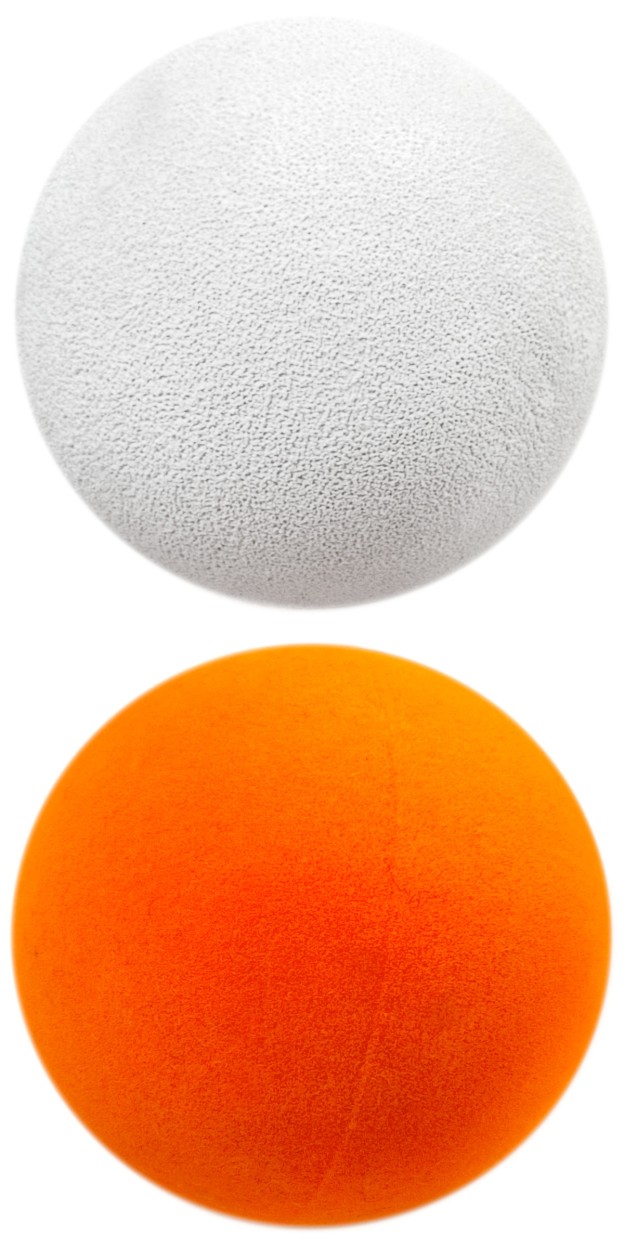
The orange ball was pioneered by John P. Ware using spray-on paint

APTA changes ball color specification

In the winter of 1963, an equipment innovation pioneered at Fox Meadow brought new color to the game. Because paddle in the north is often played in snow, the traditional white ball was difficult to see.

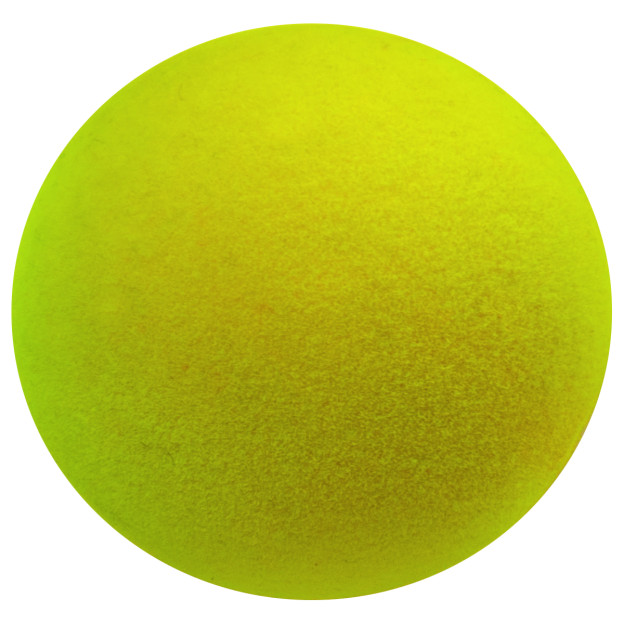
John Ware decided that coloring the balls might solve this problem. “I got a can of fluorescent paint, orangey-red, and started spraying paddle balls. These crusty orange balls worked pretty well until they dried out and cracked, and you got paint all over your clothes. But they were the precursors of the present yellow ball.”

The APTA 1963 Annual Meeting Minutes included the following recommendation of Rules and Equipment Chairman George Harrison:

“The committee has spent the past year in an unsuccessful attempt to inveigle the ball manufacturers to produce a regulation ball spray painted with a fluorescent yellow-orange paint. . . . We suggest the member clubs purchase balls in quantity and spray-paint [balls] themselves with Krylon No. 234.”

The changes didn’t officially take place until after the APTA had studied them thoroughly and worked with manufacturers.

Source: Adapted from Diana Reische, Fox Meadow Tennis Club – The First Hundred Years, 1983

Ultimately, of course, the manufacturers came around and produced the colored balls now in common use.

Formal foot-fault rules developed

The 1958 Men’s Championships saw the introduction of the formal Foot Fault Rules.

The server shall throughout his delivery (moment of impact of paddle and ball) of his service:

A. Not change his position by walking or running
(1) The server shall not by the following movements of his feet be deemed “to change his position by walking or running”
(a) Slight movements of the feet that do not materially affect the location originally taken by him
(b) An unrestricted movement of one foot so long as the other foot maintains continuously its original contact with the ground. The moving foot cannot touch the baseline or touch inside the court.

B. Maintain contact with the ground (platform)

C. Keep both feet in such a manner so as not to touch the baseline nor touch inside the court.

Source: Fessenden S. Blanchard, Platform Paddle Tennis, 1959

APTA experiments with court dimensions

There had been several suggestions that the length of the court (not the platform) should be increased in order to make it possible to lob more effectively over the heads of opponents and introduce a greater variety of offensive play. By lengthening the court, possibly two feet at each end, the idea was to make it easier to break up long rallies, where poor overheads and short lobs off the backstop were used. The APTA asked Fox Meadow Tennis Club and Orange Lawn Tennis Club to conduct some experiments.

Temporary lines were drawn on one court at each club, making the length of he court 48 feet instead of 44 feet, leaving 6 feet at each end past the backline. With reliable backstops, returning deep drives would not be extremely difficult.

A number of matches used the longer courts. The majority of the players preferred to leave the measurements as they were. Players felt that the longer courts placed too much of a burden on the server and made the game more tiring for older players. In addition, the extra two feet on each side did not make enough difference in lobbing to justify throwing “out of whack” the balance achieved with the existing measurements.

They believed, in general, that things were fine as they were and “why change such a good game?” In other words, most of them just did not like it, so the matter was dropped.

Source: Adapted from Fessenden S. Blanchard, Platform Paddle Tennis, 1959

“Although I believe that, if we had started with the longer measurements, they would have been accepted without complaint and the game might have been slightly better, I was pleased in another way that most of the players liked platform tennis as it was.”

Source: Fessenden S. Blanchard, Platform Paddle Tennis, 1959