PRO-Keds Classic – Irvine and Fitz Gibbon take the $10,000 prize money. Squires creates a promotional and instructional video from the event

The PRO-Keds Classic, held in New York City, was one of the game’s greatest marketing ideas. The event was the brainchild of Dick Squires, and was co-sponsored by Uniroyal and the New York City Department of Parks and Recreation.

A court was erected in midtown Manhattan, at the site of the fifty-story Burlington House, on 54th Street and Avenue of the Americas. The area in front of the skyscraper was offered rent free, in exchange for $5,000 worth of PRO-Keds sneakers for the New York City Urban League underprivileged children.

An integral part of the tournament was the junior program. Ninety-six children were chosen from the city’s boroughs to participate in lunchtime clinics on the court, given by Bob Callaway. General Sportcraft contributed paddles for the kids and Burlington Industries provided socks and lunch. And, of course there were free sneakers for the children from Uniroyal, who also provided a fund of $10,000 to underwrite a program of continuing instruction in platform tennis to the children. Sneakers and platform tennis equipment are also being given to children in New York Urban League’s foundling homes.

Robert E. Schott , V. P. Marketing for Uniroyal, commented “We have a deep faith in New York City and it future. We also believe in the broad appeal of platform tennis and feel it should he played and enjoyed by everyone. Hopefully, the PRO-Keds Classic will prove to be the spring-board to what will ultimately be a full-fledged paddle program in our parks.”

Despite unseasonably cold weather, the crowds became enthralled by the game. Play aired nationally over two successive weekends. In the finals, Hank Irvine and Herb Fitz Gibbon topped Chum Steele and Keith Jennings earning $5,000 each in prize money.

Paddle World Vol. 2 No. 1 Winter 76/77 carried the story.

Screen Shot 2013-12-01 at 10.49.52 AM

Tribuno starts a Women’s Tour

The circuit proved almost as popular as the men’s. The 1976–77 season kickoff was the Tribuno Platform Tennis Tournament of Cleveland, followed by Canoe Brook (New Jersey), Norwalk (Connecticut), Bronxville (New York), Detroit, and the World Championship at Forest Hills, New York. The prize money for the Women’s World Championship was $15,000.

Because Tribuno offered equal prize money to men and women for the World Championships, the women voted to play three out of five sets, like the men did. In the semifinals, the spectators got their money’s worth as they watched Gengler and Hilton beat Wendy Chase and Linda Wolf (7–6, 6–3, 4–6, 1–6, 6–4).

Sticker Painting commissioned by Coca-Cola Bottling Company of New York

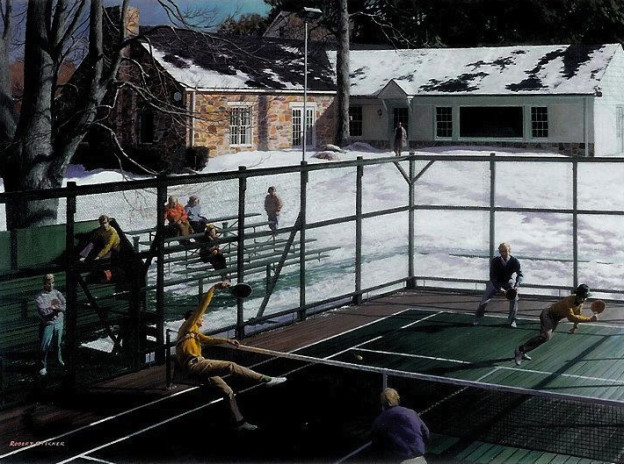
Coca-Cola commissioned Robert Sticker to do an oil painting of a platform tennis scene at the home of the game – Fox Meadow Tennis Club.

Charles Millard, President of the Coca-Cola Bottling Company of New York and a key supporter of the game, commissioned the painting1.

Source: Paddle Talk, Vol. 2 No. 2 (December)

Who are the players?
“My guess is that Sticker drew the players from scrap art – several pictures that he patched together with his brush. He must have visited FMTC for he beautifully and accurately portrays the Club, snow, court, bleachers, and spectators. As to the players, I’ve always related to the guy hitting the overhead. I recognize the posture, the pants, the green socks and the sweater. But who knows. The other player in the foreground court sure looks like the back of Paul Sullivan’s grey head. And it makes sense that he would be there. Too bad Bob Brown isn’t on the other side of the net, because he was usually in that FMTC group. The guy with the hat looks like Dave Jennings. It doesn’t make sense that he would be there, but it’s his hat and it’s classic. The fourth guy in the forehand court has the posture and look of Paul Molloy. Trouble is the racquet is in the wrong hand. I think.”

Source: Robert R. Kingsbury (private communication)

Note 1: see article below
Screen Shot 2014-02-12 at 8.58.33 AM
Robert Sticker (1922-2011) was equally adept in watercolor and oil and was a legend in the marine art field. Over the years, he created a compelling body of work. He was revered throughout the artistic community for the careful research behind each of his paintings to ensure historical accuracy. Sticker also had a unique ability to depict the drama of the human aspect of life at sea. Sticker grew up on Staten Island where watching the busy New York Harbor sparked his initial interest in the maritime world. Educated at Brooklyn College, he served in World War II as a Navy pilot, and as an executive in the oil industry before beginning five years of study under Frank J. Reilly at the Art Students League. Reilly was famous for his “24-head” problem, which demanded painting the same head over and over in 24 different kinds of light and shadow, and requiring the student to emerge from the exercise exhilarated and demanding more. Sticker began painting full time in 1963 and has painted a variety of themes from the Revolutionary War, The War of 1812, whaling scenes and an extraordinary series of inland waterway steamboats.

Sticker has a strong following for his unique work, which can be found in many private and corporate collections, such as IBM, Dow. Union Carbide, and AT&T. He received an Award of Excellence at the 1991 Mystic International. He is a founding member of the American Society of Marine Artists.

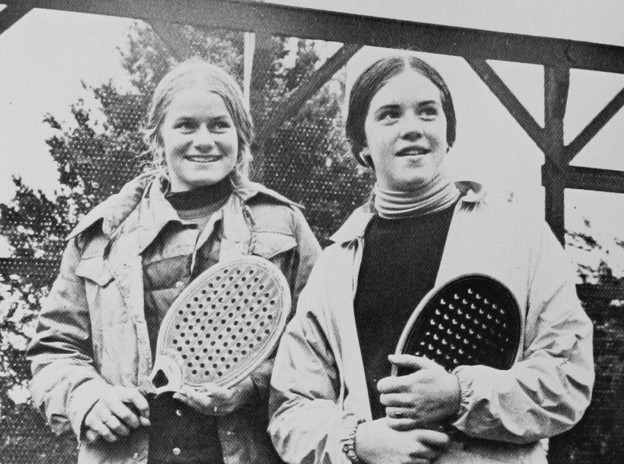
1976 Girls Fifteen and Under National Champions: Laura Parker and Becky Brown of FMTC

First New England Junior Open

In the fall, the Suburban Indoor Tennis Club in Randolph, Massachusetts held the inaugural tournament. Draws were held for both boys and girls in the 11 & under and 15 & under categories.

The Western Pennsylvania PTA (WPPTA) grows

The organization grew from the original five clubs in 1967 to seventeen clubs by 1976, and now included the Sewickely YMCA and the Mt. Lebanon Community Courts. The first five years saw a formation of a men’s League, followed by women’s A, B and C Leagues. In 1976, there were plans for an informal junior League.

Ken Ward at Maursing Island Club, Rye NY.

Ken Ward (1900- 1977): A founding father of the APTA

As President of the APTA from 1939-42, winner of one of the first Honor Awards in 1965, and inventor of the Scrambles tournament, Ken Ward’s contributions to platform tennis were many and various. He was a friend of all the pioneers of the game in the early days and maintained his interest throughout the years.

John Ware said, “Ken Ward was kind of a special man. He was a great advocator of platform tennis. He had, you might say, an acute case of the game. I remember him as being a presence at close to 40 Annual Meetings. Every year, he would get up and give the Board his personal vote of confidence and thanks. He had a graciousness and dry wit and a wonderful way of expressing himself.”

Ken Ward had this to say in a letter to Bob Brown, Chairman of the Presidents’ Council, after the last Annual Meeting:

“I thought the meeting went off very well. Everyone was well prepared. I was quite naturally disappointed that professionalism has caught up with our wonderful sport, but I am sure it was inevitable. I realize you are torn between the old nostalgia of the sport and the new generation of active players who are lured by a possible remuneration for their skill. I remember when Sidney Wood and I played together in 1948. I think it was then that we went to see Sears, Roebuck to manufacture the court on a wholesale basis for play on the roofs of apartment houses. They thought they would have to get the costs down to under $500 per court to make it successful. Imagine!”

Source: Paddle Talk, Vol. 2 No. 1 (October)

Hilary Hilton, 1980

Hilary Hilton on ABC’s Superstars

Hilton was one of twelve female athletes, and the first platform tennis player asked to compete on ABC’s Women Superstars. The following year she was asked to provide commentary alongside host Al Michaels.

Petition for paddle pays off

Burns Park in Massapequa, NY, installed the first public platform tennis courts on Long Island’s south shore. The plans for the park included the community courts after Gloria McLoughlin of Harbour Green collected 500 names on a petition to the town board.

The challenges of capturing paddle for TV

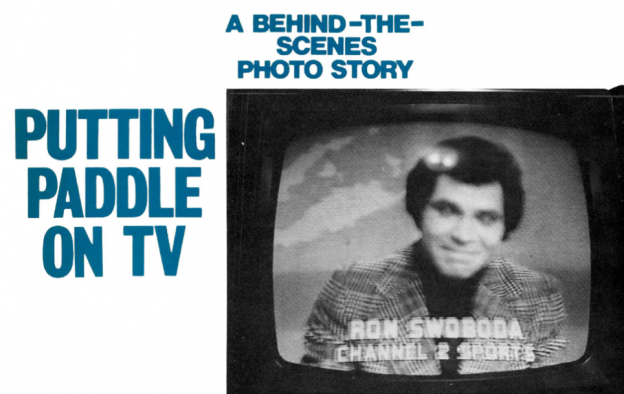
Paddle had special challenges for the TV producer. The chicken wire screen made it a challenge to film for one thing, and with continuous play, it was difficult to find time for slow motion replays.

To tape the Nationals at Fox Meadow, cameras were placed at two corners of court #1, on top of the screens, and on a scaffolding structure on a hill behind the court. A mobile camera completed the setup. It was also necessary to place a dark green backcloth at the end of the court.

The Nationals aired on March 28 in New York, New Jersey, and Connecticut.

The first time that Al Steele, Executive Producer at Connecticut Public Television, and his team covered platform tennis was for the Mixed Nationals at Hartford in 1975. “Public television is always looking for new and different sports,” said Steele, “and as I’m an enthusiast myself, it was easy to decide on platform tennis. With the help of Skip Gengras of Hartford, we got started on the Mixed.”

The Nationals and Tribuno Championships were natural next steps for the year. A good deal of preparation went into the televising of an event like the Nationals. Steele worked with John Ware of Fox Meadow and Gloria Dillenbeck of the APTA to make the arrangements and calculate costs. Bob Kingsbury of the APTA arranged for Tribuno to underwrite the program. “We had really excellent cooperation from Fox Meadow,” said Steele, “and the team really enjoyed working with the people at the club. It was a lot of fun.” The production was offered to PBS stations nationwide as part of the Eastern Educational Network and Detroit; Phoenix and Cleveland sent inquiries.

Source: Paddle Talk, No. 4 (May)

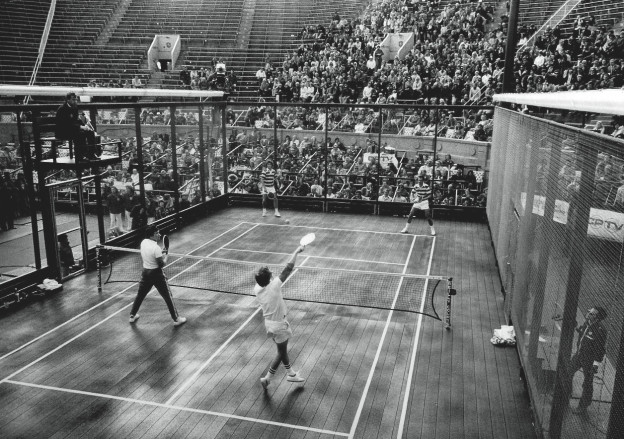
Doug Russell (left, far side) and Gordon Gray defeat Steve Baird and Chip Baird (right, near side) in five sets at the West Side Tennis Club in Forest Hills, Queens

Russell and Gray capture Tribuno Championships. They get the prize money but not the trophy

Paddle Talk head-lined the finals:

To cries of “Whoa-ho, Gordo!,” Russell and Gray became the First Tribuno World Paddle Champions, coming back from 4-6, 3-6 down after the first two sets to beat National Champions Steve and Chip Baird, with scores of 6-1, 6-3, 6-2 in the later sets.

Russell summed up the match afterwards, “Patience and power have given us the edge. The power is Gordon’s and the patience is mine.” In a season in which Gordon Gray and Doug Russell had vied with the Bairds for the top spot, it was indeed a tremendously popular victory.

Between 2,500 and 3,000 spectators were at Forest Hills to watch the semifinals, finals and pro-celebrity tournament on a cold, blustery but sunny day. Russell and Gray received a check for $4,000 and the promise of a trophy1 from Charlie Millard, Chairman of Coca-Cola Bottling Company of New York, for their victory in the climactic tournament of the Tribuno tour.

Adding fun and excitement to the festival of paddle were the celebrities and pros who participated in the benefit event for the National Council on Alcoholism. In the final, Barbara Wachenfeld and Charlie Gogolak defeated Manny Hill and Clark Graebner. Both Gogolak and Graebner played platform tennis in addition to their more renowned sporting activities.

Umpire Howard Cosell provided expert and hilarious commentary for the event, which featured New Jersey Governor Brendan Byrne, writer George Plimpton, designer Oleg Cassini, and Doug Johnson and Bill Beutel of Channel 7, among others, playing various shades of platform tennis with the top women players.

All in all, the day was a huge success, and a tribute to the game, players and their first major sponsor, Coca-Cola Bottling Company of New York.

Source: Paddle Talk, No. 4 (May)

Note 1: Coca-Cola had commissioned Jay O’Meilia to do create the Tribuno Championship Trophy and smaller version would be given to the winners (see below). Because of a shipping mistake the trophies never made it to the event.

Screen Shot 2014-02-12 at 8.58.33 AM