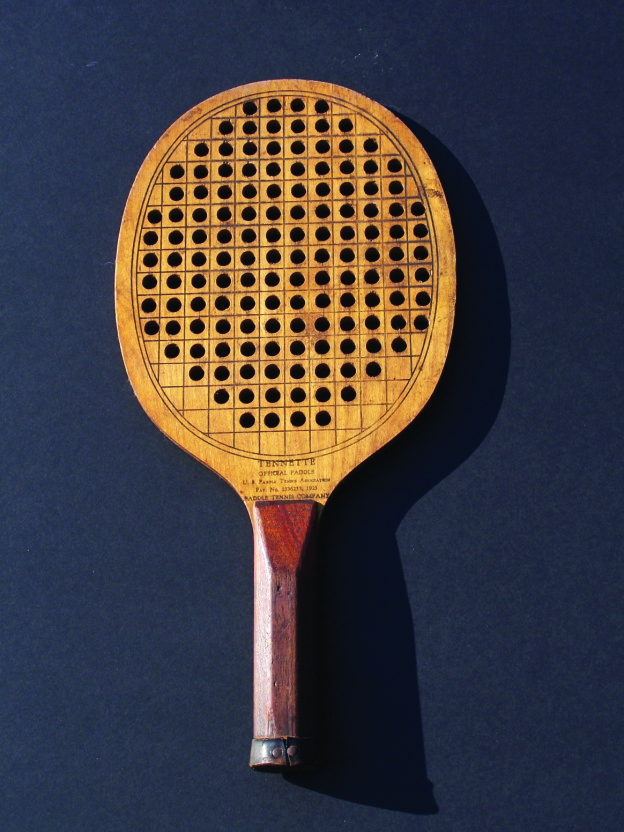
The more oval version of the original paddle with holes added but no protective rim.

Tracing the origins of Paddle Tennis

For some time, Blanchard wondered whether or not he and Cogswell had been carrying on with a game invented many centuries before. The matter arose when Esquire magazine requested some information on the game and Blanchard sought the help of an eminent historian and Old Army Athlete by the name of C. Alison Scully.

Source: Adapted from Fessenden S. Blanchard, Platform Paddle Tennis, 1959

In December 1935, Scully shared the bulk of his research in a letter to Blanchard as part of an article Blanchard was writing for Esquire.

The origin of the game of paddle tennis is lost in the mists of antiquity. The recent widespread interest in the game has renewed the desire for certitude as to its beginnings and, as a result, much that is new and enlightening to the students of the history of the game has been developed.

Recent discoveries on the Coast of Wales establish that a game, which was undoubtedly the forerunner of paddle tennis, was part of the life of the Piltdown man. Crude drawings on the walls of the caves show the players in characteristic positions. For paddles, the hip-bone of the mammoth was used. Life in this epoch was primitive and arduous and, as there was very little time for practice, the game probably did not reach a high stage of development.

The Princeton Archaeological Expedition of 1930 brought to light some very important information. Excavations in the vicinity of Abdab-mer-Sub establish that the characteristic Egyptian figure with upraised hand so familiar in all Egyptian art is not that of a female dancer, as generally supposed, but a drawing from life of Tut-Ankh-Amen serving in the first recorded game of paddle tennis doubles on the Mediterranean Coast. Tut-Ankh-Amen and Pharaoh VII played for Egypt, Caesar and Crassus for Rome. Cleopatra was one of the spectators.

As a result of further research work at Pompeii, a large flat concrete slab has been uncovered. While it was at first thought that this was a rubbing table for one of the Roman baths, the more discriminating students of archaeology are convinced that it was used for paddle tennis.

There is no record of paddle tennis in Denmark, Norway, Sweden, Latvia or Esthonia prior to A.D. 556, although it is probable that Hengist and Horsa brought the game back from England to the Continent on the latter date.

The diary of Christopher Columbus, which has just been disclosed to the world, contains references to the grumblings of the crew of the Pinta because of lack of space on the aft deck for exercise. No game adapted for use on shipboard other than paddle tennis was then known and it must have been paddle tennis that was played on that expedition.

In Colonial America, Captain John Smith and Pocahontas won the mixed doubles championship of Virginia at an early date. John and Priscilla Alden were another well-known team. George Washington first played the game after the battle of White Plains. It is a curious coincidence that the great revival of interest in the game should have taken place on the very ridge of land on which this battle was fought, at a point some five miles further south. There on the property of James K. Cogswell, in Scarsdale, paddle tennis was reborn.

C. Alison Scully

Source: Fessenden S. Blanchard, Platform Paddle Tennis, 1959
The first platform tennis tournament for cash – Mercedes-Benz Platform Tennis Classic

Held in Mid-November at Amelia Island Plantation, FL, the tournament consisted of eight of the top nine nationally-ranked teams. The winning team of Mangan and Kingsbury received $2,000, while the runners-up, Steele and Jennings, earned $500.

Highlights of the tournament were shown on the CBS show Sports Spectacular on Sunday February 23, 1975

Even though most of the players on the tour had full-time jobs outside of platform tennis, with the majority of them working in the finance industry, the prize money added another enticement to the game.

What’s in a name? Platform Tennis, Paddle Tennis are they the same?

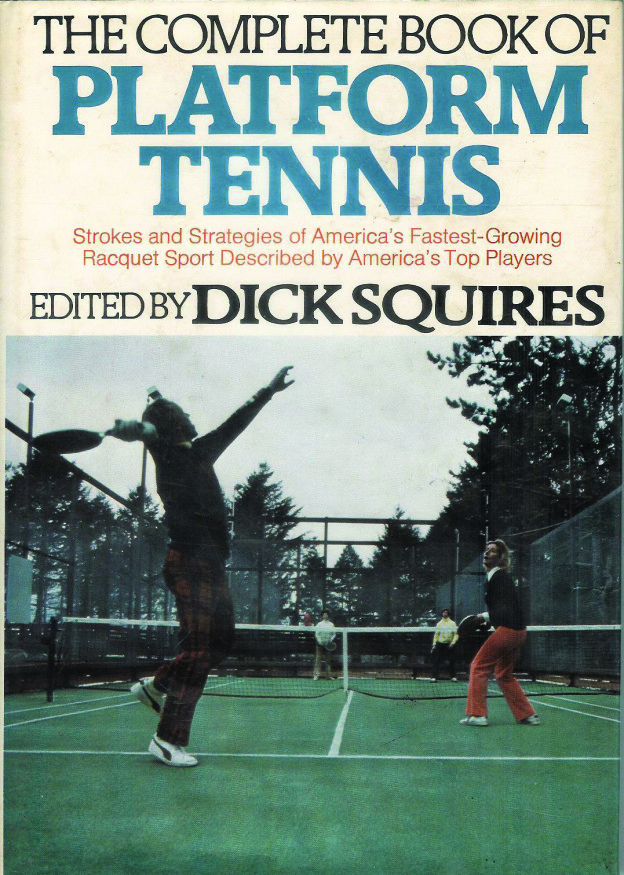
In 1974, several letters to the editor of The New York Times surfaced about the name confusion between platform tennis and paddle tennis.

Burling Lowrey of Washington, D.C., and Dick Squires exchanged pecks as proponents for their respective games. The exchange, however, was broader in scope than just the name conflict.

The Mid-Summer edition of the APTA newsletter, Off The Wire, had this to say:

It is not the intent of the APTA to enter the crossfire, but simply to set the record straight for our readers who may have read one or both of the letters, because both gentlemen are guilty of errors of fact.

Mr. Lowrey referred to the invention of platform tennis by a “group of Scarsdale millionaires,” one of the standard forms of jabs at platform tennis’ supposed snobbishness. In fact, neither Blanchard nor Cogswell were millionaires. Far from attempting to foster an aura of snobbery, the APTA was doing more each year to balance the game.

Mr. Squires, in turn, stated, “the fault lies with the purist platform tennis players as well as the present officials of the APTA. They insist on calling platform tennis paddle tennis, but mainly out of habit rather than any insidious desire to obliterate paddle tennis.” As regards to the public, it is probably true that it will be a long time before typical platform tennis players can be swayed from the conversationally- easy “let’s go play some paddle.” Regarding the APTA, however, all possible stress has been placed on the correct term platform tennis. In responding to telephone calls and written inquiries, and in promotional efforts such as last December’s press luncheon, in interviews and in editing drafts of articles about the game, all APTA officers strive for factual accuracy. Unfortunately, we are not always given the opportunity to review every item about platform tennis, hence the perpetuation of the erroneous name. Some people have suggested that we call our game “screen tennis” or “wire tennis” or “rebound tennis” among other names. What do you think? If you have an opinion on the subject, let us hear from you.

Source: Off The Wire, Vol. 5, Mid-Summer 1974

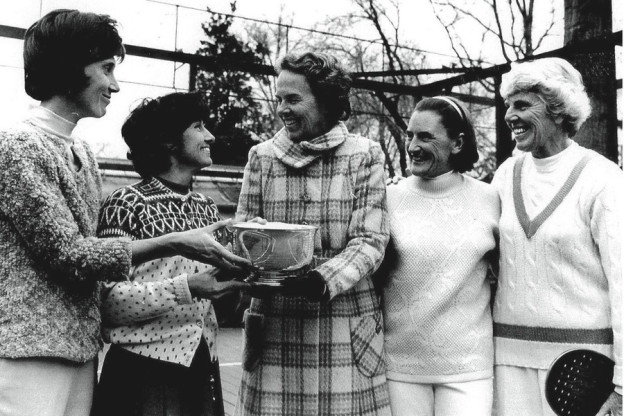
Ethel Kennedy (center) presents the trophy at a tournament in Chevy Chase, Maryland, to (from left) B. J. Debree, Gloria Dillenbeck, Peggy Stanton, and Charlotte Lee.

Gloria Dillenbeck named first Executive Secretary

The APTA named Gloria Dillenbeck as the first full-time Executive Secretary. Raised in Montclair, NJ, Dillenbeck began playing platform tennis in 1966 and had been a star varsity tennis player at Swarthmore College.

With her partner, B.J. Debree, they were the first team to challenge the dynasty of Charlotte Lee and Peggy Stanton (National Champions 1967-1970) and won the Nationals in three successive years—1971, 1972, and 1973.

Gloria Dillenbeck Dodd was inducted into the Hall of Fame in 2007.

Screen Shot 2014-02-26 at 1.09.09 PM

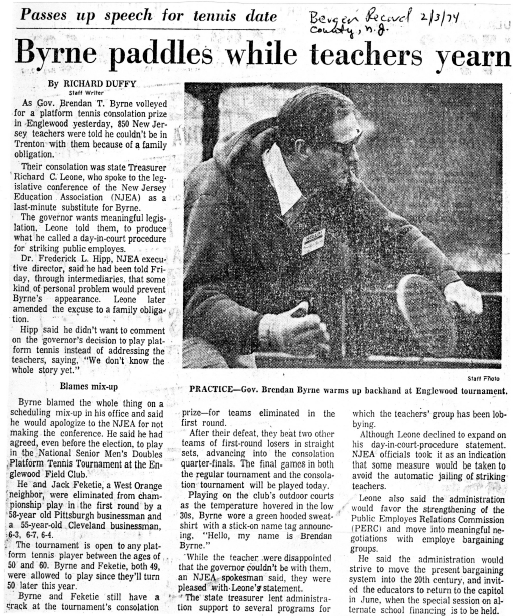
Governor of New Jersey plays hooky to play paddle

Brendan Byrne had a calendar conflict, a speech to the New Jersey Education Association at their annual conference and a date to play in the National Senior Men’s 50+ at Englewood, NJ. He chose to play paddle, lost his first round match and advanced as far as the semis in the consolation.

A newspaper covering the event characterized his game as “a conservative style bent on returning the ball.”

Source: Off The Wire, Vol. 5, No. 3

Screen Shot 2013-11-11 at 1.53.41 PM

The Battle of the Sexes

The tennis match between Billie Jean King and Bobby Riggs at the Houston Astrodome on September 20, 1973, captivated America and was a triumph for women’s athletics. Platform tennis benefitted with an increase in participation by women.

King entered the Astrodome in Cleopatra style, carried aloft in a chair held by four bare-chested muscle men dressed in the style of ancient slaves. Riggs followed in a rickshaw drawn by a bevy of scantily-clad models. Riggs presented King with a giant lollipop and she gave him a piglet named Larimore Hustle.

Rather than playing her own usual aggressive game, King mostly hugged the baseline, easily handling Riggs’s lobs and soft shots, making Riggs cover the entire court as she ran him from side to side, and beating him at his own defensive game. After quickly falling behind from the baseline, where he had intended to play, King forced Riggs to change to a serve-and-volley game. Even from the net, the result was the same: King defeated him, 6–4, 6–3, 6–3.

Source: Selena Roberts, A ray of progress for women as Battle of the Sexes turns 35, Sports Illustrated, 9/20/2008. Bobby Riggs Vs Billie Jean King, Assortment.com

Sponsorship draws talent

Corporate sponsorship ended up attracting several professional tennis players to the sport, with Herb S. Fitz Gibbon II, Clark Graebner, and Hank Irvine being the most successful.

Fitz Gibbon ranked among the world’s top tennis players between 1961 and 1973, and became the first amateur to beat a professional in the 1968 Wimbledon.

Graebner, originally from Cleveland, was on the winning U.S. Davis Cup team and ranked seventh in the world in 1968.

Irvine was from Rhodesia (now Zimbabwe) and represented his country on the Davis Cup team in 1968 and 1969, and at Wimbledon from 1970 to 1972. In 1970, he teamed with Helen Gourlay from Australia and made it to the semifinals of the Mixed at Wimbledon.

Commercial sponsorship

During the early 1970’s, commercial sponsorship came knocking, raising difficult policy questions for the APTA.

The exposure gained by commercial sponsorship would bring the sport to a much wider audience, but critics argued that money would detract from the game’s social aspects.

Foreseeing the likelihood of company-sponsored “tours,” the APTA formally established its policy on commercial activities and decided to maintain control over all commercial tournament activities.

This decision allowed platform tennis to broaden its horizon. The alternative would have undoubtedly led to the establishment of a separate professional organization.

The Cleveland Invitational directors in 1973 (from left to right): David S. Dickenson II, Richard Taylor, Willis M. McFarlane, Carrington Clark, Jr., and Robert Bartholemew. (Missing from photo: John J. Bernet and John F. Turben)

Cleveland hosts Nationals – the first time Nationals held outside of NY Metropolitan Area

Up until 1973, all National Championships had been held in or around New York City, primarily at Fox Meadow Tennis Club in Scarsdale, which had the most courts. The other two founding clubs of the APTA—The Field Club in Greenwich, CT, and Manursing Island Club in Rye, NY—also hosted, as did the Englewood Club, in Englewood, NJ.

In the fall of 1971, the Cleveland Committee, headed by Carrington Clark, submitted a comprehensive proposal to the APTA Board to host the Men’s National Championship. After some consideration, the Board approved the plan to move the Nationals. The 1973 Men’s Nationals in Cleveland were highly successful, and it signified the start of an era when the Nationals moved to a different location each year. It returned to Fox Meadow from 1974 to 1979; Montclair, New Jersey, from 1980 to 1982; New Canaan, Connecticut, in 1983; and Cleveland, Ohio, in 1984.

That same year, a group of Midwest men, including Carrington Clark, John Bernet, Dave Dickenson, and Will McFarlane founded Cleveland Tournaments Inc., a non-profit organization to support major platform tennis events in Northeast Ohio.

The logistics for the event required considerable discussion between the APTA and the Nationals organizers as reflected in the APTA Executive Committee Minutes of July 1972 and others