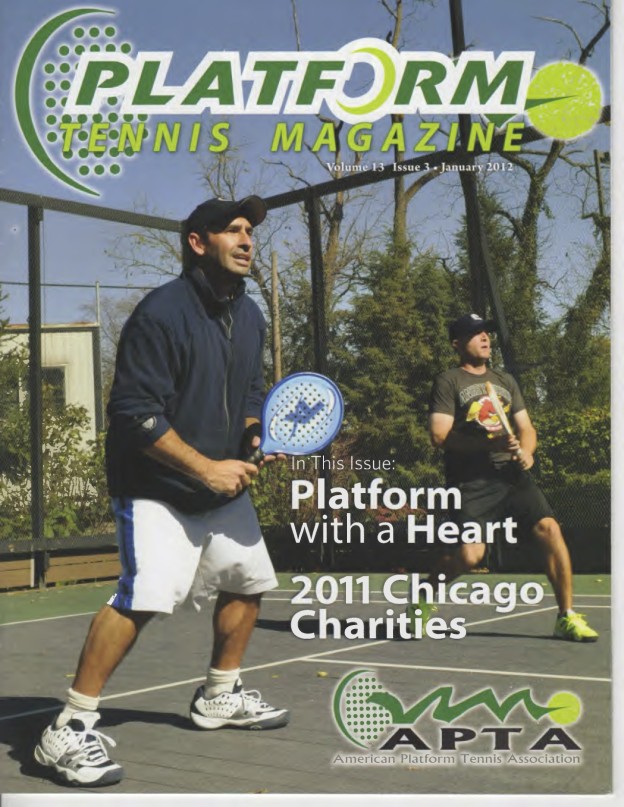
Chicago Charities – McNitt and Shipz capture the Women’s and du Randt and Parsons the Men’s

With Hurricane Sandy leaving one of platform tennis’ strongholds reeling, the devastation along the East Coast was more than evident this year at the Women’s 2012 Chicago Charities tournament. Many of the nationally-ranked teams that usually come out of the New York, New Jersey and Philadelphia region were eerily absent this year, virtually allowing Chicago women full reign of the tournament.

This year’s Charities benefitted Family Matters, a group located in Chicago’s North of Howard neighborhood that offers children and families individualized personal development experiences that provide opportunities to find their place in the world and to be a force for positive change.

The 48-team women’s event kicked off on Friday, November 2 at 8 a.m., with overcast skies and mid-50s temperatures that were sustained throughout the weekend.

The opening day matches extended women’s play through the quarter-finals, which saw top-seeded Mary Doten and Chelsea Nusslock against fifth-seeded Lynn Schneebeck and Shannon Vinson. Doten and Nusslock cruised through with a score of 6-1, 6-1.

The second quarter featured the third-seeded Hallie Bodman and Sally Jones as they defeated seventh-seeded Janet Mazzola and Ann Turner in a 3-6, 6-4, 6-4 marathon.

The newly-formed team of Wendy Shpiz and Jane McNitt was unseeded due to not having any team ranking points. Despite that fact, they triumphed over Holly Tritt and Shawna Zuccarini, 6-1, 6-1.

Suzanne Lemery and Kelly Rohrback were seeded eighth and defeated second seeds Ania Kazakevich and Marina Ohlmuller, 6-2, 6-1.

The all-Chicago semi-finals took place at 11 a.m. on Saturday morning with Doten and Nusslock advancing past Bodman and Jones while, on the neighboring court, McNitt and Shpiz defeated Lemery and Rohrbach. After the semis, both advancing teams were given an hour to reenergize in preparation for the finals.

The finals showed powerful ground strokes from Nusslock and Shpiz, mixed with finesse and more selective power from Doten and McNitt.

Playing their first tournament together, McNitt and Shpiz triumphed over the top-seeds, delivering McNitt’s third Charities championship (`02, ’05, ’12) and Shpiz’s first.

By Saturday morning it was apparent that Hurricane Sandy’s impact on air travel had waned. East Coast teams were in full force for the 64-team Men’s 2012 Charities.

Like the women’s schedule, the men played through their first day to the quarter-finals. Drew Broderick and Chris Gambino, last season’s National Champions, teamed up again and rolled through to the semi-finals by defeating eighth-seeded David Caldwell and Blake Cordish, 1-6, 6-2, 6-4.

Scott Bondurant and Mark Johnson came into the Charities unseeded and knocked off fourth-seeded Mike Marino and Dane Schmidgall, 6-2, 6-1.

In the third quarter match-up, third-seeded Juan Arraya and LennartJonason defeated sixth-seeded Scott Estes and Mike Stulac, 6-4, 6-4. And rounding off the day’s events, second-seeded Johan du Randt and Mark Parsons defeated the unseeded team of Ben McKnight and Pete Rose, 5-7, 6-2, 7-5.

Like the quarter-finals, the semi-finals were played at the hosting Glen View Club in Glen View, Illinois. Broderick and Gambino edged out Bondurant and Johnson, 4-6, 6-3, 6-1. With action
tense and each point being played as if it was match point, the battle raged for nearly three hours and included one point that lasted over ten minutes. Broderick said, “Our style is to slow play and then pick up the pace again.” He added, “Even if we lose a long point, we feel that we really win out if the point is’a good one:’

On the other side of the draw, du Randt and Parsons won a see-saw battle over Martinez-Arraya and Jonason, 6-4, 5-7, 6-2 to advance to the finals.

The finals came down to long points highlighted with bursts of speed and power. But in the end, it was du Randt and Parsons who defeated Gambino and Broderick for the title of Chicago Charities Champions.

Player Profiles – Jane McNitt and Wendy Shpiz

Jane McNitt

Residence: Winnetka, IL
Family: Husband, Peter; children: Peter Jr. (19), Johnny (17), Megan (15)
Profession: Part-time platform tennis professional
Hobbies off the courts: Swimming, biking, rollerblading and skiing
Awards/Accolades within the sport: Winner of Chicago Charities (‘05, ’10, ’12) Illinois State, Midwesterns, Indianapolis, St. Louis, Kalamazoo, and Illinois State Mixed tournaments

Wendy Shpiz

Residence: Winnetka, IL
Family: Husband, Dave; children: Jack (4), Charlie (3), Mollie (1)
Profession: Marketing Director – Nike Tennis Camps
Hobbies off the courts: Spend as much time with my family as possible, skiing and running
Awards/Accolades: 1992 Illinois State Tennis Champion. All-American at Duke University. On the pro tennis tour for three years and made Top 250 in the world.

How long have you two been playing as a team and how did your team come to be?

Shpiz: This was our first tournament playing as a team. We have practiced many times together over the last year and simply thought it would be fun to partner up for a tournament!
McNitt: As Wendy said, we have been playing together in practice matches for the past year and just thought it would be fun to try a tournament together

What strengths have you found that you each have that make the team stronger?

Shpiz: Jane may be better at answering this, but I would say our games complement and feed each other’s strength For example, her aggressive net play, quick hands and overall court sense takes pressure off and allows me to be more aggressive both when serving and returning.
McNitt: Wendy has tremendous racquet skills and is an exceptional athlete. I try to be aggressive and capitalize on all the opportunities that her strong serve and “big” forehand bring our way. And we both love to compete!

How did you feel about going into the Charities as an unseeded team?

McNitt: It’s always great to be the underdog. There are no expectations.

How long have you two been playing as a team and how did your team come to be?

Shpiz: This was our first tournament playing as a team. We have practiced many times together over the last year and simply thought it would be fun to partner up for a tournament!
McNitt: As Wendy said, we have been playing together in practice matches for the past year and just thought it would be fun to try a tournament together

What strengths have you found that you each have that make the team stronger?

Shpiz: Jane may be better at answering this, but I would say our games complement and feed each other’s strength For example, her aggressive net play, quick hands and overall court sense takes pressure off and allows me to be more aggressive both when serving and returning.
McNitt: Wendy has tremendous racquet skills and is an exceptional athlete. I try to be aggressive and capitalize on all the opportunities that her strong serve and “big” forehand bring our way. And we both love to compete!

How did you feel about going into the Charities as an unseeded team?

McNitt: It’s always great to be the underdog. There are no expectations.

What is your practice routine — are you both out aggressively training for tournament play or are you more casual about your approach to the sport?

McNitt: Definitely a casual approach! We play together once a week if we are lucky!
Shpiz: Ha! I’m just happy to get out on the court whenever possible these days! When I play, it’s a bonus.

Who were your toughest competitors for the Chicago Charities Tournament and were they the team that you initially thought going in would give you the most challenge?

Shpiz: I found all the teams to be challenging and enjoyed playing a variety of styles. We competed well all weekend and dug deep to win some key points.
McNitt: Each team we faced presented different challenges and opportunities. The competition was great!

Do you have plans to play more tournaments together this year? Perhaps the Nationals?

Shpiz: We haven’t thought that far out. If someone will take my kids for the weekend, then maybe.

Brad Easterbrook takes the reins at PPTA

Brad Easterbrook started his two-year reign as President of the PPTA (Professional Platform Tennis Association) this September. Easterbrook welcomes the challenge of his new position and the gratification of working with more than 300 top-notch professionals.

A player and pro for over 25 years, Easterbrook currently is the Director of Platform Tennis at the New Canaan Field Club in Connecticut. He has worked as a director of racquets at various clubs in the tri-state area, many of which had platform tennis courts. In 1994, he started playing platform tennis. He credits Steve O’Connell with introducing him to the game and, as with most tennis pros, he picked it up quickly. By 1998, he was playing and teaching as much paddle as tennis. He was drawn to the camaraderie and atmosphere surrounding the game. “The game is tremendous fun. Win or lose, it’s always a great time

Easterbrook was one of the first pros certified when the PPTA was in its infancy. “The PPTA originated from the hard work of dedicated and passionate individuals who desired to strengthen the standards of teaching platform tennis as a profession. The PPTA has rigorous standards for its pros,” Easterbrook said. Certification requires a four-hour written test, as well as demonstration of teaching skills for both group and private lessons. There are four levels of certification and pros are encouraged to upgrade their certification regularly. This fall the PPTA certified over 20 new members. [enlarge image to read full article]

From lunch to launch – PaddlePlayer.com

It began with lunch. Two friends at Hajime-Sushi in Harrison, New York, were talking about one of their favorite sports. Nothing unusual in that, right? But then one of them floated the idea of starting a website for like-minded enthusiasts. The other looked up from his Tolcu-Jo and said, “Let’s do it.” PaddlePlayer.com was born.

That was nearly a year ago. Since then, PaddlePlayer.com has become a great website to visit for all things platform tennis.

It features articles written by the sport’s most knowledgeable players and followers, video tips from pros, and full coverage of all major paddle tournaments and events— all with the goal of promoting the sport and helping players at all levels improve their game. Some of the most recognizable names in the sport—Mark Parsons, Alex Bancila, Drew Broderick and Johan du Randt— share their knowledge, tips, and opinions through instructional articles, editorials, and videos.

The response has far exceeded expectations. More and more people participate in monthly raffles of platform tennis gear. The latest promotion highlights the new partnership with PT Pro Ball. [enlarge image to read more]

Hall of Fame Inductee: Tim McAvoy

On Friday, March 16, 2012, the Huntington Country Club in Long Island, New York, was the place to be as APTA President ,Tim McAvoy received the APTA’s highest honor for his outstanding efforts on and off the court. Introductions began with Nationals Co-chairman, Duane Hayden (along with Tim Mangan) welcoming the crowd and introducing APTA Hall of Fame Member and keynote speaker Steve Baird. In attendance were hundreds of players, friends and family members traveling to Long Island to show their respect and appreciation for Tim.

The transcript of the induction speech delivered by Steve Baird introducing the 78th recipient is shown in its entirety below.

Where do you start when talking about Tim McAvoy’s contributions to the game? Well you start with his mom, Lucie Bel McAvoy, who was a pioneer of the game in the greater Philadelphia area and a Hall of Fame member (inducted here 20 years ago at the Nationals). Paddle is clearly in his blood and frames his perspective on the game. Those who know Tim well, know how committed he is to his family, and in many ways he treats platform tennis as an extension of his family.

He won six National Championships (two Mixed Nationals with Diane Straus Tucker and four Senior Nationals with John Adams, Scott Bondurant (twice), and Diane Straus Tucker). He also won over 20 President Cup Qualifier Tournaments including a stunning 14 Pennsylvania State Championships. He led Region III to eight President’s Cup titles (alongside Spear, Adams & Stefanik). Perhaps the tournament that most embodies his commitment to his family and this sport is his amazing nine Mixed MAPTA championships and 10 finals, all with his mom or his sister Laurie.

While Tim’s playing results are impressive, he is also renowned for his leadership contributions to the game:
• APTA Board President for the past three years
• APTA Board member for nine years
• Region III President for eight years
• Spearheaded tremendous growth in Region III
• Hall of Fame Committee member for eight years
• Nationals Chairman here in Long Island 20 years ago
• Philadelphia’s hosting of the Nationals three times

Tim’s leadership style has always been characterized by the strong relationships he develops with people, whether they are tournament and league organizers, teaching pros, fellow Board Members, or players of all abilities, sexes and ages.

He has an amazing wife, Nancy, and four terrific children. In fact, Tim never would have met Nancy if not for a paddle game after-drinks in a Toronto bar. Nancy had been to 20 straight Nationals before breaking the string to care for Tim during his battle with cancer.

Tim is probably the most admired and respected person in paddle today. I want to give you a few comments from his fellow players, friends and family:
• He is the most modest person I know
• He embraces life with boundless energy, never gets tired
• He’s a great partner, you play better because of him, you have fun, he blends his game
to fit yours.
• He is a quick, big man who “moves like a gazelle as he blitzes to the net”
• He has an unbelievably positive attitude
• He has a special determination — beating cancer twice with a “mind over matter”
resolve
• He has no temper, is gracious, win or lose
• He is selfless — and has “no ego” as a leader
• His sportsmanship on the court is unmatched
• He understands that paddle, at the end of the day, is about camaraderie, community
& competition.

In summary, our candidate is a champion player, an exceptional leader, and, finally, a true gentleman who is a role model for all.

And now, in recognition of these accomplishments, he is the recipient of the APTA’s highest honor, the Platform Tennis Hall of Faille award to Thomas B. McAvoy, IV.

Source: Platform Tennis Magazine, Vol. 13, Issue 5, April, 2012

Player Profiles: Kerith Flynn and Susan Tarzian

As a team, how did you find each other and was it an instant match?

Keri: Sue and I are both from Long Island and we played against, and with, each other often for practice before we decided to team up. I think we were a good match from the start because of our different playing styles. I tend to be more aggressive, and Sue has the ability to keep us in the points, set me up and also bring some offense when the opportunity presents itself.

Sue: Keri and I met through playing in the local women’s platform league. She plays for Nassau Country Club, and I play out of the Garden City Community Park. We have mutual paddle playing friends and we played socially on many occasions. When her partner became injured, she called me to fill in as her partner in a tournament. We had moderate success and began to play a few more events together. Her partner never recovered and we decided to continue to play as a team. We had very good chemistry from the start. It was an easy fit.

Were there any obstacles that you as a team needed to overcome to find success, such as sharing the same strengths and weaknesses, or do the strengths of one of you come to the aid of the weaknesses of another?

Keri: As with any team, it took us a while to get comfortable playing together. We had to play together for a while before we figured out what worked best for us as a team. I think from the very beginning we complemented each other. Sue is an amazing lobber and she sets up the points perfectly, while I tend to be more aggressive from the back court and at the net. She is also a great strategist and can point out the weaknesses in other teams.

Sue: Keri and I have very different strengths and weaknesses. She is obviously a better backhand player than me, with an awesome two-handed backhand, and I am more of a set-up type of player, which suits the forehand side. We know each other’s job on the court and are content with these roles. Keri is more aggressive, and I am more conservative. We complement each other’s strengths and weaknesses.

What is your practice routine/frequency?

Keri: I work full time as a designer, so unfortunately I don’t get to play as much as I would like. I try to get out at least twice a week for a game.

Sue: Since I teach platform and work at a tennis and platform facility, I practice or play at least five days a week. Keri and I strive to play a practice match together once or twice a week, but if we can’t get a game we will practice one-on-one once a week. We will take a lesson or two a few times during the season to tweak our game plan or improve a skill.

If either of you has migrated to platform from tennis, are there any advantages/disadvantages that your style brings to the game?

Keri: I grew up playing tennis at Nassau Country Club. I think coming from a tennis background is really helpful when you take up paddle. My style of play in paddle is very similar to my tennis game. The advantage is that I can end a point quickly from either the back court or the net. The disadvantage is that my aggressive nature can backfire when I’m not 100 percent on my game. You have to find the right balance of patience and offense.

Sue: The advantages of having played sports and particularly tennis and racquetball are numerous. Since I didn’t have to learn the basic skills of how to hold, swing and hit a ball with a racket, I just had to learn the strategy of the game and how to execute. There is no downside or disadvantage to having played tennis prior to learning the game of platform. Embracing the differences and the similarities of the two games is the key to taking your game to the next level.

How do you challenge each other on the court in practice and during tournaments?

Keri: When Sue and I are practicing, she is always challenging me to learn new shots and work on them until I’m comfortable using them in a match. I try to do that for her as well. When we’re playing in tournaments, we really try to work as a team and bring out the best play in each other.

Sue: Easy – I know Keri always wants to win, whether in practice or in a match. Her confidence is infectious and motivational. When we practice, we try to work on sticking to a game plan and maintaining focus. During tournaments we play the way we practice.

What racquet are you playing with and do you feel it gives you any particular advantage as far as your play style?

Keri: I play with the Wilson Blitz low density. I love it! I feel like I have great control on my drives and volleys with it.

Sue: Right now, I am playing with the Wilson Surge. This paddle is relatively on the light side, and absorbs the ball well, making it is easy on the arm. I feel this paddle is easy and quick to maneuver at the net and it is the best paddle for my game.

What advice would you give to fledgling teams trying to find success on the court?

Keri: It takes a long time to really be comfortable on the court as a team – to really know what each other is going to do and be secure in the roles you each play. We played together for quite a while before we finally started to get past the round of 16 in tournaments, and several years before we won a tournament. It takes a lot of patience, and you can’t get disappointed if you don’t get fast results.

Sue: Take some lessons as a team. Attend a good paddle clinic like Performance Paddle Camp run by Gerri Viant and Mike Gillespie at the beginning of paddle season to get yourselves off to a good, cohesive start.

Have you identified any teams that you think will be your toughest challenges this season?

Keri: I think all of the teams in the top 10 present different challenges and they are all capable of winning tournaments. You really have to take it one match at a time.

Sue: There are several very good paddle teams out there capable of winning the national championship on any given day. We are not going to underestimate any of them.

Source: Patricio Misitrano, Platform Tennis Magazine, Vol. 13, Issue 4, March, 2012

PPTA certifies coaches in Florida

In December, 2011, Hall of Famer Hank Irvine gave a two-day PPTA certification course at The Villages in Florida, a large 55-and-over retirement community. Their six ground-level asphalt courts were opened in March 2010. Since then, free lessons or clinics were held on Wednesdays and Fridays year-round by resident volunteer instructors who had played paddle before moving to Florida. The certified developmental coaches are now new members of the PPTA. They are now in the process of reviewing their teaching format based on what was learned from Hank Irvine’s course, his suggestions and the PPTA manual.

This community is in its last expansion, growing from some 86,000 residents to reach about 110,000 by 2017. As more residents desire to learn to play paddle, the plan is for the new certified coaches to teach other residents to become volunteer coaches.

Hank’s story is fascinating. He grew up in Zimbabwe, moved to London, and settled in the United States. He played professional tennis, squash, and platform tennis. Irvine was inducted into the Hall Fame in 1995

Pictured, from left: Joe Bouthillette, SeaBreeze Recreation Facilities Manager, Joanne Tocco, Russ Jones, Bernie Guenther, Hank Irvine, Keith and Maryellen Bashaw, Joe Russo, Sr., Jane Grenthal and Ivy Wahrenburg

2011 Chicago Charities coverage

The Chicago Charities tournament has become second only to the Nationals for paddle treasure.

Good work and good play go hand in hand every year at the Chicago Charities tournament, where the proceeds benefit a charity chosen by the CC committee. Glen View Club of Golf, Illinois, hosted the highly-touted tournament, known for its quality of play.

Teams came from all over—including California, Canada, and Connecticut—to vie for the Charities cup and to support a great cause, The House of Peace Shelter. And no good deed goes undone—everyone received favors of warm picnic blankets and paddle DVDs for their participation.

Hall of Famers and former national champions dotted the draw sheet for both the men’s and women’s events. The women played on Friday and Saturday morning of a golden weekend. The worst element the women had to deal with was bright sunshine. With a field embarrassing in riches, the fact that two unseeded teams (Hallie Bodman/Sally Jones and Lauren Cash/Maria Manley) snuck into the quarterfinals was impressive. Some well-known players partnered anew making it a challenge to forecast the winners.

Two East Coast teams came out on top and headed to the finals. Gerri Viant and Lauren Mandell of New York could not hold off the exacting duo of Cynthia Dardis and Amy Shay of Connecticut, 7-6, 6-7, 6-3. Dardis/Shay only lost one set in the entire tournament.

For the men’s tournament, the action started on Saturday, with over 50 teams signed on. The deep draw saw only one non-seeded team steal into the round of 16 (Ryan Baxter/ Rick Heath).

The quarterfinals took place as dusk hovered over the Glen View Club. APTA Executive Director Ann Sheedy said, smiling, “The hut and environs were packed with spectators. The evening party was beginning. It was amazing that the players could concentrate with the smell of the grill gently wafting over the court.”

On Sunday, the men were graced with overcast skies but had to contend with that famous Chicago wind during the semi-finals and finals. The strength of the field was never more apparent than in the finals, where both sides of the net could claim multiple national championships. In an amazing display of control and power, Chris Gambino and Drew Broderick won over Mark Parsons and Mike Stulac. The second seed withstood a wearing first set that lasted over an hour to beat out the #1 seeded team, 4-6, 6-1, 6-4.

In other Charities action, the well-attended Men’s 90+ took place on Sunday at neighboring Exmoor Club in Highland Park, Illinois. Tournament director John Noble and Rod Workman beat out James Goldman and Charlie Usher for the cup.

The Chicago Charities tournament once again ran seamlessly. Chairs John Noble, Robin Cohn and Howard Sipe organized an energetic event for players and fans. Umpire Bill O’Brien roamed the courts, keeping an ear to the ground and an eye to the lines. All of the good work and good play on the courts paid off—for a deserving charity and a deserving group of good sports.

Source: Nindy Pike, Platform Tennis Magazine, Vol. 13, Issue 1, 2012

Wilmington CC raises the bar – going from just OK to great

In the summer of 2010 Wilmington Country Club built a new platform tennis facility. With four courts and a fantastic hut, the complex sets a high standard for any club that intends to build the “best” new facility. As WCC starts its second paddle season with the new facility, the number of paddle players has soared. This brief history may provide other clubs with a road map for going from “just okay” to great.

WCC was founded in 1901. It has always been a premier golf club in Delaware. The South Course (one of two 18-hole courses) was designed by Robert Trent Jones. It is consistently rated one of the top courses in the country. The tennis facility boats 17 tennis courts including the only grass courts in Delaware as well as three indoor courts. Year after year the squash program produces nationally ranked juniors and college players.

The sport of platform tennis experienced rapid growth in the mid-1970s. In 1973 in Delaware, two tennis clubs, first Greenville Country Club, and then Vicmead Hunt Club, built paddle courts. Before the first season of play was over, WCC decided to build courts. Two wood courts were ready for play by the beginning of the ‘74 season. Because there was no hut, players used the living room of an old hour that was close to the courts for viewing. Although it did have a wood-burning fireplace, it was too far from the courts and too small.

In the late ‘70s the paddle community tired of replacing warped wood planks and looked for a solution. In the early ‘80s, after the sad (and unsuccessful) experiment with plastic tiles on top of the wood planks, most clubs, including WCC, converted to aluminum. In the early ‘90s WCC installed the brightest court lights south of the Philadelphia Airport. Other than the lights, no significant improvements were made to the Wilmington paddle facility for almost 30 years.

WCC is the home club of three national champions, Bunny Vosters (Hall of Famer Lucie McAvoy’s long-time partner), Pete Morrow and Cindy Prendergast (another Hall of Famer). Most clubs would be proud to have even one member win a single national championship. Wilmington can boast of a total of 13 championship wins, seven by Prendergast.

National champions, understandably, focus on playing their best paddle. Prendergast focuses on her game, but she also embraces the bigger picture of the sport. In the late ‘90s paddle participation at WCC was dwindling. At neighboring Delaware clubs it was thriving. The Wilmington men’s team dropped out of the MAPTA men’s league for lack of players, and the women were down to only one team. Prendergast decided to do something about it and worked tirelessly for 10 years to convince her club to build a first-class facility.

The WCC Board approved the project and one very important decision was made before the design was completed. The location of the courts would be changed – they would be built in a central location between the indoor tennis building and the outdoor tennis courts. During the summer, tennis players and golfers enjoy the hut. It also allows for use of the courts by the club’s junior members during their summer camp.

The hut is a few feet higher than the courts. The height of the hut, along with the expansive windows, provides excellent viewing of the matches on all four courts. The outside decks are wide enough for plenty of spectators to enjoy the action. The courts (built by David Dodge of Premier Paddle) are close enough to the hut that spectators inside the hut can follow matches on each court.

Build it and they will come. From the oversubscribed opening APTA Clinic in September 2010 to the sold-out mixed paddle dinners on Friday nights, it certainly is true for Wilmington’s paddle program. The hut is attracting non-playing members for a cocktail before dinner, as well as tennis players who stop for a beer after their indoor game.

Source: Barry Snyder, Platform Tennis Magazine, Vol. 13, Issue 2, December, 2011

Toronto welcomes PPTA Pros at first Wilson-Sponsored clinic outside of U.S.

Close to 100 players took part in seven hours of clinics over the course of two days hosted at the Kingsway Platform Tennis Club in Toronto, Canada. Juan Arraya was joined by Mark Fischl, Brian O’Connor and Newfoundlander Mark Parsons, along with Toronto’s own Paul Stulac on the Kingsway courts and led a series of clinics and exhibition matches on a challenging weather weekend.

Adults and juniors who had never picked up a paddle took part along with seasoned level 1 players.Beginners, intermediates and advanced players had only one negative comment about the clinics – WE WANT MORE! [enlarge image to read more]