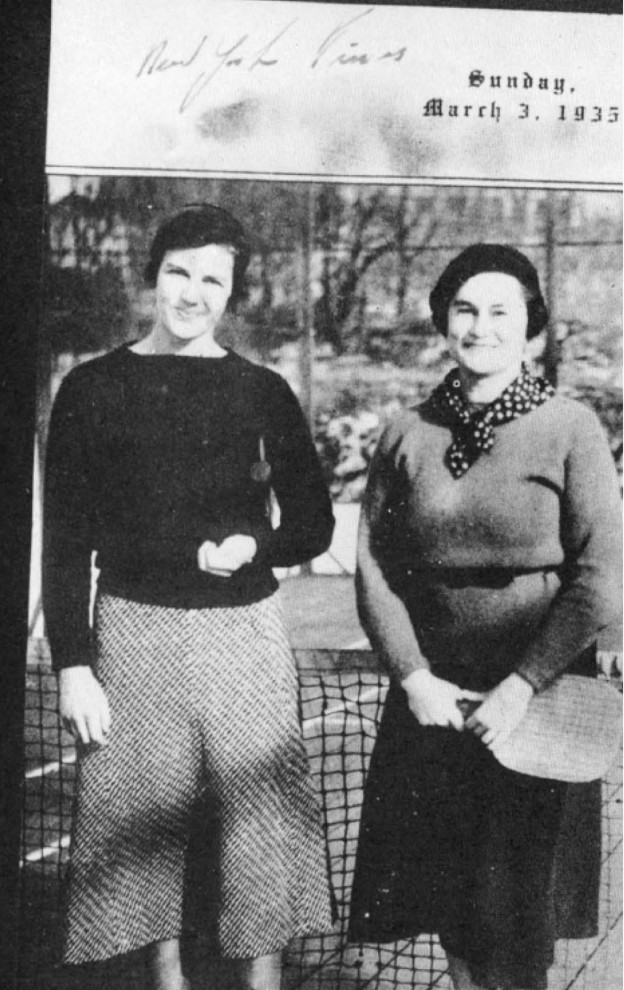
Jean Eaton and Kitty Fuller, the 1935 and 1936 Women’s Champions dressed for paddle

Game spans the generations and skill levels at Fox Meadow

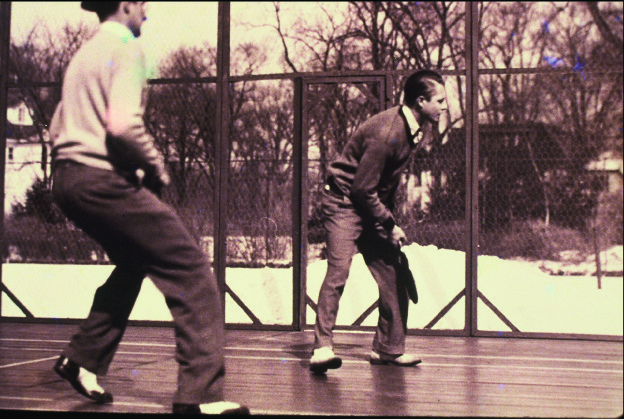
At Fox Meadow, paddle meant not just championship competition, but the inclusion of young and old, good and mediocre. This was an aspect of the sport fostered by the Old Army Athletes. From the time a youngster was old enough to get a ball across the paddle net, she or he was included, not just in Juniors play, but in some Club tournaments as well.

And Fox Meadow held a lot of tournaments: Men’s and Women’s Doubles, Singles, Mixed Doubles, Girls’, Boys’, Round Robins, Scrambles. On a single 1935 weekend, the Club held a Men’s Doubles, a Junior Boys’ Singles, and a Junior Girls’ Singles. In some of these, quite young players had a chance to face the game’s best competitors. In the winter of 1935, Ruthie Blanchard, age twelve, partnered her father to the finals of a Club championship Mixed Doubles. The Blanchards lost, but the pair across the net were Percival and Kitty Fuller, and Kitty Fuller happened to be the National Women’s champion that year.

Source: Diana Reische, Fox Meadow Tennis Club – The First Hundred Years, 1983

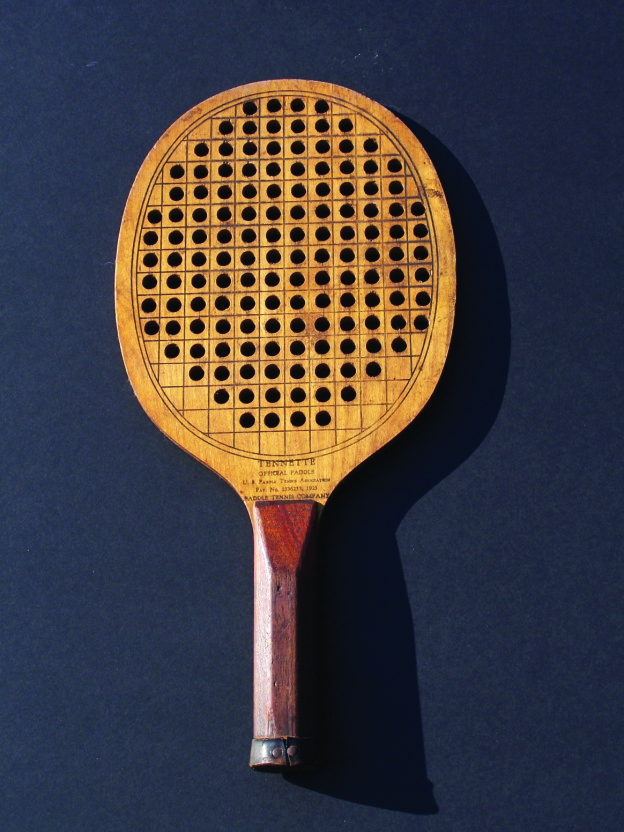
The more oval version of the original paddle with holes added but no protective rim.

Tracing the origins of Paddle Tennis

For some time, Blanchard wondered whether or not he and Cogswell had been carrying on with a game invented many centuries before. The matter arose when Esquire magazine requested some information on the game and Blanchard sought the help of an eminent historian and Old Army Athlete by the name of C. Alison Scully.

Source: Adapted from Fessenden S. Blanchard, Platform Paddle Tennis, 1959

In December 1935, Scully shared the bulk of his research in a letter to Blanchard as part of an article Blanchard was writing for Esquire.

The origin of the game of paddle tennis is lost in the mists of antiquity. The recent widespread interest in the game has renewed the desire for certitude as to its beginnings and, as a result, much that is new and enlightening to the students of the history of the game has been developed.

Recent discoveries on the Coast of Wales establish that a game, which was undoubtedly the forerunner of paddle tennis, was part of the life of the Piltdown man. Crude drawings on the walls of the caves show the players in characteristic positions. For paddles, the hip-bone of the mammoth was used. Life in this epoch was primitive and arduous and, as there was very little time for practice, the game probably did not reach a high stage of development.

The Princeton Archaeological Expedition of 1930 brought to light some very important information. Excavations in the vicinity of Abdab-mer-Sub establish that the characteristic Egyptian figure with upraised hand so familiar in all Egyptian art is not that of a female dancer, as generally supposed, but a drawing from life of Tut-Ankh-Amen serving in the first recorded game of paddle tennis doubles on the Mediterranean Coast. Tut-Ankh-Amen and Pharaoh VII played for Egypt, Caesar and Crassus for Rome. Cleopatra was one of the spectators.

As a result of further research work at Pompeii, a large flat concrete slab has been uncovered. While it was at first thought that this was a rubbing table for one of the Roman baths, the more discriminating students of archaeology are convinced that it was used for paddle tennis.

There is no record of paddle tennis in Denmark, Norway, Sweden, Latvia or Esthonia prior to A.D. 556, although it is probable that Hengist and Horsa brought the game back from England to the Continent on the latter date.

The diary of Christopher Columbus, which has just been disclosed to the world, contains references to the grumblings of the crew of the Pinta because of lack of space on the aft deck for exercise. No game adapted for use on shipboard other than paddle tennis was then known and it must have been paddle tennis that was played on that expedition.

In Colonial America, Captain John Smith and Pocahontas won the mixed doubles championship of Virginia at an early date. John and Priscilla Alden were another well-known team. George Washington first played the game after the battle of White Plains. It is a curious coincidence that the great revival of interest in the game should have taken place on the very ridge of land on which this battle was fought, at a point some five miles further south. There on the property of James K. Cogswell, in Scarsdale, paddle tennis was reborn.

C. Alison Scully

Source: Fessenden S. Blanchard, Platform Paddle Tennis, 1959

Original version

The paddle evolves into the form used for almost the next four decades before innovations in the early 1970s; Jim Tate covers the history of the paddle through the early 1990s

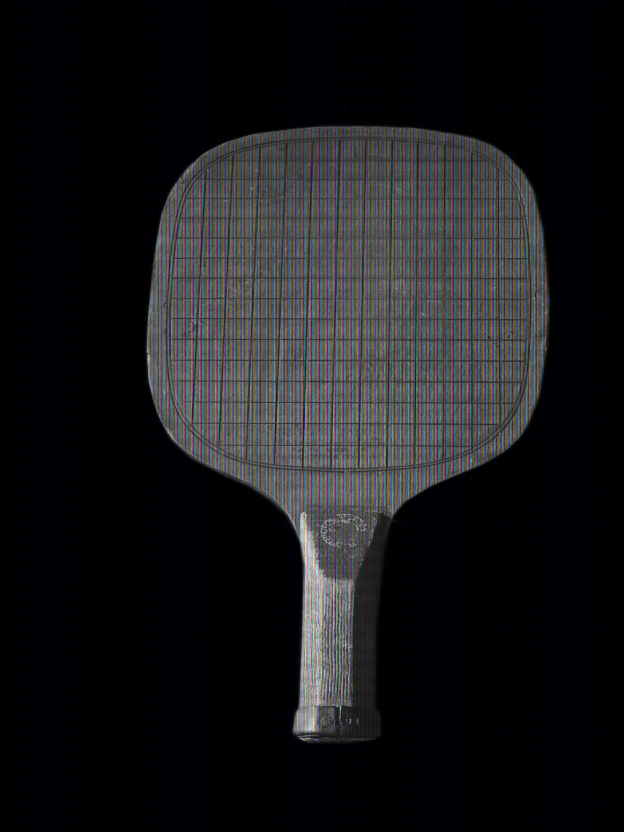
In the early stages of the game, players used the lightweight, solid, rectangular shaped paddle (The Paddle Tennis Company’s standard paddle), but it was too light for a fast game.

At the request of the Old Army Athletes The Paddle Tennis Company1 modified the shape of the paddle to a more oval design and added holes (the Tennette paddle) but this also proved to be too light and the edges tended to chip as there was no protective rim. A perforated, oval, mahogany stained paddle with a metal binding around its edges proved to be the answer and was first introduced in the late 1930s. It became the standard for the next four decades despite several efforts by the APTA to investigate better alternatives.

After the 1930s, the history of the paddle gets a little fuzzy. Apparently, the Reverend Frank Beal, who had invented playground paddle tennis, had a son who was living in the Scranton, Pennsylvania, area. This son met a local woodworker named Jankus, who could make paddles. Young Beal arranged to have Jankus produce paddles for both platform and paddle tennis. Reverend Beal would place an order through his son and Jankus would assemble them. Beal’s son would then load his car and head for Manhattan. It was a “catch as catch can” operation, according to Clint Sekol Jr., whose father bought the Dalton Manufacturing Company (the Jankus-Beal business) in 1950.

Source: Adapted from Fessenden S. Blanchard, Paddle Tennis, 1944, and Platform Paddle Tennis, 1959; and an article by Jim Tate in Platform Tennis News>and in the 1991 National Championship Tournament Brochure pp 18-19

In the 1970s and early 1980s new materials (fiberglass, foam composites, aluminum honeycomb,etc.) and construction techniques spurred a series of innovations which has continued unabated.

One of the most notable early innovations came in 1981 when Rich Maier, a multi-time APTA National Champion, formed Advanced Recreation Design with Andreas Schuler and introduced the Skymar paddle based on patent they had obtained.

Note 1: The Paddle Tennis Company was formed in 1922 by Rev Beal and Frank Contessa. It was sold in 1926 to the G. Lynn Sumner Company, a Madison Avenue advertising firm – see Frank B. Contessa

Source: Fessenden S. Blanchard, Paddle Tennis, 1944

Historical Factoid: Fessenden Blanchard on choice of serve or side: “Nails vs. No Nails: —By ‘nails or no nails’ we refer to the paddle tennis equivalent for ‘rough or smooth,’ when tossing up for choice of court or serve. Where the two leather ends come together, four tiny nails hold them. On the other side is one nail. The first side is ‘nails,’ the second, incorrectly, is ‘no nails’.”

From head to toe Killy Kilmarx and Kip Couch introduced a certain sartorial splendor to the game

Henry B Eaton develops inexpensive portable platform helping to grow the game

Fox Meadow Tennis Club member and former FMTC President (1936) Henry B Eaton, designed a collapsible platform that could be laid on an existing tennis court during the off-tennis season without damaging it. Eaton talked the New York lumber company company he worked for and the the forerunner of the Gates Sports Platform Company, to make the Eaton portable platform. The court was easy to transport and set up and only cost about $500, which made it affordable even during the Depression. These easy to install and cheap platforms were invaluable in growing the game.

Source: Adapted from Fessenden S. Blanchard, Platform Paddle Tennis, 1959

Historical Factoid: Eaton’s wife, Jean Eaton, was the winner of the Women’s Doubles and Singles Nationals in 1935 (the inaugural tournaments) and the Women’s Doubles in 1936.

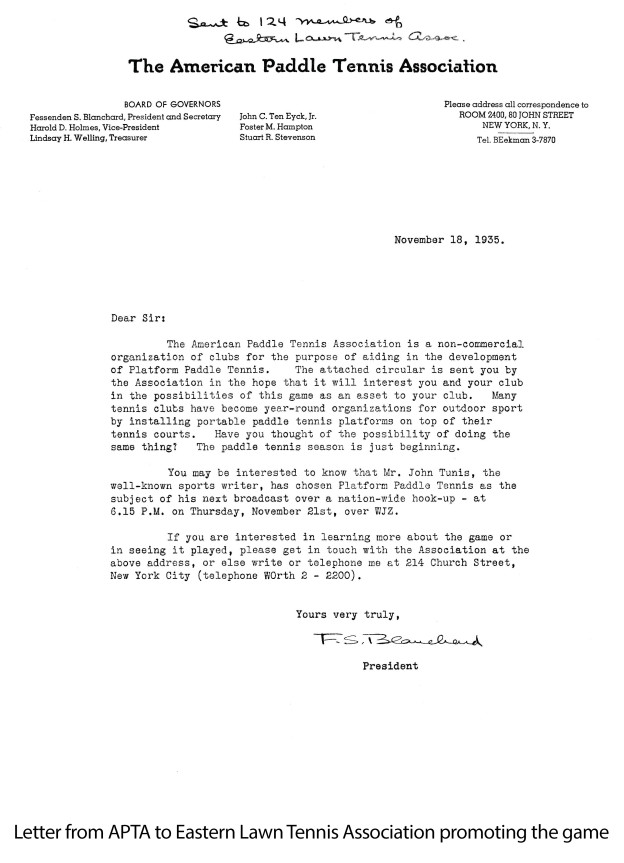
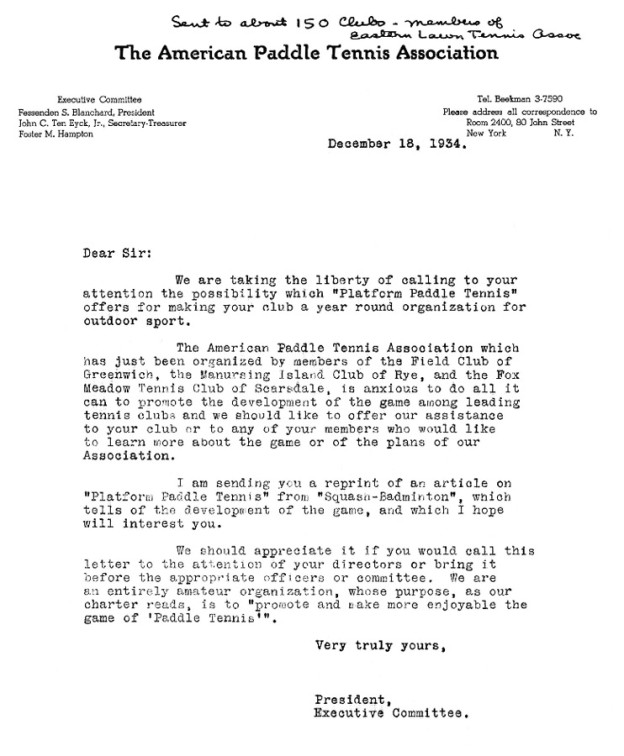
Letter from APTA to Eastern Lawn Tennis Association promoting the game

APTA works to grow the game

On November 18, 1935, brochures were sent out to Eastern Lawn Tennis Association member clubs and to others potentially interested in the game. These had photos and a description of platform tennis; tournament records of the previous year; a diagram of the platform with measurements; rules and regulations; and required equipment.

Principal activities of the Association:

(1) Annual Reports
(2) Answering inquiries about the game and helping individuals or clubs to get started
(3) Planning and Conduct of National Championships
(4) Establishment of rules and regulations and conducting investigations regarding possible improvements to the court, equipment, rules and regulations
(5) Furnishing information about tournaments and results to stimulate publicity
(6) Selling official plans and specifications for courts
(7) Organizing exhibition matches
(8) Providing leadership, in cooperation with member clubs, in the development of the social activities and enjoyment of platform tennis events among members

Source: Adapted from Fessenden S. Blanchard, Platform Paddle Tennis, 1959 and Fessenden S. Blanchard, Platform Paddle Tennis, 1959
Improvements/Inquiries undertaken or aided by the APTA:

(1) The Evans Backstop: The APTA actively encouraged its use and it became the standard for the game.
(2) Sanding the court: The standard for application was developed.
(3) Improved paddles: The APTA conducted a number of investigations over the years to see if the paddle developed by the Old Army Athletes could be improved. An acceptable substitute could not be found.
(4) Standardizing the height of net: A number of experiments and inquiries resulted in the establishment of 2’ 10” as the height in the middle and not over 3’ 1” at the posts.
(5)Bouncing the balls over the backstop: In 1946, a rule was adopted to play a “let ball” and replay the point if a ball bounced over the screens.
(6) Studying court measurements: The APTA conducted a number of studies and playing experiments but ultimately the original dimensions remained.
(7) Foot faults: For years, the APTA had closed its eyes to frequent foot faults, figuring it might lessen the fun if they kept calling them. In the mid 1950’s the APTA began to enforce the rule in championships and appointed foot-fault judges for final and semifinal matches. In 1958, a formal foot fault rule was adopted.
(8) Use of balls in tournaments: The APTA provided balls and only one ball could be used per set in a tournament unless permitted by an official.

Source: Fessenden S. Blanchard, Platform Paddle Tennis, 1959
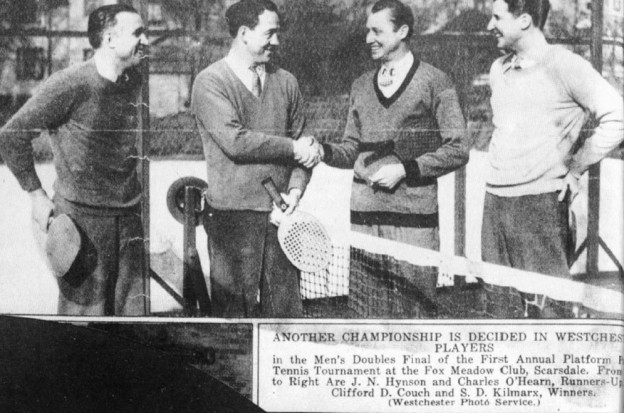
The 1935 Men’s Champions Clifford D. Couch and S. D. Kilmarx on the right and finalists J. N. Hynson and Charles O’Hearn.

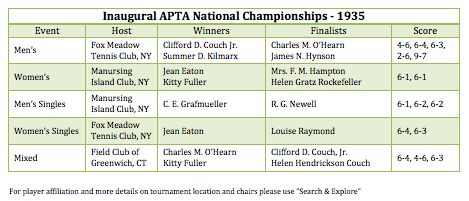
Inaugural National Championships held

1935

In 1935, the American Paddle Tennis Association started conducting a series of annual championship tournaments, held during January, February and March—the height of the season. Included for the first three years were Men’s and Women’s singles championships. But interest waned and singles were dropped in 1938. Blanchard claimed early on that paddle really was just a doubles game.

Source: Fessenden S. Blanchard, Paddle Tennis, 1944

For the first five years, with one exception, teams from the Fox Meadow Tennis Club of Scarsdale dominated these tournaments, occupying both the winning and runner-up positions. By 1940, there were 17 member clubs in the APTA, most of which entered teams in the men’s doubles. However, the experience and a large number of quality teams from the Scarsdale contingent kept them at the top of the heap. The one exception came in 1936 when a strong team from Orange, NJ, Harold D. Holmes and Richard G. Newell took the championship.

Source: Fessenden S. Blanchard, Paddle Tennis, 1944

Screen Shot 2013-11-13 at 7.35.19 AM

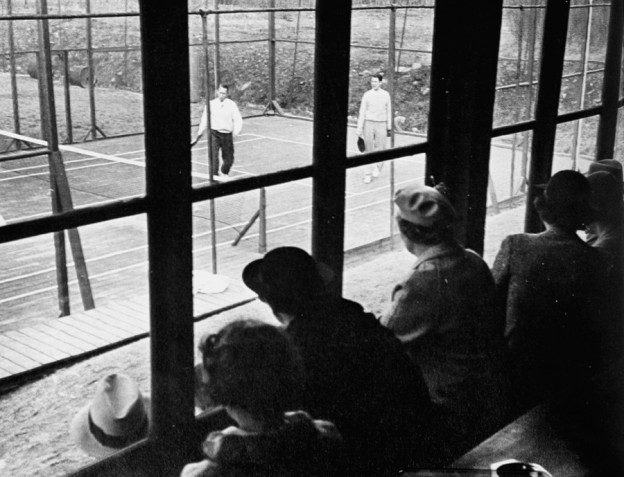
"Let the Gallery have comfortable benches from which they can look down on the court". In the mid 1930s the porch was glassed in to make watching more pleasant.

Platform Tennis saves Fox Meadow Tennis Club

By the fall of 1934, the Great Depression had begun to hit many clubs extremely hard. Membership in the Fox Meadow Tennis Club, which had been well over 100 families, dropped to 77. The club had begun to run a deficit. Strenuous measures had to be taken. There were two schools of thought. One school favored extreme economy, saving the cash reserve as long as possible. Another group, having total faith in what platform tennis might do for the club, favored putting up another platform.  They suggested raising part of the funds by members’ underwriting.  This would provide a stove for the clubhouse, and enable it to function fully as a winter club. To help put over this policy, they urged the establishment of a special winter membership for the six months from November 1, 1934, to May 1, 1935. Those willing to bet on the future of platform tennis won out, and the newly authorized court didn’t have to be called a practice tennis court. The new court helped the game take off at the club as the first court had been monopolized by a small group, discouraging others from trying the game.

The special winter memberships were at first limited to twenty families, each charged a rate of slightly less than half the annual dues. The plan was so successful that by May of 1935, most of the special members accepted an opportunity to switch to regular membership. In the fall of 1935, the directors voted to erect a third platform. By May 1936, the special winter memberships were abolished in favor of all or nothing. Family membership in the club had increased from 77 to 112.

A year or two later, the maximum (at that time) of 130 was reached, and there was a waiting list. The club increased its dues. It had become a year-round club for tennis and platform tennis. A club, which had been dead six months of the year and rather sick for the other six months, was now very much alive all year.

Source: Adapted from Fessenden S. Blanchard, Paddle Tennis, 1944, and Platform Paddle Tennis, 1958, and Diana Reische, Fox Meadow Tennis Club – The First Hundred Years, 1983

APTA letter to members of the Eastern Lawn Tennis Association explaining the benefits of the game

Fessenden S. Blanchard becomes first APTA President (1934-1938)

Blanchard, a co-inventor of the game along with James Cogswell, and one of the five co-founders of the American Paddle Tennis Association became the first President. Although Jack Ten Eyck Jr. had been the driver behind starting the APTA, it seemed sensible to have Blanchard take the lead, as he was a tireless promoter of the game he loved. Ten Eyck served as the APTA’s first Secretary. During his tenure on the APTA Board Blanchard also acted as Secretary (1935-1941), chief correspondent and publicist for the game. He authored two books on the game – Paddle Tennis (1944) and Platform Paddle Tennis (1959).

Source: Adapted from Fessenden S. Blanchard, Paddle Tennis, 1944, and Platform Paddle Tennis, 1959

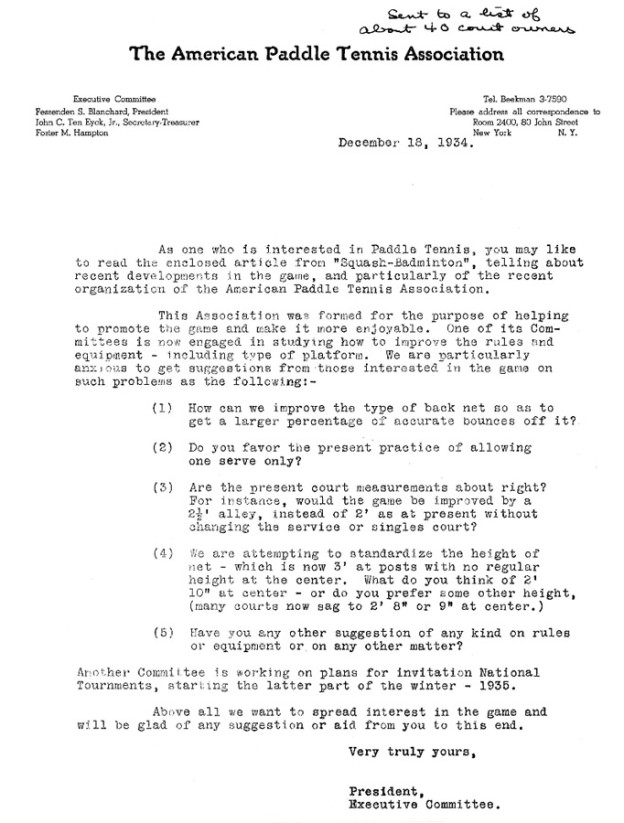
Letter sent by APTA to 40 court owners seeking their opinions on court specifications and playing rules

Origin of the name APTA

The United States Paddle Tennis Association (USPTA) had abandoned the name American Paddle Tennis Association under which it was first organized in 19261

With the permission of the USPTA, the newly formed governing body for platform tennis adopted the former name of the USPTA.

Blanchard latter regretted that they did not make a clearer distinction between the two games.

Source: Adapted from Fessenden S. Blanchard, Paddle Tennis, 1944

Note 1: According to an article in Paddle World in Fall 1976 the date that the Rev Beal and Frank Contessa formed the APTA was 1922 – see Frank B Contessa

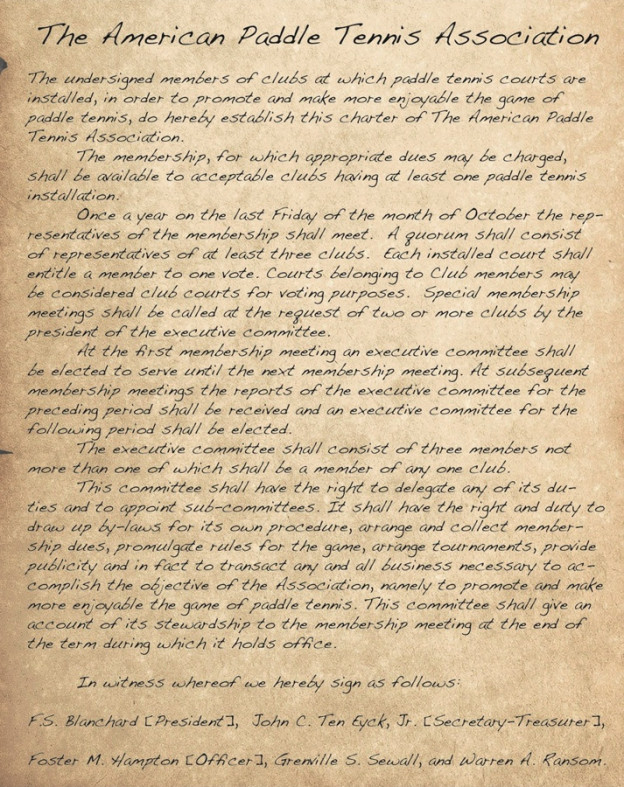
Text from the original charter of the American Paddle Tennis Association. The charter was signed in November 1934.

Founding of the APTA

Manursing Island Club of Rye, New York, was an early adopter of the game after a somewhat skeptical committee of two came to Scarsdale to try out the sport at the court on Old Army Road. After trying out the game, the discussion changed from whether to put in a court to how many. They made a decision to install two courts and two additional ones shortly after. Not long after, Manursing member John C. (Jack) Ten Eyck Jr., took the initiative in founding the American Platform Tennis Association (APTA)— first called the American Paddle Tennis Association. Initial members came from Fox Meadow, Manursing and Greenwich Field Clubs.

Source: Adapted from Fessenden S. Blanchard, Platform Paddle Tennis, 1959
In November 1934, Ten Eyck called the inaugural meeting of the APTA in his office in New York City. Representatives of three clubs that had been pioneers in the establishment of platform tennis courts were invited: Fox Meadow Tennis Club of Scarsdale, New York, the Manursing Island Club of Rye, New York, and the Field Club of Greenwich, Connecticut. Warren A. Ransom, and Grenville S. Sewall represented Manursing; Foster M. Hampton represented the Field Club; and Fessenden S. Blanchard represented Fox Meadow. All five signed the original charter.

The charter provided that meetings of member clubs were to be held at least once a year on the last Friday in October. Each installed platform entitled a member to one vote. However, there was a special provision stating that “courts belonging to club members may be considered club courts for voting purposes.” This was suggested because of the fact that in some communities, as in Scarsdale and Greenwich, many privately owned courts had been made available for Association championships and play by club members. At the time the Association was organized, the Fox Meadow Tennis Club and the Field Club at Greenwich each had only two courts compared to six at Manursing Island. However, the total number of platforms belonging to club members in the two former places was relatively large. The Manursing men generously made the proposal for this clause in the interests of fairness.

Source: Adapted from Fessenden S. Blanchard, Paddle Tennis, 1944

Within two years, the original three clubs grew to eight with the addition of Tremont Place Paddle Tennis Club (Orange, New Jersey), Ardsley Country Club (Ardsley-on-Hudson, New York), Bronxville Field Club (Bronxville, New York), American Yacht Club (Rye, New York), and Amackassin Tennis Club (Yonkers, New York).

Source: Fessenden S. Blanchard, Platform Paddle Tennis, 1959
One of the earliest steps to grow the game, was to send a reprint of an article in Squash-Badminton about platform tennis, and an announcement about the formation of the APTA to clubs belonging to the Eastern Lawn Tennis Association

Letters were also sent to forty platform owners asking these five questions:

1.     How can we improve the type of back net to get a larger percentage of accurate bounces off it? [This was sent a short time prior to the development of the Evans backstop on the Cogswell platform.]
2.     Do you favor the present practice of allowing one serve only? [All replies but one favored one serve.]
3.     Are the present court measurements about right? For instance, would a 2.5-foot alley, instead of the present 2 feet, improve the game, without changing the service or singles court? [No change was suggested at the time.]
4.     We are attempting to standardize the height of the net, which is now 3 feet at the posts with no regular height at the center. What do you think of 2’10” at the center—or do you prefer some other height? Many nets now sag to 2’8″ or 2’9″ at center. [The 2’10” was decided on, with, not over 3’1″ at the posts. This still remains the standard.]
5.     Have you any other suggestion of any kind on rules or equipment, or on any other matter?

Source: Fessenden S. Blanchard, Platform Paddle Tennis, 1959