The Evans Backstop Design

Screens are perfected – the games future is assured

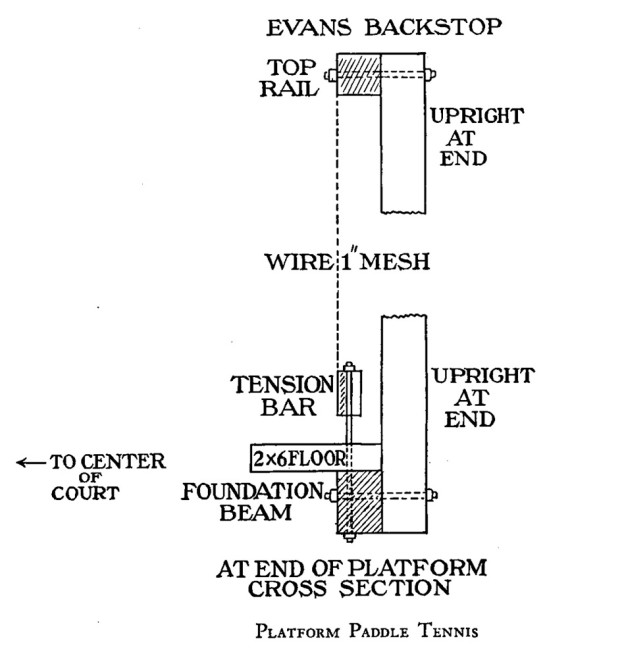
Donald K. Evans of Fox Meadow solved the game’s biggest problem, the unpredictable bounces off the backstops. Without a good solution the game had limited growth potential.

Evans devised a method to stretch a one-inch wire mesh from top to bottom inside, but not touching, the uprights surrounding the court. With adjustable tension bars, the Evans Backstop yielded a uniform bounce when a ball hit any of the four screens, and it became standard on all new courts. The future of the game was assured.

This new backstop was first erected—with the aid of John G. MacKenty—during the winter of 1934-35 on the second Cogswell court.

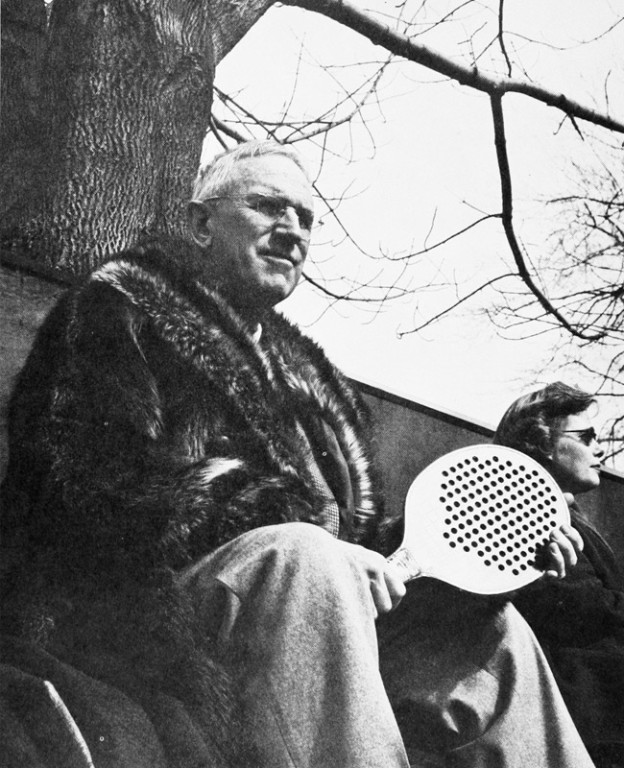
Don Evans was inducted into the Hall of Fame in 1966

Source: Adapted from Fessenden S. Blanchard, Paddle Tennis, 1944, and Platform Paddle Tennis, 1959

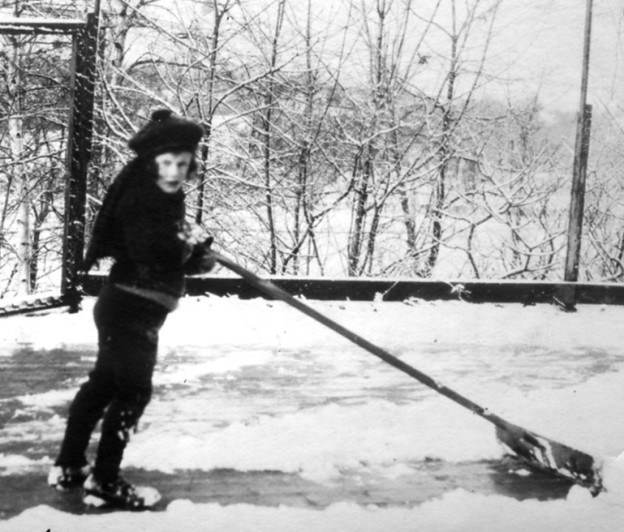
Snow shoveling is part of the fun!

Fox Meadow’s “do-it-yourself” tradition is born

FMTC’s do-it-yourself spirit was never more in evidence than during the heyday of ice-skating, which began at FMTC in the 1930s.

Mole Ware recalled: “In the thirties and forties, for many young people and for two transplanted Bostonians—Fess Blanchard and Jimmy Cogswell—an important part of the Club’s appeal in winter lay in action on the skating rink. In the thirties, the rink skirted the portable paddle courts. Later, in the forties, the skating area was expanded and the large Victrola brought down from the porch to stand on the ice by the tennis backstop. Strains of Viennese waltzes and German polkas wafted over the paddle courts while my father and Mr. Cogswell taught ice dancing to anyone brave enough to try.”

Before the prevalence of indoor rinks with their ice-making equipment, readying an outdoor rink for skating was a labor of love, seemingly always done in the frigid cold of the night. At Fox Meadow, numerous people undertook this chilling task. Marian Van Norden Frohlicher recalls that her late husband John Van Norden and Henry Eaton got up at 2:00 or 3:00 a.m. to freeze the courts. Do Cogswell Deland tells of the times her father stood at the courts, hose in hand, drenching not only the tennis court but himself as well. When he had finished, both the court and his face were covered with ice.

Source: Diana Reische, Fox Meadow Tennis Club – The First Hundred Years, 1983

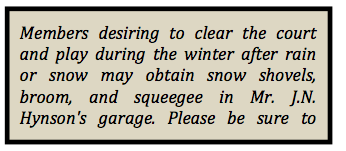
An early notice from the Paddle Committee. Hyson lived next door to the club at 15 Wayside Lane.
Screen shot 2013-01-23 at 10.41.08 PM

Source: Diana Reische, Fox Meadow Tennis Club – The First Hundred Years,1983

 

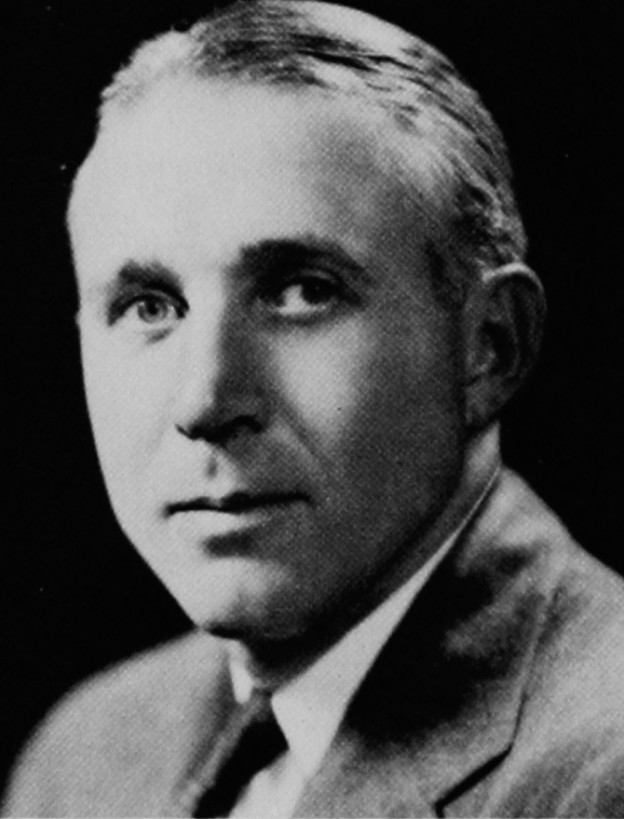
James H Hynson, FMTC President (1933-1936)

James N. Hynson elected FMTC President (1933-1935): open house and exhibition matches planned, new summer membership offered

James N. Hyson was a Princeton tennis star and squash ace and captain of his college’s 1920s championship basketball team.He was an excellent tennis player, winning two consecutive National Championships (1937-1938), and was instrumental in the construction of the first court at Fox Meadow in 1931.

Hynson won the club’s Men’s Singles six times – 1926-1929, 1933-1934, and 1936

During his tenure as President he helped oversee the addition of courts, and the building of a vibrant paddle community that lead to the club becoming known as “the home of platform tennis” and provided the momentum to expand the popularity of the game. For this later service he was among the first group of individuals inducted into the Platform Tennis Hall of Fame in 1965 (see Hynson)

SI March 31 1933
Scarsdale Inquirer March 31, 1933

Court construction plans help the game to expand

Both clubs and private estate owners usually built the first courts in accordance with plans and specifications provided by Cogswell and Blanchard—at first for nothing and later for a nominal fee.

Professor Eliot Dunlap Smith of Yale University assisted in early court improvements with Cogswell and Blanchard. Along with his personal experience playing, he consulted the Yale Department of Forestry for advice. In later years, Scarsdale architect Richard H. Tatlow also served as an advisor and worked in the American Paddle Tennis Association, the forerunner of the present day American Platform Tennis Association (APTA).

Source: Adapted from Fessenden S. Blanchard, Paddle Tennis, 1944, and Platform Paddle Tennis, 1959

Fox Meadows original sign-up system. Four paddles in a row and your foursome's ready to go.

Paddle at Fox Meadow grows slowly at first

The first court was slow in getting started.

A few neighboring enthusiasts occupied it a great deal of the time and, while players took turns, there were “owners of the house” on hand to give everybody a fabulous time and provide robes to keep the gallery warm.

The platform was raised above the somewhat uninviting bench provided for the spectators, and the clubhouse was as far away as the grounds permitted. Consequently, many club members were not encouraged to come down and wait their turn.

While this original platform was used considerably (see article below), the real success of the game at the club awaited the installation of the second and third platforms.

Source: Fessenden S. Blanchard, Platform Paddle Tennis, 1958
SI April 22 1932
Scarsdale Inquirer April 22, 1932

Fessenden S. Blanchard in His Favorite Spot - The Blanchard Box at Fox Meadow Tennis Club. Grace Pardoe beyond

Paddle ignites Fox Meadow spirit

Madeline (Madge) Childress Beck recalls that the Childresses had left Fox Meadow at one point for another club where the caliber of tennis play was higher, but “then came paddle, and our family rejoined. Paddle made the winters. It was absolutely wonderful. We spent happy, competitive winters and I looked forward to paddle in the winter more than to tennis.”

Former Club President Oscar (Oz) Moore, adds, “Fess Blanchard was the Dean, the Headmaster, the President Emeritus, and the Spirit of Fox Meadow. The debt we all owe to Fess for inventing, improving, and promoting (along with Jimmy Cogswell) our wonderful game of paddle tennis is enormous.”

“What we had as a club was fun together with the family,” recalls another club member Marian Frohlicher. “Everyone was strapped for money and wanted some exercise and fun, so we made it a simple place where we got together and did things ourselves.”

Source: Diana Reische, Fox Meadow Tennis Club – The First Hundred Years, 1983
SI Nov 25 1932
Scarsdale Inquirer November 25, 1932

SI Dec 9 1932
Scarsdale Inquirer December 9, 1932

Competitive paddle tennis begins

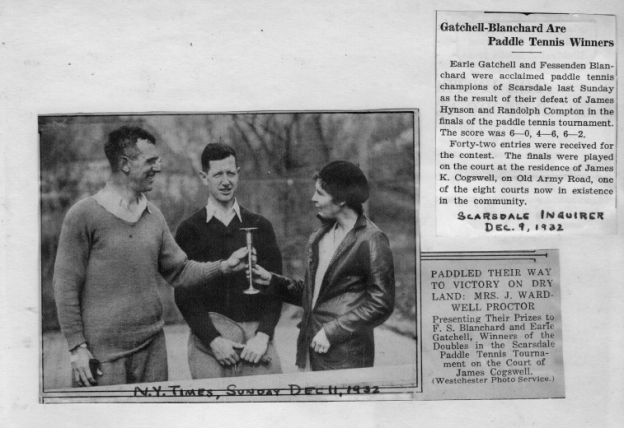
By December, there were eight platforms in Scarsdale alone and the first open tournament took place, with forty-two entries. The new, larger Cogswell platform and court were the venue for the finals. Earle Gatchell and Fessenden Blanchard, representing the Old Army Athletes, won an exciting final match, 6-0, 4-6, 6-2, from Randolph Compton and James N. Hynson. “Paddled their way to victory on dry land,” said The New York Times.

By the end of the year, more than twenty courts had been constructed in Massachusetts, Connecticut, and New York. These $500-$600 courts were initially popular on private estates. Later on, leading tennis clubs constructed their own courts.

Source: Adapted from Fessenden S. Blanchard, Paddle Tennis, 1944, and Platform Paddle Tennis, 1959

Historical Factoid: Lois Proctor – shown above presenting the trophy to Blanchard and Gatchell – had taken quite a “shine” to Blanchard (see note at left)

Source: Blanchard Scrapbook 1929-1963

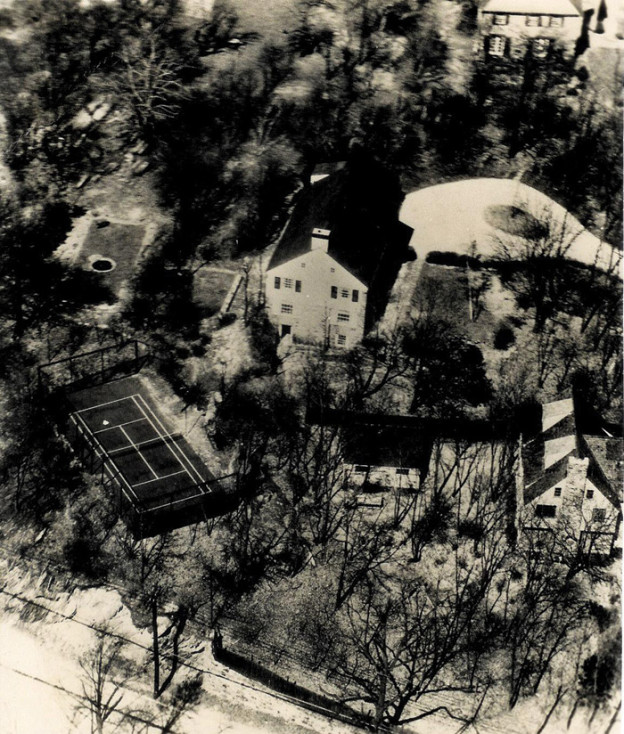
Caption: Aerial view of the second court near Old Army Road in Scarsdale, New York (Oct. 1932). Ardsley Road is shown at bottom. The Cogswell house is at center. The Blanchard house is out of sight at upper left. As shown, only three sides of the original court were screened.

Cogswell builds second court

With the help of a rock wall and some fill, the original platform morphed to the current size of 60’ x 30’.

Even with the larger platform and uneven bounces from the wire, the players continued the practice of playing the balls from the wiring. By this time, the wiring height had reached 12’ and used a smaller one-inch mesh.

The Cogswell’s held a party right before the demolition of the first court that included dancing on the “doomed” old platform.

Source: Adapted from Fessenden S. Blanchard, Platform Paddle Tennis, 1959

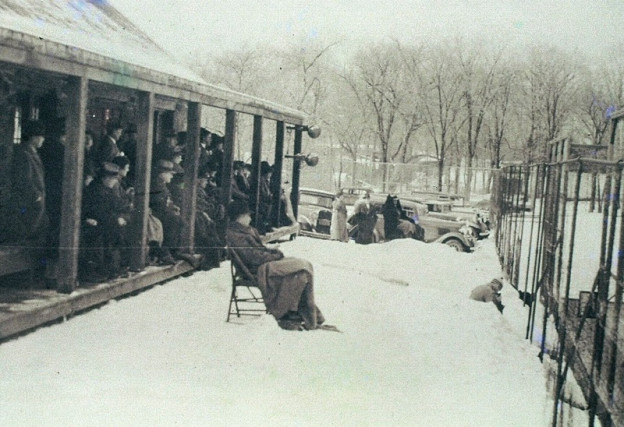
A snowy day didn’t discourage the crowd of spectators at Fox Meadow Tennis Club.

The appeal of the game

Frederick Lewis Allen, Editor of Harper’s Magazine, wrote the following letter on February 19, 1932 to a lady who had asked him what he thought of the game. The letter was written before the Evans invention had made taking balls off the backstop an assured success, before the sanding technique had practically eliminated slipping during a rain, and when the game was still largely confined to those who learned it on the Cogswell court.

“I know of no other active game which can so readily be played outdoors at all seasons and in virtually all weathers. In Scarsdale we play it every week-end from October to May (and sometimes on week-day evenings by artificial light). Golf links and tennis courts may be out of commission; skating ponds may not be frozen over; there may be no skiing or coasting—yet Paddle Tennis goes right on. We play it when the thermometer is below freezing and the snow has to be shoveled off the court. We play it on rainy days, for the wet doesn’t hurt the wooden paddles, and if the court gets a little slippery that is not fatal. I cannot exactly recommend playing in a really heavy rainstorm or a driving snow storm’, but I have played in both and enjoyed it—stopping every few minutes to shovel the fresh snow or standing rainwater off the court with a strange instrument known as a squeegee. To be able to count on the exercise and the sport all year round is an immense boon.

Another advantage is that the court is so small that many people whose grounds are not large enough to include a tennis court can easily find space for a Paddle Tennis platform; and that the platform is relatively inexpensive to build and the cost of upkeep is negligible. But these advantages would count for little if the game itself were inferior. I consider it one of the best games ever invented

Anybody who has ever played lawn tennis finds it absurdly easy to learn: I have seen men take a respectable part in a doubles match with seasoned players after only an hour’s practice. It is one of those games in which the relatively poor player is not completely outclassed and humiliated; even the duffer can return enough drives to feel that he is something more than a helpless bystander. One reason is that the paddle is so short that the ball is easy to hit quickly and with fair accuracy. You can pick any four players out of a group and be sure that they will be able to work up a pretty good match.

Yet I must not give the impression that because the game is easy to learn it is mild and innocuous. Although Paddle Tennis is less tiring than lawn tennis because the court being smaller there is less running, on the other hand the ball goes back and forth much more quickly than in lawn tennis; the rallies are usually longer, the pauses between them are shorter, and the players are on the move every second. They can (and do) hit the ball just as hard as they please; and there are plenty of opportunities for strategic placing, for outguessing one’s opponent, for alternating smashes with lobs or deep drives with cross-court pokes at the net. Most of the play, by the way, is near the net—in doubles, at least—and that means quick and exciting action. If anybody thinks Paddle Tennis is merely a children’s game or a sort of overgrown ping-pong, the sight of a fast set of men’s doubles will soon remove the idea from his mind.

If the fun that thirty or forty of us have had in Scarsdale is any criterion, it offers first-class sport—to say nothing of exercise—to anybody who can hit a sponge-rubber ball with a wooden paddle and move faster than a walk.”

Source: Adapted from Fessenden S. Blanchard, Paddle Tennis, 1944


Vassar builds first college court

Vassar President Henry MacCraken dropped by the Blanchard’s unexpectedly in late 1931 “to find out about paddle tennis.” It was a necessary visit since an alumna had donated a court.

The article headline in the New York Sun on October 24, 1931 read: “Paddle Tennis to Be Tried Out at Vassar.”

At the end of a brief article about the game the Sun added, “Vassar is the first college to experiment with the new form of sport.” Unfortunately, the experiment was a failure, likely due to poor choices of court location and backstops, and the fact that there was only one court.

Source: Adapted from Fessenden S. Blanchard, Platform Paddle Tennis, 1959

Also see The game starts to catch on