Newsweek featured platform tennis in a March 21, 1937 article and on March 23, 1937, J.P. Allen proclaimed in the New York Sun:
Davis Cup Panacea Offered.
Blanchard Proposes Paddle Tennis to Balance California Supremacy in East





Newsweek featured platform tennis in a March 21, 1937 article and on March 23, 1937, J.P. Allen proclaimed in the New York Sun:
Davis Cup Panacea Offered.
Blanchard Proposes Paddle Tennis to Balance California Supremacy in East

The first of this racquet dynasty at the Club were Avent and Madeline Childress. Mrs. Childress taught all four of her daughters to play tennis, and three of them loved the game. When the girls were introduced to paddle, they took to the game like a trio of naturals. All three became national champions: Sally Childress Auxford, Madge Childress Beck, and Maizie Childress Moore.
For decades, the family’s daughters and grandchildren formed a nearly unbeatable paddle dynasty, with a string of APTA National Championships stretching from 1936 to 1974. Sally Childress, a frequent women’s tennis champ at the Club, took her first national paddle tournament in 1937. Her partner was her sister Maizie. Nearly twenty years later Sally Childress Auxford captured a second Women’s Doubles title, with partner Barbara Koegel, and in 1959 she won the Mixed Doubles crown.
Although each of the Childress women was formidable on the court, the unfailing powerhouse was Madge Beck, who won an incredible seventeen national championships: twelve Women’s Doubles, four Mixed Doubles, and one Women’s Singles. Most consider her to be the game’s all-time best female player, and her record has never been duplicated. Famed for her terrifying backhand and aggressive play, she might have won even more tournaments had they not been canceled during World War II. For her first national championship, Madge Beck teamed with Club member Marie Walker, but in 1949, she began playing with her sister Maizie Moore, and the pair did not lose a single set for several years. Top-seeded nationally year after year, the sisters won the Women’s Doubles title five times between 1949 and 1954, and thirteen times with other partners.
Both Madge and Maizie were inducted into the Platform Tennis Hall of Fame in 1965 and 1970 respectively.
In club platform tennis championships Madge won five Women’s – 1952-1953, and 1956-1958, twice with Maizie and three times with Sally. In Mixed she won seven straight titles – 1943-1950, five of them with her husband. Sally won eight Women’s titles from 1954 through 1971 and one Mixed in 1966 with her husband Peyton. Maizie won three straight Women’s – 1952-1954.
In club tennis championships Sally won eight Singles titles during the period 1952-1972, seven Doubles titles from 1953-1973, and one Mixed Doubles in 1956. Maizie won one Singles in 1954, one Doubles in 1949, and two Mixed in 1942 and 1953, both with her husband. Madge won five Doubles titles- 1950-1952, 1954, and 1959.{Note: Astonishingly the first documented Women’s Singles and Doubles championships was in 1948 although the Scarsdale Inquirer mentions women who won tournaments in the 1923-1931 time-frame]
Source: Diana Reische, Fox Meadow Tennis Club – The First Hundred Years, 1983

This tradition began when the Cogswells arrived at FMTC with the Old Army Athletes in the 1930s.
Families took turns serving tea, cinnamon toast, and cookies. In 1936, fifteen cents entitled a member to “unlimited tea, toast, and condiments.” (see sidebar article)
So popular were the Saturday teas that they were extended to Sundays, and iced tea was served during tennis season.
It was not until the 1970s that the Sunday teas were discontinued.
Source: Diana Reische, Fox Meadow Tennis Club – The First Hundred Years, 1983
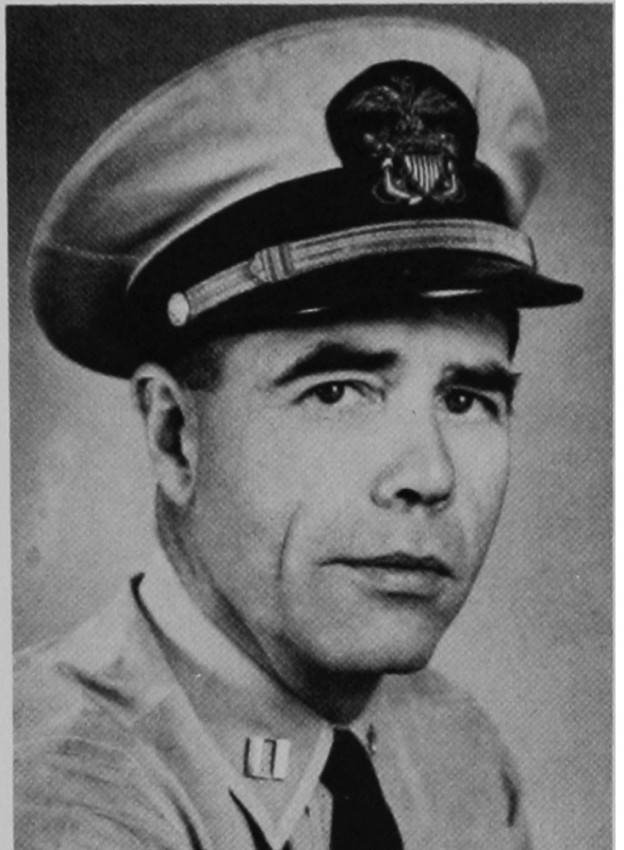
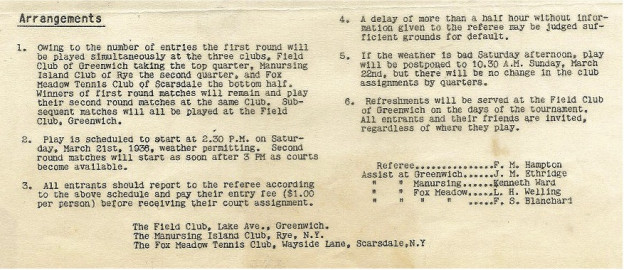
By the end of 1936, the APTA consisted of eight clubs: FMTC, Tremont Place Tennis Club, Manursing Island Tennis Club, Field Club of Greenwich, Ardsley Country Club, Bronxville Field Club, American Yacht Club, and the Amackassin Tennis Club. The Association began organizing exhibitions at various clubs: Orange Lawn Tennis Club, Wee Burn Club, Hartford Golf Club, Short Hills Club, and others.
Source: Fessenden S. Blanchard, Platform Paddle Tennis, 1959
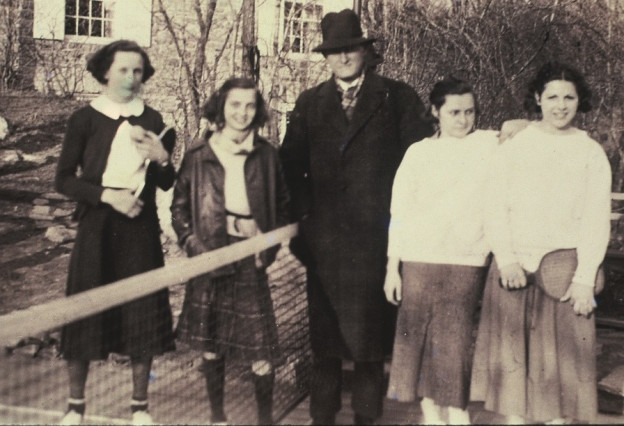
Frank Beal, the inventor in 1911 of the playground form of paddle tennis, visited the Cogswells in March 1936. He brought with him the winners of the New York City Junior Girls’ Championship, Alice Elazat and Estelle Suarez, who played Do Cogswell and Ruth Blanchard, winners of the Fox Meadow Tennis Club Championships.
The home team won.
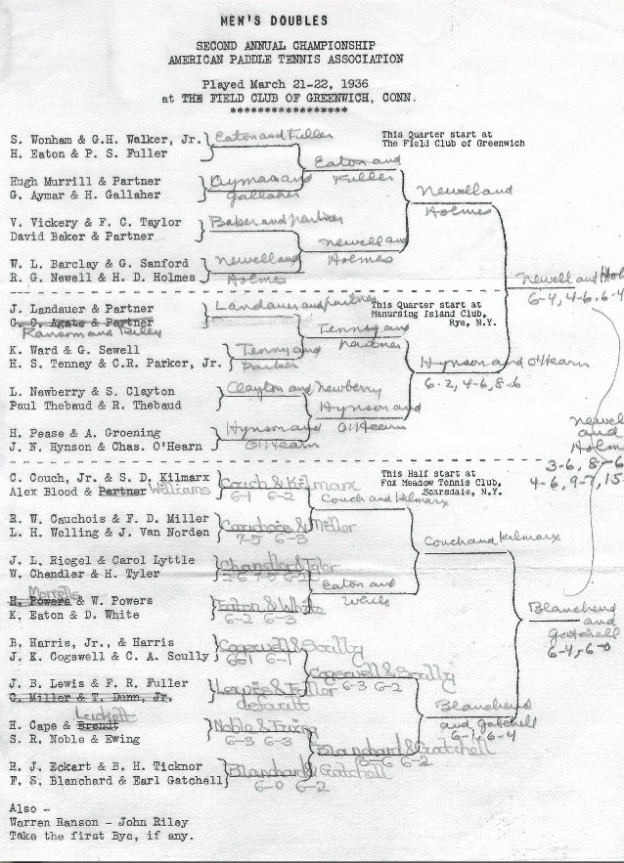
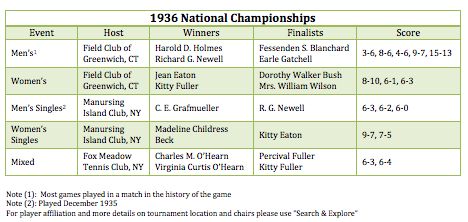
Harold D. Holmes and Richard G. Newell from Tremont Place Platform Tennis Club in New Jersey won the Men’s Championship in an epic match against the Fox Meadow Tennis Club team of Fessenden S. Blanchard and Earle Gatchell.Blanchard was devastated that a non-Scarsdale team had won a National title!
Blanchard recalled the match in his 1944 book:
“The Men’s final match still holds the APTA record for length and closeness. Both teams had already played in the quarters and semi-finals that same day. The referee made the finals the best of five sets, as opposed to the standard best of three. For the first time, a Platform Paddle Tennis championship went outside of Scarsdale, with Holmes and Newell winning the epic match: 3-6, 8-6, 4-6, 9-7, 15-13, a 77 game final, over Blanchard and Gatchell. Holmes and Newell had 13 match points before winning.”
Historical Factoid: One of the finalist in the Women’s Doubles event, Dorothy Walker Bush, was the mother of George Herbert Walker Bush the 41st President of the United States.
Source: Fessenden S. Blanchard, Paddle Tennis, 1944
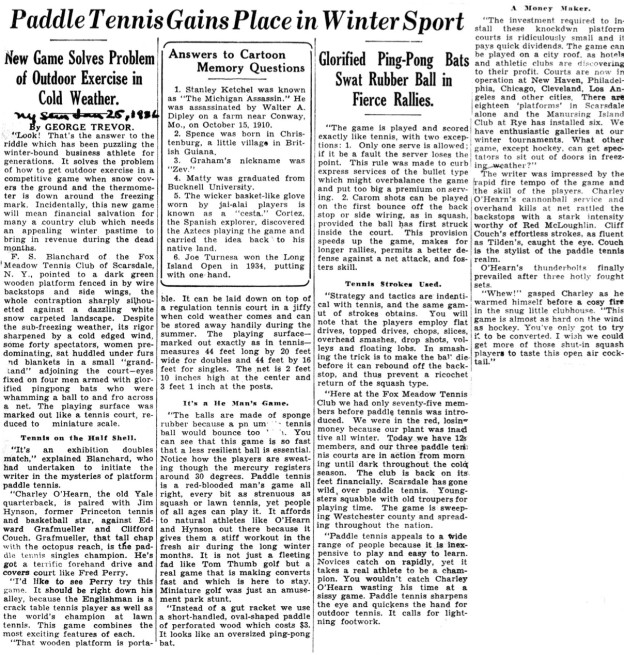
On January 25th, 1936 George Trevor (1892-1951), remembered as one of the best sports writers in the business, began an article on Platform Tennis as follows:
Paddle Tennis Gains Place as Winter Sport
Look! That’s the answer to the riddle that has been puzzling the winter-bound business athlete for generations. It solves the problem of how to get outdoor exercise in a competitive game when snow covers the ground and the thermometer is down around the freezing mark. Incidentally, this new game will mean financial salvation for many a country club that needs an appealing winter pastime to bring in revenue during the dead months.
Trevor gave his impressions of the exhibition match he had watched (Charley O’Hearn and Jim Hynson vs. Kip Couch and Ed Grafmueller):
The writer was impressed by the rapid-fire tempo of the game and the skill of the players. Charley O’Hearn’s cannon ball service and overhead kills at the net rattled the backstops with a stark intensity worthy of a Red McLoughlin. Kip Couch’s effortless strokes, as fluent as Tilden’s, caught my eye. Couch is the stylist of the paddle tennis realm. O’Hearn’s thunderbolts finally prevailed after three hotly fought sets. “Whew!” gasped Charley as he warmed himself before a cozy fire in the snug little clubhouse. “This game is almost as hard on the wind as hockey. You’ve only got to try it to be converted. I wish we could get more of those shut-in squash players to taste this open-air cocktail.”
Source: Fessenden S. Blanchard, Platform Paddle Tennis, 1959; The New York Sun, January 25, 1936
The members of the Tremont Place Paddle Tennis Club of Orange, NJ, developed the textured court. Sprinkling beach sand into the freshly painted deck before the paint dried produced the non-skid surface. When properly applied, the sand prevented both players and balls from skidding in wet conditions. The surface also eliminated glare from the reflection of a bright sun.
Source: Adapted from Fessenden S. Blanchard, Paddle Tennis, 1944
The APTA gave the following information to its members in its 1936 report:
“An improved court surface has been developed at the Tremont Place court in Orange, thanks to the research of Richard Grant, Herbert Pease and others.
This is accomplished by sprinkling about 40 pounds* of fine beach sand on the platform as it is painted and while the paint is wet.
This gives a less slippery surface, enabling the court to be played upon even when slightly damp or soon after a rain.
It also eliminates glare on a bright day. In view of the enthusiastic reports of our Orange members on this type of surface it is recommended for consideration of our other members when painting their courts in the fall.”
*Later revised to 100-180 pounds
Source: Fessenden S. Blanchard, Platform Paddle Tennis, 1959
“It is a splendid means of entertainment for all of those who have places large enough for a court and who are sociably inclined. But don’t put up a platform if you are a social isolationist or want to enjoy complete peace and quiet, uninterrupted by the sounds of laughter and exclamations in many keys. For once you have a court and have invited your friends, you’ll find it hard to keep them away. “
Source: Fessenden S. Blanchard, Paddle Tennis, 1944
 © 2026 Platform Tennis Museum and Hall of Fame Foundation, All Rights Reserved.