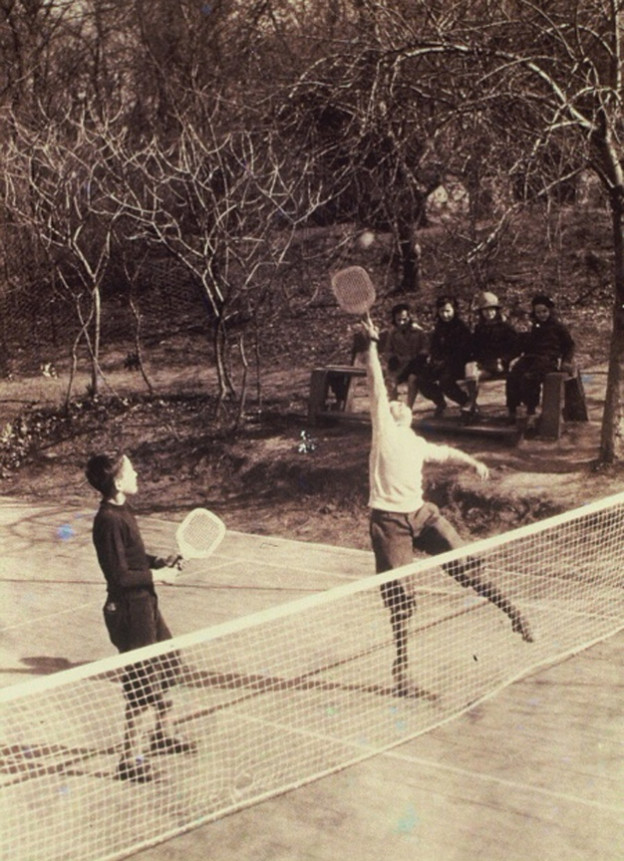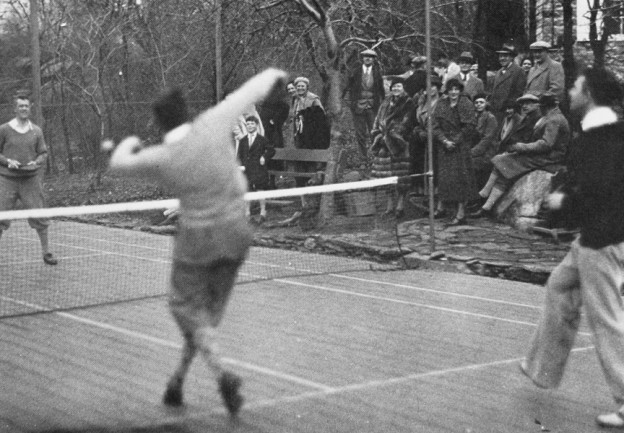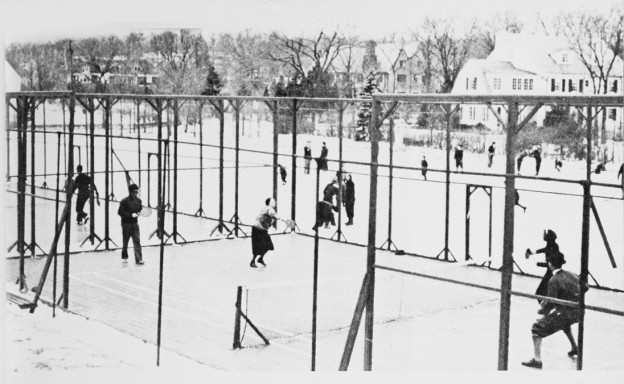
Winter activity at Fox Meadow in 1936 included paddle and ice-skating. Playing paddle are Fess Blanchard and his daughter Ruth (on the right) playing against Kitty Fuller and an unidentified partner.  

Old Army Athletes bring their spirit to Fox Meadow

With the completion of the first paddle court, the Old Army Athletes joined Fox Meadow almost en masse and transferred their camaraderie and sense of fun to the Club. They formed the core of the new Paddle Committee (Cogswell, Gatchell, Blanchard and W. C. Harrison) and posted a notice on the Club bulletin board explaining the game in simple terms.

Source: Adapted from Fessenden S. Blanchard, Platform Paddle Tennis, 1958, and Diana Reische, Fox Meadow Tennis Club – The First Hundred Years, 1983

The informal quality of the games stems from these beginnings and the influence of the Great Depression. As paddle drew more people on frigid days Blanchard, an enthusiastic skater, conceived the idea of flooding the unused tennis courts for ice-skating.

The unique ambience that still clings today to Fox Meadow evolved during winters of paddle and skating. It is captured in a frequently published photograph that first appeared in the Sunday New York Times in 1936. The picture shows a winter scene with ice skaters in the background and, in the foreground, a paddle match with Fess Blanchard and his daughter Ruth playing against Kitty Fuller and an unidentified partner.

Source: Adapted from Diana Reische, Fox Meadow Tennis Club – The First Hundred Years, 1983


First club court built at Fox Meadow Tennis Club in Scarsdale, NY

Of the twenty-five or more families comprising the Old Army Athletes (O.A.A.) in 1928, five were members of Fox Meadow Tennis Club and one of them had built their own court. They urged the club to put in a paddle court so Fox Meadow could become a year round sports rendezvous.

Source: Adapted from Fessenden S. Blanchard, Paddle Tennis, 1944

Expanding into an untried sport in the midst of a national economic depression was risky. Gradually worn down by the arguments of its O.A.A. members, the Board of Directors of the Fox Meadow Tennis Club had a meeting on April 15, 1931, to make a crucial decision. Should they or should they not put up a platform tennis court? They represented a tennis club and some of the avid tennis-playing members didn’t warm up a bit. Finally, a happy compromise was proposed on which the conservatives and the enthusiasts could agree. The club would put up a platform with a boarded end, marked suitably for practicing tennis strokes. It would also be marked for platform tennis with an easily removable net at the center.

On motion “duly made, seconded and carried [as the minutes of that meeting read] the Board authorized the construction of a Practice Tennis Court.” On November 1, 1931, the grand opening of the new platform, no longer called a “practice tennis court,” was featured by matches between teams from “both sides of the tracks.”

Source: Adapted from Fessenden S. Blanchard, Paddle Tennis, 1944, and Platform Paddle Tennis, 1958

Also see The game starts to catch on

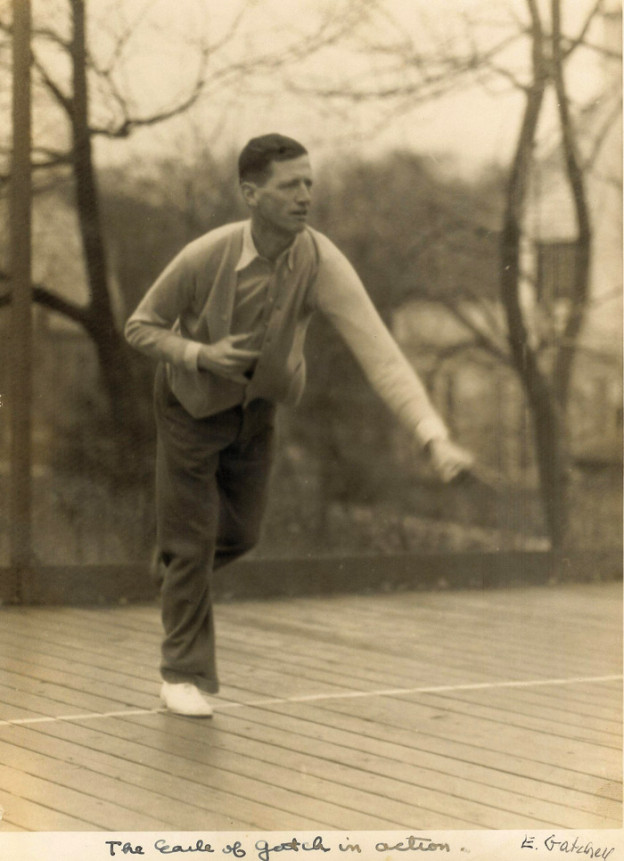
Earle Gatchell on first court.

Lighting the court to extend the game

Early on, lighting was added to courts so play could continue during short winter days.

Blanchard’s description of the first lighting system:

“The best procedure is to set up 4 individual poles made of pipe, 2 along each side of the platform at distances of 8 to 14 feet from each corner (opinions vary as to the better of these distances). The pipes should have reflectors at the top with either 750 or 1000 watt bulbs on each, raised about 20 feet above the surface and suspended over the platform on a short arm at the top of the pipe.

The lighting cost is not high and can be kept at a very low figure if you have a good amateur plumber and handy man among your friends.

Jimmy Cogswell put up the lights at his court and we only needed expert help on the electrical switchboard.”

Source: Fessenden S. Blanchard, Paddle Tennis, 1944

Court size and dimensions set

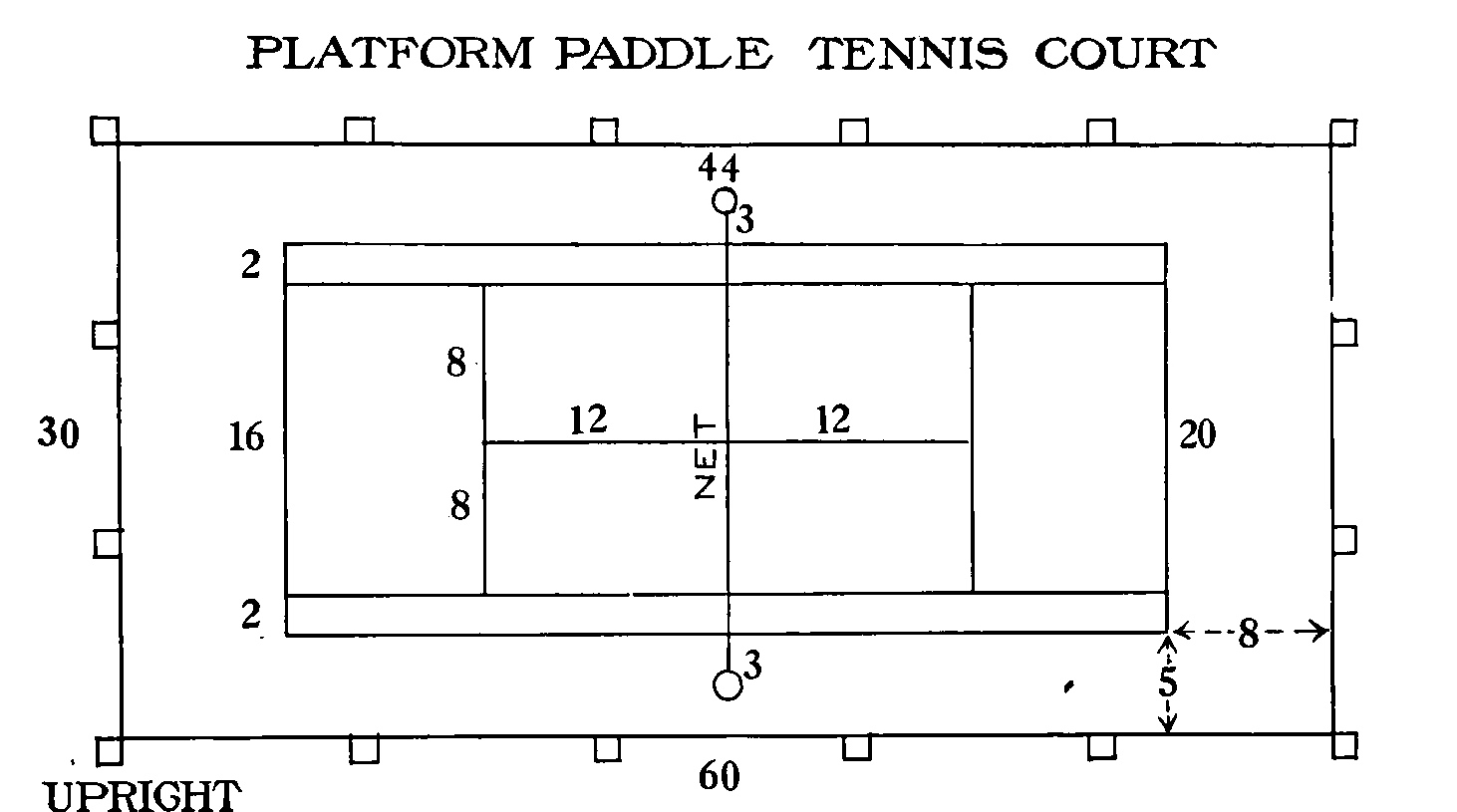
The dimensions from Cogswell’s original court, including service and single court measurements, have stood the test of time.

There have been a number of experiments at changing them, including an APTA sponsored experiment at Fox Meadow Tennis Club in 1956 where the court length was extended 2 feet on either end to 48 feet.

The platform size was increased to the present day dimensions of 60 x 30 feet in 1932 when Cogswell built a second court with a larger platform. This made the playing area one quarter the size prescribed for a tennis court.

Era 1 Early Years - 023 - Version 2 copy

Source: Adapted from Fessenden S. Blanchard, Platform Paddle Tennis, 1944.

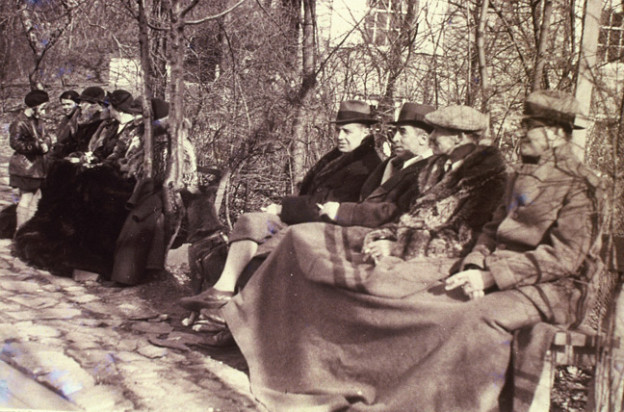
Old Army Athletes spectators at the Cogswell court, 1933.

Origin of Fox Meadow’s “Drop-Ins”

“From October to April, beginning in the winter of 1928-29, hardly a weekend or holiday went by without a gathering of the Old Army Athletes (O.A.A.). We often had a gallery of twenty-five or more men, women and children, most of them waiting their turn to play.”

This called for organization. One bench, erected under the supervision of the gang boss who had directed the platform project, Cogswell by name, was soon followed by two more. And in the nearby Cogswell cellar there began the accumulation of a collection of bear rugs, coonskin coats, and army blankets, many of them donated by members of the O.A.A. Jimmy and I would assume the job of trying to give everyone a chance to play, including ourselves, and we would attempt to arrange matches which would be as even as possible.”

Source: Adapted from Fessenden S. Blanchard, Platform Paddle Tennis, 1958

Horton Heath (left) and a friend practice at the original Cogswell court.

 Surviving The Great Depression

The Great Depression also influenced the formative years of paddle. Money was short, and even those who were not suffering were reluctant to spend it.

In paddle, gear was cheap, no particular clothes were needed, and a court could be built for as little as $400.

It was a perfect game for lean times.

Old Army Athletes spectators at the Cogswell court, 1933. The matches were followed by tea with Francesca (Teck) Cogswell in the Cogswell's living room.

Social aspect grows with the game

old-army-athletes

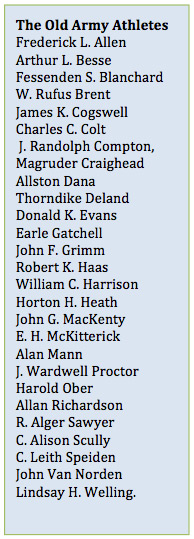
From the first game, Jimmy and Fess knew they were onto something promising. The court became a gathering place for their families and friends to socialize, play and fine-tune the game. The expanding circle of founders dubbed themselves the Old Army Athletes, for Old Army Road on which the Cogswell’s house stood.

During the winters of 1928, 1929, and 1930, the Old Army Athletes shaped the rules and character of platform tennis. They made it a family game, a sport that players of disparate abilities and ages could play together happily. This enthusiastic group of 25-30 families infused the game with the camaraderie and informality that has become its hallmark.

The Old Army Athletes even started a ”marital championship” with sixteen teams of husband-wife pairs only. There was a penalty of one point for each time a husband criticized the play of his wife, and vice versa. The judges had to listen carefully to detect any faint signs of sarcasm when sweet remarks seemed somewhat overdone.

Molly Blanchard Ware in a 1985 New York Times article recalled “Sagas were composed about the Titanic struggles on that Cogswell court. Pretty good sagas, as a matter of fact, because a Blanchard neighbor, Frederick Lewis Allen , author of Only Yesterday, a history of America in the 1920’s, was an ardent Old Army Athlete. Lives were changed and friendships cemented, because something new and fun and worth saving a weekend for had been invented.”

Source: Adapted from Fessenden S. Blanchard, Paddle Tennis, 1944, Fessenden S. Blanchard, Platform Paddle Tennis, 1959, Diana Reische, Fox Meadow Tennis Club – The First Hundred Years, 1983, and Platform Tennis – Back Where it all Began, New York Times, March 10, 1985

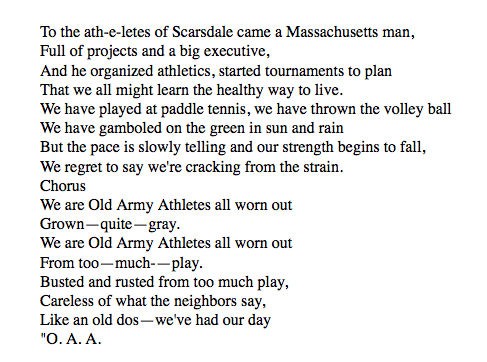
On December 28, 1929, there was a gathering of the Old Army Athletes at Alger Sawyer’s house in Scarsdale. Frederick Lewis Allen (Editor of Harper’s Magazine at the time) and his wife staggered in and serenaded the guests. The song they sang was to the tune of Kipling’s “Gentlemen Rankers:”

Screen shot 2013-01-22 at 12.16.09 AM

Source: Fessenden S. Blanchard, Platform Paddle Tennis, 1959

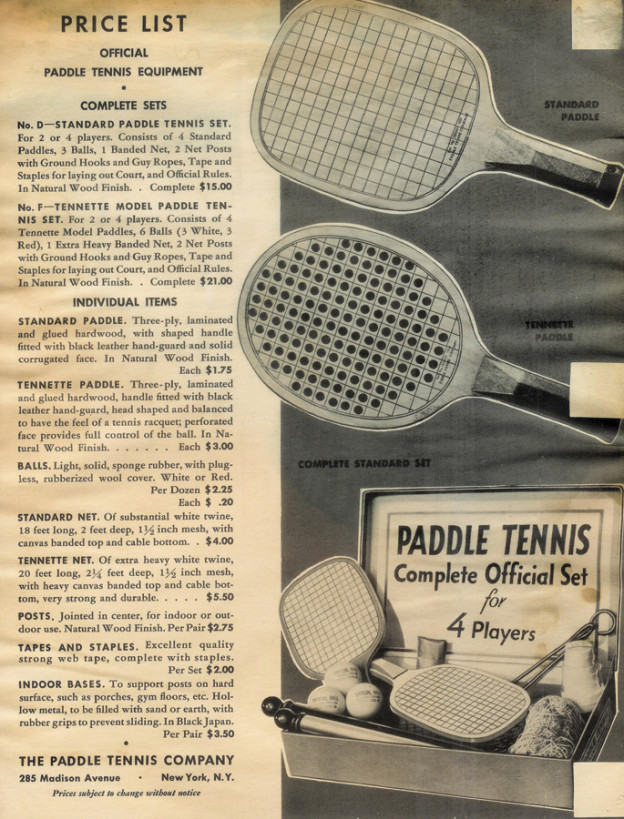
Price list for paddle tennis equipment, late 1930s

One-serve rule introduced

The net height was lowered and court dimensions altered from the original Paddle Tennis standards. These changes and the adoption of the one serve rule allowed for a nice balance of advantage between server and receiver.

The one serve rule was adopted at the beginning and has never been seriously challenged

A cold winter day in 1930. Earle Gatchell (left) and Fessenden S. Blanchard on the first platform tennis court.

The move from Paddle Tennis to Platform Paddle Tennis begins and the wires come into play with a “ground rule”

While deck tennis rings and badminton birds were easy to keep in bounds, paddle tennis balls were a challenge. To keep the balls from running down the surrounding landscape, the court needed back and side wiring. Before long two-inch mesh chicken wires were stapled to eight feet high upright two by fours that surrounded the court. Gradually the court was completely surrounded by wires. The screens rose to 12 feet by 1932 as play evolved.

Source: Adapted from Fessenden S. Blanchard, Paddle Tennis, 1944, and Platform Paddle Tennis, 1959

Blanchard and Cogswell soon decided that the badminton 44′ x 20′ measurements were much better than the 39′ x 18′ measurements used in the original form of paddle tennis. By using the outer lines of badminton doubles, only two feet separated each back line and the chicken wire. This didn’t give them enough room to swing their paddles.

This led to the decision, which in the opinion of all present-day players, has “made the game.” They decided to allow players to take the ball off the back or side wiring: that is, as it bounced off the wire after having first hit inside the proper court, and before it had hit the platform a second time.

They called this a “ground rule” after the ground rules in baseball that are special rules particular to each baseball park1&2

If the landscape had allowed the court to be lengthened, it would never have been discovered how much this new rule added to the fun of the game. The rule prolonged rallies and took the advantage away from the net players. Irregular bounces and balls sticking in the mesh plagued the early days. Reducing the mesh size to one-inch solved the ball sticking problem but eliminating irregular bounces had to wait until the development of the Evans backstop in 1934-35.

Source: Adapted from Fessenden S. Blanchard Paddle Tennis, 1944

Note 1: Some secondary sources cite the following incident recounted in Blanchard’s book Platform Paddle Tennis as the beginnings of what was called the “ground rule”. “And sometimes the balls stuck in the two-inch mesh, which we used at first. I remember once when that happened on our side of the net I ran around behind the back net and gave the ball a hefty swat. To everyone’s surprise it went over the net into the other court. My partner kept the ball in play until I got back and we finally won the point.”. This is incorrect as both Blanchard books explicitly state that the “ground rule” was adopted at the very beginning. He called this Lucky Incident Number 2. Lucky Incident Number 1 was the decision on the court sized based on the geographical constraints.

Note 2: At a presentation to Fox Meadow members in March of 1997, Molly Ware, Blanchard’s daughter, confirmed the apocryphal nature of the story. “As has often been reported, it is not true that my father dashed around the back and whacked a bail that was stuck in the screen across the net, shouting, ‘it’s in play.’ A terrific story, but sheer fiction.” She explained that the insufficient area from the baseline to the screen did not allow for a full back swing and created a condition where play off the screens became a necessity.