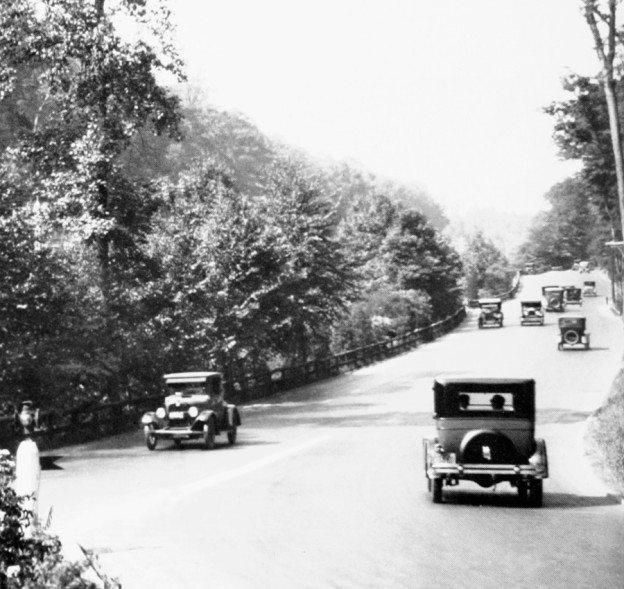
A spring day on the Bronx River Parkway in 1926

Post war boom brings change to Scarsdale life

The “war to end all wars” marked a clear dividing line in the tempo and style of Scarsdale life. A postwar building boom redrew the map of the community while land prices climbed sharply.

Automobiles began to displace carriages on the town’s dirt roads, although cars were still banned from Emily Butler’s 500-acre Fox Meadow estate. Visitors were free to stroll, ride horses, or drive carriages on her property, but cars—except those of house-guests—were prohibited on the estate grounds.

Even the Fox Meadow estate was shrinking, however, for Miss Butler began to sell and give away bits and pieces of her land. All around the Fox Meadow Tennis Club the sounds of construction could be heard, as roads, schools, and houses were built.

Miss Butler sold twenty-five acres between the Club and the Post Road to the Village for Scarsdale’s first public high school, which opened in 1919, and for the recreation area now known as Butler Field. The limited-access Bronx River Parkway—the first road of its kind in the world—opened to traffic in 1924, part of it on land donated by Emily Butler.

Source: Diana Reische, Fox Meadow Tennis Club – The First Hundred Years, 1983

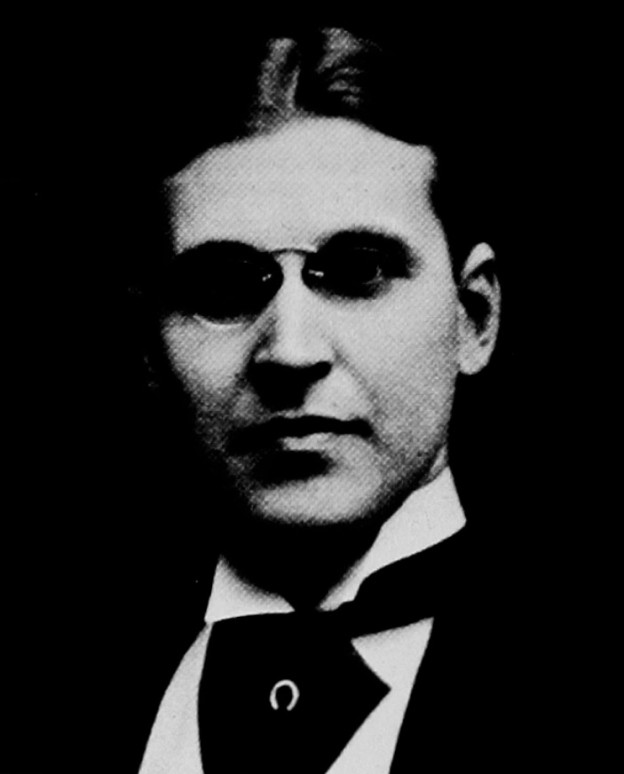
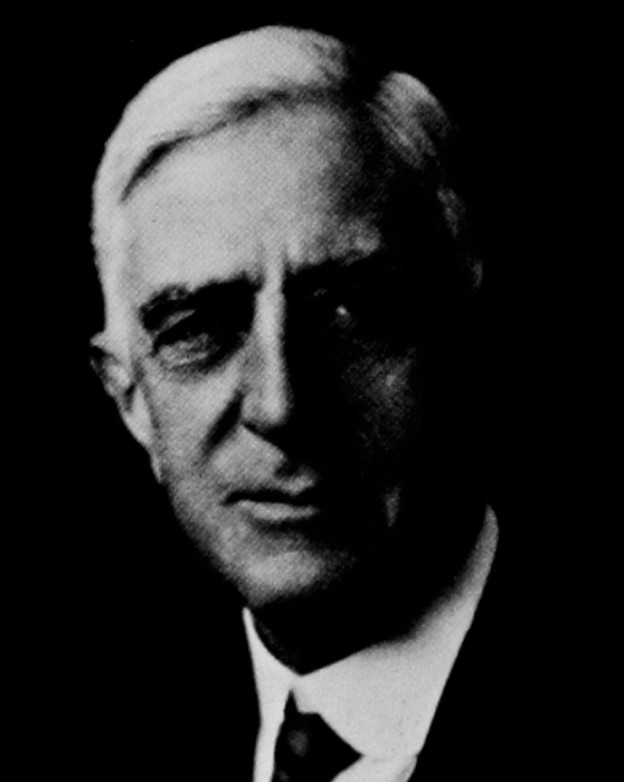
Frank O. Ayres. President, 1916-1919

Search for permanent home begins (1916-1922).

By 1916 a joint committee with members from both Fox Meadow Tennis Club and the Town Club had been formed to “prepare a financial plan for procuring a site for the Club.”

Within a year the Fox Meadow Board of Governors noted that the Butlers seemed willing to sell the Club three or four acres at Fox Meadow for approximately $4,000 an acre.

World War I interrupted efforts to buy a permanent home and reorganize the Club. Eleven members’ names were shifted to an Inactive Military List at no dues for the duration of the war.

In 1917 the Club held a tournament to benefit the Scarsdale Red Cross and sent off a check for $300 from the proceeds.

There do not seem to have been regular tournaments during this period for, in 1919, Rollin Kirby suggested that preparations be made for holding tournaments. Club President Frank Ayres favored junior tournaments and advocated allowing high school students to have limited use of the Club’s courts.

Before there was a clubhouse in which to store records, FMTC apparently did not keep a running list of tournament winners. Efforts to assemble a list have produced some discrepancies. Certain names, however, recur in newspaper accounts.

On July 8, 1922, the Scarsdale Inquirer, reporting on the Fox Meadow Men’s Singles, said that “the most noteworthy event…was the defeat of Rev. Alan R. Chalmers, who was on his way to being the Club’s perpetual and universal champion.” Chalmers was rector of St. James the Less and father of member Ruth Chalmers.

The year the reverend lost his title, Fox Meadow Tennis Club at last was able to buy itself a permanent home.

Source: Diana Reische, Fox Meadow Tennis Club – The First Hundred Years, 1983

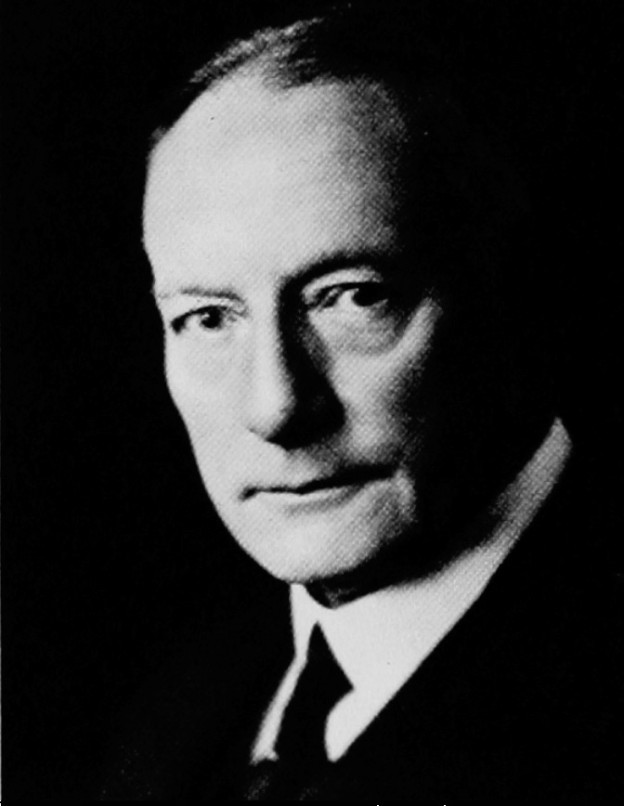
J Nelson Shreve. President, 1914-1915

Difficult financial times for the Club.

J. Nelson Shreve elected FMTC President (1914-1915); articles of incorporation filed, a portable clubhouse installed, purchase of Wayside Cottage considered

The period after 1913 appears to have been financially precarious, as neighboring clubs built and upgraded their facilities. The Scarsdale Golf Club built tennis courts in 1911, and in 1912 the County Tennis Club in Hartsdale constructed a clubhouse. Both events apparently lured some members and potential members from Fox Meadow.

The Club’s treasurer wrote endless letters dunning people for lapsed dues and asking payment for such items as tennis balls. (New balls were forty cents each, used balls twenty-five cents.) The Club’s treasury did not cover all costs, as is indicated by the following letter from Herbert B. Shronk concerning a $45 bill for trophies: “As the Club now has in its treasury only about $10, it will be necessary to make up the sum by subscription. I understand the necessary funds were pledged by Messrs. Ayres, Aspinwall, you [J. Nelson Shreve], and myself. …”

To offset a deficit in 1913, the Club raised dues for new members from $5 to $7.50 for individuals, and from $10 to $15 for families. [2014 Dues Notice] The increase was apparently too stiff, for dues were reduced in 1917.

The earliest surviving membership list, dated 1914, showed several names from the formative years, including Alex Crane, Hopeton Atterbury, and Miss E. Popham. New members included Frank Ayres, whose family would play an important role during the Club’s middle decades. Fox Meadow had forty-nine family members in 1915, with an additional forty-five individual members.

Groundskeeper Ira Jones worked a six-day week during the tennis season for $60 a month. In season, deliveries of ice and water arrived regularly at the Club, which as yet had no building other than a storage shed donated in 1902 by Hopeton Atterbury.

Hours available for play must have been extended around 1914, for the organist and musical director of the Church of St. Mary the Virgin wrote the following letter: “I desire to withdraw from the Fox Meadow Tennis Club as I do not approve of the Club courts’ being open on Sundays during the hours of Public Worship. Yours very truly, Walter Fleming.”

There were four committees in 1915: an Admissions Committee chaired by Vera Quaid Ayres, a Grounds Committee chaired by Hugh White, a Tournament Committee chaired by Pliny Williamson, and a House Committee chaired by Mrs. John Carstensen.

The Club took three major steps in 1915. It filed articles of incorporation, installed a portable clubhouse for $400, and launched a major drive to raise funds to buy a permanent home. [See also Letter to Membership seeking input on future development of the club] None of these ventures went off smoothly. In later years members of the Board of Governors referred to the Club as a non-incorporated entity, apparently because records were lost or memories faded.

During the same year, the board apparently hoped to buy Wayside Cottage and its adjoining land. Unfortunately, a gap of more than a year in the Club’s minutes makes it impossible to reconstruct exactly what transpired. Many decisions involving Fox Meadow Tennis Club were made at informal lunches in Manhattan clubs, so no official notes were taken.

The third step taken in 1915 was that Frederick L. Collins proposed a plan for “raising the remaining subscriptions for the Fox Meadow Club.” He called for a notice stating “that it has become necessary to give up the present club and to form a new one to be called the Fox Meadow Club, which will purchase and operate the Wayside Cottage property; that almost all the funds necessary for this purpose have already been subscribed.”

At least $4,000 had been pledged, but for unexplained reasons the effort to buy Wayside failed. Emily Butler ultimately gave the property to the Village for use by the Scarsdale Woman’s Club.

The little clubhouse bought in 1915 was another failure. In 1916 it was sold at a loss, evidently because the Butlers objected to the structure and insisted upon its removal. The Inquirer reported, “The cozy little weatherworn clubhouse of the Fox Meadow Tennis Club has been purchased by the Italian settlement workers at the Village, and it will be removed shortly to a site near Brook Street for use as a community house for the Italians of that vicinity.”

Source: Diana Reische, Fox Meadow Tennis Club – The First Hundred Years, 1983

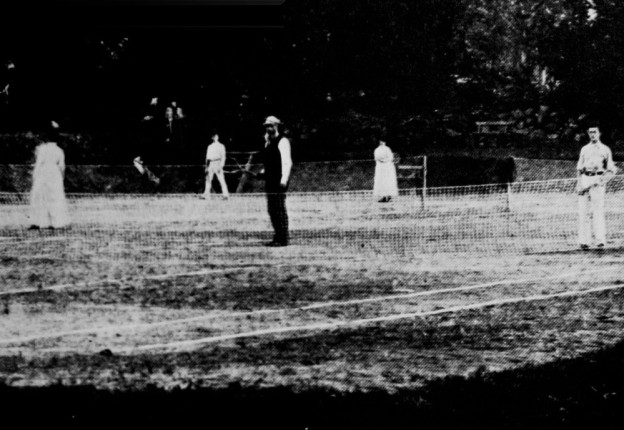
On the courts of the Scarsdale Tennis Club in the 1890s

Club moves from Butler estate in 1892 and changes its name to Fox Meadow Tennis Club

Around 1892 the Club moved close to its present location, to a site just off Church Lane on land then owned by the Pophams and loaned to the Club by Lewis Popham1. At the new location, members played on four dirt courts.

The Club changed its name to Fox Meadow Tennis Club about the time it shifted to the Popham land. However, even after the turn of the century, newspapers continued to refer to the Scarsdale Lawn Tennis Club.

In the Club’s first two decades, the community around it began to change appreciably. The trolley arrived with great fanfare on the Post Road in 1895; the town hired its first policeman in 1908; and the town’s first store, the Scarsdale Supply Company, opened for business in 1912.

Source: Diana Reische, Fox Meadow Tennis Club – The First Hundred Years,/em>, 1983

Note 1: Emily O. Butler, daughter of Charles Butler acquired the property in 1911 and leased it back to the club

Scarsdale neighbors found Platform (Paddle) Tennis

In the fall of 1928, Scarsdale, NY neighbors James (Jimmy) Cogswell and Fessenden (Fess) Blanchard were on a hunt for an outdoors winter sport close to home. This led them to build a multi-purpose wooden platform on a small strip of land on Cogswell’s property for deck tennis, badminton or volleyball. The size and shape of that strip of land had a significant effect on the whole future of Platform Paddle Tennis.

The job was completed by the end of November 1928. The result was a 48′ x 20′ green platform marked out for both badminton and deck tennis. The landscape proved a challenge. The platform couldn’t be wider than 20 feet without raising it over a rock. The ground fell off so sharply at 48 feet in length that a major operation would be required to increase it. Volleyball was no longer an option.

They quickly realized that the unsheltered spot also was not ideal for badminton, so the platform was largely used for deck tennis.

Source: Adapted from Fessenden S. Blanchard Paddle Tennis, 1944

Historical Factoid: Henry B. Eaton, an executive with a lumber business in NYC and a friend of Blanchard and Cogswell, was helpful in supplying material for the first court and was instrumental in getting his company to support the building of many of the early courts, including the first non-privately owned court in 1931 (Fox Meadow). Eaton was President of Fox Meadow Tennis Club in 1936. His wife, Jean Eaton, was the winner of the Women’s Doubles and Singles Nationals in 1935 (the inaugural tournaments) and the Women’s Doubles in 1936. See also – Portables Deck and Gates Sports Platform Company

Source: Joan Eaton Mauk, daughter of the Eatons

Thomas F. Burgess. First President of the Scarsdale Lawn Tennis Club, 1883-1884

Scarsdale Lawn Tennis Club established (1883). Thomas F. Burgess elected first President (1883-1884)

1883 was a time when America was feeling its industrial might, and when inventions and technical advances followed one another with breathtaking regularity. Chester Arthur, of the fluffy sideburns and Prince Albert waistcoats, occupied the White House, while Grover Cleveland was the governor in Albany. Down in New York City, that engineering marvel, the Brooklyn Bridge, opened with a full day of celebrations and fireworks.

Scarsdale, however, was still a rather somnolent country town of not many more than 600 residents. There was, as yet, no village center, no store, no high school, no police. Yet sprinkled throughout the rolling landscape could be found the manicured country estates of a growing number of wealthy families with the leisure to seek out new pastimes.

In 1883, about a dozen college-age men from these landed families decided to form a club for lawn tennis, a new game being played in Newport, Rhode Island. Modern tennis had been invented in 1873, just ten years earlier.

The Scarsdale Lawn Tennis Club, formed by those dozen young men, was the first tennis club in Westchester County and one of the earliest in the nation.

First officers were twenty-year-old Thomas Burgess, president; Cortlandt Fish, secretary; and James Bleecker, treasurer. Also in the founding group were Charles Fleming and “the six Butler boys, including Allan, Grenville, and Frank.”

In its first year, membership totaled about twenty young men who played on two courts at “Fair View,” home of a Mr. Hamilton. When membership was opened to women the second year, total enrollment rose to about thirty.

Source: Diana Reische, Fox Meadow Tennis Club – The First Hundred Years, 1983

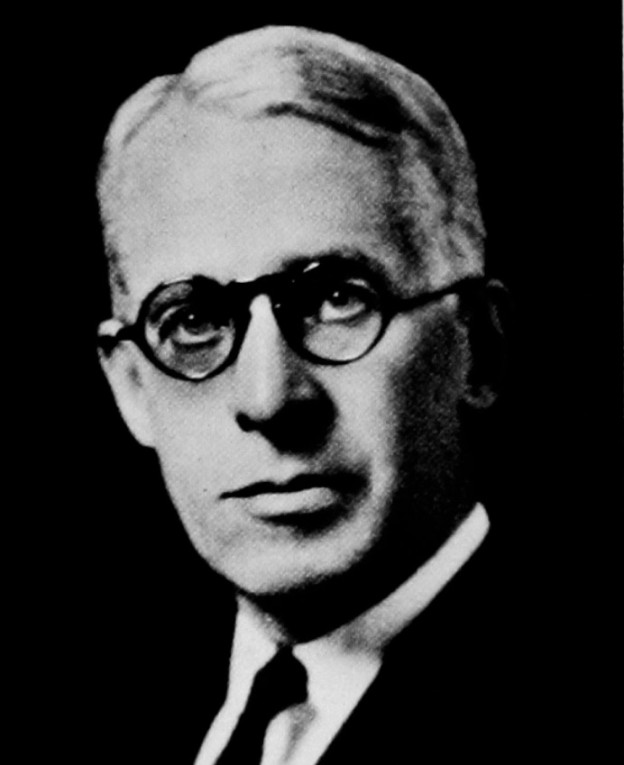
Alexander M. Crane. Third President of the Club in 1903, 1904 and 1906 and son of Alexander B Crane, distinguished Scarsdale landowner

Club records sparse between 1886 and 1913. Alexander M. Crane elected FMTC President (1903-1904 & 1906)

Information about the Club is sparse between 1886 and 1913, when a new regime of record-keepers and minutes-takers took charge.

There are some tantalizing fragments of information, however. Women were not only members before the 1913 reorganization; they also served on the Board of Governors, and one woman was president of the Club for at least two years, 1907 and 1909.

Her election was described in a 1907 Scarsdale Inquirer:

“Owing to an oversight, we have omitted any account of the annual meeting of the Scarsdale Lawn Tennis Club, which took place on the third Thursday of April, at the residence of Colonel Crane. Mr. Alexander M. Crane, the president, directed the meeting. The following officers were elected:

President, Miss Hopeton Drake Atterbury; vice-president, Rupert W. K. Anderson; secretary, Harry Van Cortlandt Fish; treasurer, Robert Campbell Winmill; governing committee, Alexander M. Crane, Miss Isabel F. Atterbury, Rev. L. R. Schuyler, Charles C. D. Gott, John H. Hyatt.”

Source: Diana Reische, Fox Meadow Tennis Club – The First Hundred Years, 1983

SI May 5 1904
Scarsdale Inquirer May 5, 1904

Fessenden S. Blanchard (left) and James K. Cogswell

The Founders

As innovators of a new sport, the duo made a balanced team.

Jimmy Cogswell was a trained engineer with a job in sales. “He was fascinated with the question of how to build the court, the technical side of it,” said his daughter, Do Cogswell Deland.

By contrast, Fess Blanchard “was so un-mechanical he couldn’t change a light bulb,” according to his daughter Molly Ware. He was the game’s pied piper, publicist, and chief promoter.

These complementary skills provided a great impetus to the development of the game.

The biggest stroke of luck was that these displaced Bostonians had ended up being neighbors in the first place. Blanchard had moved to New York to pursue a textile career in New York City, but Cogswell had set his sights on using his engineering training in a mining career in Canada. Fortunately, his wife would have none of that and he re-invented himself as a textile salesman. He moved his family to Scarsdale where Blanchard was his back-yard neighbor and was employed in the same industry.

Blanchard and Cogswell were among the first inductees into the Platform Tennis Hall of Fame in 1965

Blanchard promoted the sport in countless articles and letters in the 1930s and ‘40s. He did radio interviews and published the first book about the sport in 1944.

Both Blanchard and Cogswell had a keen sense of fun, according to Do Deland. Molly Ware agreed, “One thing they had in common was their enthusiasm. They were like kids, never blasé. Neither of them minded being thought an idiot.”

 Source: Diana Reische, Fox Meadow Tennis Club – The First Hundred Years, 1983

Fox Meadow Gardens on the estate of Charles Butler – the early site of the Scarsdale Tennis Club

Club moves to Fox Meadow estate of Charles Butler around 1885. Allen M. Butler elected SLTC President (1885-1886)

Perhaps to accommodate the additional numbers, the Club shifted to the Fox Meadow estate of Charles Butler, great-uncle of “the Butler boys.” At the time, he was still enlarging his landholdings. In 1887 he owned 358 acres; by 1899, his only surviving child and heir, Emily O. Butler, owned 491 acres stretching from Wayside Lane to Fenimore Road and from Tompkins Road to the Bronx River.

On four grass courts near the Butler mansion, members of the tennis club played two tournaments in 1885, a Ladies’ Singles and a Mixed Doubles.

A year later membership had grown to forty-four, and two more grass courts were added.

J. Thomas Scharf’s massive History of Westchester County described the three-year-old tennis club as the “only organization of a peculiarly social nature” in Scarsdale, and said it “now forms a prominent feature in the social life of the town.” [see excerpt below]

Annual dues in the new club were $1 in 1886, with an initiation fee of $2. Bylaws permitted members to bring guests and imposed a fine of not less than twenty-five cents for “failure to wear tennis shoes while on the courts.”

Source: Diana Reische, Fox Meadow Tennis Club – The First Hundred Years, 1983
Screen Shot 2014-01-02 at 10.18.10 AM

Hopeton D. Atterbury. First woman President of the Club, 1907, 1909

First women President. Hopeton D. Atterbury elected FMTC President (1907,1909); Club has strong family tradition.

Hopeton Atterbury’s connections illustrate both the family nature of Fox Meadow Tennis Club and the continuity of many family ties with the organization.

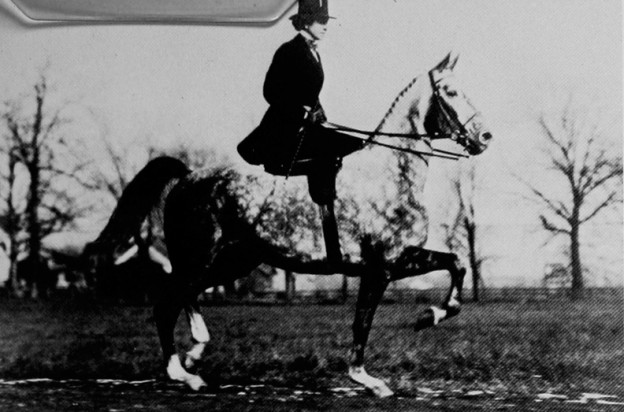
The Club’s only woman president (1907-1909) to date1 was one of seven Atterbury daughters at “Woodlands,” a twenty-five-acre estate off the Baraud extension of Drake Road just over the New Rochelle border. A niece recalls her as a champion horsewoman and a commanding presence.

Hopeton Atterbury married Club member William Quaid, one of Theodore Roosevelt’s Rough Riders in the Spanish-American War, and both remained active members of Fox Meadow.

Quaid’s sister Vera married Francis (Frank) Ayres, a president of the Club from 1916 to 1919.

Hopeton Atterbury’s sister Isabel was the mother of member Anne Sanford.

Source: Diana Reische, Fox Meadow Tennis Club – The First Hundred Years, 1983
NOTE 1: Since Diana Reische wrote the book three other women have served as president, Barbara Wood (1989-1991), Sally D. Rogers (1998-2000), and Catherine C. Souther (2008-2010)