



The “pro-circuit” had made those who could not compete feeling left out. The ‘B’ events were designed to address this issue.
APTA Forms Men’s and Women’s Players’ Committee
As the game expanded and the APTA added more and more tournaments, they recognized the need to establish more direct communication with players. The Player’s Committees served as forums to discuss issues of concern to players, such as equipment and tournament regulations.
The Committees liaised with the Tournament Committees and the APTA Board (John Mangan was the first head of the Men’s Player’s committee and had to deal with his old partner, Bob Kingsbury, on the APTA Board; they got along so well they never had a meeting!).
Source: Paddle Talk, No. 2. Personal communication from Robert R. Kingsbury.
The American Professional Platform Tennis Teaching Association formed
Formed in the fall, the Association had the objective of establishing standards for playing and teaching.
Founding members were: Doug Russell, John Brownlow, Bob Callaway, Peter Chase, Hank Irvine, Dave Jennings, Craig Mielke, Steve Nycum, Chuck Saacke, Robin White and Joan Silbersher.
The Paddle Tennis Center in Norwalk, Connecticut held the first training and certification session on the weekend of October 25 and 26.
Source: Paddle Talk, No.2
Dr Pepper Junior Development Program
The Dr Pepper Junior Development Program consisted of two aspects: educational, which covered the Exhibition-Clinic program and the printing of 10,000 rules booklets, and the tournaments. Dr Pepper sponsored the two-part program for the 1975-76 season to the tune of $50,000.
This funding was to be spent on mounting the Exhibition-Clinics, providing prizes at the tournaments, and advertising and promotional materials. At the tournaments, Dr Pepper would provide prizes, supply sweatshirts and travel bags, and have coolers with refreshments at each court location. A representative of the Company would present the winners of each tournament with a check for the cost of their transportation to the 1976 Nationals. Miss Teen New Jersey would present the prizes at the Nationals.
Jim Gollhofer, New York Metro Manager for the Dr Pepper Company, commented that the program offered the Company “the opportunity to work with youth on a semi-National basis” and that the Company was pleased to be involved with “a good sport – prestigious but with broad appeal.”
Source: Paddle Talk, No.2
APTA Annual Meeting focuses on sponsorship challenges
The University Club hosted the meeting on October 27th with close to 200 in attendance.
In a summary of the year’s developments, President Mike North stressed that transition was taking place, both in the internal organization of the APTA, and in its relationships with other organizations. Platform tennis was transitioning from game to sport to business. The responsibility of the APTA was be to ensure that the organization could handle the transition smoothly, while protecting the traditions, the essential character of the game, and the informal quality which made it attractive to players in the first place.
The highlight of the proceedings was APTA Chairman of Commercial Development Bob Kingsbury’s presentation of the relationship between the APTA and Coca-Cola Bottling Company of New York. From an Igloo Cooler, he pulled product after product, from Tribuno Vermouth, through Rumbles cocktail mixes, to Dr Pepper and other sodas, to demonstrate the wide variety of products distributed and marketed by the company. He showed that one more product was to be added to this list—paddle tennis.
Mr. Kingsbury described the development of the relationship and welcomed members of CCBNY and the Jack Cantwell Agency to the meeting. He concluded by introducing Mr. Bill Sullivan, Executive Vice President of CCBNY, who acted as the company’s representative since Mr. Millard was unable to attend. Sullivan expressed the pleasure of the company at their involvement both with the sport of paddle tennis, and with the people in the game. He said that the aims of the company were to help platform tennis grow in popularity as well as developing a long-term relationship with the APTA.
Source: Paddle Talk, No.2
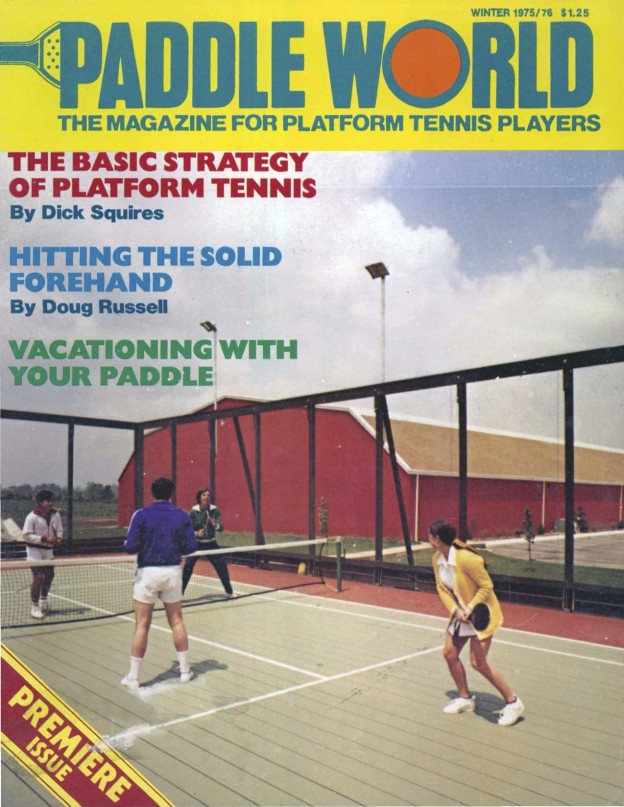
APTA announces tie in with Eastern Tennis Magazine
In November, Tennis Trade started a new publication, Paddle World, devoted entirely to platform tennis. All APTA members received one year’s free subscription.
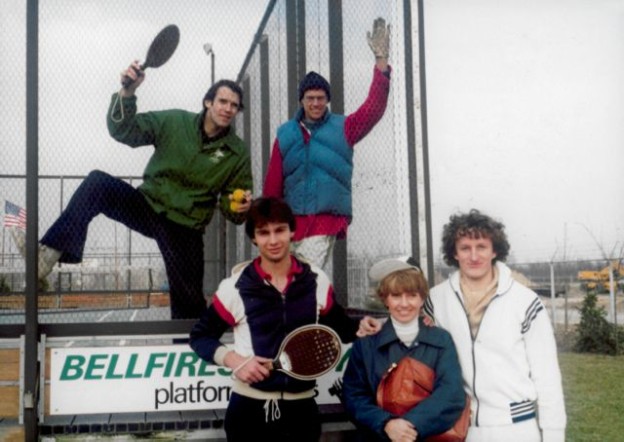
Paddle hits Holland with Gloria Dillenbeck’s help
The spring edition of Paddle Talk carried this story.
“If the Dutch haven’t heard of platform tennis yet, then they soon will, or so at least hopes Cees Cuppens of Bellfires BV in Holland. Recently he visited the U.S.A. and met with Gloria Dillenbeck of the APTA to discuss his plans for marketing courts in Europe. The Dutch are already tennis-mad, inspired by the success of their national tennis heroes, Betty Stove and Tom Okker. And the tennis twosome just happened to be paddle freaks, too.
Bellfires BV makes fireplaces, but recently decided to expand the business. They have chosen to go into the leisure industry, ironically one of the few areas that have benefited from current adverse economic conditions. The path that has led Mr. Nico de Wal, President of Bellfires, and Cees Cuppens to see the potential of platform tennis was determined by conditions specific to a tiny country inhabited by 15 million people. Cuppens explains that the shortage of land in Holland is so severe that each community boasts a recreation director, whose job is solely to determine how recreational land can be used in the most productive way. There are, for instance, no golf courses at all in Holland. Bellfires are convinced platform tennis must catch on with both the powers that be and the population once they learn about a sport that gives so much enjoyment and takes such a small space. Indeed, Cuppens has already attracted support and interest in his preliminary discussions with Dutch municipalities.”
Source: Paddle Talk, No. 1
Executive Director Gloria Dillenbeck recalled the event:
“One day a gentleman from Holland called the APTA office to ask me about our game. He wanted to visit the US to see the game played and to talk to a court builder. As it happened we had readied a court for play at Forest Hills next to the stadium for a televised exhibition. He flew over to see that match which was umpired by Howard Cosell. Half way through the match a strong gust of air blew Cosell’s toupe off his head and floated slowly to the platform deck. The crowd fell silent. I was ‘on air’ commenting for TV and was dumb-struck but Howard never lost his cool and play went on. After watching the match Nico de Wal agreed to build two courts and he invited me to bring sixteen ranking players to Eindhoven to stay for a week as guests of Bellfires and introduce some of the top tennis players in Holland to the game.”
At the end of the week Gloria knew enough Dutch to thank everyone for their hospitality at the closing dinner celebrations.
Source: Gloria Dillenbeck Dodd, Hall of Fame remarks after receiving her award
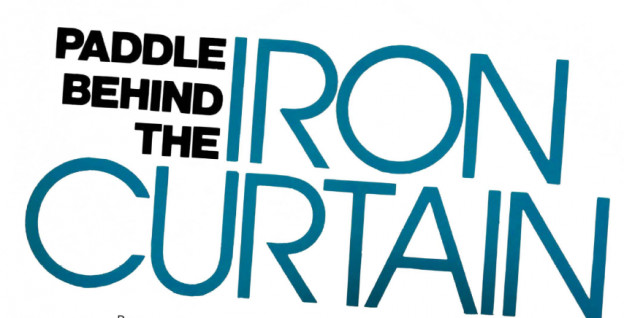
Moscow thrashes Warsaw. Ambassador Walter Stoessel, Jr. brings the game behind the Iron Curtain
Ambassador Walter Stoessel, a keen player and lover of the game, had introduced platform tennis to both Moscow and Warsaw, and had courts built in both capitals.
The Warsaw Chapter of the APTA sent the association a report on an inter-embassy tournament played on April 26 and 27 between them and a team from Moscow that included Stoessel, the American Ambassador in Moscow.
The Moscow Chapter claimed the title of Champions of the Eastern Hemisphere based on their triumph in the tournament, in which they won eight of the contests.
Source: Paddle Talk, No. 1

Paddle World Vol. 1 No. 2 Mid-Winter 1976
APTA allows on-grade court construction
In recognition of the growth of interest in on-grade courts in warm-weather areas, the Board confirmed that a court need not be built on a platform to meet APTA specifications.
Paddle innovations drive APTA to revise specifications for number of holes allowed in paddles; balls also required to meet APTA specs.
The APTA Board accepted the Equipment Committee’s recommendations to update the standards at their June meeting.
Only balls and paddles certified by the Equipment Committee as meeting these specifications could be used in sanctioned or ranking tournaments. However, it was now not necessary for balls and paddles to be formally “APTA Approved”; this designation was awarded to equipment at a later date.
The rapid growth of the game the high expectation for its continued expansion had encouraged a number manufactures to produce paddles and this drove innovation. This innovation forced a change in the APTA paddle specifications, specifically with respect to the number of holes allowed. Up to late 1974 the had been a requirement that the paddle should have 63 holes with a tolerance of 52-74. the developments of the Play-morTM paddle which used an aluminum honeycomb core and had just 4 holes and the Marc II paddle by Marcraft which had 87 holes in 1974-1975 forced the APTA’s hand and paddles now could have “a maximum” of 87 holes.
NOTE: For the history of the paddle from the early days through early 1990s: Jim Tate’s article The Paddle Itself has a History Too!
[See APTA Official Rules for 1974 and 1975 for specific changes]


 © 2026 Platform Tennis Museum and Hall of Fame Foundation, All Rights Reserved.