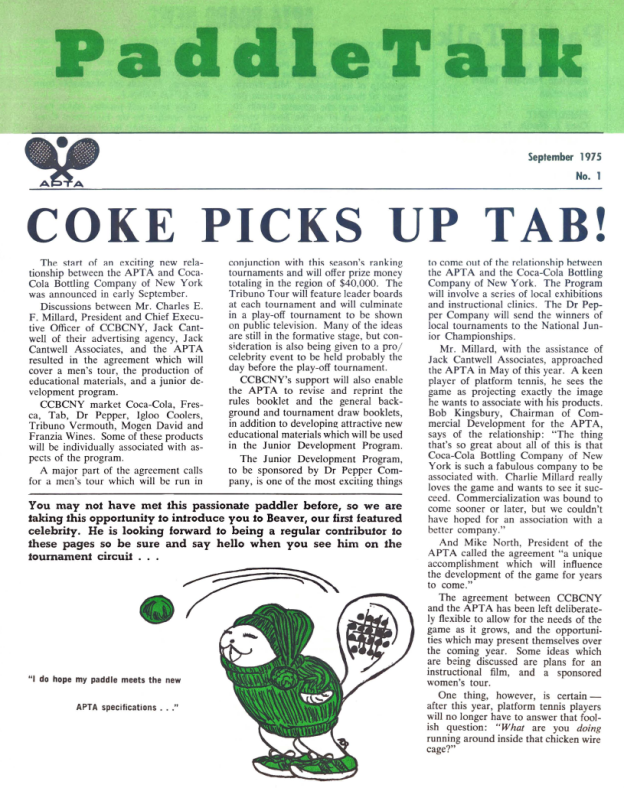
Coke picks up the tab, and why? The sport is growing fast and has more than 200,000 players

In early September, the APTA and Coca-Cola Bottling Company of New York announced the start of an exciting new relationship.

Discussions between Mr. Charles E. F. Millard, President and Chief Executive Officer of CCBCNY, Jack Cantwell of their advertising agency, Jack Cantwell Associates, and the APTA resulted in the agreement that covered a men’s tour, the production of educational materials, and a junior development program.

Millard was a keen player and loved the game.

Source: Paddle Talk, No. 1

John P. Ware (1921-1999)

John P. Ware elected FMTC President (1975-1977).Paddle courts changed to all aluminum

John Ware (1921-1999) was born in Chestnut Hill, MA and was a graduate of the Brooks School and Princeton University. He served as a first lieutenant in World War II as well as in the Korean War where he received the Bronze Star.

Before his retirement in 1987, he was director of industrial sales and professional development at John Wiley & Sons, publishers, and served on the national committee of the American Society for Training and Development

The wooded paddle courts were always difficult to maintain and the club began experimenting with an aluminum deck in the early 1970s. After some trial usage, and with the Board anguishing over the cost, the decision was made during Ware’s term to convert all the courts to all-aluminum. The new courts now had heaters under them to melt snow and ice and this extended the available playing time.

Ware served as APTA President from 1961-1963 where he was a great supporter of developing junior players. He was known as the game’s historian and was inducted into the APTA Hall of Fame in 1995

Cecil J. (Mike) North, Jr. Photograph taken at Fox Meadow in 1978 at a gathering of past APTA presidents.

Cecil J. (Mike) North, Jr. elected APTA President (1975-1977)

The North years led to the emergence of a meaningful Junior Development program; the beginnings of regional management, including an international region; the formation of the players’ committee; the upgrading of communications with the APTA membership; and the beginnings of solid financial based planning in APTA Board activities.

In the first issue of Paddle Talk in September, New President Cecil North Jr., expressed his views on the issues facing the APTA.

Source: Paddle Talk, No. 1

Wendy Chase teamed with Linda Wolf and took the tour by storm in 1975 and 1976

APTA moves election of Officers and Directors from fall to spring

APTA President Robert Brown explained the reasoning behind the change:

“The reason for this change is to place the officers who will be responsible for the affairs of the Association during the next season in their functions at an earlier date than in the past. This new management team will then have the spring, summer, and early fall to prepare for the coming season, and we feel that this will have real management benefits.”

Source: Off The Wire, Vol. 6 No. 3

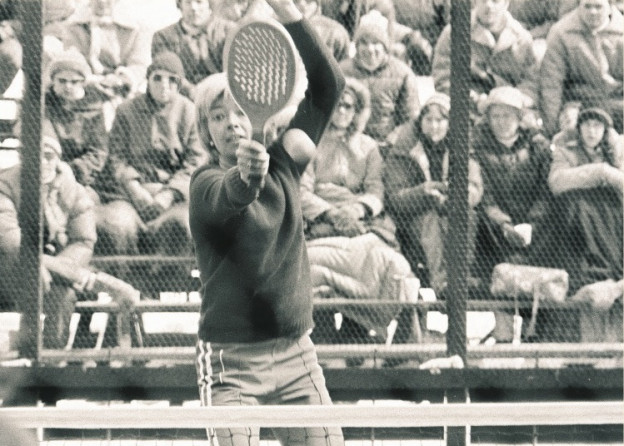
Bob Kingsbury in action at the 1975 Nationals at Fox Meadow

APTA initiates Life Membership

The APTA initiated a Life Membership for a fee of $100.

Buffy Briggs became the first Life Member by putting up her money on the very night the APTA created the new membership category.

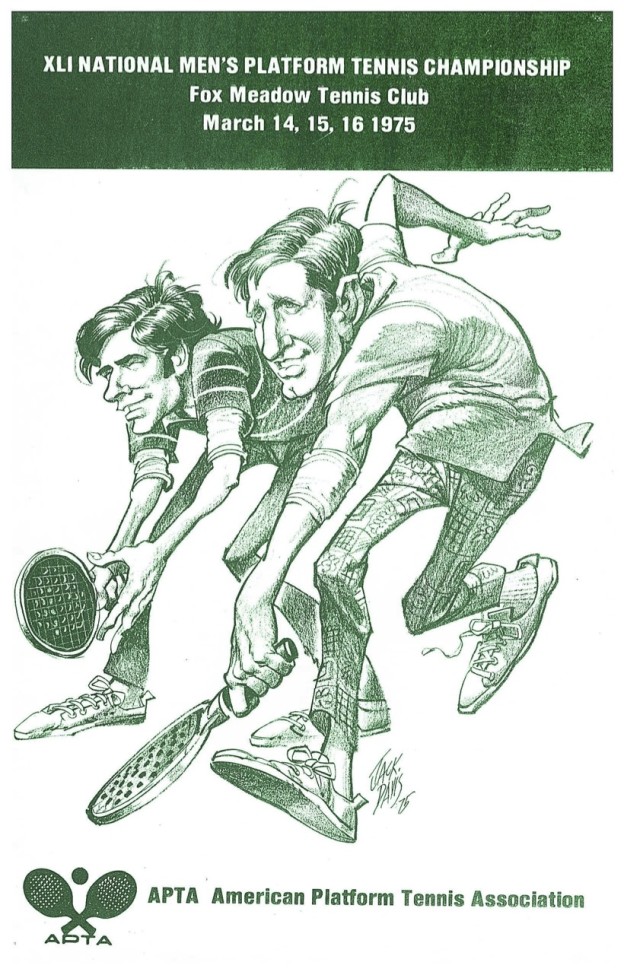
1975 Men's Nationals program

National Championships – Men’s finals were filmed

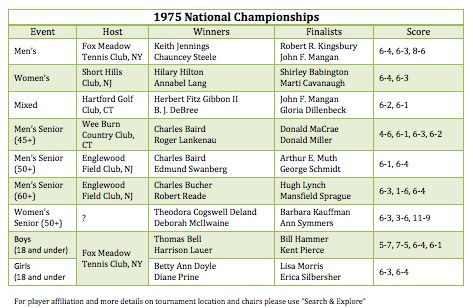
1975 - Rev1
1975

In the Men’s, the previous year’s finalists Jennings and Steele, emerged as the champions over two-time winners Kingsbury and Mangan.

In the Women’s, the California duo of Hilary Hilton and Annabel Lang, who excelled in paddle tennis, were imported to break the dominance of the East Coast and did just that.

In the Senior events, Chuck Baird and Ned Swanberg won their fourth straight 50+ title, establishing an unrivaled record. Baird and Lankenau won their second straight 45+ and Do Deland, daughter of the co-founder of the game Jimmy Cogswell, won the Women’s 50+ with Deborah McIlwaine.

Screen Shot 2013-11-11 at 2.26.08 PM

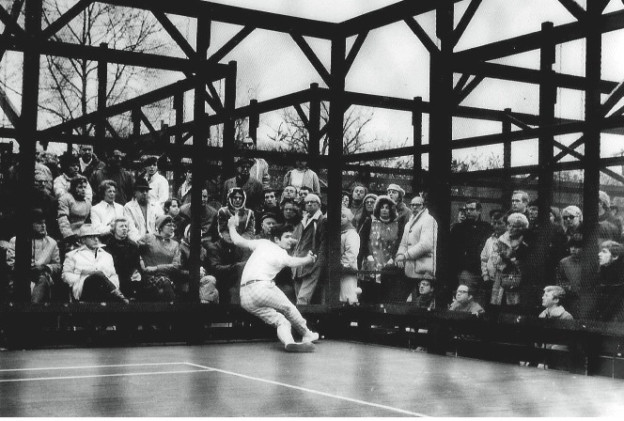
Spectators at Fox Meadow Tennis Club, Scarsdale, NY watching the final of the 1977 Men's Nationals

Men’s Nationals go under the Big Top

Handling the crowds at the Men’s Nationals created some challenges. With the growing popularity and spectator appeal of the game, the APTA decided to limit the crowds and defray tournament expenses by charging admission into the Fox Meadow grounds. Also, for the 1975 event, Fox Meadow Tennis Club planned to install a large tent in the parking lot, in order to provide creature comforts and food for spectators at the semis and finals.

There would be a general admission charge of $2 for adults and $1 for children. Super-fans could purchase a clubhouse pass, entitling them to lunch for $10. Under this new format only pass-holders, officials, semi-finalists and their wives would be permitted access to the clubhouse.

Source: Off The Wire, Vol. 6 No. 3

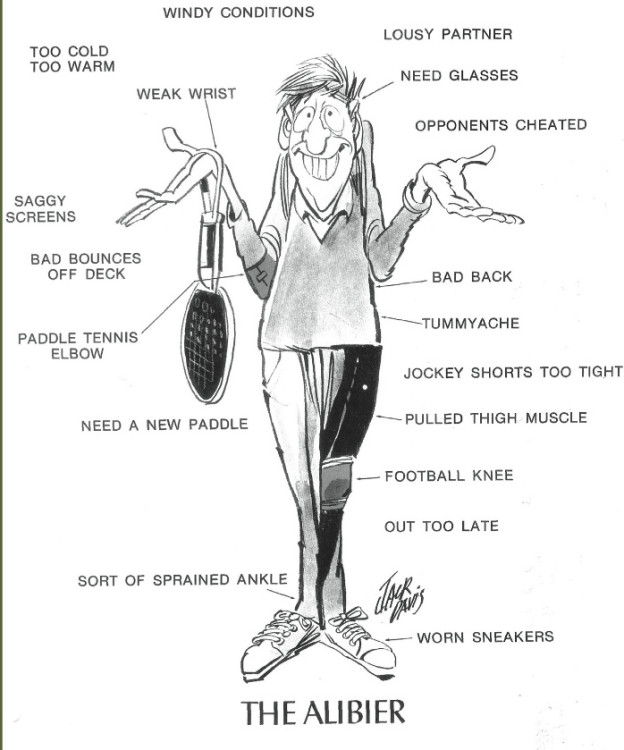
One of many Jack Davis paddle drawings

Jack Davis cartoons

Jack DavisJack Davis as BoyScreen Shot 2016-08-16 at 11.39.11 AM

Born in 1924, Jack Davis is one of the best-known American illustrators of the past fifty years. During his illustrious career, he created art for magazine covers, film posters, record jackets, advertisements, and books. Perhaps he is most admired for his work in MAD Magazine.

In the platform tennis world, he is famous for his zany drawings that feature outlandish characters on the court. During the 1970’s, he created twelve widely distributed platform tennis prints. A former Scarsdale resident, Davis played platform tennis socially at the Scarsdale Golf Club. Although he claims that he didn’t base his characters on anyone specific, it is hard not to identify with each of them.

The Society of Illustrators Hall of Fame inducted Davis in 2003.

Interesting factoid: Jack Davis had Fox Meadow Tennis Club member Karen Reuter (1943-2008) do quite a bit of coloring for his cartoons before they were reproduced