The first platform tennis tournament for cash – Mercedes-Benz Platform Tennis Classic

Held in Mid-November at Amelia Island Plantation, FL, the tournament consisted of eight of the top nine nationally-ranked teams. The winning team of Mangan and Kingsbury received $2,000, while the runners-up, Steele and Jennings, earned $500.

Highlights of the tournament were shown on the CBS show Sports Spectacular on Sunday February 23, 1975

Even though most of the players on the tour had full-time jobs outside of platform tennis, with the majority of them working in the finance industry, the prize money added another enticement to the game.

APTA Honor Award: Reilly

Richard J. Reilly, Jr. was a major force in developing the game through his innovations in court construction and his unwavering support for the game over many years.

Among his many improvements to court engineering was the pioneering of the aluminum deck in the early 1970s

Reilly’s contributions helped make the game what it is today and was a factor in expanding the reaches of the game across the U.S., as well as to Canada, France, Poland, Bulgaria, and Japan.

Committee on Commercialization

Foreseeing the likelihood of company-sponsored “tours,” a special Committee on Commercialization chaired by Mike North, was formed.,

By mid-1974, the APTA formally established its policy on commercial activities and decided to maintain control over all commercial tournament activities, as not doing so would have undoubtedly led to the establishment of a separate professional organization.

Bob Kingsbury was appointed director of commercial activities, while Gloria Dillenbeck, Executive Secretary, assisted him.

Umpires Committee established

Prompted by increasing concern about line calls and foot-faulting, APTA President Robert Brown formed a committee to advise and recommend steps to cope with these matters. The committee recommended the establishment of an Umpires Committee, whose function would be to post line judges to make out calls and any foot-fault calls.

The APTA concurred with the recommendation. Paul Malloy, Paul Sullivan and Brook Kindred, from Fox Meadow formed the nucleus, along with renowned tennis umpires Jack Stahr and Mike Dunne.

Change to rule for ball over the screen

Previously, when a ball went over the screen, the point had been played as a let. Under the new rule, approved by the APTA Board in September, the striker lost the point outright.

The Board intended to evaluate the rule over the coming season to see if it should be confirmed or discarded.

It was later confirmed.

APTA addresses foot-faults

In order to discourage foot-faults, the partner of the receiver was now empowered to call them against the server. This experimental rule was based on a Jack Stahr “Decisions” column from the July 1973 issue of World Tennis. The intent of the APTA was to evaluate the rule over the coming season to see if it should be confirmed or discarded.

The appropriate section of this ruling was as follows:

Question: “…who is entitled to call foot-faults?”

Ruling: ” …..simply call a few of those services ‘faults’ under a broad interpretation of the official Explanation under Rule 8, which says that ‘it is customary for the Receiver to determine whether the service is good or a fault.’ (If it is illegally delivered, it is a fault.) This might not be the most sociable thing to do, but consider the unsociable effect that legal servers experience upon seeing their opponents take unfair advantage of them. ”

The Official Rules of Platform Tennis published

First Platform Tennis Rule Book published

Bill Ballard spearheaded this initiative with assistance from Bob Brown.

Prior to the publication of this book the guidance on platform tennis rules simply stated: “The rules of platform tennis are the same as for tennis except for the one serve rule and play off the wires etc.” The new Rule Book provided a comprehensive review of all the rules and regulations governing play.

The book was so well received that the first printing run of 6,000 copies quickly disappeared, necessitating a second printing in 1975.

The rules allowed a let to be played if a ball hit the crossbar, the angular beam between the side screen and the back screen which were standard on courts at the time. Eagle-eyed umpires who spotted an apparent ambiguity on this position involving Rules 2, 13, and 19, were informed that the overriding ruling was to be found at 13 (d), to wit, if the ball hits a crossbar, play a let.

The Rule Book also indicated that the standards for holes in paddles might be waived, so if a paddle didn’t have between 52 and 74 holes, that didn’t necessarily, make it illegal.

Sources: Off The Wire, Vol. 6 No. 1 and No. 3, and Robert A. Brown, personal communication

APTA’s ball standards revised

The APTA reported that all four of the approved ball suppliers met the new, tougher standards and that they now had their own testing capability, so if any balls became sub-standard during the season they could be “unapproved.”

The new balls were lighter and less bouncy and a yellow ball was approved for night play.

The approved suppliers were Barr, Vittert, Beconta, Inc. (a division of Puma), and Marcraft.

The APTA set forth the new ball standards:

I. BOUNCE TEST FOR REBOUND
Balls are conditioned at 70 degrees for 24 hours, then dropped from
90 inches to a concrete slab, and the rebound is measured.

Standard Rebound: 40 inches; Acceptable Tolerance: 38″ to 42″

II. WEIGHT TEST
Standard Weight: 72.5 Grams; Acceptable Tolerance: 70 to 75 grams

III. DIAMETER TEST
Measure diameter along two perpendicular axes of the ball. Both
readings must be within tolerance.

Standard Diameter: 2 ½” inches; Acceptable Tolerance: 2 ½” – 2 19/32″

Source: Off The Wire, Vol. 6 No. 1<.small>

What’s in a name? Platform Tennis, Paddle Tennis are they the same?

In 1974, several letters to the editor of The New York Times surfaced about the name confusion between platform tennis and paddle tennis.

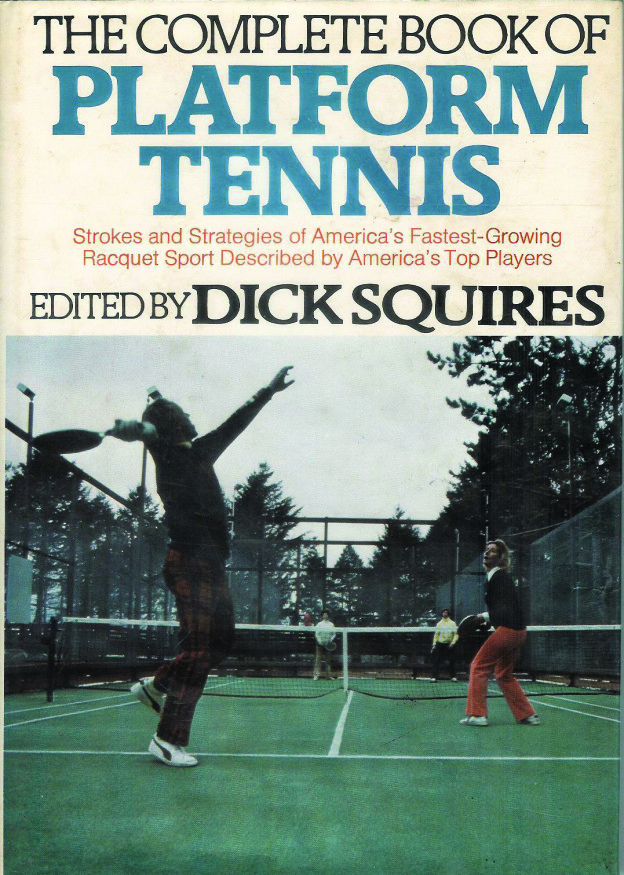
Burling Lowrey of Washington, D.C., and Dick Squires exchanged pecks as proponents for their respective games. The exchange, however, was broader in scope than just the name conflict.

The Mid-Summer edition of the APTA newsletter, Off The Wire, had this to say:

It is not the intent of the APTA to enter the crossfire, but simply to set the record straight for our readers who may have read one or both of the letters, because both gentlemen are guilty of errors of fact.

Mr. Lowrey referred to the invention of platform tennis by a “group of Scarsdale millionaires,” one of the standard forms of jabs at platform tennis’ supposed snobbishness. In fact, neither Blanchard nor Cogswell were millionaires. Far from attempting to foster an aura of snobbery, the APTA was doing more each year to balance the game.

Mr. Squires, in turn, stated, “the fault lies with the purist platform tennis players as well as the present officials of the APTA. They insist on calling platform tennis paddle tennis, but mainly out of habit rather than any insidious desire to obliterate paddle tennis.” As regards to the public, it is probably true that it will be a long time before typical platform tennis players can be swayed from the conversationally- easy “let’s go play some paddle.” Regarding the APTA, however, all possible stress has been placed on the correct term platform tennis. In responding to telephone calls and written inquiries, and in promotional efforts such as last December’s press luncheon, in interviews and in editing drafts of articles about the game, all APTA officers strive for factual accuracy. Unfortunately, we are not always given the opportunity to review every item about platform tennis, hence the perpetuation of the erroneous name. Some people have suggested that we call our game “screen tennis” or “wire tennis” or “rebound tennis” among other names. What do you think? If you have an opinion on the subject, let us hear from you.

Source: Off The Wire, Vol. 5, Mid-Summer 1974