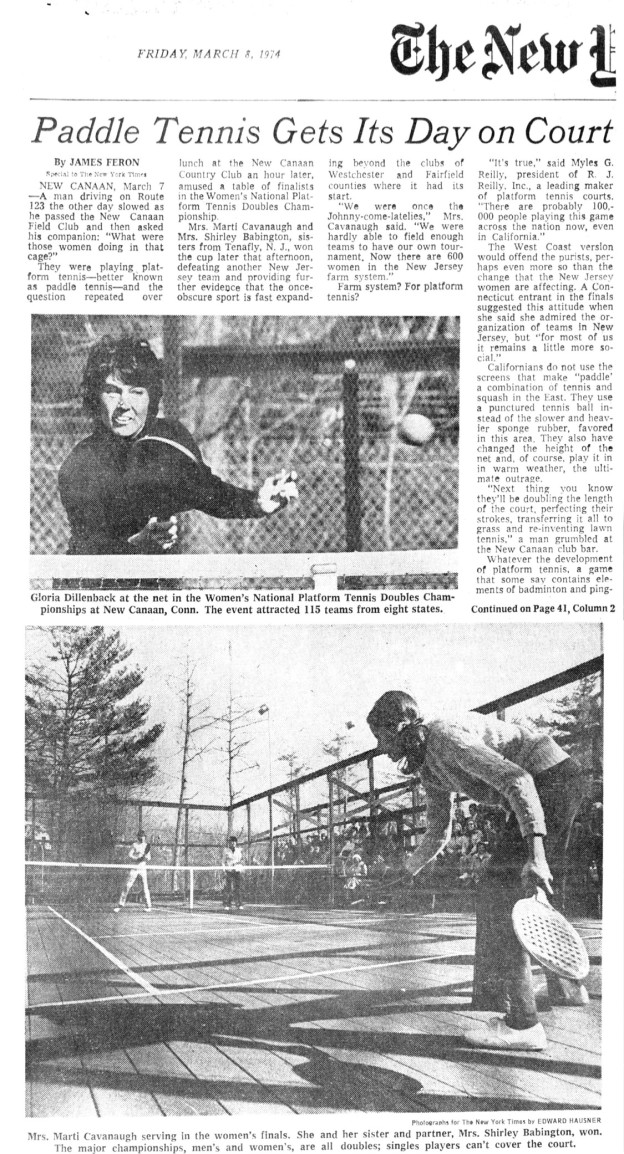
New York Times, March 1974

APTA hosts press party

The January/February edition of Off The Wire covered the event held at the Town Tennis Club in New York City. “Thirty-two card carrying reporters were invited to come and see how our game is supposed to be played. The better to understand that Platform Tennis is not ping-pong, is not paddleball, is not deck tennis. Allowing for no-shows, crashers, ancillary invitees, etc., a good time was had by 73 people. Bob Brown introduced the matches, the players, and the celebs, and set the stage for our audience.” Celebrities included Sid Wood, Chuck McKinley and Stan Smith.

Source: Off The Wire, Vol. 5 No. 2

The Battle of the Sexes

The tennis match between Billie Jean King and Bobby Riggs at the Houston Astrodome on September 20, 1973, captivated America and was a triumph for women’s athletics. Platform tennis benefitted with an increase in participation by women.

King entered the Astrodome in Cleopatra style, carried aloft in a chair held by four bare-chested muscle men dressed in the style of ancient slaves. Riggs followed in a rickshaw drawn by a bevy of scantily-clad models. Riggs presented King with a giant lollipop and she gave him a piglet named Larimore Hustle.

Rather than playing her own usual aggressive game, King mostly hugged the baseline, easily handling Riggs’s lobs and soft shots, making Riggs cover the entire court as she ran him from side to side, and beating him at his own defensive game. After quickly falling behind from the baseline, where he had intended to play, King forced Riggs to change to a serve-and-volley game. Even from the net, the result was the same: King defeated him, 6–4, 6–3, 6–3.

Source: Selena Roberts, A ray of progress for women as Battle of the Sexes turns 35, Sports Illustrated, 9/20/2008. Bobby Riggs Vs Billie Jean King, Assortment.com

Sponsorship draws talent

Corporate sponsorship ended up attracting several professional tennis players to the sport, with Herb S. Fitz Gibbon II, Clark Graebner, and Hank Irvine being the most successful.

Fitz Gibbon ranked among the world’s top tennis players between 1961 and 1973, and became the first amateur to beat a professional in the 1968 Wimbledon.

Graebner, originally from Cleveland, was on the winning U.S. Davis Cup team and ranked seventh in the world in 1968.

Irvine was from Rhodesia (now Zimbabwe) and represented his country on the Davis Cup team in 1968 and 1969, and at Wimbledon from 1970 to 1972. In 1970, he teamed with Helen Gourlay from Australia and made it to the semifinals of the Mixed at Wimbledon.

Commercial sponsorship

During the early 1970’s, commercial sponsorship came knocking, raising difficult policy questions for the APTA.

The exposure gained by commercial sponsorship would bring the sport to a much wider audience, but critics argued that money would detract from the game’s social aspects.

Foreseeing the likelihood of company-sponsored “tours,” the APTA formally established its policy on commercial activities and decided to maintain control over all commercial tournament activities.

This decision allowed platform tennis to broaden its horizon. The alternative would have undoubtedly led to the establishment of a separate professional organization.

The APTA gets serious about foot-faults

APTA reviews foot-fault rule

The rule was essentially the same as in tennis, but because of the shorter distance from baseline to net, and the higher premium on being at the net in paddle, foot-fault infractions were seen as more serious. The problem was two-fold: first, whether the statement of the rule itself should be revised; second, how to enforce the rule.

A seven-man working committee formed to cope with this rather controversial question. Chaired by Bob Brown, the committee consisted of Chuck Baird, John Beck, Brad Drowne, Bill Hoffmann, Paul Molloy, and Dick Squires.

In addition, the APTA called a 26-member Advisory Committee for the purpose of providing the broadest possible cross-section of views on this delicate matter.

The formation of the APTA’s Umpires Committee in 1974 was an outcome of the Working Committee’s deliberations.

Source: Off The Wire, Vol. 5 No 1

Tournament drawsheet and results

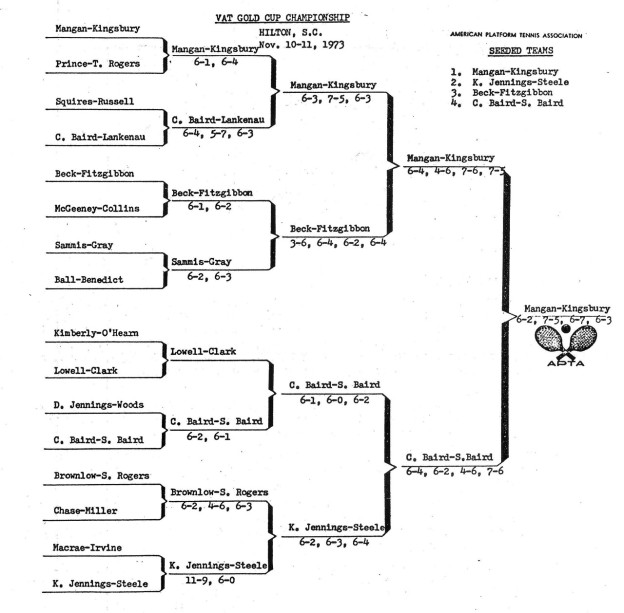
First APTA-sanctioned professional tournament – Vat Gold Cup International at Hilton Head – Kingsbury and Mangan win a thriller

Dick Squires organized the first truly commercial play-for-pay event. Sea Pines Plantation, in Hilton Head Island, SC, hosted the first Vat Gold Cup Invitational Tournament on November 10-11. It was also the first major platform tennis competition to be played in the Deep South.

The marketers of Vat 69 Gold, a brand of scotch whiskey, appreciated the demographic appeal of platform tennis enthusiasts. For the first time, top teams competed for money. The purse was $10,000, and “CBS Sports Spectacular” broadcasted highlights.

The New York Times covered the event in an article by Charles Friedman, entitled “And Now a Word for Platform Tennis” in the Sunday, November 18th edition.

For the event, the top sixteen men’s teams in the country were invited to participate. The offer included all-expense-paid travel, and the winners received a ten-day trip to Europe courtesy of National Distillers. Eleven of the top sixteen teams agreed to play, and Sea Pines built four courts just for the tournament. Bob Brown chaired the Championship match.

Although South Carolina can be warm during November, the weather cooperated. A cold front blanketed the area during the tournament, and the temperatures fell to as low as 35 degrees.

Bob Kingsbury and John Mangan won the tournament in an exciting four set final over Chip Baird and Steve Baird. Hundreds of spectators, many of whom were new to the sport, took in the final. The match has been described as one of the most thrilling ever, and Kingsbury and Mangan celebrated by being bathed in scotch.

The winning team received $3,000 for a trip to Europe.

Source: Off The Wire, Vol. 5 No. 1, and Charles Friedman, New York Times, November 18, 1973

APTA publishes “How to Conduct a Tournament Draw”

This booklet, authored by Robert A. Brown, included suggestions on the makeup of the draw committee; how to determine the byes and where to place them; how to seed and rank competitors; and how the seeds, and the other teams should be placed in the draw.

In the centerfold of the booklet, there was a sample draw that showed where each team would go. The procedure for conducting the draw was to be followed by all tournaments on the APTA Sanctioned Tournament Schedule.

Source: Off The Wire, Vol. 5 No 1

APTA develops policy on tournament sanctioning

The first issue of Off The Wire had the full Tournament Sanction Policy:

“The APTA has recently adopted a policy on Tournament Sanction, which is quoted in full as follows:

The purpose of sanctioning of platform tennis tournaments by the American Platform Tennis Association is to insure a high standard of quality covering all aspects of competitive platform tennis tournament play. Tournaments which are sanctioned will be included on the APTA ‘Sanctioned Tournaments’ schedule.

In order for a tournament to receive official sanction from the American Platform Tennis Association certain established standards and procedures must be agreed to in advance by the local tournament committee. Likewise, tournament play itself and post-tournament reporting must be carried out in accordance with established APTA standards. APTA reserves the right to withhold, or withdraw, sanction if established standards are not met. APTA may elect to charge a sanction fee. In requesting sanctioning, the local tournament committee commits itself to strict adherence to all requirements of sanctioning as detailed below.

1. The local tournament committee will submit, in writing, by July 1st, a request for tournament sanction to the APTA. This request will include name of tournament; name, address and phone number of sponsoring club or clubs; name, address and phone number of tournament chairman; requested dates and, if appropriate, alternate dates.

2. The APTA will notify the local tournament chairman of the approved dates. At the same time, APTA will request of the local tournament chairman written confirmation of the acceptance of the APTA’s sanctioning requirements. This written confirmation will be returned to APTA by the local tournament chairman by September 1st. When received, the APTA will include the tournament on the APTA Sanctioned Tournament Schedule, which is published about September 15th.

3. Prior to the beginning of each tournament season, the APTA will designate those sanctioned tournaments, which will be used for purposes of national rankings when publishing the schedule of sanctioned tournaments.

4. As a condition of sanctioning,
(a) the local tournament committee agrees to make use of courts, equipment and material which meet established APTA specifications or have APTA approval.
(b) the local tournament committee agrees to seed the tournament and conduct the draw in accordance with APTA regulations and procedures.
(c) the local tournament committee agrees to conduct the tournament in accordance with APTA regulations and procedures.
(d) the local tournament committee agrees to make no change in the established dates without further APTA approval.
(e) for those tournaments that are designated by the APTA to be used for national purposes,
(i) The APTA National Tournament Director will be invited to participate in the draw and he or his designated representative will attend,
(ii) the local tournament committee agrees to submit to the APTA a complete tournament draw showing results of the tournament within 2 weeks after completion of the tournament.

5. Except for national championship tournaments, the APTA does not exercise any control over the invitations. Invitations for sanctioned tournaments (other than national championships) will be extended and limited at the pleasure of the local tournament committee.

Sponsors of all tournaments requesting inclusion on the APTA Sanctioned Tournament schedule should take special note of the time schedule and other important provisions of the policy. A key condition on sanction is the conduct of the draw in accordance with the established APTA procedure, which is the subject of another paragraph in this Newsletter. The draws of all National Championship Tournaments are to be conducted by the APTA; and the National Tournament Director or his representative will attend.”

Source: Off The Wire, Vol. 5 No 1

Robert A. Brown. Photograph taken at Fox Meadow Tennis club on January 22, 1978 at gathering of APTA's "President's Council"

Robert A. Brown elected APTA President (1973-1975)

Platform tennis came of age while Brown was President, and he had a major influence on the APTA’s policies and plans as both an Officer and Director.

During his term, the APTA published its first official “Rules of Platform Tennis” booklet, under the lead of Bill Ballard.

He hired the association’s first full-time Executive Director, got the APTA on sound financial footing, and instituted detailed record-keeping of National Championship results.

He also engineered the transition during 1973-1974 from orange to yellow ball, which was used for the first time in the Nationals in 1975, and authored the booklets “The Etiquette of Platform Tennis” and “How to Conduct a Tournament Draw.”

APTA President Mike North noted, when thanking Brown for his service to the organization at the end of his tenure as President, “Brown has just begun his contribution to platform tennis.”

That was prophetic as Bob became very active in chairing, as well as competing, in Senior Tournaments, and as chairman of the Hall of Fame.

He also served again on the APTA Board in the 1990s as Region I president and as Rules and Equipment chairman, resulting in a total of 22 years of service on the APTA Board, a record that is not likely to be broken.

Brown was a major force behind the Board approval, in 1998, of the no-let rule on service.

Source: Paddle Talk, No. 2, November 1975

APTA looks into ball specifications

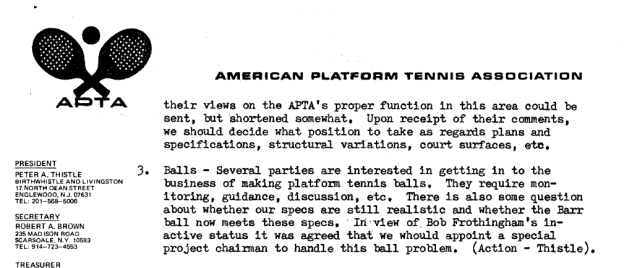
Ball quality had been a constant problem, and if anything, it seemed to get worse as time went on.
The APTA concluded that either suppliers were not making balls to its specifications, or the specifications themselves were incorrect.

The APTA invited sixteen top players to Fox Meadow to spend the day playing with balls in an organized testing program. Bob Brown and Amby Hardwick, who was the New Jersey Regional Vice President of the Association, chaired the project committee. Balls manufactured by Barr, Marcraft, Eagle Seamco and Robinson Bros. were tested and balls that met players’ approval were then further tested by the U. S. Testing Company so that they could draw up a set of specifications. Companies who met the specifications were issued approvals.

The APTA encouraged a number of manufacturers in the sporting goods field interested in making balls for platform tennis to develop prototypes and submit them for approval. The results were encouraging. The new balls lasted longer, played more consistently, and the velour-type flocking was a vast improvement and worth the increased cost. Among possible new developments were hollow balls, tested and deemed “interesting” by the test squad. A yellow colored ball, for higher visibility during night play, was also tested. All the manufacturers were told that the requirement for approval beyond the current season was the consistency of playing qualities.

In 1972, the Eagle Seamco (or Rubber) Company had submitted samples of yellow balls to the APTA that met ball specifications. They promoted the yellow coloring as having better visibility, especially at night. The balls were made available along with the traditional orange ball. Over the next two years, sales rapidly outgrew those of the orange ball and, by the end of 1974, orange balls were extinct.

The 1974 Nationals were the last ones to use the orange ball.

Source: The APTA Paddle Newsletter, Vol. 4 No. 4; Off The Wire, Vol. 5 No. 1; and Robert A. Brown, personal communication