APTA Incorporated as Non-Profit

APTA incorporates as Non-Profit and amends by-laws. Net Worth is $17,078. New by-laws provided for establishment of APTA Regions

During the summer, the APTA completed the incorporation of the Association and a redrawing of its by-laws. The financial records as of the date of incorporation, August 3, 1973 showed a net worth of $17,078

On July 30, at a special meeting of membership in New York City, the Association decided to incorporate under the New York State Not For Profit Corporation Law. The APTA was now the American Platform Tennis Association, Inc.

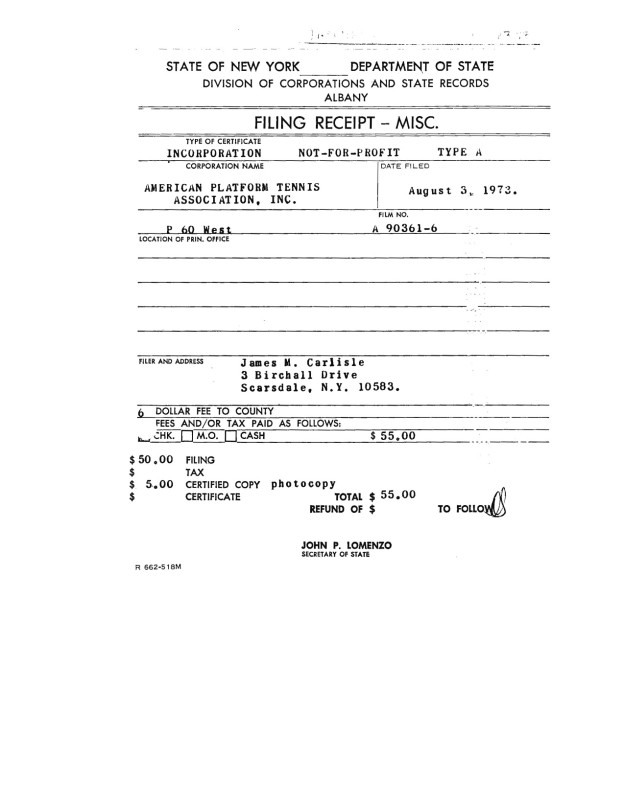
On August 3, the State Department of New York filed the certificate of incorporation of the American Platform Tennis Association, Inc.

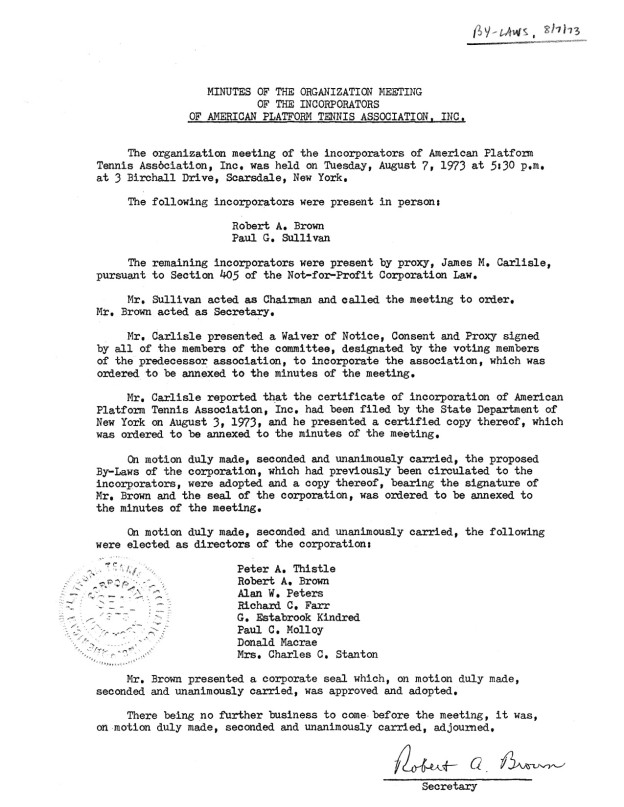
On August 7, the incorporators met and adopted a new set of By-laws that the By- law Committee had developed and submitted for approval1. Paul Sullivan chaired the By-Law Committee and other members were Edmund Swanberg, Peter A. Thistle, Robert A. Brown and Howard Kafer. The Association engaged James M. Carlisle as counsel in the handling of the project.

The new by-laws provided for the establishment of Regions as deemed appropriate by the APTA Board.

Minutes of Incorporators of APTA, Inc. Aug 7, 1973

APTA Minutes of Special Meeting of Voting Membership July 30 1973

Source: The APTA Paddle Newsletter, Vol. 4 No. 4

Note 1: In a memo dated June 29, 1973 from APTA Secretary,Robert A. Brown, to the By-Law Committee regarding an upcoming meeting on July 9, 1973, they were advised that “in view of the importance of the subject and the considerable ground that must be covered, one cocktail will be served prior to 5:30 pm and cocktails will then be suspended until the business portion of the meeting is concluded.”

Gordon S. Gray (1933-2007)

APTA Honor Award: Gray

‎Gordon S. Gray: Gray discovered paddle in 1965, and right from the start, played to win. He was a fine tennis player and his natural talent, coupled with an analytical approach and hard work, quickly paid off with three National Mixed wins in a row (1966-1968), the third time this had been achieved.

He followed up this accomplishment with three Men’s title in a row, from 1969-1972, a feat done only once before by Hebard and Carver.

In compiling this record, Gray and his partner, Jesse Sammis, changed the game by introducing a whole new level of aggressive, but consistent, play. (Field Club of Greenwich).

Screen Shot 2013-11-12 at 8.15.54 AM

William F. Koegel, 1983. Photograph was taken at the celebration of Fox Meadow Tennis Club's centennial

William F. Koegel elected FMTC President (1973-1975)

Koegel came close to disaster and humiliation during his term as president when he realized on a Sunday afternoon a half hour before the traditional Governors’Tea, held each year in April, that neither he nor his wife, Ruth, had bought the ingredients.

One does not become an FMTC president without steady nerves and the ability to handle emergencies, however. A liquor store owner was persuaded to rush to his store, open it, and produce the urgently needed ingredients. The Koegels got to the Club and mixed the punch in time.

“No one suspected the near catastrophe,” Koegel recalled, “and I thus escaped impeachment from the presidency and possible expulsion from membership.”

Source: Diane Reische, Fox Meadow Tennis Club – The First Hundred Years, 1983

Revised bylaws approved

APTA seeks input on proposed revision of by-laws

In the spring, the APTA announced that the Executive Committee and a specially designated By-Law Committee were going to revise the by-laws.

All member clubs in the Association were sent material concerning the changes, together with a proxy statement and an announcement of a special Association meeting to take place in July or August.

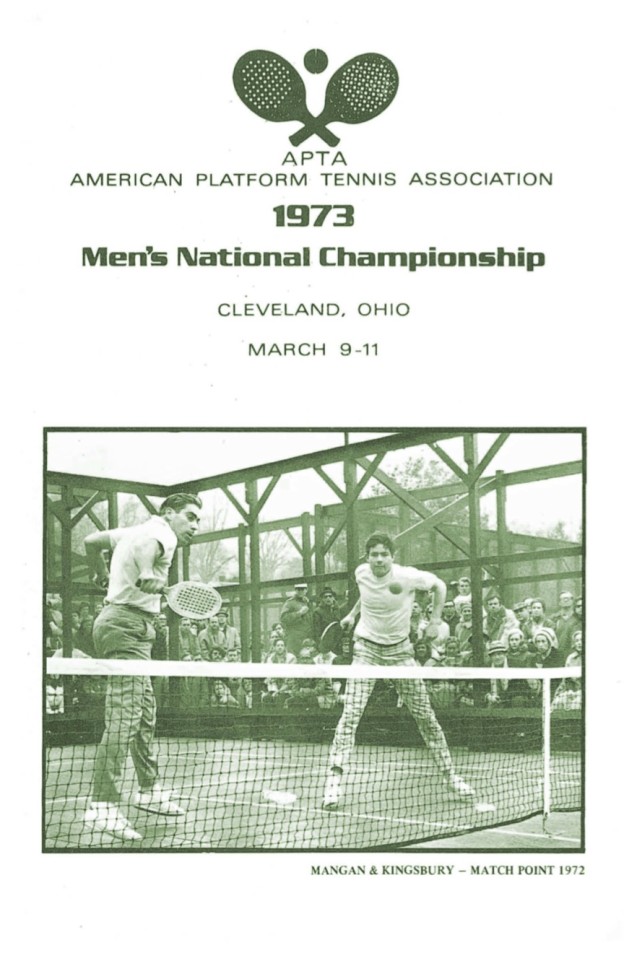
1973 Men's Nationals Program Brochure

National Championships

1973-Rev 1

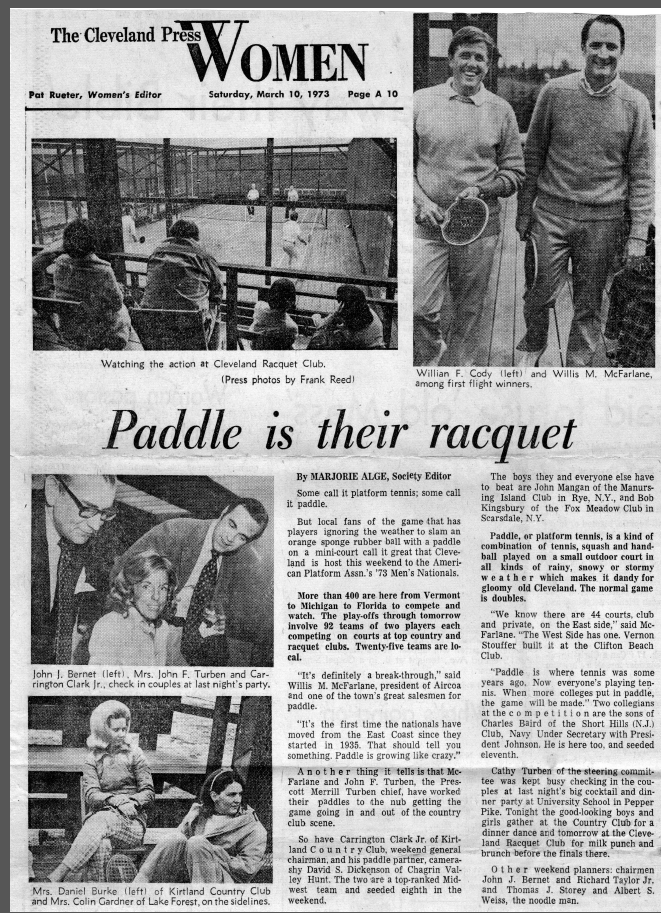
The 1973 Men’s Championships, held in Cleveland OH, saw Kingsbury and Mangan capture their second straight title.

On the Women’s side, DeBree and Dillenback took their third victory in a row. The Mixed final was a repeat of the previous year, but this time Cecil North and Mrs. Raymond O’Connell took the title, winning the second set over John Beck and Susan Wasch 14-12.

In the Seniors, Baird and Swanberg won their second straight 50+.

In the Junior’s, Chip Baird won for the fifth time in a row, a remarkable achievement.

A full description of the events and drawsheets was given in The APTA Paddle Newsletter, Vol. 4 No. 3.

Source: The APTA Paddle Newsletter, Vol. 4 No. 3

Screen Shot 2013-11-11 at 1.17.05 PM

The Cleveland Invitational directors in 1973 (from left to right): David S. Dickenson II, Richard Taylor, Willis M. McFarlane, Carrington Clark, Jr., and Robert Bartholemew. (Missing from photo: John J. Bernet and John F. Turben)

Cleveland hosts Nationals – the first time Nationals held outside of NY Metropolitan Area

Up until 1973, all National Championships had been held in or around New York City, primarily at Fox Meadow Tennis Club in Scarsdale, which had the most courts. The other two founding clubs of the APTA—The Field Club in Greenwich, CT, and Manursing Island Club in Rye, NY—also hosted, as did the Englewood Club, in Englewood, NJ.

In the fall of 1971, the Cleveland Committee, headed by Carrington Clark, submitted a comprehensive proposal to the APTA Board to host the Men’s National Championship. After some consideration, the Board approved the plan to move the Nationals. The 1973 Men’s Nationals in Cleveland were highly successful, and it signified the start of an era when the Nationals moved to a different location each year. It returned to Fox Meadow from 1974 to 1979; Montclair, New Jersey, from 1980 to 1982; New Canaan, Connecticut, in 1983; and Cleveland, Ohio, in 1984.

That same year, a group of Midwest men, including Carrington Clark, John Bernet, Dave Dickenson, and Will McFarlane founded Cleveland Tournaments Inc., a non-profit organization to support major platform tennis events in Northeast Ohio.

The logistics for the event required considerable discussion between the APTA and the Nationals organizers as reflected in the APTA Executive Committee Minutes of July 1972 and others

APTA Honor Award: Osborne

Philip W. Osborne had been an active player in the New York metropolitan area at Englewood Field Club, NJ until he was relocated to Pittsburgh, which at the time was a platform tennis desert. He set about changing this and he did. Initially he tried to convince clubs to build courts but was turned down. So, he built his out facility, Fox Chapel Racquet Club, and that was the start of what has become one of the most active regions for the game in the country. Osborne, who worked for Alcoa, was a keen supporter of the aluminum deck that became the standard in the early 1970s. (Fox Chapel Racquet Club)

Source: “Minutes of Annual Meeting” The APTA Paddle Newsletter Vol. 4 No. 1

Minutes from the APTA’s 1972 Annual Meeting noted recent articles in American Home, Town & Country, The Wall Street Journal, and The New York Times.

APTA Annual Meeting highlights significant progress

The Princeton Club in New York City played host to the 1972 Annual Meeting, with 132 people in attendance.

President Peter Thistle reported on the escalating growth of the sport; the increasing tournament activity; the establishment of the Equipment Committee to ensure uniform playing conditions for the game, and the success of the new initiative to include individual membership in the APTA.

Dues and selling plans and specifications for courts provided most of the total income of $14,274.74 and contributed to a healthy profit of $7,722.37. The net worth of the APTA now stood at $19,267.27

Secretary Robert A. Brown provided a detailed account of the activities of the Secretary’s Office – answering requests for literature and information on the game, providing plans and specifications for courts (at a price of $30), and a summary of how these requests had grown over the past three years from 60 to 191.

He commented on the “unprecedented number of articles on the game” and how the number of tournaments kept growing (29 in 1971).

Brown also reported: “in a discussion with Barr Rubber Company, the only manufacturer of balls, we were advised that this year’s production and sales of balls will be 35% over last year.” This was following a 100% increase over the previous year.

Source: “Minutes of the Annual Meeting,” The APTA Paddle Newsletter, Vol. 4 No. 1

APTA starts National Rankings for Men and Women

The December 10th, 1971 APTA Paddle Newsletter published the first ranking for Men and Women

“National Rankings were initiated this year for the first time. Men’s teams were ranked on the basis of play in at least 3 of 7 specifically selected tournaments during the year and the Women’s on the basis of 2 of 5 tournaments. The tournaments were selected and weighted on the basis of the size and quality of the draw.”

Gordon Gray and Jesse Sammis III were ranked first in the Men’s and B. J. DeBree and Gloria Dillenbeck were first in the Women’s

[click image at left to enlarge and see full list]

Source:The APTA Paddle Newsletter, Vol 3, No 1, December 10, 1971

APTA develops policy on platform tennis court builders

The September 15th Newsletter carried the following basic policy:

• It is the intent of the APTA that the game of Platform Tennis be played under uniform court conditions wherever it is played.

• The APTA considers it appropriate to provide advice and guidance, where needed, to ensure quality and uniformity in court construction while recognizing the desirability of encouraging innovations in the use of materials and methods of construction so long as the basic nature of the play of the game is not affected.

• The APTA will offer guidance to those seeking information on plans, specifications, and builders of platform tennis courts. Such guidance is offered within the framework of this policy, the implementation of which is outlined below; while it is based upon the best information available, the APTA cannot accept responsibility for quality of construction, delays, or failure of any sort in contractual arrangements between builder and customer.

The APTA implementation Plan had the following elements:

(1) A list of builders will be maintained, divided into two sections; Section I, “Builders of Wooden Courts to APTA Specifications” and Section II, “Builders of
Courts to APTA Dimensions but Using Materials other than Wood or other Construction Design.”
(2) Any builder who wishes to be included on the list may apply in writing. If he is a new builder constructing courts to APTA specifications, a completed court (or courts) will be inspected by the APTA and, if considered satisfactory, the builder will be included on the list with a footnote indicating:

“New builder constructing courts to APTA specifications which have been inspected and are considered satisfactory by the APTA but which have not been in use for two full playing seasons.”

If he is either a new builder or an established builder constructing courts with different construction materials or construction design, he should outline in his written application specific deviations from APTA plans and specifications. A completed court (or courts) will be inspected by the APTA and, if considered satisfactory, the builder will be included on the list with a footnote indicating:

“Builder constructing courts with different construction materials or construction design which have been inspected and are considered satisfactory by the APTA but which have not been in use for two full playing seasons.”

In each of the above cases, after two playing seasons of use and a satisfactory
second inspection, the applicable footnote will be removed from the builder’s listing.

In the event that a builder who has been in the business for more than two seasons applies for listing, both a recently constructed court (or courts) as well as a court (or courts) which have been in use for two or more seasons of play will be inspected and, if considered satisfactory by the APTA, the builder will be included on the list as applicable without footnote.

(3) Inspections will be made by APTA officials, including regional Vice Presidents, or others specifically designated. No expense may be incurred by the Association for
such inspections. If in the judgment of the inspecting officials, including actual play on the court, the bounce of the ball on the deck and off the screens and the feel of the deck are similar, and provided court dimensions are according to APTA regulations, then recognition as applicable will be granted.

(4) The APTA reserves the right to remove any builder from the list at any time if, in the judgment of the APTA, the quality of courts being constructed by that builder and/or the construction performance of that builder are considered to be below normally acceptable standards.

Source: The APTA Newsletter, Vol. 3 No. 4