The Etiquette of Platform Tennis

“The Etiquette of Platform Tennis” published

The Annual Meeting minutes included the following report by Secretary Robert A. Brown.

“The rapid growth of the game is attributable to the increasing number of ‘newcomers’ who are exposed to and are taken up by the game. With this in mind and in order to maintain the high level of sportsmanship and good conduct that is such an important part of ‘paddle,’ the APTA recently published a new booklet entitled “The Etiquette of Platform Paddle Tennis.”

The author of the booklet was Robert A. Brown. It has been reprinted a number of times and is still available.

The APTA mailed the booklet to all members, and it was well received. Subsequently, the APTA received requests for over 3,000 additional copies of the booklet. Although intended for the newcomer, a number of old-timers requested copies for their close friends who played.

Source: The APTA Paddle Newsletter, Vol. 3 No. 4

As game expands Fox Meadow players lose dominance at tournaments but the “spirit” of the game remains an essential part of the club

By the mid-1970’s, platform tennis was a national game, attracting an estimated 500,000 competitors. The game was no longer exclusively played by Eastern clubs. The tournaments were often commercially sponsored. As the game widened, Fox Meadow lost its dominance of the Nationals, but the Club’s impact in other areas remained strong.

Cecil J. (Mike) North, Jr.(APTA President 1975-1977) of Bedford Golf and Tennis Club wrote in the program for an earlier Nationals:

“As platform tennis attracts greater numbers of players, expands geographically, and becomes increasingly money-oriented, I think it is important to remember why people played it in the first place: because it is informal, because it is fun. Fox Meadow is a reminder of these qualities.”

Source: Diana Reische, Fox Meadow Tennis Club – The First Hundred Years, 1983

APTA Newsletters covered National and Regional Tournament results

For many years, the APTA newsletters carried the results of all the major tournaments from the round of 16 on.

The February, April, and September newsletters included the draw sheets from the round of 16 for the Women’s Nationals; Senior Women’s; Western Pennsylvania Men’s, Women’s and Mixed; Connecticut State Men’s; Long Island Men’s Invitational; Rye Men’s Invitational; Middle Atlantic Men’s; Short Hills; and Bronxville Field Club Women’s Invitational. There were also notes on the New Canaan Men’s Invitational, the APTA Senior Men’s, and the first North Carolina Men’s tournament.

R.J. Reilly, Inc. pioneers the aluminum court deck

Richard J. Reilly, Jr. had been building wooden courts since the mid 1960’s and had made numerous innovations over time. But, it was Wilson Sporting Goods that ultimately gave Reilly his best idea.

Wilson had come out with a metal tennis racquet and their major rival, Head, was anxious to catch up and had some consultants working on an aluminum racquet as a competitive response. It so happened that Reilly had built a wooden court for Peter Fisher in Katonah, NY and Fisher suggested he visit George Vaughn and Dick Hargrave who, along with an engineer with a PhD in the aluminum field, were the principal consultants for Head. This Princeton, NJ based team helped Reilly develop all the technology (specifications, extrusion dyes and techniques), required to manufacture an aluminum deck.

As a woodworking purist, he hated the idea of using aluminum, but saw it as providing the longevity that wood didn’t have, as well as the capability for conducting heat, which would help with snow removal. He was right, and by the mid 1970’s, 85% of his courts were aluminum.

There were many obstacles to overcome. The first aluminum boards had just two stiffening ribs and the boards sagged and bent at the edges. Adding a third rib solved this issue and became the standard ever since.

The other challenge was paint adherence but using wood floor sanders helped roughen the surface enough to obtain excellent adhesion. Reilly also experimented with paint formulations the best of which was a two-part epoxy paint but it dried so quickly on a hot day that spreading the aggregate that was used to create the rough texture on the deck had to be done very fast using a high pressure spray. This was tricky and on windy days more than one car parked nearby was accidentally painted.

Reilly had originally used sand as the aggregate (as pioneered by the Tremont Place Paddle Tennis Club in the mid 1930s) but then switched to walnut shells (too soft) and then aluminum oxide, the present day standard.

The epoxy paint was a big improvement over the deck enamel used previously as with deck enamel courts had to be painted every one to two years and the heavy paint build-up tended to chipped and became very uneven creating a poor playing surface. A well-painted epoxy deck on the other hand would last 7-8 years.

Source: Adapted from Off The Wire, Vol. 6 No. 3 and personal communication from Richard J. Reilly


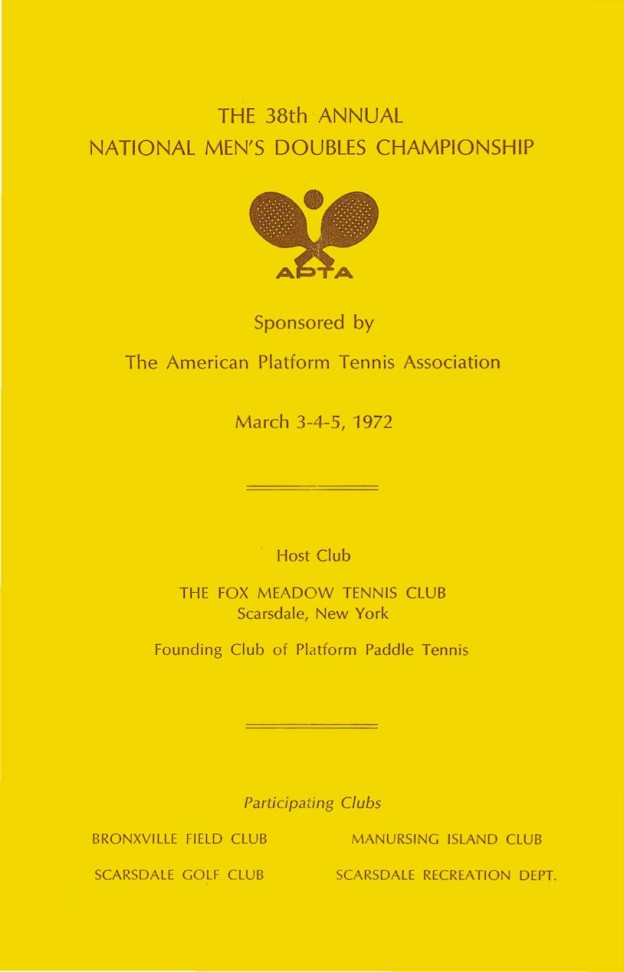
1972 National Men's program

National Championships

1972- Rev 1

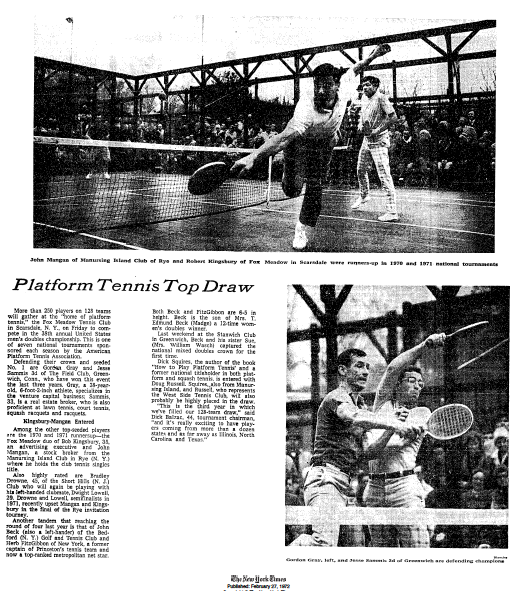
Bob Kingsbury and John Mangan broke through to win the Men’s over the three time defending champions, Gray and Sammis. It was a dominating performance by Kingsbury and Mangan, taking the title without losing a set.

Gloria Dillenbeck and B.J. DeBree1 repeated as Women’s champions, and the brother-sister team of John Beck and Susan Wasch won the Mixed.

In the Senior events, Charlotte Lee and Eleanor Hesseltine1 repeated as winners of the Women’s 50+, Charles Baird and Edmund Swanberg won the Men’s 50+, and Walter Frese and Ken LaVine won the 60+ (Veterans).

Charles (Chip) Baird, Jr. won his fourth straight Junior Boy’s title.

Note 1: Historical Factoid:This was the second year in a row that Charlotte Lee won the Senior Women’s with Eleanor Hesseltine and also the second year in a row where she lost to Eleanor Hesseltine’s daughter, B. J DeBree, and her partner Gloria Dillenbeck in the Women’s Nationals

Screen Shot 2013-11-11 at 12.05.27 PM

Arapahoe Tennis Club establishes a tournament in memory of Hig Gould who brought the game to Denver, CO

George H.B. (Hig) Gould, introduced paddle to the Mile High City with the formation of the Arapahoe Tennis Club in 1964.

He was tragically killed in a car accident in April 1971.

The Arapahoe Tennis Club established an annual tournament in his honor that rapidly became well attended by nationally ranked players seeking to both ski and play paddle. The Hertz Corporation offered to put up cash prizes but the organizers declined the offer as they wanted to keep the event low-key.

Hig was an accomplished player and had competed in the 1969 National Platform Tennis Championship at Scarsdale, NY.

At the time of his death, he was president and a director of Gates LearJet Corp.

5th Anniversary of Western Pennsylvania Platform Tennis Association

At their annual dinner, the Western Pennsylvania Platform Tennis Association (WPPTA) elected Neil Van Horn as President, replacing Eldridge (Woolly) Birmingham, who was a founding member.

Birmingham had been largely instrumental in the development of paddle tennis in the Pittsburgh area, from court building to initiating the Men’s, Women’s and Mixed Doubles Invitational Tournaments.

The WPPTA now had 10 member clubs.

Source:The APTA Paddle Newsletter, Vol. 3 No. 3