APTA Board Member: Katie Bliss

Katie Bliss

Age: 56
Family: Husband of 29 years, Mark, 2 children – Son, Taylor (age 24) and Daughter, Genie (22) both post-college.
Residence: Maplewood, NJ
Profession: I’m the owner and proprietor of Bliss-Full Gardening Services, a design, installation and maintenance firm with clients throughout Essex County, NJ. Timing is perfect for paddle players! Winters off!
Achievements in Tennis/Platform Tennis: I’m the former president of the New Jersey Women’s State Platform Tennis League, a league of over 800 women. It’s a 14-week season that plays from mid-October to mid-February. I spent 11 years on the NJWPTL board, holding various positions. I’ve also been the Tournament Chair of the Short Hills Club Platform Tennis Invitational and served on the Tournament Committee for over 10 years. I am nationally ranked #4 Husband/Wife 50+ for 2011.
Hobbies off the courts: Gardening, sewing, cooking – Martha Stewart watch out!

[enlarge image to read full profile]

2012 APTA Board Nominees – Steve Caccam, Rob Coster, Hendy Dayton and Aila Main

Steve was introduced to platform tennis in 2003 by four friends in New Canaan, Connecticut and learned to play on the town’s public courts in Waveny Park. Once beyond the frustration of getting only one serve, he learned to embrace the many unique characteristics of the game, most of all the wonderful camaraderie. That first winter, he became truly obsessed with the game and collected email addresses and telephone numbers of anyone with whom he could arrange a friendly game. This core group eventually grew into what is now the New Canaan Men Paddle League, Inc., a league he formed with a couple of friends in 2004 and today numbers over 250 current players.

Steve was fortunate to have benefited from early tutelage and inspiration from Dave and Marina Ohlmuller, David Kjeldsen, Marjorie Hodson, and especially Mike Gillespie, from whom he learned the joy of teaching this wonderful game. He was given the opportunity to expand his knowledge of the game working with Darlene Finnegan at the Beacon Hill Club in Summit, New Jersey, and Mark Parsons at Manursing Island Club in Rye, New York.

He was a Co-Director of the 2008 APTA Mixed Nationals and was the Tournament Director of the 2010 APTA Junior Nationals, both held in New Canaan. He currently serves as a Director of the Fairfield County Platform Tennis League.

Steve lives in Darien, Connecticut with his incredibly supportive wife, Ann, and three children, Emily, Blair, and Paige, all of whom enjoy playing on the town’s public courts at Weed Beach.

Rob Coster was introduced to the game of platform tennis as a high school student in his hometown of Wilton, Connecticut. After a long hiatus from the sport, Rob picked up a paddle again after settling in Madison, Connecticut.

As Region II President for the past four years, Rob has taken a proactive role encouraging the growth of the game, as well as keeping APTA members informed. He publishes an email newsletter and created a Region 2 Facebook group that has helped tournament directors increase participation in all events. He currently runs an 110+ men’s platform tennis group at the Essex Platform Tennis Club and previously served on the APTA Board. He and his wife, Barbara, live in Madison, and have three children who all enjoy playing.

Hendy Dayton was introduced to paddle as a young girl in Greenwich, Connecticut. Her grandfather, Clifford Couch, won the Men’s National Championships three times, including the first men’s title in 1935. He was a finalist in four other men’s championships and was inducted into the APTA Hall of Fame in 1965. The love of the sport was passed on through the generations and Hendy competed as a young girl in Greenwich and at the Junior Nationals in Pittsburgh. She also played at Williams College and in New York on the wonderful skyline courts on 28th Street. Moving to California 20 years ago limited her paddle fun until she discovered the wonderful paddle community at the Lagunitas Club in Ross. Hendy has competed on numerous President Cup teams at the Nationals as well as in various other national tournaments. Hendy joined the APTA Board in 2009 as President of Region VI and has been chairman of the Branding Committee. When she is not playing paddle, Hendy is a Leadership and Executive Coach with the Boda Group. have three children who all enjoy playing.

Aila has been an avid player for over 10 years now and regularly plays both women’s and mixed events. Like so many in the game, she made the transition from the tennis court to the paddle court, and became hooked. She and Kerri Delmonico won the Women’s Nationals in 2005, as well as several other tournament titles over the years. Aila is currently the National Women’s Ranking Chair and head of the Women’s Player’s Committee.

She is thrilled to be involved in the paddle community, and looks forward to many more years on the court. Aila lives in Manhattan with her daughter, Sophie, and dog, Samantha.

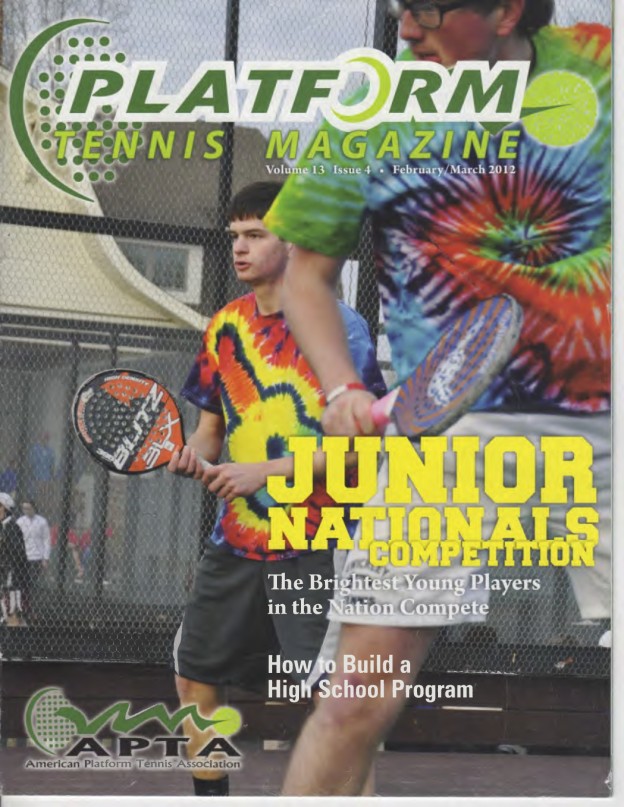
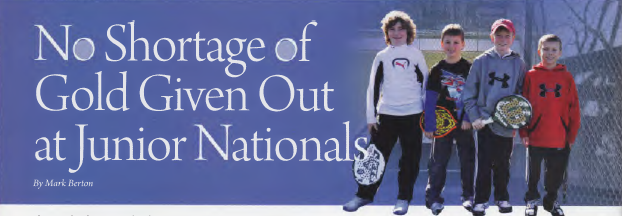
Indian Trail Club, Franklin Lakes, NJ hosts Junior Nationals

Screen Shot 2013-06-04 at 6.34.08 AM

Shorts and T-shirts were what they were wearing on the courts for the 2012 Junior Nationals. That’s because unseasonable warm weather shot the mercury into the mid-50s by midday, but that warmth was short lived, giving way to the cold breezes whipping in from the waves of Franklin Lake. And by nightfall, the gas lamp’s ignitions were crackling the flames into life for the spectators who preferred to watch outside of the Indian Trail Club.

What they were watching was the culmination of a long, hard-fought day of paddle through several age brackets. The younger ones finished up earlier in the day, leaving the Boys 18s finals to continue long into the evening.

The participants were Tyler Kratky and CJ Purse of Greenwich, CT, against William Brosnan of Garden City, NJ, and Scott Safford of Malvern, PA.

The match was about endurance, and height, as Brosnan/Safford towered over Kratky/Purse, working shots at the net that the smaller team had to meet with speed.

Kratky/Purse said that in the end, they felt that their average size actually helped them win the match, 6-3, 5-7, 6-2. “I think in paddle, it actually helps to be average height: Purse said. “If you’re taller, there are some advantages as well as disadvantages. We were pretty fast today. I thought we tracked down a lot of balls, especially a lot of drop shots and won a lot of points at the net, so I actually think it was an advantage that we had.”

Kratky agreed. “When they hit lobs and whatnot, it’s tougher throughout to receive when you’re not as tall, but at the same time, we provided speed to get everything back,” he said.

Kratky/Purse had played Brosnan/Safford in the past as individual players on separate teams. This was the first time they encountered Brosnan and Safford working together. “They both had separate partners when we played them,” Kratky said. “We had an idea of what we were going to do, but the way that they played in the second set, they played too well and they took it from us, so we had to make some changes. The whole match, we were shifting it around, seeing what their weaknesses were based on how they were playing.” “Every point we were talking,” said Purse. “We were communicating, deciding what we were going to do for the next point, so our game plan actually changed halfway through the match and we started doing other stuff. We were definitely changing stuff up throughout the match.”

In the Boys 14s, Connor Daley and Alex Slobin of Fairfield, CT, took home another championship this year, defeating finalists Bobby Clarke and Robbie Gavigan of Garden City, NJ, 6-2, 6-2.

Jake Freedman and Peter Horne oflArumetka, IL, defeated Riggs Johnson of Locust Valley, NY, and his partner Teddy McLanahan of Glen Cove, NY, 6-1, 6-3, in the Boys 12s.

Jack Ramsay and Jack Uhlman of Darien, CT, defeated Chase Connolly and Peter Denious of4Vilton, CT, 1-6, 6-3, 6-4, in the Boys 10s.

The Girls 18s was every bit as dramatic as the Boys 18s, with Corey Delaney and Nicki Ross of Chatham, NJ, defeating Hannah Kratky, of Greenwich, CT, and Meghan Foster of White Plains, NY, 6-3, 6-4, locking in Delaney and Ross’s sixth national championship win.

“I did recognize their strength early on in the tournament,” Ross said. “I figured that if we made it to the finals, we would be up against them: “I did not know they were last year’s winners of the younger bracket, but I knew they were good,” Delaney said. “I was not familiar with them before the tournament started but I knew there would be new younger competition that Nicki and I would have to be ready for this year. After having seen them play in the round robin part of the tournament, I knew they were good and that they were potential competition for us in the semis or finals. I was actually pretty nervous when I saw them play because they were a new team we hadn’t seen that could really play.”

“They both had great drives and were both solid players in every aspect of the game,” Delaney said. “We just played our game, with Nicki providing offense with her great drive and me providing the defense with lobs and wire play. We started blitzing more in the second set which was very effective. Nicki and I knew that if we kept the point alive long enough they would hopefully make a mistake. As for our vulnerabilities, I felt pressure when we were serving because their drives were hard and placed well, which gave us, or at least me, trouble for holding serve.”

Delaney/Ross, like many of the other 18s who finish up their Junior Nationals careers, face the challenges of being separated by college. While Ross already is in college, she said that Delaney’s studies shouldn’t be too much burden for the team to continue on.

“I am in college already, which didn’t pose a problem for us this year,” Ross said. “I played in tournaments over breaks and made sure I could come home for the Nationals. Corey practiced a lot while I was at school, and I tried to stay in shape while I was off the court! I’m sure Corey and I will play in more tournaments together in the future. Hopefully being 10 hours apart next year won’t end our platform tennis career together!”

“Hopefully, Nicki and I will find time to play some tournaments next year when we are both back from college on our breaks;’ Delaney said. “We both want to continue playing and start adjusting to the women’s game as soon as possible. I’m sure we will find a way to work something out next year so we can still be a team that competesf

Despite being a six-time Junior Nationals champion, Delaney said she’s nervous about future competitions.

“To win my final title in the junior Nationals was a great way to go out;’ she said. As for playing in Nationals next year, lam a little nervous about the change in level from juniors to women. It’s a big step, and I hope I can adjust and find success there like I have had in the juniors. I will miss the Junior Nationals because of all the new girls you get to meet and the fun you have at the tournaments.”

In the other age brackets, Ryan Freeman and Kaitlin Schroeder of Summit, NJ, defeated Alexandra Shay of Wilton, CT, and her partner, Emily Dardis, of Stamford, CT, 6-7, 6-3, 6-2, in the Girls 14s at Knickerbocker. Shay-Dardis were last year’s Girls 12s champions.

In the Girls 12s, local Wayne, NJ, team Callie and Catie Burkhart defeated Eliza Denious ofWilton, CT, and Emily Tregellas of New Canaan, CT, 2-6, 6-3, 6-4.

Libby Gardner and Hannah Amendola of Fairfield, CT, defeated Mary Margaret Schroeder and Louisa Randazzo of Summit, NJ, S-7, 6-1, 7-6, in the Girls 10s.

Source: Mark Berton, Platform Tennis Magazine, Vol. 13, Issue 4, March, 2012

PPTA certifies coaches in Florida

In December, 2011, Hall of Famer Hank Irvine gave a two-day PPTA certification course at The Villages in Florida, a large 55-and-over retirement community. Their six ground-level asphalt courts were opened in March 2010. Since then, free lessons or clinics were held on Wednesdays and Fridays year-round by resident volunteer instructors who had played paddle before moving to Florida. The certified developmental coaches are now new members of the PPTA. They are now in the process of reviewing their teaching format based on what was learned from Hank Irvine’s course, his suggestions and the PPTA manual.

This community is in its last expansion, growing from some 86,000 residents to reach about 110,000 by 2017. As more residents desire to learn to play paddle, the plan is for the new certified coaches to teach other residents to become volunteer coaches.

Hank’s story is fascinating. He grew up in Zimbabwe, moved to London, and settled in the United States. He played professional tennis, squash, and platform tennis. Irvine was inducted into the Hall Fame in 1995

Pictured, from left: Joe Bouthillette, SeaBreeze Recreation Facilities Manager, Joanne Tocco, Russ Jones, Bernie Guenther, Hank Irvine, Keith and Maryellen Bashaw, Joe Russo, Sr., Jane Grenthal and Ivy Wahrenburg

APTA Board Member, Amy Halstead

Amy Halstead Residence: Lake Bluff, IL
Date Elected to APTA Board of Directors: May 2009
Family: Single
Years Playing: 7 years
Largest Competitive Achievement: Back Draw Winner in Chicago Charities 2009; Last Chance Winner in Chicago Charities 2011

What do you feel your contribution to the board is?

I am a Growth Committee Member and help interested parties learn how to start public facilities, which includes learning how to deal with government bodies for zoning and construction permits; where and how to purchase new or used courts, and how to create a paddle program to generate membership and league play.

As far as Platform Tennis Magazine, I am in charge of overseeing the production schedule and that it is synchronized with the strategy and mission of the APTA— governing the sport and growing the sport.

[enlarge image to read full profile]

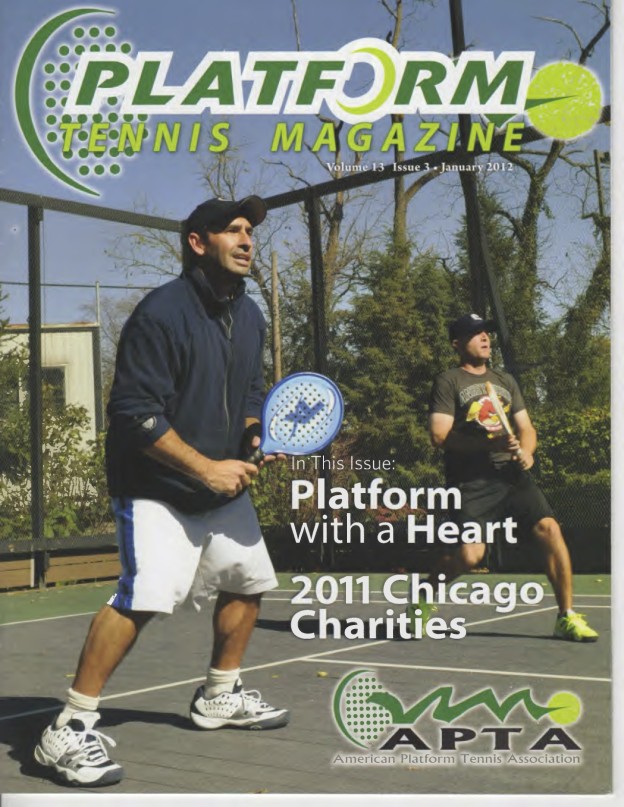
2011 Chicago Charities coverage

The Chicago Charities tournament has become second only to the Nationals for paddle treasure.

Good work and good play go hand in hand every year at the Chicago Charities tournament, where the proceeds benefit a charity chosen by the CC committee. Glen View Club of Golf, Illinois, hosted the highly-touted tournament, known for its quality of play.

Teams came from all over—including California, Canada, and Connecticut—to vie for the Charities cup and to support a great cause, The House of Peace Shelter. And no good deed goes undone—everyone received favors of warm picnic blankets and paddle DVDs for their participation.

Hall of Famers and former national champions dotted the draw sheet for both the men’s and women’s events. The women played on Friday and Saturday morning of a golden weekend. The worst element the women had to deal with was bright sunshine. With a field embarrassing in riches, the fact that two unseeded teams (Hallie Bodman/Sally Jones and Lauren Cash/Maria Manley) snuck into the quarterfinals was impressive. Some well-known players partnered anew making it a challenge to forecast the winners.

Two East Coast teams came out on top and headed to the finals. Gerri Viant and Lauren Mandell of New York could not hold off the exacting duo of Cynthia Dardis and Amy Shay of Connecticut, 7-6, 6-7, 6-3. Dardis/Shay only lost one set in the entire tournament.

For the men’s tournament, the action started on Saturday, with over 50 teams signed on. The deep draw saw only one non-seeded team steal into the round of 16 (Ryan Baxter/ Rick Heath).

The quarterfinals took place as dusk hovered over the Glen View Club. APTA Executive Director Ann Sheedy said, smiling, “The hut and environs were packed with spectators. The evening party was beginning. It was amazing that the players could concentrate with the smell of the grill gently wafting over the court.”

On Sunday, the men were graced with overcast skies but had to contend with that famous Chicago wind during the semi-finals and finals. The strength of the field was never more apparent than in the finals, where both sides of the net could claim multiple national championships. In an amazing display of control and power, Chris Gambino and Drew Broderick won over Mark Parsons and Mike Stulac. The second seed withstood a wearing first set that lasted over an hour to beat out the #1 seeded team, 4-6, 6-1, 6-4.

In other Charities action, the well-attended Men’s 90+ took place on Sunday at neighboring Exmoor Club in Highland Park, Illinois. Tournament director John Noble and Rod Workman beat out James Goldman and Charlie Usher for the cup.

The Chicago Charities tournament once again ran seamlessly. Chairs John Noble, Robin Cohn and Howard Sipe organized an energetic event for players and fans. Umpire Bill O’Brien roamed the courts, keeping an ear to the ground and an eye to the lines. All of the good work and good play on the courts paid off—for a deserving charity and a deserving group of good sports.

Source: Nindy Pike, Platform Tennis Magazine, Vol. 13, Issue 1, 2012

Wilmington CC raises the bar – going from just OK to great

In the summer of 2010 Wilmington Country Club built a new platform tennis facility. With four courts and a fantastic hut, the complex sets a high standard for any club that intends to build the “best” new facility. As WCC starts its second paddle season with the new facility, the number of paddle players has soared. This brief history may provide other clubs with a road map for going from “just okay” to great.

WCC was founded in 1901. It has always been a premier golf club in Delaware. The South Course (one of two 18-hole courses) was designed by Robert Trent Jones. It is consistently rated one of the top courses in the country. The tennis facility boats 17 tennis courts including the only grass courts in Delaware as well as three indoor courts. Year after year the squash program produces nationally ranked juniors and college players.

The sport of platform tennis experienced rapid growth in the mid-1970s. In 1973 in Delaware, two tennis clubs, first Greenville Country Club, and then Vicmead Hunt Club, built paddle courts. Before the first season of play was over, WCC decided to build courts. Two wood courts were ready for play by the beginning of the ‘74 season. Because there was no hut, players used the living room of an old hour that was close to the courts for viewing. Although it did have a wood-burning fireplace, it was too far from the courts and too small.

In the late ‘70s the paddle community tired of replacing warped wood planks and looked for a solution. In the early ‘80s, after the sad (and unsuccessful) experiment with plastic tiles on top of the wood planks, most clubs, including WCC, converted to aluminum. In the early ‘90s WCC installed the brightest court lights south of the Philadelphia Airport. Other than the lights, no significant improvements were made to the Wilmington paddle facility for almost 30 years.

WCC is the home club of three national champions, Bunny Vosters (Hall of Famer Lucie McAvoy’s long-time partner), Pete Morrow and Cindy Prendergast (another Hall of Famer). Most clubs would be proud to have even one member win a single national championship. Wilmington can boast of a total of 13 championship wins, seven by Prendergast.

National champions, understandably, focus on playing their best paddle. Prendergast focuses on her game, but she also embraces the bigger picture of the sport. In the late ‘90s paddle participation at WCC was dwindling. At neighboring Delaware clubs it was thriving. The Wilmington men’s team dropped out of the MAPTA men’s league for lack of players, and the women were down to only one team. Prendergast decided to do something about it and worked tirelessly for 10 years to convince her club to build a first-class facility.

The WCC Board approved the project and one very important decision was made before the design was completed. The location of the courts would be changed – they would be built in a central location between the indoor tennis building and the outdoor tennis courts. During the summer, tennis players and golfers enjoy the hut. It also allows for use of the courts by the club’s junior members during their summer camp.

The hut is a few feet higher than the courts. The height of the hut, along with the expansive windows, provides excellent viewing of the matches on all four courts. The outside decks are wide enough for plenty of spectators to enjoy the action. The courts (built by David Dodge of Premier Paddle) are close enough to the hut that spectators inside the hut can follow matches on each court.

Build it and they will come. From the oversubscribed opening APTA Clinic in September 2010 to the sold-out mixed paddle dinners on Friday nights, it certainly is true for Wilmington’s paddle program. The hut is attracting non-playing members for a cocktail before dinner, as well as tennis players who stop for a beer after their indoor game.

Source: Barry Snyder, Platform Tennis Magazine, Vol. 13, Issue 2, December, 2011

APTA/PPTA clinics and exhibition at Homestead CC, Kansas

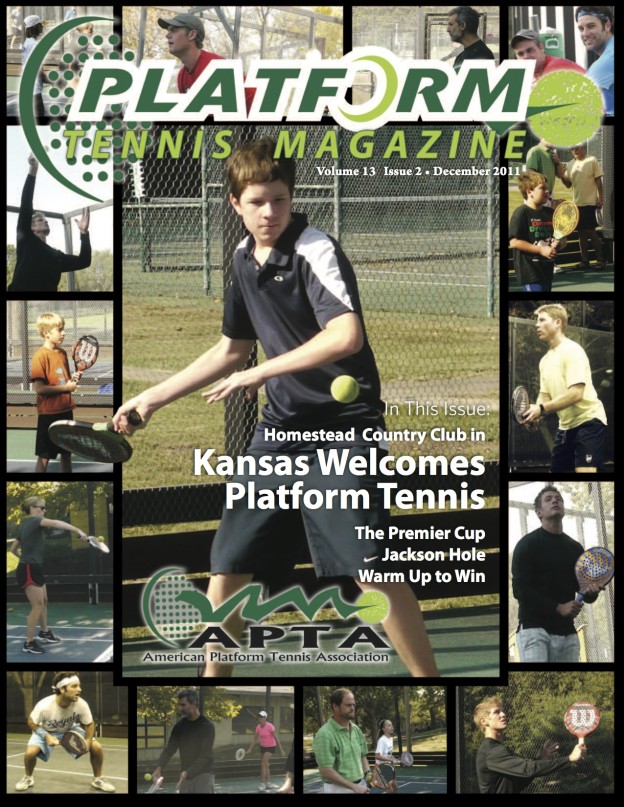
Some days you win, some days you lose, and some days… it’s hot – at least by paddle standards. Nevertheless, over 60 players braved the 88-degree temperatures on Saturday, October 8 to participate in an APTA-sponsored clinic and exhibition on the brand new Homestead Country Club courts. Homestead Country Club is located in Prairie Village, Kansas (about 10 blocks from Kansas City), and has about 300 members, many of them active tennis players on Homestead’s 16 hard courts. This summer, with great help and support from the APTA and its grant program, Homestead recently built two new platform tennis courts and began offering an economical seasonal platform tennis membership.

To launch the inaugural season, several pros came in for a Wilson-sponsored APTA/PPTA clinic and exhibition.

The Kansas City paddle community was excited to welcome Nathan LeFevre, Mark Fischl, Sebastian Bredberg, and George Wilkinson – four great players and phenomenal instructors. The day started with some fun sets against local pros and players, including several former college tennis players who are learning the game quickly. Following the morning play, LeFevre, Fischl, Bredberg, and Wilkinson ran free clinics from 10-12 and from 2-4 covering all areas of platform tennis including volleys, overheads, drives, lobs, serves, and everyone’s favorite – screens! It seems clear that the 50 to 60 participants of all ages, many holding a paddle for the first time, will soon begin playing in clinics and leagues to help grow the game in the Kansas City area.

Between the clinics, LeFevre and Fischl played an exhibition against Bredberg and Wilkinson, which was USA/Australia versus Ireland/Sweden, (sorry I mean England/Sweden – anyone at the event will know what I am talking about!). Honors went to the USA/Australia team and, when asked for a rematch, they said wanted to wait until next year! The highlight was the first point of the exhibition with at least a 150-ball rally. The day concluded with some more play in the cooler evening, and it is safe to say that all involved had a great time.

A big thank you to the host club, Homestead, and we wish them all the best with their new platform tennis program. Also, thank you to Chace Brundige and head pro Kevin Kowalik for all their work putting the weekend together. The temperatures cooled as nighttime approached and the courts were again filled by avid clinic participants.

Source: Platform Tennis Magazine, Vol. 13, Issue 2, December, 2011

Toronto welcomes PPTA Pros at first Wilson-Sponsored clinic outside of U.S.

Close to 100 players took part in seven hours of clinics over the course of two days hosted at the Kingsway Platform Tennis Club in Toronto, Canada. Juan Arraya was joined by Mark Fischl, Brian O’Connor and Newfoundlander Mark Parsons, along with Toronto’s own Paul Stulac on the Kingsway courts and led a series of clinics and exhibition matches on a challenging weather weekend.

Adults and juniors who had never picked up a paddle took part along with seasoned level 1 players.Beginners, intermediates and advanced players had only one negative comment about the clinics – WE WANT MORE! [enlarge image to read more]

Player Profiles: Matt Warner and Mark Johnson

You two recently paired up as a team. How did you find each other and was it an instant gelling?

Warner: “Mark was my junior tennis coach during my high school years. A few years after attending SIUE, Mark and I began corresponding again and soon began to practice on the paddle court. It wasn’t until this year that we seriously discussed pairing up. We are good friends off the court, and we were curious to see how our strengths would complement each other on the court.”

What about each of your styles of play do you think make your team strong?

Warner: “Through the use of spin on both serves and overheads, we try to keep our opponents neutralized from attacking from the backcourt; as a righty/lefty combo, we find sometimes we can create more pressure on the net team with our forehand drives and blitzes from the middle of the court.”

Where do you see yourselves having to work out weaknesses?

Warner: “At times, we have to remind ourselves that you can’t always bring the ‘full court press.’ This game was built on patience, good shot selection, and minimal errors.”

What is your practice routine/frequency?

Warner: “We try to drill at least once or twice a week in a one-on-one or two-on-one setting to focus on specific situational patterns.”

If either of you has migrated to platform from tennis, are there any advantages/disadvantages that your style brings to the game?

Warner: “With a few minor adjustments, I feel my serve has made a good transition from tennis to platform tennis. I still feel I am able to consistently hit a spin serve that, for the most part, is able to neutralize most opponents from consistently driving on the return of serve.”

As partners, you obviously are unified on the court, but what do you think you do to challenge each other as well?

Warner: “The mental game – strategy, discipline and focus – is what differentiates the good from the great players. Each and every point is a battle. As the game grows, talent continues to migrate into this game so it’s imperative to play within ourselves and play disciplined in order to win matches against the top teams.”

What racquet are you playing with and do you feel it gives you any particular advantage as far as your play style?

Warner: “The Wilson Blitz Low. I have had elbow issues in the past and this paddle plays a bit softer on my arm.”

Johnson: “I play with the Viking O-Zone paddle. With my style of play, I feel it is a little more of a forgiving paddle. I like the feel of the ball staying longer on the paddle.”

What advice would you give to fledgling teams trying to find success on the court?

Warner: “To newer players, play as much as you can – tournaments, etc., seek insight from more experienced players, determine and discuss what your strengths are individually so that you can play as a team towards those strengths.”

Johnson: “My advice for players trying to make success on the court, is that the game of paddle takes time to get familiar with the smaller court screens, etc. Be patient with this game. Give yourself time to learn and don’t give up. Lastly, you always learn from the best. Watch the great players, take notes and ask questions about game.”

Have you identified any teams that you think will be your toughest challenges this season?

Warner: “There are many, many teams that offer different types of challenges. We don’t expect to have any easy matches in tournament play.”

Johnson: “The game of paddle has changed dramatically. There are so many great players and teams out in the paddle world now. In my opinion, every match is a tough challenge.”

Source:Platform Tennis Magazine, Vol. 13, Issue 2, December, 2011